Comparison

Chinese Hemlock vs Eastern Hemlock

Chinese Hemlock (Tsuga chinensis) and Eastern Hemlock (Tsuga canadensis) both belong to the genus Tsuga (hemlock) and part ways below it.

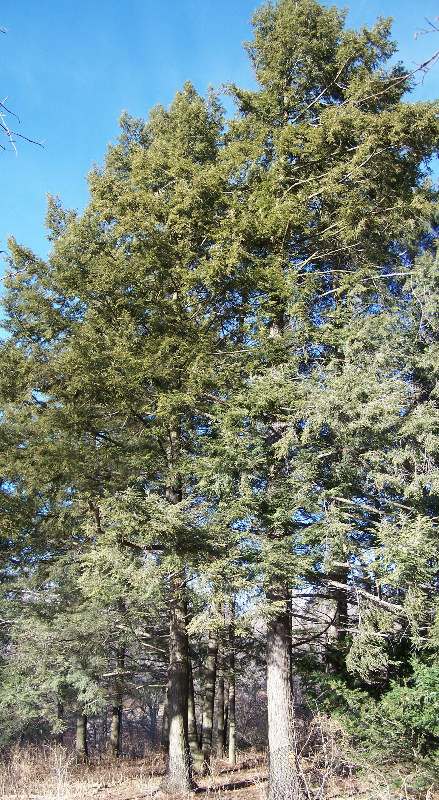
Chinese Hemlock

Chinese Hemlock

Tsuga chinensis

Zilupe, CC BY 2.0, via Wikimedia Commons

Eastern Hemlock

Eastern Hemlock

Tsuga canadensis

Bruce Marlin, CC BY-SA 3.0, via Wikimedia Commons

Side by side

Chinese HemlockEastern Hemlock
Scientific nameTsuga chinensis (Franch.) Pritz.Tsuga canadensis (L.) Carrière
English nameChinese HemlockEastern Hemlock
GroupConifers and alliesConifers and allies
ClassPinopsida ConiferPinopsida Conifer
OrderPinalesPinales
FamilyPinaceae Pine FamilyPinaceae Pine Family
GenusTsuga HemlockTsuga Hemlock
Red List categoryLeast ConcernNear Threatened
Countries on record3 countries4 countries
GBIF occurrence records3,698 records68,238 records

Rows where the two agree are shown in grey.

Where each is found

Only Chinese Hemlock (3)

Only Eastern Hemlock (4)

From Catalogue of Life checklists and GBIF occurrence records. A country missing from a list means no record is held, which is not proof of absence.

Checked facts

Chinese HemlockEastern Hemlock
Appearance
  • Tsuga chinensis is a large coniferous tree with blackish-brown bark. English Wikipedia
  • Its bark has irregular longitudinal breaks and inconspicuous lenticels. English Wikipedia
  • Its outer bark is approximately 6 mm thick and consists of alternating pale yellowish-brown corky and brown fibrous layers. English Wikipedia
  • Its inner bark is 4–5 mm thick, pale reddish-brown, and fibrous. English Wikipedia
  • Freshly cut wood is pale yellowish-white with inconspicuous wood rays. English Wikipedia
  • Its leaves are linear, flat, olive-green, and arranged spirally in an approximately two-ranked pattern. English Wikipedia
  • Its leaves have a grooved upper surface and two white stomatic bands underneath. English Wikipedia
  • Its female cones are initially green and later become reddish-brown. English Wikipedia
  • Its female cones are pendulous and long-ovoid. English Wikipedia
  • Its seeds are winged. English Wikipedia
  • Its bark is brown, scaly, and deeply fissured, particularly on older trees. English Wikipedia
  • Its flattened needles are typically arranged in two rows along the twigs. English Wikipedia
  • The upper surfaces of its needles are shiny green to yellow-green. English Wikipedia
  • The undersides of its needles have two broad, clearly visible stomatal bands. English Wikipedia
  • Its outer bark has dull reddish-purple layers. tidcf.nrcan.gc.ca
SizeNo checked fact yet
Habitat
  • The species primarily grows in mixed forests near river basins, mountains, and valleys. English Wikipedia
  • In Vietnam, the species occurs at elevations of approximately 1,300–1,700 m. English Wikipedia
  • In China, the species occurs at elevations between 1,000 and 3,500 m. English Wikipedia
  • Eastern hemlock can grow along swamp margins where peat and muck soils are shallow. research.fs.usda.gov
  • It favors moist to very moist sites with good drainage. research.fs.usda.gov
  • The species grows in acidic soils including sandy loams, loamy sands, and silty loams. research.fs.usda.gov
  • In the northeastern United States, the species occurs from sea level to approximately 730 metres elevation. research.fs.usda.gov
  • In the southern Appalachian Mountains, it grows at elevations of approximately 610–1,520 metres. research.fs.usda.gov
DietNo checked fact yet
Behaviour
  • The species exhibits tolerance to hemlock woolly adelgid in comparison with the North American hemlocks discussed in the study. agresearchmag.ars.usda.gov
  • One observed resistance mechanism involves fewer hemlock woolly adelgids settling on the trees. agresearchmag.ars.usda.gov
  • A second observed resistance mechanism involves slower growth and lower survival of settled adelgids. agresearchmag.ars.usda.gov
No checked fact yet
Reproduction
  • Its staminate flowers occur singly on one-year-old shoots or in groups of one to five on two-year-old shoots. English Wikipedia
  • Its male cones develop at the ends of very short shoots. English Wikipedia
Distribution
  • Eastern hemlock is native to eastern North America. English Wikipedia
  • Its native range extends from northeastern Minnesota eastward through southern Quebec to Nova Scotia. English Wikipedia
  • Its southern distribution extends through the Appalachian Mountains to northern Georgia and Alabama. English Wikipedia
ConservationNo checked fact yet
  • Hemlock woolly adelgid was first detected within Kejimkujik National Park in Nova Scotia in 2018. English Wikipedia
Uses
  • Eastern hemlock timber is used for general construction and manufacturing crates. English Wikipedia
  • Its wood is used to manufacture railroad ties. English Wikipedia
  • Eastern hemlock wood is used as a source of pulp for paper manufacturing. English Wikipedia
  • Its bark was historically used as a tannin source by the leather tanning industry. English Wikipedia
  • Eastern hemlock is cultivated as an ornamental tree. English Wikipedia
  • Its branches were historically used as brooms by American pioneers. English Wikipedia
  • The inner bark can be eaten raw or boiled and can also be made into flour. English Wikipedia
OtherNo checked fact yet

In brief

Chinese Hemlock

Chinese Hemlock is a large coniferous tree with blackish-brown bark. It is native to China, Taiwan, and Vietnam, where it grows primarily in mixed forests near river basins, mountains, and valleys. It has linear, flat olive-green leaves with two white stomatic bands underneath and pendulous female cones that become reddish-brown. Full profile

Eastern Hemlock

Tsuga canadensis is native to eastern North America, with a range extending from northeastern Minnesota through southern Quebec to Nova Scotia and south through the Appalachian Mountains to northern Georgia and Alabama. It has flattened needles typically arranged in two rows, with shiny green to yellow-green upper surfaces and two broad stomatal bands underneath. Full profile

Compare something else

Page built on 29 November 2026 from the data on the two species pages, where every source is listed.

Cite this page

ScientificNames.org. (2026). Chinese Hemlock vs Eastern Hemlock. Retrieved November 29, 2026, from https://scientificnames.org/compare/chinese-hemlock-vs-eastern-hemlock