Species · Conifers and allies
Chinese Hemlock Tsuga chinensis
The scientific name of the Chinese Hemlock is Tsuga chinensis. It is a species of gymnosperm in the family Pinaceae (pine family), order Pinales.
- Scientific name
- Tsuga chinensis (Franch.) Pritz.
- Common name
- Chinese Hemlock
- Genus
- Tsuga
- Family
- Pinaceae (Pine Family)
- Order
- Pinales
- Class
- Pinopsida
- Red List category
- LC Least Concern
- Recorded in
- 3 countries
- Name status
- accepted in the Catalogue of Life

Overview
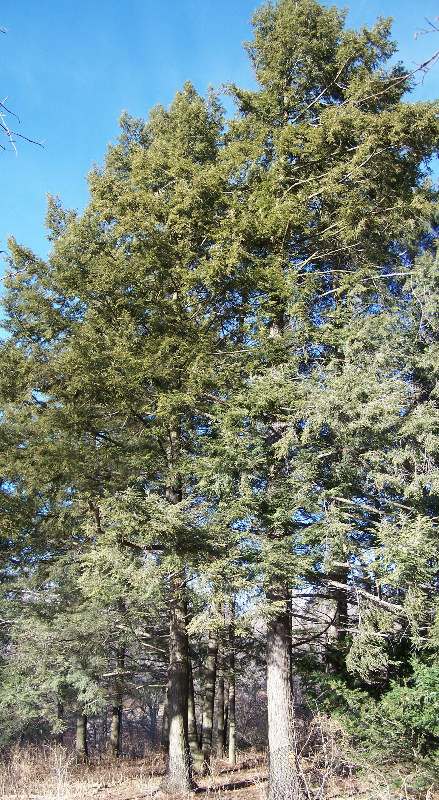
Chinese Hemlock is a large coniferous tree with blackish-brown bark. It is native to China, Taiwan, and Vietnam, where it grows primarily in mixed forests near river basins, mountains, and valleys. It has linear, flat olive-green leaves with two white stomatic bands underneath and pendulous female cones that become reddish-brown.
Written 26 November 2026 from the sources listed below. Each statement was checked against the passage it cites; statements that could not be supported were removed.
Appearance
Chinese Hemlock is a large coniferous tree with blackish-brown bark marked by irregular longitudinal breaks and inconspicuous lenticels. Its outer bark is approximately 6 mm thick and consists of alternating pale yellowish-brown corky and brown fibrous layers. Its inner bark is 4–5 mm thick, pale reddish-brown, and fibrous.[1][2][3][4]
Its freshly cut wood is pale yellowish-white with inconspicuous wood rays. Its leaves are linear, flat, olive-green, and arranged spirally in an approximately two-ranked pattern. They have a grooved upper surface, two white stomatic bands underneath, and measure approximately 16–20 mm in length.[5][6][7][8]
Its seeds are winged and measure approximately 7 mm long, including the wing.[9][10]
Habitat
Chinese Hemlock primarily grows in mixed forests near river basins, mountains, and valleys.[11]
In Vietnam, it occurs at elevations of approximately 1,300–1,700 m. In China, it occurs at elevations between 1,000 and 3,500 m.[12][13]
Behaviour
Chinese Hemlock exhibits tolerance to hemlock woolly adelgid in comparison with the North American hemlocks discussed in the study. One observed resistance mechanism involves fewer adelgids settling on the trees.[14][15]
A second observed resistance mechanism involves slower growth and lower survival of settled adelgids.[16]
Reproduction and life cycle
Its staminate flowers occur singly on one-year-old shoots or in groups of one to five on two-year-old shoots. Its male cones develop at the ends of very short shoots.[17][18]
Uses
Chinese Hemlock timber is used in construction and furniture manufacturing. It is also used as support material in mines.[19][20]
Its tannin-rich bark is harvested for dye extraction, and its trunk is used as a source of resin.[21][22]
Its roots, trunk, and branches are used to produce aromatic oils.[23]
Classification of the Chinese Hemlock
| Kingdom | Plantae |
|---|---|
| Subkingdom | Pteridobiotina |
| Phylum | Tracheophyta |
| Class | Pinopsida (Conifer) |
| Subclass | Pinidae |
| Order | Pinales |
| Family | Pinaceae (Pine Family) |
| Genus | Tsuga (Hemlock) |
| Species | Tsuga chinensis (Franch.) Pritz. |
Where the Chinese Hemlock is found
Checklists and occurrence records place Tsuga chinensis in 3 countries. GBIF holds 3,698 georeferenced records of it.
Countries
Regions and cities with the most records
- Taiwan, Taiwan 1,109
- Sichuan, China 1,031
- Anhui, China 175
- Hubei, China 173
- Shaanxi, China 109
- Songbai, China 85
- Kangding, China 83
- Guizhou, China 72
- Chongqing, China 69
- Hunan, China 61
- Gecheng, China 55
- Yunnan, China 44
- Henan, China 38
- Gansu, China 34
- Guangdong, China 32
- Guangxi, China 31
- Jiangxi, China 31
- Zhejiang, China 29
- Fujian, China 26
- Pingwu County, China 23
- Wuyishan, China 23
- Daxi, Taiwan 16
- Zhouqu Chengguanzhen, China 15
- Jiujiang, China 14
- Shiquan, China 14
- Huangshan, China 12
- Lijiang, China 12
- Guandu, China 11
- Liangping, China 11
- Longjing, China 11
- Shuanglong, China 11
- Wushan, China 11
- Zhudong, Taiwan 8
- Chenggu, China 7
- Dachang, China 6
- Weining, China 6
6 more countries have a few records outside this range
These countries hold a few records of Tsuga chinensis but lie outside the range the checklists give for it. Such records are often zoo or garden specimens, museum material or vagrants, so the species is not counted as occurring there.
A number beside a place is its count of GBIF occurrence records. A place without a number comes from a checklist alone. Records show where a species has been observed or collected, which can include escapes and vagrants.
Common names
English
- Chinese Hemlock
Names in 12 other languages
- Chinese
- Tie Shan, 鐵杉, 铁杉
- Czech
- jedlovec čínský
- Dutch
- Chinese hemlockspar
- Esperanto
- Ĉina cugo
- French
- Pruche de Chine, Tsuga de Chine
- German
- Chinesische Hemlocktanne, Taiwan-Hemlocktanne
- Japanese
- チュウゴクツガ, テーシャン
- Polish
- choina chińska
- Russian
- Тсуга китайская
- Slovak
- jedľovec čínsky
- Swedish
- kinesisk hemlock
- Turkish
- Çin Göknarı, Çin sugası
Synonyms
13 other scientific names have been used for this species and are now treated as synonyms of Tsuga chinensis.
- Abies chinensis Franch.
- Abies dumosa var. chinensis (Franch.) Franch.
- Abies theisha David
- Abies thunbergii (Lamb.) Lindl.
- Picea thunbergii (Lamb.) Asch. & Graebn. ex Engl.
- Pinus thunbergii Lamb.
- Tsuga brunoniana var. chinensis (Franch.) Mast.
- Tsuga chinensis subsp. formosana (Hayata) Silba
- Tsuga chinensis subsp. patens (Downie) A.E.Murray
- Tsuga chinensis subsp. tchekiangensis (Flous) Silba
- Tsuga chinensis var. daibuensis S.S.Ying
- Tsuga dumosa var. chinensis (Franch.) E.Pritz.
- Tsuga patens Downie
Subspecies and varieties
- Tsuga chinensis var. chinensis (Chinese Hemlock) variety
- Tsuga chinensis var. oblongisquamata variety
- Tsuga chinensis var. robusta variety
Related species
-
 Eastern HemlockTsuga canadensis
-
 Western HemlockTsuga heterophylla
-
 Mountain HemlockTsuga mertensiana
-
 Carolina HemlockTsuga caroliniana
-
 Japanese HemlockTsuga sieboldii
-
 Northern Japanese HemlockTsuga diversifolia
-
 Himalayan HemlockTsuga dumosa
- Ulleungdo HemlockTsuga ulleungensis
Compare
Questions and answers
What is the scientific name of the Chinese Hemlock?
The scientific name of the Chinese Hemlock is Tsuga chinensis. Written with its author, the full name is Tsuga chinensis (Franch.) Pritz..
Which family does the Chinese Hemlock belong to?
Tsuga chinensis belongs to the family Pinaceae, in the order Pinales and the class Pinopsida.
Where is the Chinese Hemlock found?
Checklists and occurrence records place Tsuga chinensis in 3 countries: China, Taiwan and Vietnam.
What is the conservation status of the Chinese Hemlock?
The IUCN Red List category recorded for Tsuga chinensis is Least Concern (LC).
What is hemlock in Chinese?
The Chinese name recorded for Chinese Hemlock is tieshan.[24]
Is Tsuga hemlock?
The recorded English name of Tsuga chinensis is Chinese Hemlock.[1]
Where do hemlocks grow best?
Chinese Hemlock primarily grows in mixed forests near river basins, mountains, and valleys.[11]
Is a hemlock tree deciduous or coniferous?
Chinese Hemlock is a coniferous tree.[1]
Sources
Passages the profile rests on
- Tsuga chinensis is a large coniferous tree with blackish-brown bark. Source passage: “Tsuga chinensis is a large tree with bark that is a blackish brown in colour.” — English Wikipedia
- Its bark has irregular longitudinal breaks and inconspicuous lenticels. Source passage: “The scaly bark has irregular longitudinal breaks, and lenticels that are very inconspicuous.” — English Wikipedia
- Its outer bark is approximately 6 mm thick and consists of alternating pale yellowish-brown corky and brown fibrous layers. Source passage: “The outer bark is about 6 mm thick with alternating tiered layers of pale yellowish brown corky bark, and brown lignified fibrous bark.” — English Wikipedia
- Its inner bark is 4–5 mm thick, pale reddish-brown, and fibrous. Source passage: “The inner bark is about 4 to 5 mm (0.16 to 0.20 inches) thick and pale reddish brown in colour. It is fibrous in texture” — English Wikipedia
- Freshly cut wood is pale yellowish-white with inconspicuous wood rays. Source passage: “Freshly cut wood is a pale yellowish white with inconspicuous wood rays.” — English Wikipedia
- Its leaves are linear, flat, olive-green, and arranged spirally in an approximately two-ranked pattern. Source passage: “The leaves are arranged spirally in a manner more or less 2-ranked. They are linear and flat in shape and olive green in colour.” — English Wikipedia
- Its leaves have a grooved upper surface and two white stomatic bands underneath. Source passage: “The upper side of the leaf is grooved and keeled, while the underside has 2 white stomatic bands.” — English Wikipedia
- Its leaves measure approximately 16–20 mm in length. Source passage: “they measure 16 to 20 mm (0.63 to 0.79 inches) long.” — English Wikipedia
- Its seeds are winged. Source passage: “The seeds are winged” — English Wikipedia
- Its seeds measure approximately 7 mm long, including the wing. Source passage: “measure about 7 mm (0.28 inches) long with the wing included.” — English Wikipedia
- The species primarily grows in mixed forests near river basins, mountains, and valleys. Source passage: “It is found primarily in mixed forests near river basins and in mountains and valleys.” — English Wikipedia
- In Vietnam, the species occurs at elevations of approximately 1,300–1,700 m. Source passage: “in Vietnam the tree is only found in mountains 1,300 to 1,700 m (4,300 to 5,600 feet) above sea level.” — English Wikipedia
- In China, the species occurs at elevations between 1,000 and 3,500 m. Source passage: “In China it is present at altitudes of 1,000 to 3,500 m (3,300 to 11,500 feet)” — English Wikipedia
- The species exhibits tolerance to hemlock woolly adelgid in comparison with the North American hemlocks discussed in the study. Source passage: “We found T. chinensis and its hybrids to be the most tolerant to HWA” — agresearchmag.ars.usda.gov
- One observed resistance mechanism involves fewer hemlock woolly adelgids settling on the trees. Source passage: “fewer adelgids settling on the trees, called ‘antixenosis,’” — agresearchmag.ars.usda.gov
- A second observed resistance mechanism involves slower growth and lower survival of settled adelgids. Source passage: “slower growth and lower survival of the settled adelgids, called ‘antibiosis.’” — agresearchmag.ars.usda.gov
- Its staminate flowers occur singly on one-year-old shoots or in groups of one to five on two-year-old shoots. Source passage: “The stamenate flowers appear singly on one-year-old shoots, or in groups of 1 to 5 on two-year-old shoots.” — English Wikipedia
- Its male cones develop at the ends of very short shoots. Source passage: “The male cones are terminal on a very short shoot” — English Wikipedia
- Its timber is used in construction and furniture manufacturing. Source passage: “The timber obtained from T. chinensis is used in construction, furniture making” — English Wikipedia
- Its timber is also used as support material in mines. Source passage: “and as a support in mines.” — English Wikipedia
- Its tannin-rich bark is harvested for dye extraction. Source passage: “The bark is high in tannins, which is often extracted and used as a dye.” — English Wikipedia
- Its trunk is used as a source of resin. Source passage: “The trunk is used as a source of resin.” — English Wikipedia
- Its roots, trunk, and branches are used to produce aromatic oils. Source passage: “the roots, trunk, and branches are all used in the production of aromatic oils” — English Wikipedia
- The Chinese name recorded for the species is tieshan. Source passage: “or in Chinese as tieshan” — inaturalist.org
Data
- Catalogue of Life, 2026-10-16 XR cc by
- Global Biodiversity Information Facility CC BY 4.0
- Wikidata CC0
- GeoNames CC BY 4.0
- Wikimedia Commons per image; credit shown with each image
- Within the Catalogue of Life, this name comes from Pinopsida from WFO cc0
References
- Bot. Jahrb. Syst. 29(2): 217. 1900 [4 Sep 1900] Link where the name was published
- Conifer TEN record for Tsuga chinensis (Franch.) Pritz. Link
This species in other databases
- Catalogue of Life 59HM8
- Wikidata Q1073911
- iNaturalist 120847
- World Flora Online wfo-0000456399-2026-06
- GRIN 40701
Page built on 27 November 2026. See how the catalog is made and all sources and licences.
Cite this page
ScientificNames.org. (2026). Tsuga chinensis (Chinese Hemlock). Retrieved November 27, 2026, from https://scientificnames.org/species/tsuga-chinensis
“Tsuga chinensis (Chinese Hemlock).” ScientificNames.org, 2026, scientificnames.org/species/tsuga-chinensis. Accessed 27 Nov. 2026.
ScientificNames.org. “Tsuga chinensis (Chinese Hemlock).” Accessed November 27, 2026. https://scientificnames.org/species/tsuga-chinensis.
@misc{scientificnames_tsuga_chinensis_chinese_hemlock,
  author = {{ScientificNames.org}},
  title = {Tsuga chinensis (Chinese Hemlock)},
  year = {2026},
  url = {https://scientificnames.org/species/tsuga-chinensis},
  note = {Accessed 2026-11-27}
}