| Appearance | - Corylus colurna has a pale grey-buff bark with a thick, corky texture. English Wikipedia
- Young trees have a slender, conical crown that becomes broader and irregular as they age. English Wikipedia
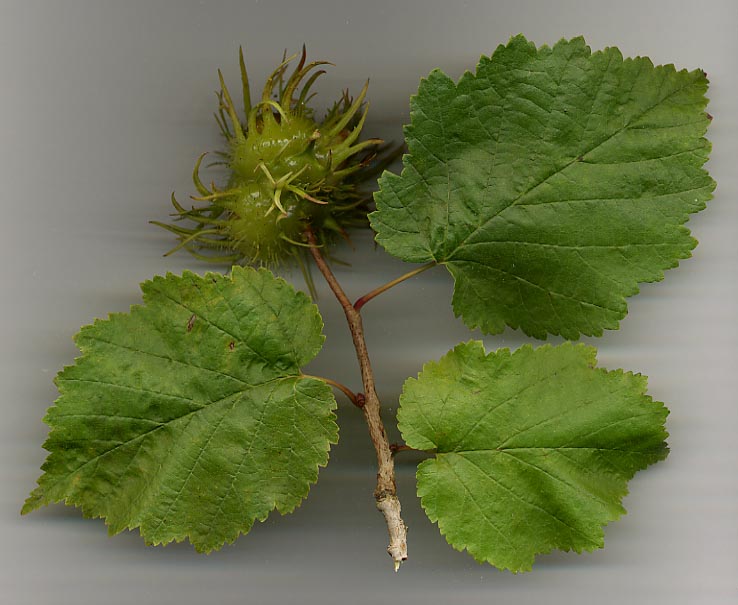
- Its leaves are deciduous, rounded and softly hairy on both surfaces. English Wikipedia
- The leaf margins are coarsely double-serrate to shallowly lobed. English Wikipedia
- The male flowers occur in conspicuous, pale-yellow catkins. English Wikipedia
- The female flowers are inconspicuous and have bright-red styles measuring 1–3 mm. English Wikipedia
- Its fruits are nuts enclosed in thick, softly spiny and bristly husks. English Wikipedia
- The nuts occur in clusters of three to eight, with their husks fused at the base. English Wikipedia
| - Corylus maxima is a deciduous shrub with rounded leaves bearing coarsely double-serrated margins. English Wikipedia
- The species produces pale-yellow male catkins measuring 5–10 centimetres long. English Wikipedia
- Its female catkins are bright red and measure 1–3 millimetres long. English Wikipedia
- Its fruits develop as nuts in clusters containing one to five nuts. English Wikipedia
- Each nut measures 1.5–2.5 centimetres long and is completely enclosed by a tubular husk measuring 3–5 centimetres long. English Wikipedia
|
|---|
| Size | | - The shrub reaches a height of 6–10 metres and its stems can reach 20 centimetres in thickness. English Wikipedia
- Its leaves measure 5–12 centimetres long and 4–10 centimetres wide. English Wikipedia
|
|---|
| Habitat | - The species occurs mainly on shallow, nutrient-poor limestone soils. English Wikipedia
- At lower elevations, it occurs in thermophilous oak forests alongside Hungarian oak, Oriental hornbeam and flowering ash. English Wikipedia
- At higher elevations, it occurs alongside beech and sycamore maple. English Wikipedia
- The species occupies elevations ranging from 100 metres in the Balkans to 1,700 metres in the Caucasus. English Wikipedia
- It becomes dominant mainly in very dry sites because it is relatively uncompetitive. English Wikipedia
- In cultivation, it prefers moist, well-drained soil and full sun. English Wikipedia
| - Filberts crop best in locations receiving full sun or light shade. rhs.org.uk
- Filberts prefer sheltered growing positions without frost pockets. rhs.org.uk
- Filberts tolerate various soil types but prefer light, sandy, well-drained soils. rhs.org.uk
|
|---|
| Behaviour | | - Filbert nuts are generally harvested in late September when their husks begin turning yellow. rhs.org.uk
|
|---|
| Reproduction | - Corylus colurna is monoecious, producing male and female flowers on the same tree. English Wikipedia
- The flowers appear in late winter or early spring before the leaves emerge. English Wikipedia
- The fruits mature between September and October. English Wikipedia
- Nut production is irregular and generally occurs every two to three years. English Wikipedia
| - The flowers of Corylus maxima are pollinated by wind. English Wikipedia
- The species produces its flowers in catkins during late winter. English Wikipedia
- Filberts are monoecious, producing separate male and female flowers on the same plant. rhs.org.uk
- The flowering period of filberts generally extends from January through March over four to six weeks. rhs.org.uk
- Self-pollination in filberts is sporadic because the male and female flowering periods seldom overlap. rhs.org.uk
- Some filbert cultivars require cross-pollination with another compatible cultivar to produce nuts. rhs.org.uk
- Planting at least two different compatible cultivars is recommended to improve nut set. rhs.org.uk
- Wild hazel growing nearby can pollinate most filbert cultivars. rhs.org.uk
- Filberts generally begin producing nuts after three or four years. rhs.org.uk
- Filberts can be propagated by removing and replanting rooted suckers. rhs.org.uk
- Layering is a successful propagation method for filberts. rhs.org.uk
- Filberts can also be propagated from seed, although seed-grown plants may be inferior to their parent plants. rhs.org.uk
- Filbert seeds require cold stratification for propagation. rhs.org.uk
- Commercial producers may propagate filberts by grafting. rhs.org.uk
|
|---|
| Distribution | - The species is native to southeastern Europe and southwestern Asia. English Wikipedia
- Its native range extends from the southern Balkans through northern Anatolia to the Caucasus. English Wikipedia
| - Corylus maxima is native to southeastern Europe and southwestern Asia, extending from the Balkans to Turkey. English Wikipedia
|
|---|
| Conservation | - The species is generally uncommon across its natural range but can be locally abundant in suitable habitats. English Wikipedia
| No checked fact yet |
|---|
| Uses | - Corylus colurna is used as a single-stemmed rootstock for grafting common hazel cultivars. English Wikipedia
- The species is cultivated as an ornamental tree in Europe and North America. English Wikipedia
- Its dense shade makes it suitable for use as a shade tree. English Wikipedia
- Its narrow crown and tolerance of air pollution make it suitable for planting along urban streets. English Wikipedia
| - The nuts of Corylus maxima are edible. English Wikipedia
- Filbert nuts are used as large filler nuts in many mixed-nut containers in the United States. English Wikipedia
- Corylus maxima is cultivated in orchards for its nuts, although less frequently than common hazel. English Wikipedia
- The purple-leaved cultivar Corylus maxima 'Purpurea' is grown as an ornamental garden shrub. English Wikipedia
- The name filbert was historically used in Oregon to refer broadly to commercial hazelnuts. English Wikipedia
|
|---|
| Similar species | - Corylus jacquemontii is a closely related species that was formerly treated as a variety of Corylus colurna. English Wikipedia
| - Corylus maxima resembles Corylus avellana but differs in having nuts that are more completely enclosed by a tubular husk. English Wikipedia
- The tubular husk enclosing the nut is a feature also shared with Corylus cornuta and Corylus sieboldiana. English Wikipedia
|
|---|
| Name origin | No checked fact yet | - The English name filbert may derive from Norman French. English Wikipedia
- The plant may have been named after Saint Philibert because its nuts were possibly mature on his feast day, 20 August in the old calendar. English Wikipedia
|
|---|