Comparison
Twoflower Pea vs Indian Pea
Twoflower Pea (Lathyrus biflorus) and Indian Pea (Lathyrus sativus) both belong to the genus Lathyrus (pea) and part ways below it. Both are recorded in 1 country.
Twoflower Pea
Lathyrus biflorus
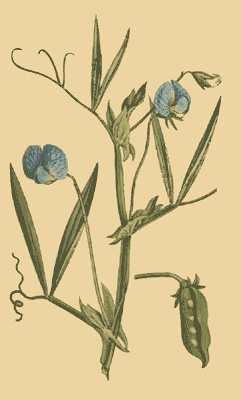
Indian Pea
Lathyrus sativus
Curtis, William The Botanical Magazine, Vol. 4, Public domain, via Wikimedia Commons

Side by side
| Twoflower Pea | Indian Pea | |
|---|---|---|
| Scientific name | Lathyrus biflorus T.W.Nelson & J.P.Nelson | Lathyrus sativus L. |
| English name | Twoflower Pea | Indian Pea |
| Group | Flowering plants | Flowering plants |
| Class | Magnoliopsida | Magnoliopsida |
| Order | Fabales | Fabales |
| Family | Fabaceae Bean | Fabaceae Bean |
| Genus | Lathyrus Pea | Lathyrus Pea |
| Countries on record | 1 country | 64 countries |
| GBIF occurrence records | 26 records | 11,526 records |
Rows where the two agree are shown in grey.
Where each is found
Both recorded in 1 country
Only Indian Pea (63)
- Afghanistan
- Albania
- Algeria
- Angola
- Australia
- Austria
- Bangladesh
- Belgium
- Bulgaria
- China
- Croatia
- Cyprus
- Czechia
- Denmark
- Ecuador
- Egypt
- Estonia
- Ethiopia
- Finland
- France
- Germany
- Greece
- Haiti
- Hungary
- India
- Indonesia
- Iran
- Iraq
- Isle of Man
- Italy
- Kazakhstan
- Kenya
- Kyrgyzstan
- Latvia
- Libya
- Luxembourg
- Moldova
- Mongolia
- Morocco
- Myanmar
- Nepal
- Norway
- Pakistan
- Poland
- Portugal
- Romania
- Russia
- Slovakia
- Spain
- Sri Lanka
- Sudan
- Sweden
- Switzerland
- Tajikistan
- Tanzania
- The Netherlands
- Tunisia
- Turkey
- Turkmenistan
- Ukraine
- United Kingdom
- Uzbekistan
- Yemen
From Catalogue of Life checklists and GBIF occurrence records. A country missing from a list means no record is held, which is not proof of absence.
Checked facts
| Twoflower Pea | Indian Pea | |
|---|---|---|
| Appearance |
|
|
| Size |
| No checked fact yet |
| Habitat |
|
|
| Diet | No checked fact yet |
|
| Distribution |
|
|
| Uses | No checked fact yet |
|
| Other |
|
|
In brief
Twoflower Pea
The twoflower pea is a petite perennial herb in the genus Lathyrus and family Fabaceae. It is endemic to southeastern Humboldt County, California, where it grows on serpentine soil outcrops in Jeffrey pine woodlands at elevations between 1,300 and 1,400 meters. It is distinguished by inflorescences bearing two greenish-white flowers and hairless legume pods that split open at maturity. Full profile
Indian Pea
Indian pea is a much-branched annual herb with a well-developed taproot. It occurs in arid and semi-arid regions and is cultivated in Asia and East Africa. Its seeds contain high levels of protein and the neurotoxic amino acid β-N-oxalyl-L-α,β-diaminopropionic acid (ODAP). Full profile
Compare something else
Page built on 27 November 2026 from the data on the two species pages, where every source is listed.
Cite this page
ScientificNames.org. (2026). Twoflower Pea vs Indian Pea. Retrieved November 27, 2026, from https://scientificnames.org/compare/twoflower-pea-vs-indian-pea
“Twoflower Pea vs Indian Pea.” ScientificNames.org, 2026, scientificnames.org/compare/twoflower-pea-vs-indian-pea. Accessed 27 Nov. 2026.
ScientificNames.org. “Twoflower Pea vs Indian Pea.” Accessed November 27, 2026. https://scientificnames.org/compare/twoflower-pea-vs-indian-pea.
@misc{scientificnames_twoflower_pea_vs_indian_pea,
  author = {{ScientificNames.org}},
  title = {Twoflower Pea vs Indian Pea},
  year = {2026},
  url = {https://scientificnames.org/compare/twoflower-pea-vs-indian-pea},
  note = {Accessed 2026-11-27}
}