Comparison

Blue Lorikeet vs Stephen's Lorikeet

Blue Lorikeet (Vini peruviana) and Stephen's Lorikeet (Vini stepheni) both belong to the genus Vini (vini lories) and part ways below it.
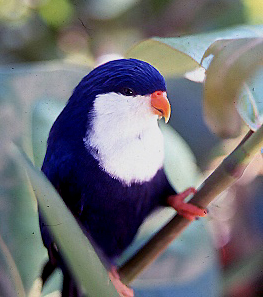
Blue Lorikeet

Blue Lorikeet

Vini peruviana

guignia, Public domain, via Wikimedia Commons

Stephen's Lorikeet

Stephen's Lorikeet

Vini stepheni

Henrik Grønvold, Public domain, via Wikimedia Commons

Side by side

Blue LorikeetStephen's Lorikeet
Scientific nameVini peruviana (P. L. S. Müller, 1776)Vini stepheni (North, 1908)
English nameBlue LorikeetStephen's Lorikeet
GroupBirdsBirds
ClassAves BirdAves Bird
OrderPsittaciformes ParrotPsittaciformes Parrot
FamilyPsittaculidae LoriesPsittaculidae Lories
GenusVini Vini LoriesVini Vini Lories
Named in17761908
Red List categoryVulnerableVulnerable
Countries on record2 countries1 country
GBIF occurrence records310 records105 records

Rows where the two agree are shown in grey.

Where each is found

Only Blue Lorikeet (2)

Only Stephen's Lorikeet (1)

From Catalogue of Life checklists and GBIF occurrence records. A country missing from a list means no record is held, which is not proof of absence.

Checked facts

Blue LorikeetStephen's Lorikeet
Appearance
  • The species has predominantly dark blue plumage with white feathers covering the upper chest, throat, and lower face. English Wikipedia
  • The feathers on the top of its head can be raised and display light blue streaks. English Wikipedia
  • Its bill is orange, its irises are yellow-brown, and its legs are orange. English Wikipedia
  • Adult males and females have the same external appearance. English Wikipedia
  • Juveniles lack the adult's white plumage and have dark grey-blue faces and lower body parts. English Wikipedia
  • Juveniles have black bills, dark brown irises, and orange-brown legs. English Wikipedia
Size
Habitat
  • The species inhabits wooded environments throughout its range, including cultivated areas. English Wikipedia
  • The species is most abundant in mixed stands of coconut palms and Heliotropium foertherianum. English Wikipedia
  • The species inhabits subtropical or tropical moist lowland forest. English Wikipedia
  • The species inhabits coconut palms and dense interior forest on Henderson Island. English Wikipedia
  • The species is associated with native primary forest on Henderson Island. ebird.org
Diet
  • On Rangiroa, coconut flowers constituted most of the recorded diet during a three-week study. English Wikipedia
  • The species also eats insects found among leaves and on the forest floor. English Wikipedia
  • The species supplements its diet with leaf shoots and soft fruits. English Wikipedia
  • The diet includes nectar, pollen, fruits, and butterfly and moth larvae. English Wikipedia
  • Much of the nectar consumed comes from Scaevola sericea flowers. English Wikipedia
  • Much of the nectar consumed comes from Timonius polygamus flowers. English Wikipedia
Behaviour
  • The species roosts in coconut palm trees. English Wikipedia
  • Individuals become active at dawn and call and preen before feeding. English Wikipedia
  • The species usually occurs in flocks containing fewer than ten birds. English Wikipedia
  • Individuals rest in shaded places during the hottest part of the day before feeding again in the afternoon. English Wikipedia
  • At dusk, groups fly around calling before retreating between palm leaves to roost after dark. English Wikipedia
  • Individuals feed quietly in small groups and use brush-like tongues to collect nectar and pollen. English Wikipedia
  • Individuals use their bills to open flowers that have not fully opened. English Wikipedia
  • After feeding on all the flowers of one tree, individuals move to another tree while calling. English Wikipedia
ReproductionNo checked fact yet
  • The breeding season is thought to occur around April or the beginning of May. English Wikipedia
DistributionNo checked fact yet
  • Stephen's lorikeet is endemic to Henderson Island in the Pitcairn Islands of the South Pacific. English Wikipedia
Conservation
  • The species is classified as endangered in the supplied document. English Wikipedia
  • Invasive cats, rats, swamp harriers, and mosquitoes carrying avian malaria are identified as threats to the species. English Wikipedia
  • The species is assessed as vulnerable by the IUCN. English Wikipedia
  • The estimated population is between 720 and 1,820 individuals. English Wikipedia
  • Accidental predator introductions to Henderson Island are a major threat because of the species' extremely restricted range. English Wikipedia
  • Habitat loss caused by deforestation or natural disasters is a threat to the species. English Wikipedia
  • The species appears to have adapted to the introduction of at least one invasive predator, the Polynesian rat. English Wikipedia
  • An attempt to eradicate invasive rodents from Henderson Island was unsuccessful. English Wikipedia
Similar species
  • The ultramarine lorikeet is identified as a related species that shares blue plumage with the blue lorikeet. English Wikipedia
No checked fact yet

In brief

Blue Lorikeet

Vini peruviana inhabits wooded environments, including cultivated areas, and is most abundant in mixed stands of coconut palms and Heliotropium foertherianum. It is distinguished by predominantly dark blue plumage, white feathers covering the upper chest, throat, and lower face, and an orange bill. Full profile

Stephen's Lorikeet

Vini stepheni is endemic to Henderson Island in the Pitcairn Islands of the South Pacific. Adults have green upperparts and a red breast that transitions to purple toward the abdomen and thighs. Full profile

Compare something else

Page built on 29 November 2026 from the data on the two species pages, where every source is listed.

Cite this page

ScientificNames.org. (2026). Blue Lorikeet vs Stephen's Lorikeet. Retrieved November 29, 2026, from https://scientificnames.org/compare/blue-lorikeet-vs-stephens-lorikeet