Species · Birds
Blue Lorikeet Vini peruviana
The scientific name of the Blue Lorikeet is Vini peruviana. It is a species of bird in the family Psittaculidae (lories), order Psittaciformes. The name dates from 1776.
- Scientific name
- Vini peruviana (P. L. S. Müller, 1776)
- Common name
- Blue Lorikeet
- Genus
- Vini
- Family
- Psittaculidae (Lories)
- Order
- Psittaciformes
- Class
- Aves
- Red List category
- VU Vulnerable
- Recorded in
- 2 countries
- Name status
- accepted in the Catalogue of Life
Overview
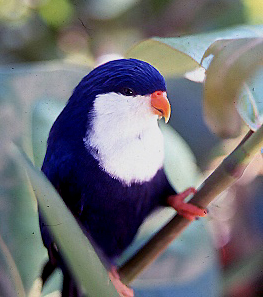
Vini peruviana inhabits wooded environments, including cultivated areas, and is most abundant in mixed stands of coconut palms and Heliotropium foertherianum. It is distinguished by predominantly dark blue plumage, white feathers covering the upper chest, throat, and lower face, and an orange bill.
Written 26 November 2026 from the sources listed below. Each statement was checked against the passage it cites; statements that could not be supported were removed.
Appearance
The Blue Lorikeet has predominantly dark blue plumage, with white feathers covering the upper chest, throat, and lower face. The feathers on the top of its head can be raised and display light blue streaks.[1][2]
Its bill and legs are orange, and its irises are yellow-brown. Adult males and females have the same external appearance.[3][4]
Juveniles lack the adult's white plumage and have dark grey-blue faces and lower body parts. They have black bills, dark brown irises, and orange-brown legs.[5][6]
The species measures approximately 18 cm in length.[7]
Habitat
The Blue Lorikeet inhabits wooded environments throughout its range, including cultivated areas. It is most abundant in mixed stands of coconut palms and Heliotropium foertherianum.[8][9]
Diet
On Rangiroa, coconut flowers constituted most of the recorded diet during a three-week study. The species also eats insects found among leaves and on the forest floor.[10][11]
Its diet is supplemented with leaf shoots and soft fruits.[12]
Behaviour
The Blue Lorikeet usually occurs in flocks containing fewer than ten birds and roosts in coconut palm trees. Individuals become active at dawn and call and preen before feeding.[13][14][15]
Individuals feed quietly in small groups and use brush-like tongues to collect nectar and pollen. They use their bills to open flowers that have not fully opened.[16][17]
After feeding on all the flowers of one tree, individuals move to another tree while calling. They rest in shaded places during the hottest part of the day before feeding again in the afternoon.[18][19]
At dusk, groups fly around calling before retreating between palm leaves to roost after dark.[20]
Conservation
The Blue Lorikeet is classified as endangered. Invasive cats, rats, swamp harriers, and mosquitoes carrying avian malaria are identified as threats to the species.[21][22]
Similar species
The ultramarine lorikeet is a related species that shares blue plumage with the Blue Lorikeet.[23]
Classification of the Blue Lorikeet
| Kingdom | Animalia |
|---|---|
| Phylum | Chordata |
| Subphylum | Vertebrata |
| Infraphylum | Gnathostomata |
| Parvphylum | Osteichthyes |
| Megaclass | Tetrapoda |
| Class | Aves (Bird) |
| Order | Psittaciformes (Parrot) |
| Family | Psittaculidae (Lories) |
| Genus | Vini (Vini Lories) |
| Species | Vini peruviana (P. L. S. Müller, 1776) |
Where the Blue Lorikeet is found
Checklists and occurrence records place Vini peruviana in 2 countries across Oceania. GBIF holds 310 georeferenced records of it.
Countries
Regions and cities with the most records
- Aitutaki, Cook Islands 118
- Îles du Vent, French Polynesia 17
- Punaauia, French Polynesia 16
- Papeete, French Polynesia 15
- Leeward Islands, French Polynesia 5
- Avarua, Cook Islands 4
1 more country has a few records outside this range
These countries hold a few records of Vini peruviana but lie outside the range the checklists give for it. Such records are often zoo or garden specimens, museum material or vagrants, so the species is not counted as occurring there.
Range as the checklists state it
Oceania
A number beside a place is its count of GBIF occurrence records. A place without a number comes from a checklist alone. Records show where a species has been observed or collected, which can include escapes and vagrants.
Common names
English
- Blue Lorikeet
- Tahitian Lorikeet
- Violet Lorikeet
Names in 27 other languages
- Catalan
- Cotorra blava, lori blau
- Chinese
- 蓝鹦鹉, 藍吸蜜鸚鵡
- Croatian
- modri lori
- Czech
- charmozin běloprsý, vini běloprsý
- Danish
- Safirlori
- Dutch
- Saffierlori
- Esperanto
- blua lorio
- Estonian
- ametüst-nestepapagoi
- Finnish
- tahitinlurikki
- French
- Lori nonette, Lori nonnette
- German
- Saphir-Lori, Saphirlori, Tahiti-Blaulori
- Hungarian
- zafírkék pálmalóri, zafírlóri
- Italian
- Lorichetto blu
- Japanese
- ノドジロルリインコ
- Lithuanian
- taitinis loris atsiskyrėlis
- Norwegian
- hvitbrystlori
- Polish
- loreczka białogardła
- Portuguese
- loriquito-azul, lóri-azul
- Russian
- Синий лори-отшельник
- Serbian
- Safirni lori
- Slovak
- lori zafírový
- Spanish
- Lori monjita
- Swedish
- safirlorikit
- Turkish
- Mavi Loriket
- Ukrainian
- лорі-віні синьо-фіолетовий
- Welsh
- lori Tahiti
- pnb
- نیلا طوطا
Synonyms
13 other scientific names have been used for this species and are now treated as synonyms of Vini peruviana.
- Coriphilus cyanescens Wilson, SB, 1907
- Coriphilus cyaneus Wilson, SB, 1907
- Coriphilus notatus Gray, GR, 1845
- Coriphilus peruvianus Müller, PLS, 1776
- Coriphilus sapphirinus Wagler, JG, 1832
- Coriphilus taitianus Gmelin, JF, 1788
- Lorius vini Lesson, RP, 1830
- Psittacus cyaneus Sparrman, A, 1787
- Psittacus peruvianus P. L. S. Müller, 1776
- Psittacus porphyrio Nodder, FP; Shaw, G, 1789
- Psittacus sparrmanni Bechstein, JM, 1811
- Psittacus taitianus Gmelin, JF, 1788
- Psittacus varius Gmelin, JF, 1788
Related species
-
 Collared LoryVini solitaria
-
 Ultramarine LorikeetVini ultramarina
-
 Blue-crowned LorikeetVini australis
-
 Kuhl's LorikeetVini kuhlii
-
 Stephen's LorikeetVini stepheni
-
 Conquered LorikeetVini vidivici
- Sinoto's LorikeetVini sinotoi
- Meek's LorikeetVini meeki
Compare
Questions and answers
What is the scientific name of the Blue Lorikeet?
The scientific name of the Blue Lorikeet is Vini peruviana. Written with its author, the full name is Vini peruviana (P. L. S. Müller, 1776).
Which family does the Blue Lorikeet belong to?
Vini peruviana belongs to the family Psittaculidae, in the order Psittaciformes and the class Aves.
Where is the Blue Lorikeet found?
Checklists and occurrence records place Vini peruviana in 2 countries: French Polynesia and Cook Islands.
What is the conservation status of the Blue Lorikeet?
The IUCN Red List category recorded for Vini peruviana is Vulnerable (VU).
What other names does the Blue Lorikeet have?
Vini peruviana is also known in English as Tahitian Lorikeet and Violet Lorikeet.
Sources
Passages the profile rests on
- The species has predominantly dark blue plumage with white feathers covering the upper chest, throat, and lower face. Source passage: “Its plumage is mainly dark blue and it has a white area over its upper chest, throat and lower face.” — English Wikipedia
- The feathers on the top of its head can be raised and display light blue streaks. Source passage: “Erectile feathers on the top of its head show light blue streaks.” — English Wikipedia
- Its bill is orange, its irises are yellow-brown, and its legs are orange. Source passage: “Its beak is orange and its irises are yellow-brown. It has orange legs.” — English Wikipedia
- Adult males and females have the same external appearance. Source passage: “Adult males and females have identical external appearance.” — English Wikipedia
- Juveniles lack the adult's white plumage and have dark grey-blue faces and lower body parts. Source passage: “The juvenile lacks the white plumage of the adult and has a dark grey-blue face and lower parts.” — English Wikipedia
- Juveniles have black bills, dark brown irises, and orange-brown legs. Source passage: “The juvenile also has a black bill, dark brown irises, and its legs are orange brown.” — English Wikipedia
- The species measures approximately 18 cm in length. Source passage: “The blue lorikeet is 18 cm long with a short rounded tail.” — English Wikipedia
- The species inhabits wooded environments throughout its range, including cultivated areas. Source passage: “The blue lorikeet will live in any wooded habitat within its range, including cultivated areas.” — English Wikipedia
- The species is most abundant in mixed stands of coconut palms and Heliotropium foertherianum. Source passage: “It is most abundant in mixed stands of coconuts and Heliotropium foertherianum.” — English Wikipedia
- On Rangiroa, coconut flowers constituted most of the recorded diet during a three-week study. Source passage: “On Rangiroa they fed mostly on coconut flowers during one three-week study.” — English Wikipedia
- The species also eats insects found among leaves and on the forest floor. Source passage: “They also feed on insects among leaves and on the forest floor” — English Wikipedia
- The species supplements its diet with leaf shoots and soft fruits. Source passage: “and on leaf shoots and soft fruits.” — English Wikipedia
- The species roosts in coconut palm trees. Source passage: “They roost in coconut palm trees” — English Wikipedia
- Individuals become active at dawn and call and preen before feeding. Source passage: “rising at dawn and calling and preening before feeding.” — English Wikipedia
- The species usually occurs in flocks containing fewer than ten birds. Source passage: “They are usually found in small flocks of less than ten birds.” — English Wikipedia
- Individuals feed quietly in small groups and use brush-like tongues to collect nectar and pollen. Source passage: “They feed silently in small groups, and use their brush-like tongue to lap up nectar and pollen.” — English Wikipedia
- Individuals use their bills to open flowers that have not fully opened. Source passage: “Where flowers had not fully opened, they will use their bills to open them.” — English Wikipedia
- Individuals rest in shaded places during the hottest part of the day before feeding again in the afternoon. Source passage: “They rest during the heat of the day in shade before resuming feeding in the afternoon.” — English Wikipedia
- After feeding on all the flowers of one tree, individuals move to another tree while calling. Source passage: “After all the flowers on one tree have been fed at, they will move to the next tree, calling as they go.” — English Wikipedia
- At dusk, groups fly around calling before retreating between palm leaves to roost after dark. Source passage: “At dusk groups fly around calling until dark, when they retreat to spaces between palm leaves to roost for the night.” — English Wikipedia
- The species is classified as endangered in the supplied document. Source passage: “They are endangered primarily by invasive species” — English Wikipedia
- Invasive cats, rats, swamp harriers, and mosquitoes carrying avian malaria are identified as threats to the species. Source passage: “including cats, rats, swamp harriers, and mosquitoes carrying avian malaria.” — English Wikipedia
- The ultramarine lorikeet is identified as a related species that shares blue plumage with the blue lorikeet. Source passage: “Blue plumage, which is shares with the related ultramarine lorikeet, is very unusual in the parrot order.” — English Wikipedia
Data
- Catalogue of Life, 2026-10-16 XR cc by
- Global Biodiversity Information Facility CC BY 4.0
- Wikidata CC0
- GeoNames CC BY 4.0
- Wikimedia Commons per image; credit shown with each image
- Within the Catalogue of Life, this name comes from The Integrated Taxonomic Information System cc0
References
- Gill, Frank, & and Minturn Wright. (2006). Birds of the World: Recommended English Names.
- Dickinson, E. C., and L. Christidis, eds. (2014). The Howard and Moore Complete Checklist of the Birds of the World, 4th Edition, Vol. 2 Passerines.
This species in other databases
Page built on 29 November 2026. See how the catalog is made and all sources and licences.
Cite this page
ScientificNames.org. (2026). Vini peruviana (Blue Lorikeet). Retrieved November 29, 2026, from https://scientificnames.org/species/vini-peruviana
“Vini peruviana (Blue Lorikeet).” ScientificNames.org, 2026, scientificnames.org/species/vini-peruviana. Accessed 29 Nov. 2026.
ScientificNames.org. “Vini peruviana (Blue Lorikeet).” Accessed November 29, 2026. https://scientificnames.org/species/vini-peruviana.
@misc{scientificnames_vini_peruviana_blue_lorikeet,
  author = {{ScientificNames.org}},
  title = {Vini peruviana (Blue Lorikeet)},
  year = {2026},
  url = {https://scientificnames.org/species/vini-peruviana},
  note = {Accessed 2026-11-29}
}