Comparison

Stephen's Lorikeet vs Blue Lorikeet

Stephen's Lorikeet (Vini stepheni) and Blue Lorikeet (Vini peruviana) both belong to the genus Vini (vini lories) and part ways below it.

Stephen's Lorikeet

Stephen's Lorikeet

Vini stepheni

Henrik Grønvold, Public domain, via Wikimedia Commons

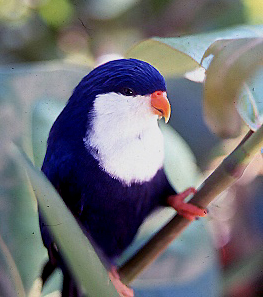
Blue Lorikeet

Blue Lorikeet

Vini peruviana

guignia, Public domain, via Wikimedia Commons

Side by side

Stephen's LorikeetBlue Lorikeet
Scientific nameVini stepheni (North, 1908)Vini peruviana (P. L. S. Müller, 1776)
English nameStephen's LorikeetBlue Lorikeet
GroupBirdsBirds
ClassAves BirdAves Bird
OrderPsittaciformes ParrotPsittaciformes Parrot
FamilyPsittaculidae LoriesPsittaculidae Lories
GenusVini Vini LoriesVini Vini Lories
Named in19081776
Red List categoryVulnerableVulnerable
Countries on record1 country2 countries
GBIF occurrence records105 records310 records

Rows where the two agree are shown in grey.

Where each is found

Only Stephen's Lorikeet (1)

Only Blue Lorikeet (2)

From Catalogue of Life checklists and GBIF occurrence records. A country missing from a list means no record is held, which is not proof of absence.

Checked facts

Stephen's LorikeetBlue Lorikeet
Appearance
  • The species has predominantly dark blue plumage with white feathers covering the upper chest, throat, and lower face. English Wikipedia
  • The feathers on the top of its head can be raised and display light blue streaks. English Wikipedia
  • Its bill is orange, its irises are yellow-brown, and its legs are orange. English Wikipedia
  • Adult males and females have the same external appearance. English Wikipedia
  • Juveniles lack the adult's white plumage and have dark grey-blue faces and lower body parts. English Wikipedia
  • Juveniles have black bills, dark brown irises, and orange-brown legs. English Wikipedia
Size
Habitat
  • The species inhabits subtropical or tropical moist lowland forest. English Wikipedia
  • The species inhabits coconut palms and dense interior forest on Henderson Island. English Wikipedia
  • The species is associated with native primary forest on Henderson Island. ebird.org
  • The species inhabits wooded environments throughout its range, including cultivated areas. English Wikipedia
  • The species is most abundant in mixed stands of coconut palms and Heliotropium foertherianum. English Wikipedia
Diet
  • The diet includes nectar, pollen, fruits, and butterfly and moth larvae. English Wikipedia
  • Much of the nectar consumed comes from Scaevola sericea flowers. English Wikipedia
  • Much of the nectar consumed comes from Timonius polygamus flowers. English Wikipedia
  • On Rangiroa, coconut flowers constituted most of the recorded diet during a three-week study. English Wikipedia
  • The species also eats insects found among leaves and on the forest floor. English Wikipedia
  • The species supplements its diet with leaf shoots and soft fruits. English Wikipedia
Behaviour
  • The species roosts in coconut palm trees. English Wikipedia
  • Individuals become active at dawn and call and preen before feeding. English Wikipedia
  • The species usually occurs in flocks containing fewer than ten birds. English Wikipedia
  • Individuals rest in shaded places during the hottest part of the day before feeding again in the afternoon. English Wikipedia
  • At dusk, groups fly around calling before retreating between palm leaves to roost after dark. English Wikipedia
  • Individuals feed quietly in small groups and use brush-like tongues to collect nectar and pollen. English Wikipedia
  • Individuals use their bills to open flowers that have not fully opened. English Wikipedia
  • After feeding on all the flowers of one tree, individuals move to another tree while calling. English Wikipedia
Reproduction
  • The breeding season is thought to occur around April or the beginning of May. English Wikipedia
No checked fact yet
Distribution
  • Stephen's lorikeet is endemic to Henderson Island in the Pitcairn Islands of the South Pacific. English Wikipedia
No checked fact yet
Conservation
  • The species is assessed as vulnerable by the IUCN. English Wikipedia
  • The estimated population is between 720 and 1,820 individuals. English Wikipedia
  • Accidental predator introductions to Henderson Island are a major threat because of the species' extremely restricted range. English Wikipedia
  • Habitat loss caused by deforestation or natural disasters is a threat to the species. English Wikipedia
  • The species appears to have adapted to the introduction of at least one invasive predator, the Polynesian rat. English Wikipedia
  • An attempt to eradicate invasive rodents from Henderson Island was unsuccessful. English Wikipedia
  • The species is classified as endangered in the supplied document. English Wikipedia
  • Invasive cats, rats, swamp harriers, and mosquitoes carrying avian malaria are identified as threats to the species. English Wikipedia
Similar speciesNo checked fact yet
  • The ultramarine lorikeet is identified as a related species that shares blue plumage with the blue lorikeet. English Wikipedia

In brief

Stephen's Lorikeet

Vini stepheni is endemic to Henderson Island in the Pitcairn Islands of the South Pacific. Adults have green upperparts and a red breast that transitions to purple toward the abdomen and thighs. Full profile

Blue Lorikeet

Vini peruviana inhabits wooded environments, including cultivated areas, and is most abundant in mixed stands of coconut palms and Heliotropium foertherianum. It is distinguished by predominantly dark blue plumage, white feathers covering the upper chest, throat, and lower face, and an orange bill. Full profile

Compare something else

Page built on 29 November 2026 from the data on the two species pages, where every source is listed.

Cite this page

ScientificNames.org. (2026). Stephen's Lorikeet vs Blue Lorikeet. Retrieved November 29, 2026, from https://scientificnames.org/compare/stephens-lorikeet-vs-blue-lorikeet