Comparison
Viola hossei vs North American Common Blue Violet
Viola hossei (Viola hossei) and North American Common Blue Violet (Viola sororia) both belong to the genus Viola (violets) and part ways below it.
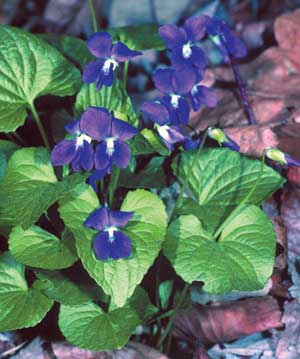
North American Common Blue Violet
Viola sororia
Unknown author, Public domain, via Wikimedia Commons

Side by side
| Viola hossei | North American Common Blue Violet | |
|---|---|---|
| Scientific name | Viola hossei W.Becker | Viola sororia Willd. |
| English name | Not recorded | North American Common Blue Violet |
| Group | Flowering plants | Flowering plants |
| Class | Magnoliopsida | Magnoliopsida |
| Order | Malpighiales | Malpighiales |
| Family | Violaceae Violet Family | Violaceae Violet Family |
| Genus | Viola Violets | Viola Violets |
| Countries on record | 4 countries | 5 countries |
| GBIF occurrence records | 126 records | 19,318 records |
Rows where the two agree are shown in grey.
Where each is found
Only Viola hossei (4)
Only North American Common Blue Violet (5)
From Catalogue of Life checklists and GBIF occurrence records. A country missing from a list means no record is held, which is not proof of absence.
Checked facts
| Viola hossei | North American Common Blue Violet | |
|---|---|---|
| Appearance | No checked fact yet |
|
| Size | No checked fact yet |
|
| Habitat | No checked fact yet |
|
| Diet | No checked fact yet |
|
| Behaviour | No checked fact yet |
|
| Reproduction | No checked fact yet |
|
| Distribution | No checked fact yet |
|
| Uses | No checked fact yet |
|
In brief
North American Common Blue Violet
Viola sororia is native to eastern North America and occurs in the eastern half of the United States, Canada, and part of eastern Mexico. It has heart-shaped leaves and five-petaled flowers that can be white, blue, or purple. Full profile
Compare something else
Page built on 26 November 2026 from the data on the two species pages, where every source is listed.
Cite this page
ScientificNames.org. (2026). Viola hossei vs North American Common Blue Violet. Retrieved November 26, 2026, from https://scientificnames.org/compare/viola-hossei-vs-north-american-common-blue-violet
“Viola hossei vs North American Common Blue Violet.” ScientificNames.org, 2026, scientificnames.org/compare/viola-hossei-vs-north-american-common-blue-violet. Accessed 26 Nov. 2026.
ScientificNames.org. “Viola hossei vs North American Common Blue Violet.” Accessed November 26, 2026. https://scientificnames.org/compare/viola-hossei-vs-north-american-common-blue-violet.
@misc{scientificnames_viola_hossei_vs_north_american_common_blue_violet,
  author = {{ScientificNames.org}},
  title = {Viola hossei vs North American Common Blue Violet},
  year = {2026},
  url = {https://scientificnames.org/compare/viola-hossei-vs-north-american-common-blue-violet},
  note = {Accessed 2026-11-26}
}