Comparison
Hawaii Violet vs North American Common Blue Violet
Hawaii Violet (Viola lanaiensis) and North American Common Blue Violet (Viola sororia) both belong to the genus Viola (violets) and part ways below it. Both are recorded in 1 country.
Hawaii Violet
Viola lanaiensis
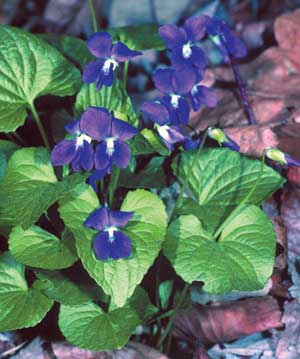
North American Common Blue Violet
Viola sororia
Unknown author, Public domain, via Wikimedia Commons

Side by side
| Hawaii Violet | North American Common Blue Violet | |
|---|---|---|
| Scientific name | Viola lanaiensis W.Becker | Viola sororia Willd. |
| English name | Hawaii Violet | North American Common Blue Violet |
| Group | Flowering plants | Flowering plants |
| Class | Magnoliopsida | Magnoliopsida |
| Order | Malpighiales | Malpighiales |
| Family | Violaceae Violet Family | Violaceae Violet Family |
| Genus | Viola Violets | Viola Violets |
| Countries on record | 1 country | 5 countries |
| GBIF occurrence records | 68 records | 19,318 records |
Rows where the two agree are shown in grey.
Where each is found
Both recorded in 1 country
Only North American Common Blue Violet (4)
From Catalogue of Life checklists and GBIF occurrence records. A country missing from a list means no record is held, which is not proof of absence.
Checked facts
| Hawaii Violet | North American Common Blue Violet | |
|---|---|---|
| Appearance |
|
|
| Size |
|
|
| Habitat |
|
|
| Diet | No checked fact yet |
|
| Behaviour | No checked fact yet |
|
| Reproduction | No checked fact yet |
|
| Lifespan |
| No checked fact yet |
| Distribution |
|
|
| Conservation |
| No checked fact yet |
| Uses | No checked fact yet |
|
| Other |
| No checked fact yet |
In brief
Hawaii Violet
The Hawaii Violet (Viola lanaiensis W.Becker) is a short-lived perennial subshrub in the family Violaceae. It grows in moist and wet forest habitats and is known only from the island of Lanai. It has narrow leaves and white flowers with purple tinges or veins. Full profile
North American Common Blue Violet
Viola sororia is native to eastern North America and occurs in the eastern half of the United States, Canada, and part of eastern Mexico. It has heart-shaped leaves and five-petaled flowers that can be white, blue, or purple. Full profile
Compare something else
Page built on 27 November 2026 from the data on the two species pages, where every source is listed.
Cite this page
ScientificNames.org. (2026). Hawaii Violet vs North American Common Blue Violet. Retrieved November 27, 2026, from https://scientificnames.org/compare/hawaii-violet-vs-north-american-common-blue-violet
“Hawaii Violet vs North American Common Blue Violet.” ScientificNames.org, 2026, scientificnames.org/compare/hawaii-violet-vs-north-american-common-blue-violet. Accessed 27 Nov. 2026.
ScientificNames.org. “Hawaii Violet vs North American Common Blue Violet.” Accessed November 27, 2026. https://scientificnames.org/compare/hawaii-violet-vs-north-american-common-blue-violet.
@misc{scientificnames_hawaii_violet_vs_north_american_common_blue_violet,
  author = {{ScientificNames.org}},
  title = {Hawaii Violet vs North American Common Blue Violet},
  year = {2026},
  url = {https://scientificnames.org/compare/hawaii-violet-vs-north-american-common-blue-violet},
  note = {Accessed 2026-11-27}
}