Comparison

Downy-yellow Violet vs North American Common Blue Violet

Downy-yellow Violet (Viola pubescens) and North American Common Blue Violet (Viola sororia) both belong to the genus Viola (violets) and part ways below it. Both are recorded in 2 countries.

Downy-yellow Violet

Downy-yellow Violet

Viola pubescens

en:user:Bridesmill, CC BY-SA 3.0, via Wikimedia Commons

North American Common Blue Violet

North American Common Blue Violet

Viola sororia

Unknown author, Public domain, via Wikimedia Commons

Side by side

Downy-yellow VioletNorth American Common Blue Violet
Scientific nameViola pubescens AitonViola sororia Willd.
English nameDowny-yellow VioletNorth American Common Blue Violet
GroupFlowering plantsFlowering plants
ClassMagnoliopsidaMagnoliopsida
OrderMalpighialesMalpighiales
FamilyViolaceae Violet FamilyViolaceae Violet Family
GenusViola VioletsViola Violets
Countries on record2 countries5 countries
GBIF occurrence records9,095 records19,318 records

Rows where the two agree are shown in grey.

Where each is found

Both recorded in 2 countries

Only North American Common Blue Violet (3)

From Catalogue of Life checklists and GBIF occurrence records. A country missing from a list means no record is held, which is not proof of absence.

Checked facts

Downy-yellow VioletNorth American Common Blue Violet
Appearance
  • Viola pubescens has simple, alternate leaves that are typically heart-shaped with clearly visible veins. lakeforest.edu
  • Its leaves are medium green and usually covered with soft, velvety hairs, although some leaves are hairless. lakeforest.edu
  • The species produces both basal and cauline leaves. English Wikipedia
  • Its leaves are generally alternate and simple, with leafy stipules. lakeforest.edu
  • Its flowers have five yellow petals, with several purple or brownish lines marking the lower petal. lakeforest.edu
  • Its flowers have five acute sepals, five stamens, and one pistil with a superior ovary. lakeforest.edu
  • Its flowers grow on stalks called peduncles. lakeforest.edu
  • Its flowers are often slightly fragrant. lakeforest.edu
  • Its fruits are oval capsules. lakeforest.edu
  • The lower three petals of the flowers are hairy. English Wikipedia
  • The flowers can be white, blue, or purple. English Wikipedia
  • The flowers have five petals, with two pointing upward and three pointing downward. extension.psu.edu
  • The flowers have dark veins radiating from their whitish throats toward the petals. extension.psu.edu
  • The leaves are heart-shaped to oval-shaped with rounded teeth along their margins. extension.umn.edu
  • The leaves grow alternately and have smooth, waxy upper surfaces and hairy undersides. extension.umn.edu
Size
  • The plant grows approximately 0.5 to 1 foot tall. lakeforest.edu
  • The plant spreads approximately 0.5 to 1 foot wide. lakeforest.edu
  • Its leaves typically measure approximately three inches wide and two and a half inches long. lakeforest.edu
  • Its flowers measure approximately three-quarters of an inch across. lakeforest.edu
  • Its fruit capsules measure between five and twelve millimeters. lakeforest.edu
Habitat
  • The species grows in rich, mesic woodlands and occasionally in meadows. English Wikipedia
  • Its natural habitats include meadows, low woods, sandy woodlands, and other woodlands. lakeforest.edu
  • The species develops in habitats ranging from slightly moist to moderately wet conditions. lakeforest.edu
  • The species prefers partial sun to light shade. lakeforest.edu
Diet
  • The species' seeds are consumed by Slate-Colored Juncos, Ruffed Grouse, Bobwhites, Wild Turkeys, and Mourning Doves. lakeforest.edu
  • Cottontail Rabbits, Eastern Chipmunks, and Wood Turtles consume the species' leaves and stems. lakeforest.edu
  • The plant provides food for wild turkeys, rabbits, deer, livestock, mourning doves, bobwhites, and white-footed mice. English Wikipedia
  • The plant's leaves and flowers are edible, while its roots are not edible. English Wikipedia
  • The plant's leaves can be eaten as a potherb, and its leaves and flowers can be added to salads. naturalresources.extension.iastate.edu
  • The plant serves as a food source for songbirds, wild turkeys, grouse, bobwhites, mourning doves, and mice. extension.psu.edu
Behaviour
  • The species attracts flies and butterflies that feed on its pollen and foliage. lakeforest.edu
Reproduction
  • The species produces two types of flowers during the growing season: chasmogamous flowers in early spring and cleistogamous flowers from summer through fall. English Wikipedia
  • Bees are the primary agents of cross-pollination for the species. lakeforest.edu
  • The species' flowers attract bees through their nectar and pollen. lakeforest.edu
  • Its fruits mature around midsummer. lakeforest.edu
  • Its seeds are pale brownish to white in color. lakeforest.edu
DistributionNo checked fact yet
  • The plant is native to eastern North America. English Wikipedia
  • The plant occurs across the eastern half of the United States, Canada, and part of eastern Mexico. English Wikipedia
Uses
  • The species is cultivated in ornamental gardens because of the aesthetic appeal of its bright yellow petals. lakeforest.edu
Similar species
  • Viola rotundifolia resembles Viola pubescens, but the two species can be distinguished by their leaf shapes and margins. English Wikipedia
  • Viola rotundifolia has only basal leaves, whereas Viola pubescens has both basal and cauline leaves. English Wikipedia
No checked fact yet

In brief

Downy-yellow Violet

Viola pubescens grows in rich, mesic woodlands, other wooded habitats, and occasionally in meadows. It is distinguished by its typically hairy, heart-shaped leaves and yellow flowers marked with purple or brownish lines on the lower petal. Full profile

North American Common Blue Violet

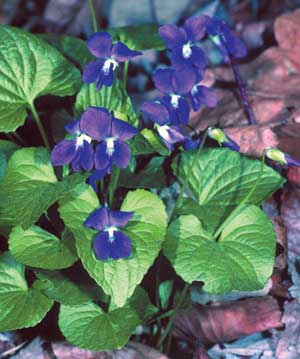
Viola sororia is native to eastern North America and occurs in the eastern half of the United States, Canada, and part of eastern Mexico. It has heart-shaped leaves and five-petaled flowers that can be white, blue, or purple. Full profile

Compare something else

Page built on 27 November 2026 from the data on the two species pages, where every source is listed.

Cite this page

ScientificNames.org. (2026). Downy-yellow Violet vs North American Common Blue Violet. Retrieved November 27, 2026, from https://scientificnames.org/compare/downy-yellow-violet-vs-north-american-common-blue-violet