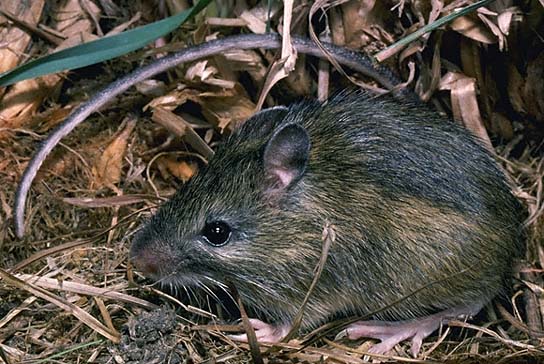
| Appearance | - The western jumping mouse has coarse, dark-greyish-brown fur on its upper body, a broad yellow-to-red band along its flanks, and pale yellowish-white underparts. English Wikipedia
- The species has elongated hind feet and reduced forelimbs. English Wikipedia
- Some individuals have white spots on their upper body or tail tip. English Wikipedia
- Males and females are similar in appearance and size. English Wikipedia
- The species has a dark dorsal band, yellow sides, and a usually white belly that may have a yellow tinge. animaldiversity.org
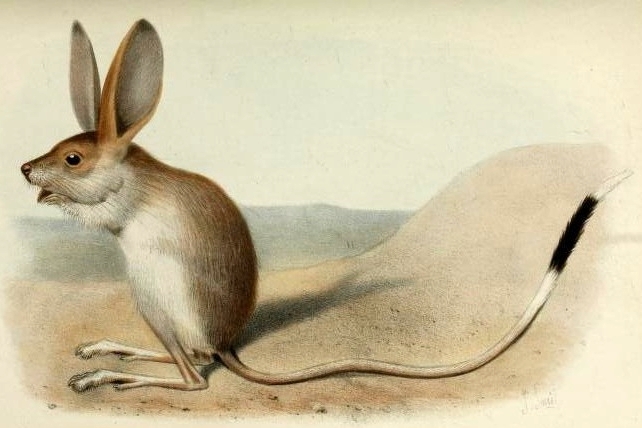
| - The long-eared jerboa has reddish-yellow to light russet upperparts and a white belly. animaldiversity.org
- The long-eared jerboa has ears approximately one-third longer than its head. animaldiversity.org
- The long-eared jerboa has a tail with short hairs and a terminal tuft of black and white hairs. animaldiversity.org
- The long-eared jerboa has five digits on each hind foot, with shorter lateral digits than central digits. animaldiversity.org
- The central metatarsals of the long-eared jerboa are fused over a short distance. animaldiversity.org
- The long-eared jerboa has tufts of bristly hairs covering its feet. animaldiversity.org
- The long-eared jerboa has thin, white incisors. animaldiversity.org
- The long-eared jerboa has a small premolar on each side of its upper jaw. animaldiversity.org
- Female long-eared jerboas have eight mammary glands. animaldiversity.org
|
|---|
| Size | | |
|---|
| Habitat | - The species inhabits mountainous terrain with moderately damp climates. English Wikipedia
- The species occurs in meadows and forests dominated by alder, aspen, or willow. English Wikipedia
- Individuals are commonly found in dense vegetation near fresh water. English Wikipedia
- The species inhabits moist fields, thickets, and woodlands with dense grass, sedge, or other green plant cover. animaldiversity.org
- Individuals are usually found within 50 metres of streams, ponds, or lakes. animaldiversity.org
- Individuals live in self-dug burrows or burrows made by other animals. animaldiversity.org
| - Long-eared jerboas have been collected in sandy valleys covered with low-growing bushes. animaldiversity.org
- The long-eared jerboa inhabits arid desert and semi-desert environments in the Mengxin and Aerjin Mountain regions. animaldiversity.org
- The long-eared jerboa also inhabits cold, high-elevation desert environments in the Qing-Zang Plateau region. animaldiversity.org
- Haloxylon ammodendron has been documented at some long-eared jerboa capture sites. animaldiversity.org
|
|---|
| Diet | - The species is omnivorous, with grass and herb seeds forming the largest part of its diet. English Wikipedia
- Other food items include fruits, fungi, and insects. English Wikipedia
- The main foods consumed include arthropods, seeds, and leaves. animaldiversity.org
- Arthropods may replace seeds as an important food source when seeds are unavailable. animaldiversity.org
- The species is mostly herbivorous and eats seeds, fruit, and occasionally insects. swap.dgf.nm.gov
| |
|---|
| Behaviour | - The species is primarily nocturnal but may also forage during daylight. animaldiversity.org
- Individuals are active during summer and hibernate during the remainder of the year. English Wikipedia
- In some locations, individuals spend eight to ten months annually in hibernation. English Wikipedia
- During hibernation, individuals rely entirely on stored body fat rather than cached food. English Wikipedia
- During hibernation, individuals wake on average once every 38 days. English Wikipedia
- Individuals generally enter their dens after the first snowfall if they have not entered earlier. English Wikipedia
- Individuals emerge from hibernation when ground temperatures reach approximately 8–9.5 °C. English Wikipedia
- When alarmed, individuals drum their tails against the ground. animaldiversity.org
- When startled, individuals can escape through a series of jumps measuring 90–150 cm. animaldiversity.org
- Individuals can swim and climb. animaldiversity.org
- Individuals tend to use existing runways made by other animals. animaldiversity.org
- Fat deposition begins approximately one month before hibernation. animaldiversity.org
| - Long-eared jerboas are presumed to be mainly nocturnal. animaldiversity.org
- The long-eared jerboa locates flying insects using sound and captures them by leaping rapidly into the air. animaldiversity.org
- The long-eared jerboa belongs to a species whose mating system has not been established. animaldiversity.org
- The long-eared jerboa is gonochoric, with separate male and female sexes. animaldiversity.org
|
|---|
| Reproduction | | - Female long-eared jerboas nurse and care for their offspring at least until weaning. animaldiversity.org
|
|---|
| Distribution | - The species occurs in western North America from Yukon to New Mexico. English Wikipedia
- The species occurs throughout western Canada and much of the western United States. animaldiversity.org
| - The long-eared jerboa occurs from southernmost Mongolia into northwestern China. animaldiversity.org
|
|---|
| Conservation | - The species is classified as less vulnerable to climate change under both RCP 4.5 and RCP 8.5 scenarios in the New Mexico assessment. swap.dgf.nm.gov
| - The long-eared jerboa was identified as one of the ten focal species of the EDGE project in 2007. English Wikipedia
- Ongoing human disturbance is identified as a major threat to the long-eared jerboa. animaldiversity.org
- The long-eared jerboa's population has experienced an observed or probable reduction of at least 80 percent over ten years. animaldiversity.org
|
|---|
| Uses | - The species is an important component of healthy grass-dominated habitats throughout its range. animaldiversity.org
| No checked fact yet |
|---|
| Other | No checked fact yet | - The long-eared jerboa is the only recognized member of its genus, Euchoreutes. English Wikipedia
- The long-eared jerboa is also the only recognized member of its subfamily, Euchoreutinae. English Wikipedia
|
|---|