Comparison
Western Red Cedar vs Japanese Cedar
Western Red Cedar (Thuja plicata) and Japanese Cedar (Cryptomeria japonica) both belong to the family Cupressaceae (cypress) and part ways below it. Both are recorded in 25 countries.

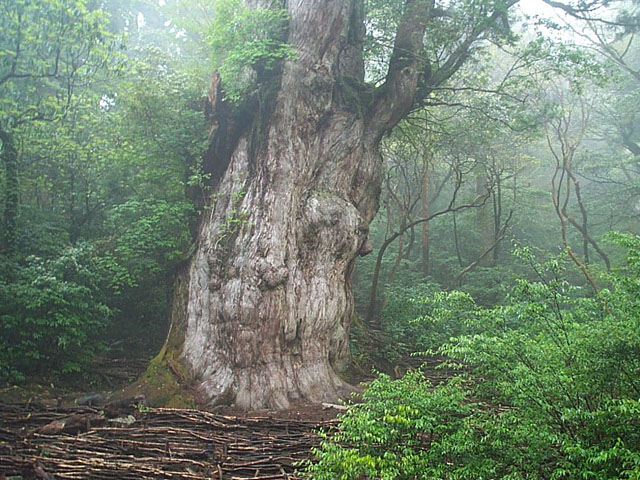


How they differ
Canoe Cedar (Thuja plicata) has flat foliage sprays with opposite scale-like leaves, while Japanese Cedar (Cryptomeria japonica) has needle-like leaves arranged spirally. Canoe Cedar (Thuja plicata) has slender cones measuring 10–18 mm long and 4–5 mm wide, while Japanese Cedar (Cryptomeria japonica) has globular seed cones measuring 1–2 centimetres in diameter. Canoe Cedar (Thuja plicata) is native to the Pacific Northwest of North America, with a natural range from southeastern Alaska to northern California, while Japanese Cedar (Cryptomeria japonica) is endemic to Japan.
| Western Red Cedar | Japanese Cedar | |
|---|---|---|
| Bark | Canoe Cedar has thin, gray-brown bark divided into vertical fissures. | Japanese Cedar has red-brown bark that peels in vertical strips. |
| Leaves | Canoe Cedar has individual leaves on most foliage sprays measuring 1–4 mm long and 1–2 mm wide. | Japanese Cedar has needle-like leaves measuring 0.5–1 centimetres in length. |
| Habitat | Canoe Cedar grows best in moist locations with wet maritime climates. | Japanese Cedar grows in warm, moist environments on deep, well-drained soils. |
| Behaviour | Canoe Cedar is highly shade-tolerant and can establish beneath other forest trees. | Japanese Cedar grows rapidly under warm, moist conditions with deep, well-drained soils. |
| Diet | Canoe Cedar foliage provides year-round food for browsing ungulates, including Roosevelt elk and black-tailed deer. | Japanese Cedar serves as a food plant for larvae of several moths in the genus Endoclita. |
| Reproduction | Canoe Cedar can reproduce vegetatively through layering and the development of branches from fallen branches or trees. | Japanese Cedar has seed cones with approximately 20–40 scales. |
Written from the checked facts listed further down. Statements that the sources did not support were removed.
Side by side
| Western Red Cedar | Japanese Cedar | |
|---|---|---|
| Scientific name | Thuja plicata Donn ex D.Don | Cryptomeria japonica (Thunb. ex L.) D.Don |
| English name | Western Red Cedar | Japanese Cedar |
| Group | Conifers and allies | Conifers and allies |
| Class | Pinopsida Conifer | Pinopsida Conifer |
| Order | Cupressales | Cupressales |
| Family | Cupressaceae Cypress | Cupressaceae Cypress |
| Genus | Thuja Cedar | Cryptomeria Sugis |
| Red List category | Least Concern | Near Threatened |
| Countries on record | 27 countries | 50 countries |
| GBIF occurrence records | 56,660 records | 15,755 records |
Rows where the two agree are shown in grey.
Where each is found
Both recorded in 25 countries
- Austria
- Belgium
- Bulgaria
- Canada
- Czechia
- Denmark
- Finland
- France
- Germany
- Hungary
- Ireland
- Isle of Man
- Italy
- Luxembourg
- Norway
- Poland
- Portugal
- Russia
- Spain
- Sweden
- Switzerland
- The Netherlands
- Ukraine
- United Kingdom
- United States
Only Western Red Cedar (2)
Only Japanese Cedar (25)
- Bhutan
- Brazil
- Cambodia
- China
- Croatia
- Georgia
- Guadeloupe
- Hong Kong
- India
- Indonesia
- Israel
- Jamaica
- Japan
- Latvia
- Martinique
- Mexico
- Nepal
- Philippines
- Reunion
- Slovakia
- Slovenia
- South Korea
- Sri Lanka
- Taiwan
- Turkey
From Catalogue of Life checklists and GBIF occurrence records. A country missing from a list means no record is held, which is not proof of absence.
Checked facts
| Western Red Cedar | Japanese Cedar | |
|---|---|---|
| Appearance |
|
|
| Size |
|
|
| Habitat |
|
|
| Diet |
|
|
| Behaviour |
|
|
| Reproduction |
| No checked fact yet |
| Distribution |
|
|
| Uses |
|
|
| Similar species |
|
|
| Other | No checked fact yet |
|
In brief
Western Red Cedar
Thuja plicata is native to the Pacific Northwest of North America, with a natural range extending from southeastern Alaska to northern California. Its foliage consists of flat sprays of scale-like leaves that produce a strong pineapple-like aroma when crushed. Full profile
Japanese Cedar
The species is considered endemic to Japan and has been introduced and cultivated in several places outside its native range. It has red-brown bark that peels in vertical strips, spirally arranged needle-like leaves and globular seed cones. Full profile
Compare something else
Page built on 24 November 2026 from the data on the two species pages, where every source is listed.
Cite this page
ScientificNames.org. (2026). Western Red Cedar vs Japanese Cedar. Retrieved November 24, 2026, from https://scientificnames.org/compare/western-red-cedar-vs-japanese-cedar
“Western Red Cedar vs Japanese Cedar.” ScientificNames.org, 2026, scientificnames.org/compare/western-red-cedar-vs-japanese-cedar. Accessed 24 Nov. 2026.
ScientificNames.org. “Western Red Cedar vs Japanese Cedar.” Accessed November 24, 2026. https://scientificnames.org/compare/western-red-cedar-vs-japanese-cedar.
@misc{scientificnames_western_red_cedar_vs_japanese_cedar,
  author = {{ScientificNames.org}},
  title = {Western Red Cedar vs Japanese Cedar},
  year = {2026},
  url = {https://scientificnames.org/compare/western-red-cedar-vs-japanese-cedar},
  note = {Accessed 2026-11-24}
}