Species · Conifers and allies
Japanese Cedar Cryptomeria japonica
The scientific name of the Japanese Cedar is Cryptomeria japonica. It is a species of gymnosperm in the family Cupressaceae (cypress), order Cupressales.
- Scientific name
- Cryptomeria japonica (Thunb. ex L.) D.Don
- Common name
- Japanese Cedar
- Genus
- Cryptomeria
- Family
- Cupressaceae (Cypress)
- Order
- Cupressales
- Class
- Pinopsida
- Red List category
- NT Near Threatened
- Recorded in
- 50 countries
- Name status
- accepted in the Catalogue of Life
Overview
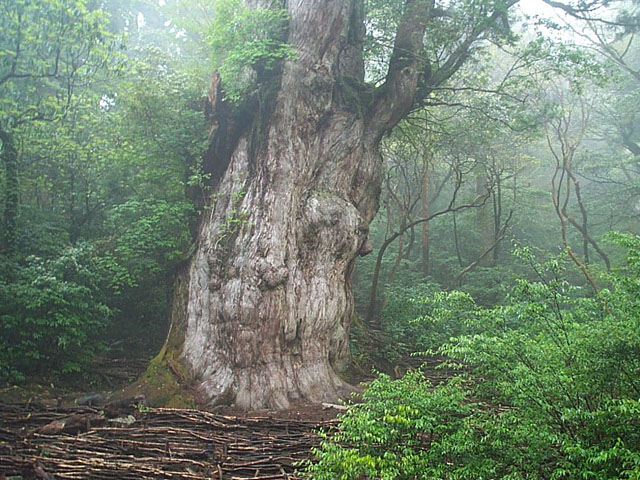
The species is considered endemic to Japan and has been introduced and cultivated in several places outside its native range. It has red-brown bark that peels in vertical strips, spirally arranged needle-like leaves and globular seed cones.
Written 24 November 2026 from the sources listed below. Each statement was checked against the passage it cites; statements that could not be supported were removed.
Appearance
Japanese Cedar has red-brown bark that peels in vertical strips. Its needle-like leaves are arranged spirally, and its seed cones are globular with approximately 20–40 scales.[1][2][3]
The needle-like leaves measure 0.5–1 centimetres in length. The globular seed cones measure 1–2 centimetres in diameter.[4][5]
The cultivar 'Elegans' retains juvenile foliage throughout its life.[6]
Similar species
Japanese Cedar is superficially similar in appearance to the giant sequoia. It differs in having longer leaves, smaller cones and harder trunk bark.[7][8][9]
Habitat
Japanese Cedar grows in forests on deep, well-drained soils. Its natural growing conditions include warm and moist environments.[10][11]
Behaviour
Japanese Cedar grows rapidly under warm, moist conditions with deep, well-drained soils. It does not tolerate poor soils or cold, drier climates.[12][13]
Diet
Japanese Cedar serves as a food plant for larvae of several moths in the genus Endoclita. These include Endoclita auratus, Endoclita punctimargo and Endoclita undulifer.[14][15]
Uses
Japanese Cedar is cultivated for timber production. Its timber is used to manufacture staves, tubs, casks and furniture, and is suitable for light construction, boxes, veneers and plywood.[16][17][18]
The species is cultivated as an ornamental tree in temperate regions. Dwarf cultivars are used in rock gardens and for bonsai.[19][20]
The species is sometimes harvested using the Japanese coppicing method known as daisugi. It is also planted around temples and shrines in Japan.[21][22]
Classification of the Japanese Cedar
| Kingdom | Plantae |
|---|---|
| Subkingdom | Pteridobiotina |
| Phylum | Tracheophyta |
| Class | Pinopsida (Conifer) |
| Subclass | Cupressidae |
| Order | Cupressales |
| Family | Cupressaceae (Cypress) |
| Genus | Cryptomeria (Sugis) |
| Species | Cryptomeria japonica (Thunb. ex L.) D.Don |
Where the Japanese Cedar is found
Checklists and occurrence records place Cryptomeria japonica in 50 countries. GBIF holds 15,755 georeferenced records of it.
Countries
- Austria 8
- Belgium 171
- Bhutan 4
- Brazil 393
- Bulgaria 3
- Cambodia 4
- Canada 22
- China 1,377
- Croatia 6
- Czechia 136
- Denmark 45
- Finland 3
- France 128
- Georgia 22
- Germany 92
- Guadeloupe 3
- Hong Kong 4
- Hungary 9
- India 61
- Indonesia 14
- Ireland 15
- Isle of Man 8
- Israel 3
- Italy 30
- Jamaica 6
- Japan 3,874
- Latvia 3
- Luxembourg 67
- Martinique 3
- Mexico 35
- Nepal 96
- Norway 11
- Philippines 4
- Poland 32
- Portugal 3,921
- Reunion 406
- Russia 19
- Slovakia 43
- Slovenia 3
- South Korea 958
- Spain 105
- Sri Lanka 3
- Sweden 109
- Switzerland 32
- Taiwan 705
- The Netherlands 268
- Turkey 12
- Ukraine 7
- United Kingdom 1,658
- United States 814
Regions and cities with the most records
- Azores, Portugal 3,620
- England, United Kingdom 1,191
- Akita, Japan 453
- Taiwan, Taiwan 435
- Tokyo, Japan 310
- Fuchū, Japan 287
- Inagi, Japan 280
- Kokubunji, Japan 274
- Komae, Japan 267
- Chōfu, Japan 265
- Koganei, Japan 254
- Musashino, Japan 253
- Nishi-Tokyo-shi, Japan 244
- Kodaira, Japan 237
- Higashikurume, Japan 231
- Kanagawa, Japan 223
- Kiyose, Japan 214
- Nakano, Japan 197
- Wales, United Kingdom 196
- Tokyo, Japan 195
- Kawasaki, Japan 193
- Le Tampon, Reunion 192
- Kyoto, Japan 191
- Ōta, Japan 190
- Kita, Japan 185
- Jeollanam-do, South Korea 184
- Tama, Japan 181
- Wako, Japan 178
- Chūō, Japan 175
- Machida, Japan 175
- Kawaguchi, Japan 174
- Minato City, Japan 174
- Asaka, Japan 172
- Shimotoda, Japan 172
- Scotland, United Kingdom 170
- Hino, Japan 167
15 more countries have a few records outside this range
These countries hold a few records of Cryptomeria japonica but lie outside the range the checklists give for it. Such records are often zoo or garden specimens, museum material or vagrants, so the species is not counted as occurring there.
A number beside a place is its count of GBIF occurrence records. A place without a number comes from a checklist alone. Records show where a species has been observed or collected, which can include escapes and vagrants.
Common names
English
- Japanese Cedar
- Japanese Red-Cedar
- Japanese Cryptomeria
- Japanese Redwood
- Japanese-cedar
- Cryptomeria
- Peacock Pine
Names in 39 other languages
- Afrikaans
- Japanse seder
- Arabic
- سرو اليابان
- Armenian
- Կրիպտոմերիա ճապոնական
- Catalan
- Cedre japonès
- Chinese
- Liu Shan, 日本柳杉, 柳杉
- Croatian
- Japanska kriptomerija
- Czech
- kryptomerie japonská
- Danish
- Japansk Kryptomeria, japangran
- Dutch
- Japanse cipres, Sikkelcipres
- Esperanto
- Sugio
- Estonian
- jaapani krüptomeeria
- French
- cryptoméria du Japon, cèdre du Japon
- Galician
- Criptomeria
- Georgian
- კრიპტომერია
- German
- Japanische Zeder, Sicheltanne
- Hebrew
- קריפטומריה
- Hungarian
- Japánciprus
- Italian
- Cedro del Giappone, crittomeria
- Japanese
- Sugi, スギ, 杉
- Korean
- 삼나무
- Lithuanian
- Japoninė kriptomerija
- Nepali
- धुपी सल्ला
- Norwegian Bokmål
- japanseder, skjermgran
- Persian
- سدر ژاپنی
- Polish
- Kryptomeria Japońska, Szydlica Japońska
- Portuguese
- cedro-japonês, criptoméria, criptoméria-do-japão
- Russian
- Криптомерия японская
- Slovak
- kryptoméria japonská
- Slovenian
- japonska kriptomerija
- Spanish
- Cedro japonés, Criptomeria japonesa
- Swedish
- kryptomeria
- Turkish
- Japon Çamı
- Ukrainian
- Криптомерія японська
- Vietnamese
- Liễu sam
- Welsh
- Cedrwydden Goch Japan, Cochwydden Japan
- dsb
- Japańska kryptomerija
- hsb
- Japanska kryptomerija
- mrj
- Криптомери
- udm
- Криптомерия
Synonyms
56 other scientific names have been used for this species and are now treated as synonyms of Cryptomeria japonica.
- Cryptomeria araucarioides Henkel & W.Hochst.
- Cryptomeria araucarioides Carrière
- Cryptomeria compacta Beissn.
- Cryptomeria elegans Jacob-Makoy
- Cryptomeria elegans J.Veitch fil.
- Cryptomeria fortunei Hooibr. ex Billain
- Cryptomeria generalis E.H.L.Krause
- Cryptomeria japonica f. araucarioides (Henkel & W.Hochst.) Beissn.
- Cryptomeria japonica f. compacta Beissn.
- Cryptomeria japonica f. dacrydioides (Carrière) Rehder
- Cryptomeria japonica f. elegans (Jacob-Makoy) Beissn.
- Cryptomeria japonica f. japonica
- Cryptomeria japonica f. lobbii (Carrière) Beissn.
- Cryptomeria japonica f. nana (Carrière) Beissn.
- Cryptomeria japonica f. pungens (Carrière) Beissn.
- Cryptomeria japonica f. spiralis (Miq.) Rehder
- Cryptomeria japonica subsp. japonica
- Cryptomeria japonica subsp. sinensis (Miq.) P.D.Sell
- Cryptomeria japonica var. araucarioides (Henkel & W.Hochst.) Jacob-Makoy
- Cryptomeria japonica var. caespitosa Makino
- Cryptomeria japonica var. compacta (Beissn.) C.K.Schneid.
- Cryptomeria japonica var. compacta Jacob-Makoy
- Cryptomeria japonica var. dacrydioides Carrière
- Cryptomeria japonica var. elegans-variegata Van Geert
- Cryptomeria japonica var. fortunei (Hooibr. ex Billain) A.Henry
- Cryptomeria japonica var. japonica
- Cryptomeria japonica var. lobbii (Billain) Carrière
- Cryptomeria japonica var. lobbii Lavallée
- Cryptomeria japonica var. nana Carrière
- Cryptomeria japonica var. pendula Leroy ex Dallim. & A.B.Jacks.
- Cryptomeria japonica var. pendulata Bronsart
- Cryptomeria japonica var. pungens Carrière
- Cryptomeria japonica var. radicans Nakai
- Cryptomeria japonica var. sinensis Miq.
- Cryptomeria japonica var. spiralis Miq.
- Cryptomeria kawaii Hayata
- Cryptomeria lobbiana Billain
- Cryptomeria lobbii (Carrière) Lavallée
- Cryptomeria lobbii Hort. ex Fr. Schneider
- Cryptomeria lobbii (Carrière) Beissn.
Showing 40 of 56.
Related species
-
 Giant SequoiaSequoiadendron giganteum
-
 Coast RedwoodSequoia sempervirens
-
 Bald CypressTaxodium distichum
-
 Eastern Red CedarJuniperus virginiana
-
 Northern White CedarThuja occidentalis
-
 Western Red CedarThuja plicata
-
 Dawn RedwoodMetasequoia glyptostroboides
-
 Mediterranean CypressCupressus sempervirens
Compare
- Dawn Redwood vs Japanese Cedar
- Mediterranean Cypress vs Japanese Cedar
- Japanese Cedar vs Hinoki Cypress
- Western Red Cedar vs Japanese Cedar
- Japanese Cedar vs Common Juniper
- Japanese Cedar vs Giant Sequoia
- Japanese Cedar vs Coast Redwood
- Japanese Cedar vs Bald Cypress
- Japanese Cedar vs Eastern Red Cedar
- Japanese Cedar vs Northern White Cedar
Questions and answers
What is the scientific name of the Japanese Cedar?
The scientific name of the Japanese Cedar is Cryptomeria japonica. Written with its author, the full name is Cryptomeria japonica (Thunb. ex L.) D.Don.
Which family does the Japanese Cedar belong to?
Cryptomeria japonica belongs to the family Cupressaceae, in the order Cupressales and the class Pinopsida.
Where is the Japanese Cedar found?
Checklists and occurrence records place Cryptomeria japonica in 50 countries, including Portugal, Japan, United Kingdom, China, South Korea and United States.
What is the conservation status of the Japanese Cedar?
The IUCN Red List category recorded for Cryptomeria japonica is Near Threatened (NT).
What other names does the Japanese Cedar have?
Cryptomeria japonica is also known in English as Japanese Red-Cedar, Japanese Cryptomeria, Japanese Redwood, Japanese-cedar, Cryptomeria and Peacock Pine.
What is the common name for Cryptomeria japonica?
The common name used here is Japanese Cedar. The species is known as Sugi in Japan.[23]
Sources
Passages the profile rests on
- The species has red-brown bark that peels in vertical strips. Source passage: “with red-brown bark which peels in vertical strips.” — English Wikipedia
- Its leaves are needle-like and arranged spirally. Source passage: “The leaves are arranged spirally, needle-like, 0.5–1 cm” — English Wikipedia
- Its seed cones are globular and have approximately 20–40 scales. Source passage: “the seed cones globular, 1–2 cm (1⁄2–3⁄4 in) diameter with about 20–40 scales.” — English Wikipedia
- Its needle-like leaves measure 0.5–1 centimetres in length. Source passage: “needle-like, 0.5–1 cm (1⁄4–3⁄8 in) long” — English Wikipedia
- Its globular seed cones measure 1–2 centimetres in diameter. Source passage: “the seed cones globular, 1–2 cm (1⁄2–3⁄4 in) diameter” — English Wikipedia
- The cultivar 'Elegans' retains juvenile foliage throughout its life. Source passage: “The cultivar 'Elegans' is notable for retaining juvenile foliage throughout its life” — English Wikipedia
- The species is superficially similar in appearance to the giant sequoia. Source passage: “It is superficially similar to the related giant sequoia (Sequoiadendron giganteum)” — English Wikipedia
- The species differs from giant sequoia in having longer leaves and smaller cones. Source passage: “by the longer leaves (under 0.5 cm or 1⁄4 in in the giant sequoia) and smaller cones (4–6 cm or 1+1⁄2–2+1⁄4 in in the giant sequoia)” — English Wikipedia
- The species has harder trunk bark than giant sequoia. Source passage: “and the harder bark on the trunk (thick, soft and spongy in giant sequoia).” — English Wikipedia
- The species grows in forests on deep, well-drained soils. Source passage: “Cryptomeria grows in forests on deep, well-drained soils” — English Wikipedia
- Its natural growing conditions include warm and moist environments. Source passage: “subject to warm, moist conditions” — English Wikipedia
- The species grows rapidly under warm, moist conditions with deep, well-drained soils. Source passage: “and it is fast-growing under these conditions.” — English Wikipedia
- The species does not tolerate poor soils or cold, drier climates. Source passage: “It is intolerant of poor soils and cold, drier climates.” — English Wikipedia
- The species serves as a food plant for larvae of several moths in the genus Endoclita. Source passage: “It is used as a food plant by the larvae of some moths of the genus Endoclita” — English Wikipedia
- Moth species whose larvae feed on this tree include Endoclita auratus, Endoclita punctimargo and Endoclita undulifer. Source passage: “including E. auratus, E. punctimargo and E. undulifer.” — English Wikipedia
- The species is cultivated for timber production. Source passage: “cultivated for wood production on the Azores and elsewhere.” — English Wikipedia
- Its timber is used to manufacture staves, tubs, casks and furniture. Source passage: “The timber is used for the making of staves, tubs, casks, furniture and other indoor applications.” — English Wikipedia
- Its timber is suitable for light construction, boxes, veneers and plywood. Source passage: “it is favoured for light construction, boxes, veneers and plywood.” — English Wikipedia
- The species is cultivated as an ornamental tree in temperate regions. Source passage: “widely cultivated as an ornamental tree in other temperate areas” — English Wikipedia
- Dwarf cultivars of the species are used in rock gardens and for bonsai. Source passage: “There are numerous dwarf cultivars that are widely used in rock gardens and for bonsai” — English Wikipedia
- The species is sometimes harvested using the Japanese coppicing method known as daisugi. Source passage: “In Japan, the coppicing method of daisugi (台杉) is sometimes used to harvest logs.” — English Wikipedia
- The species is planted around temples and shrines in Japan. Source passage: “Sugi is commonly planted around temples and shrines” — English Wikipedia
- The species is known as Sugi in Japan. Source passage: “where it is known as Sugi (杉).” — English Wikipedia
- The species can reach 60 metres in height. Source passage: “reaching up to 60 m (200 ft) tall” — English Wikipedia
- Its trunk can reach 4 metres in diameter. Source passage: “and 4 m (13 ft) trunk diameter” — English Wikipedia
- A measured specimen in Tosa Prefecture reached 50 metres in height. Source passage: “which measured 50 m (160 ft) in height” — English Wikipedia
Data
- Catalogue of Life, 2026-10-16 XR cc by
- Global Biodiversity Information Facility CC BY 4.0
- Wikidata CC0
- GeoNames CC BY 4.0
- Wikimedia Commons per image; credit shown with each image
- Within the Catalogue of Life, this name comes from Pinopsida from WFO cc0
References
- Trans. Linn. Soc. London 18: 167. (1841) where the name was published
- Conifer TEN record for Cryptomeria japonica (Thunb. ex. L.) D.Don Link
This species in other databases
- Catalogue of Life ZY5W
- Wikidata Q147388
- iNaturalist 71147
- World Flora Online wfo-0000628423-2026-06
- GRIN 12526
Page built on 24 November 2026. See how the catalog is made and all sources and licences.
Cite this page
ScientificNames.org. (2026). Cryptomeria japonica (Japanese Cedar). Retrieved November 24, 2026, from https://scientificnames.org/species/cryptomeria-japonica
“Cryptomeria japonica (Japanese Cedar).” ScientificNames.org, 2026, scientificnames.org/species/cryptomeria-japonica. Accessed 24 Nov. 2026.
ScientificNames.org. “Cryptomeria japonica (Japanese Cedar).” Accessed November 24, 2026. https://scientificnames.org/species/cryptomeria-japonica.
@misc{scientificnames_cryptomeria_japonica_japanese_cedar,
  author = {{ScientificNames.org}},
  title = {Cryptomeria japonica (Japanese Cedar)},
  year = {2026},
  url = {https://scientificnames.org/species/cryptomeria-japonica},
  note = {Accessed 2026-11-24}
}