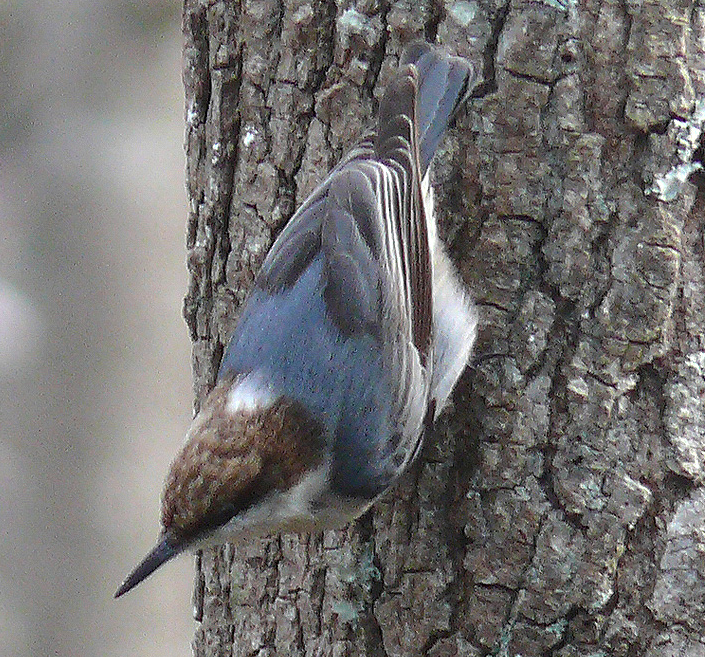
| Appearance | - The Western Rock Nuthatch has a large head, short tail, powerful bill and feet, and relatively long legs and bill. English Wikipedia
- The nominate subspecies has dark grey upperparts, a prominent black eyestripe, a white throat, and underparts that become buff towards the belly. English Wikipedia
- Young Western Rock Nuthatches are slightly duller in appearance than adults. English Wikipedia
- The subspecies Sitta neumayer tschitscherini has paler grey upperparts and a weaker eyestripe than the nominate subspecies. English Wikipedia
- The subspecies Sitta neumayer plumbea has greyer underparts than Sitta neumayer tschitscherini. English Wikipedia
| - The species has a brown cap, a narrow black eyeline, buff-white cheeks, a chin and belly, and bluish-gray wings. English Wikipedia
- Males and females have similar body sizes and coloration. animaldiversity.org
- Juveniles resemble adults in both coloration and size. animaldiversity.org
|
|---|
| Size | | |
|---|
| Habitat | - The Western Rock Nuthatch inhabits areas with exposed rocks, particularly mountainous regions. English Wikipedia
- Western Rock Nuthatches build nests in rock crevices, caves, or beneath overhangs on rock faces. English Wikipedia
| - The species typically inhabits open, mature pine stands with sparse understory vegetation. animaldiversity.org
- Areas subject to frequent prescribed burns provide suitable habitat by maintaining open understories and creating nesting snags. animaldiversity.org
- The species is generally found at elevations below 700 metres. animaldiversity.org
- The species is associated with forests, woodlands, shrublands, savannas, and thickets. audubon.org
- Pine forests provide the species with both food and shelter. nps.gov
|
|---|
| Diet | - The Western Rock Nuthatch eats insects and spiders during summer. English Wikipedia
- Seeds and snails supplement the Western Rock Nuthatch's diet during winter. English Wikipedia
| - The species eats both seeds and insects. nps.gov
- Pine seeds become a more important food source during winter when insect activity decreases. nps.gov
- The species consumes more insects during warmer months when insects are abundant. nps.gov
- The species is particularly attracted to sunflower seeds and suet cakes at feeding stations. English Wikipedia
|
|---|
| Behaviour | - The Western Rock Nuthatch forages on the ground. English Wikipedia
- The Western Rock Nuthatch wedges large food items into rock crevices and hammers them open with its bill. English Wikipedia
- The Western Rock Nuthatch also catches insects in flight. English Wikipedia
- The Western Rock Nuthatch is largely resident, although some individuals disperse after breeding. English Wikipedia
- Individuals occupying the highest elevations may move to lower elevations during winter. English Wikipedia
- The Western Rock Nuthatch is territorial. English Wikipedia
- The Western Rock Nuthatch decorates areas near its nest entrance by pushing objects into nearby crevices and cracks. English Wikipedia
- The Western Rock Nuthatch lines its nest with soft materials and seals the entrance with mud. English Wikipedia
- The Western Rock Nuthatch produces a tsik call and a trilled tui tui tui song. English Wikipedia
| - The species uses pieces of bark, small twigs, and pine needles as tools when searching for insects. English Wikipedia
- Individuals use loose bark as wedges to remove additional pieces of bark and expose insects. animaldiversity.org
- Individuals wedge seeds into bark depressions and crack them by hammering with their beaks. animaldiversity.org
- The species travels in single-species flocks of four to five birds during the breeding season. animaldiversity.org
- During the non-breeding season, individuals travel in mixed-species flocks containing eight to twenty birds. animaldiversity.org
- The species is bold, inquisitive, and readily approachable by humans. English Wikipedia
- The species is the only member of the family Sittidae documented using tools. animaldiversity.org
|
|---|
| Reproduction | - The Western Rock Nuthatch constructs flask-shaped nests using mud, dung, hair, or feathers. English Wikipedia
- The eggs of the Western Rock Nuthatch are white and speckled with yellow. English Wikipedia
| - Brown-headed Nuthatches are cooperative breeders, with groups of two to five adults participating in raising young. animaldiversity.org
- Cooperative breeding groups include one to three helper birds in addition to the breeding pair. animaldiversity.org
- Nest construction generally begins in February. animaldiversity.org
- Nests are commonly located in snags, birdhouses, or abandoned woodpecker cavities. animaldiversity.org
- Nest entrances are usually less than 2.5 cm in diameter. animaldiversity.org
- The nest cavity is at least 30 cm deep and less than three metres above the ground. animaldiversity.org
- Females generally lay four to eight eggs per brood between March and July. animaldiversity.org
- Nestlings remain in the nest for approximately 17 to 19 days after hatching. animaldiversity.org
- Young birds fledge approximately 18 to 19 days after hatching. animaldiversity.org
- Most adults produce only one clutch of eggs annually. nps.gov
- Females lay an average of four to six eggs per nest. nps.gov
|
|---|
| Distribution | - The Western Rock Nuthatch breeds from Croatia eastward through Greece and Turkey to Iran. English Wikipedia
- The Western Rock Nuthatch overlaps geographically with the Eastern Rock Nuthatch in the eastern part of its range. English Wikipedia
| - The Brown-headed Nuthatch is endemic to pine forests throughout the southeastern United States. English Wikipedia
- The species occurs as far north as Virginia, as far west as Texas, and as far south as southern Florida. animaldiversity.org
- A small, declining population occurs on the Grand Bahama Islands. animaldiversity.org
- The species occurs along the coastal states of the southeastern United States from North Carolina to Texas. nps.gov
|
|---|
| Conservation | No checked fact yet | - The species is classified as a Species of Conservation Concern by the Missouri Department of Conservation. mdc.mo.gov
|
|---|
| Similar species | No checked fact yet | - The Brown-headed Nuthatch is approximately the same size as the Pygmy Nuthatch, and both are identified as the world's smallest nuthatches. English Wikipedia
- The Brown-headed Nuthatch overlaps geographically with Red-breasted and White-breasted Nuthatches, which are larger and differently marked. English Wikipedia
|
|---|
| Other | - The Western Rock Nuthatch is classified as a passerine bird. English Wikipedia
- The Western Rock Nuthatch is reported to be common in suitable habitat across most of its range. English Wikipedia
| - The Bahama Nuthatch was formerly classified as a subspecies of the Brown-headed Nuthatch but is now recognized as a separate species. English Wikipedia
|
|---|