Comparison

Wood Mouse vs Yellow-necked Mouse

Wood Mouse (Apodemus sylvaticus) and Yellow-necked Mouse (Apodemus flavicollis) both belong to the genus Apodemus (field mice) and part ways below it. Both are recorded in 35 countries.

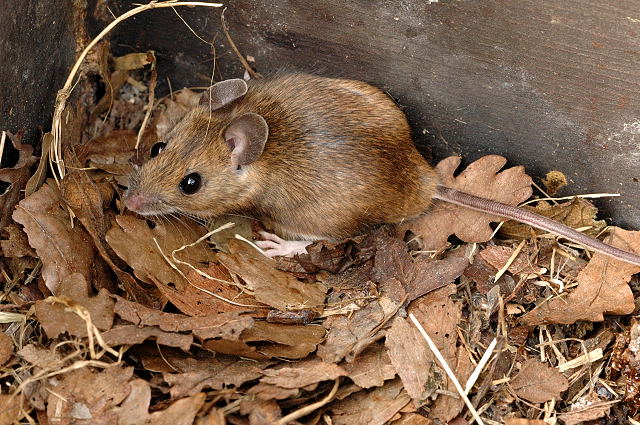
Wood Mouse

Wood Mouse

Apodemus sylvaticus

Hans Hillewaert, CC BY-SA 3.0, via Wikimedia Commons

Yellow-necked Mouse

Yellow-necked Mouse

Apodemus flavicollis

James Lindsey, CC BY-SA 3.0, via Wikimedia Commons

Side by side

Wood MouseYellow-necked Mouse
Scientific nameApodemus sylvaticus (Linnaeus, 1758)Apodemus flavicollis (Melchior, 1834)
English nameWood MouseYellow-necked Mouse
GroupMammalsMammals
ClassMammalia MammalMammalia Mammal
OrderRodentia RodentRodentia Rodent
FamilyMuridae MiceMuridae Mice
GenusApodemus Field MiceApodemus Field Mice
Named in17581834
Red List categoryLeast ConcernLeast Concern
EnvironmentNot recordedterrestrial
Countries on record47 countries39 countries
GBIF occurrence records216,009 records109,411 records

Rows where the two agree are shown in grey.

Where each is found

Both recorded in 35 countries

Only Wood Mouse (12)

Only Yellow-necked Mouse (4)

From Catalogue of Life checklists and GBIF occurrence records. A country missing from a list means no record is held, which is not proof of absence.

Checked facts

Wood MouseYellow-necked Mouse
Appearance
  • The species has a complete band of yellow fur across its neck. English Wikipedia
  • The species has slightly larger ears than the wood mouse. English Wikipedia
  • Its upperparts are brownish-grey, with a browner shade than those of the wood mouse. English Wikipedia
  • Its underparts are white, with a sharply defined boundary separating them from the upperparts. English Wikipedia
  • The species has an ochre-coloured fur patch between its forelegs, which is often inconspicuous. English Wikipedia
  • Juveniles have paler greyish-brown upperparts than adults. English Wikipedia
Size
Habitat
  • The species is predominantly associated with woodland and often lives near forest edges. English Wikipedia
  • In mountainous regions, the species occupies all parts of the forest. English Wikipedia
  • The species commonly inhabits mature deciduous woodland. English Wikipedia
  • Its habitats also include scrubland, hedgerows, orchards and plantations. English Wikipedia
  • The species favours habitats containing large nut-bearing trees such as oaks and hazels. English Wikipedia
  • The species also occurs in parks, gardens and areas beside alder-fringed streams. English Wikipedia
Diet
  • Seeds are a primary food source for wood mice. English Wikipedia
  • The species consumes seeds from oak, beech, ash, lime, hawthorn, and sycamore trees. English Wikipedia
  • Wood mice may eat snails and insects when seeds are scarce, particularly in late spring and early summer. English Wikipedia
  • Later in the year, the species consumes berries, fruits, fungi, and roots. English Wikipedia
  • The species also consumes grains, nuts, grasses, and insects. animaldiversity.org
  • The species eats nuts, buds, shoots, fruits, seedling plants and occasionally small invertebrates. English Wikipedia
Behaviour
  • The species remains active throughout the year and does not hibernate. English Wikipedia
  • Individuals sometimes huddle together during winter to conserve heat. English Wikipedia
  • The species is an accomplished climber that moves through trees and bushes. English Wikipedia
  • The species uses crevices, tree-base burrows, tree-trunk holes, hollow logs and bird nesting boxes as shelters. English Wikipedia
  • Its burrows often have multiple entrances and complex internal layouts. English Wikipedia
  • The species stores food such as acorns and beechmast in underground storage chambers. English Wikipedia
  • The species lines its nesting chambers with dry plant material. English Wikipedia
  • The species also creates food stores in tree holes away from its burrow. English Wikipedia
  • Unconsumed beech nuts cached by the species can germinate and contribute to the dispersal of beech trees. English Wikipedia
  • The species is nocturnal and active both on the ground and in the tree canopy. English Wikipedia
  • Its home range is considerably smaller than half a hectare. English Wikipedia
  • The species is preyed upon by owls, foxes, weasels and other predators. English Wikipedia
  • The species can leap to escape predators and has tail skin that detaches readily when grasped. English Wikipedia
Reproduction
Distribution
Conservation
  • The species has a wide geographic range and is common in suitable habitats within that range. English Wikipedia
  • Recorded population densities in Eastern Europe reach 100 individuals per hectare. English Wikipedia
  • The species has a stable population and no identified specific threats. English Wikipedia
  • The species is classified as Least Concern on the IUCN Red List. English Wikipedia
UsesNo checked fact yet
Similar species
  • The wood mouse is closely related to the yellow-necked mouse, Apodemus flavicollis. English Wikipedia
  • The wood mouse differs from the yellow-necked mouse by lacking a yellow fur band around its neck. English Wikipedia
  • The wood mouse is usually slightly smaller than the yellow-necked mouse. English Wikipedia
  • The species is closely related to the wood mouse and was historically confused with it. English Wikipedia
  • Apodemus ponticus is considered a synonym of Apodemus flavicollis. English Wikipedia
Other
  • The species can transmit the virus responsible for tick-borne encephalitis while remaining immune to the virus itself. English Wikipedia
  • The species is a natural reservoir of Dobrava virus, which causes haemorrhagic fever with renal syndrome in humans. English Wikipedia

In brief

Wood Mouse

Apodemus sylvaticus inhabits forests, grasslands, and cultivated fields, and is native to Europe and northwestern Africa. It has large eyes and ears, white feet, and a moderately hairy, non-prehensile tail. Full profile

Yellow-necked Mouse

Apodemus flavicollis is native to Europe and western Asia, with its Asian distribution extending eastward to the Ural Mountains. It is distinguished by a complete band of yellow fur across its neck. Full profile

Compare something else

Page built on 29 November 2026 from the data on the two species pages, where every source is listed.

Cite this page

ScientificNames.org. (2026). Wood Mouse vs Yellow-necked Mouse. Retrieved November 29, 2026, from https://scientificnames.org/compare/wood-mouse-vs-yellow-necked-mouse