Species · Mammals
Yellow-necked Mouse Apodemus flavicollis
The scientific name of the Yellow-necked Mouse is Apodemus flavicollis. It is a species of mammal in the family Muridae (mice), order Rodentia. The name dates from 1834.
- Scientific name
- Apodemus flavicollis (Melchior, 1834)
- Common name
- Yellow-necked Mouse
- Genus
- Apodemus
- Family
- Muridae (Mice)
- Order
- Rodentia
- Class
- Mammalia
- Red List category
- LC Least Concern
- Environment
- terrestrial
- Recorded in
- 39 countries
- Name status
- accepted in the Catalogue of Life
Overview
Apodemus flavicollis is native to Europe and western Asia, with its Asian distribution extending eastward to the Ural Mountains. It is distinguished by a complete band of yellow fur across its neck.
Written 26 November 2026 from the sources listed below. Each statement was checked against the passage it cites; statements that could not be supported were removed.
Appearance
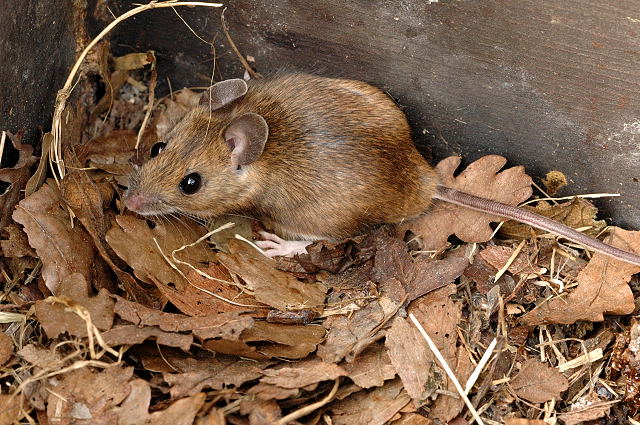
The Yellow-necked Mouse has brownish-grey upperparts, with a browner shade than those of the wood mouse. Its underparts are white, with a sharply defined boundary separating them from the upperparts.[1][2]
It has slightly larger ears than the wood mouse and an ochre-coloured fur patch between its forelegs, which is often inconspicuous. Juveniles have paler greyish-brown upperparts than adults.[3][4][5]
Adult head-and-body length ranges from 89 to 133 mm, and body weight ranges from 28 to 43 g. The tail is approximately as long as the head and body combined.[6][7][8]
Similar species
The Yellow-necked Mouse is closely related to the wood mouse and was historically confused with it.[9]
Habitat
The Yellow-necked Mouse is predominantly associated with woodland and often lives near forest edges. It commonly inhabits mature deciduous woodland, while in mountainous regions it occupies all parts of the forest.[10][11][12]
Its habitats also include scrubland, hedgerows, orchards and plantations. It favours habitats containing large nut-bearing trees such as oaks and hazels.[13][14]
The species also occurs in parks, gardens and areas beside alder-fringed streams.[15]
Behaviour
The Yellow-necked Mouse is nocturnal and active both on the ground and in the tree canopy. It remains active throughout the year and does not hibernate.[16][17]
It is an accomplished climber that moves through trees and bushes. Its home range is considerably smaller than half a hectare.[18][19]
The species uses crevices, tree-base burrows, tree-trunk holes, hollow logs and bird nesting boxes as shelters. Its burrows often have multiple entrances and complex internal layouts.[20][21]
The species lines its nesting chambers with dry plant material. It stores food such as acorns and beechmast in underground storage chambers and also creates food stores in tree holes away from its burrow.[22][23][24]
Unconsumed beech nuts cached by the species can germinate and contribute to the dispersal of beech trees. Individuals sometimes huddle together during winter to conserve heat.[25][26]
The species is preyed upon by owls, foxes, weasels and other predators. It can leap to escape predators and has tail skin that detaches readily when grasped.[27][28]
Diet
The Yellow-necked Mouse eats nuts, buds, shoots, fruits, seedling plants and occasionally small invertebrates.[29]
Reproduction and life cycle
Breeding can occur between February and October. Females can experience successive pregnancies at short intervals, with a gestation period of approximately 26 days.[30][31][32]
Females can mate again while still nursing their previous litter. Litters contain between two and eleven offspring, with five being the usual number.[33][34]
Newborn offspring are naked, blind and helpless. Young mice open their eyes at approximately two weeks of age and are weaned at approximately 18 days old.[35][36][37]
Early-born offspring may reproduce during their birth year, whereas late-born offspring mature sexually the following spring.[38]
Conservation
The Yellow-necked Mouse has a wide geographic range and is common in suitable habitats within that range. Recorded population densities in Eastern Europe reach 100 individuals per hectare.[39][40]
The species has a stable population and no identified specific threats. It is classified as Least Concern on the IUCN Red List.[41][42]
Uses
The Yellow-necked Mouse can transmit the virus responsible for tick-borne encephalitis while remaining immune to the virus itself. It is also a natural reservoir of Dobrava virus, which causes haemorrhagic fever with renal syndrome in humans.[43][44]
Classification of the Yellow-necked Mouse
| Kingdom | Animalia |
|---|---|
| Phylum | Chordata |
| Subphylum | Vertebrata |
| Infraphylum | Gnathostomata |
| Parvphylum | Osteichthyes |
| Megaclass | Tetrapoda |
| Class | Mammalia (Mammal) |
| Subclass | Theria |
| Infraclass | Eutheria |
| Order | Rodentia (Rodent) |
| Suborder | Myomorpha (Mice) |
| Superfamily | Muroidea |
| Family | Muridae (Mice) |
| Subfamily | Murinae (Old World Mice) |
| Genus | Apodemus (Field Mice) |
| Species | Apodemus flavicollis (Melchior, 1834) |
Where the Yellow-necked Mouse is found
Checklists and occurrence records place Apodemus flavicollis in 39 countries. GBIF holds 109,411 georeferenced records of it.
Countries
- Aland Islands 68
- Andorra 6
- Austria 1,887
- Belarus 56
- Belgium 1,130
- Bosnia and Herzegovina 74
- Bulgaria 2,024
- Croatia 223
- Czechia 132
- Denmark 30,509
- Estonia 1,110
- Finland 2,838
- France 6,141
- Germany 5,785
- Greece 215
- Hungary 657
- Israel 393
- Italy 445
- Kosovo 10
- Latvia 11
- Liechtenstein 243
- Lithuania 18
- Luxembourg 564
- Moldova 3
- Montenegro 19
- North Macedonia 160
- Norway 795
- Poland 25,356
- Romania 353
- Russia 2,880
- Serbia 151
- Slovakia 179
- Slovenia 90
- Spain 1,141
- Sweden 3,206
- Switzerland 10,396
- The Netherlands 1,802
- Ukraine 1,622
- United Kingdom 6,719
Regions and cities with the most records
- Capital Region, Denmark 23,382
- Lillerød, Denmark 22,883
- Hillerød, Denmark 22,832
- Karlebo, Denmark 22,781
- Allerød, Denmark 21,796
- Hørsholm, Denmark 19,342
- Birkerød, Denmark 17,448
- Farum, Denmark 12,240
- Frederikssund, Denmark 10,905
- Helsingør, Denmark 10,666
- England, United Kingdom 5,294
- Zealand, Denmark 2,416
- Vernier, Switzerland 2,373
- Meyrin, Switzerland 2,371
- Śrem, Poland 2,357
- Kościan, Poland 2,351
- Geneva, Switzerland 2,315
- Carouge, Switzerland 2,304
- Onex, Switzerland 2,264
- Auvergne-Rhône-Alpes, France 2,169
- Annemasse, France 1,968
- Vaud, Switzerland 1,881
- Nyon, Switzerland 1,868
- Bourgogne-Franche-Comté, France 1,813
- Samara Oblast, Russia 1,647
- South Denmark, Denmark 1,597
- Haskovo, Bulgaria 1,513
- Svilengrad, Bulgaria 1,498
- Geneva, Switzerland 1,279
- Central Jutland, Denmark 1,277
- Ticino, Switzerland 1,202
- Wales, United Kingdom 1,180
- Zhigulëvsk, Russia 1,129
- Swarzędz, Poland 1,107
- Środa Wielkopolska, Poland 1,099
- Roskilde, Denmark 1,035
7 more countries have a few records outside this range
These countries hold a few records of Apodemus flavicollis but lie outside the range the checklists give for it. Such records are often zoo or garden specimens, museum material or vagrants, so the species is not counted as occurring there.
Range as the checklists state it
Europe & Northern Asia (excluding China)
A number beside a place is its count of GBIF occurrence records. A place without a number comes from a checklist alone. Records show where a species has been observed or collected, which can include escapes and vagrants.
Common names
English
- Yellow-necked Mouse
- Yellow-necked Field Mouse
Names in 9 other languages
- Danish
- Halsbåndmus
- Dutch
- Geelhalsbosmuis, Grote bosmuis, Halsbandmuis
- Finnish
- metsähiiri
- French
- Mulot à collier
- German
- Gelbhalsmaus
- Norwegian Bokmål
- gulhalsmus, stor skogmus
- Spanish
- Ratón Leonado
- Swedish
- halsbandsmus, större skogsmus
- Welsh
- Llygod Bronfelyn, Llygoden Fronfelen
Synonyms
18 other scientific names have been used for this species and are now treated as synonyms of Apodemus flavicollis.
- Apodemus arianus (Blanford, 1881)
- Apodemus brauneri
- Apodemus cellarius
- Apodemus flavicollis brauneri Martino, 1927
- Apodemus flavicollis samariensis Ognev, 1923
- Apodemus flavicollis saturatus Neuhäuser, 1936
- Apodemus parvus
- Apodemus samariensis
- Apodemus wintoni
- Mus arianus Blanford, 1881
- Mus cellarius Fischer, 1866
- Mus flavicollis Melchior, 1834
- Mus sylvaticus fennicus Hilzheimer, 1911
- Mus sylvaticus princeps Barrett-Hamilton, 1900
- Mus sylvaticus typicus Barrett-Hamilton, 1900
- Mus sylvaticus wintoni Barrett-Hamilton, 1900
- Sylvaemus sylvaticus stankovici Martino & Martino, 1937
- Mus erythronotus Blanford, 1875 ambiguous synonym
Related species
-
 Wood MouseApodemus sylvaticus
-
 Striped Field MouseApodemus agrarius
-
 Large Japanese Field MouseApodemus speciosus
-
 Ural Field MouseApodemus uralensis
-
 Small Japanese Field MouseApodemus argenteus
-
 Korean Field MouseApodemus peninsulae
- Kashmir Field MouseApodemus rusiges
-
 Alpine Field MouseApodemus alpicola
Compare
Questions and answers
What is the scientific name of the Yellow-necked Mouse?
The scientific name of the Yellow-necked Mouse is Apodemus flavicollis. Written with its author, the full name is Apodemus flavicollis (Melchior, 1834).
Which family does the Yellow-necked Mouse belong to?
Apodemus flavicollis belongs to the family Muridae, in the order Rodentia and the class Mammalia.
Where is the Yellow-necked Mouse found?
Checklists and occurrence records place Apodemus flavicollis in 39 countries, including Denmark, Poland, Switzerland, United Kingdom, France and Germany.
What is the conservation status of the Yellow-necked Mouse?
The IUCN Red List category recorded for Apodemus flavicollis is Least Concern (LC).
What other names does the Yellow-necked Mouse have?
Apodemus flavicollis is also known in English as Yellow-necked Field Mouse.
Are yellow-necked mice rare?
No. The Yellow-necked Mouse has a wide geographic range and is common in suitable habitats within that range. Its population is stable and it is classified as Least Concern on the IUCN Red List.[39][41][42]
What is the scientific genus name for mice?
The Yellow-necked Mouse belongs to the genus Apodemus.[45]
What can yellow-necked mice do?
Yellow-necked Mice can climb through trees and bushes, leap to escape predators, and store food in underground chambers and tree holes. Unconsumed cached beech nuts can germinate and contribute to the dispersal of beech trees.[18][22][24][26][28]
What do yellow-necked mice eat?
Yellow-necked Mice eat nuts, buds, shoots, fruits, seedling plants and occasionally small invertebrates.[29]
What is the diet of mice?
The Yellow-necked Mouse eats nuts, buds, shoots, fruits, seedling plants and occasionally small invertebrates.[29]
Sources
Passages the profile rests on
- Its upperparts are brownish-grey, with a browner shade than those of the wood mouse. Source passage: “The upperparts are brownish-grey, a rather more brown shade than the wood mouse.” — English Wikipedia
- Its underparts are white, with a sharply defined boundary separating them from the upperparts. Source passage: “The underparts are white and there is a sharp demarcation line between the two colours.” — English Wikipedia
- The species has slightly larger ears than the wood mouse. Source passage: “slightly larger ears” — English Wikipedia
- The species has an ochre-coloured fur patch between its forelegs, which is often inconspicuous. Source passage: “ochre-coloured patch of fur between its forelegs but this is often inconspicuous.” — English Wikipedia
- Juveniles have paler greyish-brown upperparts than adults. Source passage: “The upperside of juveniles is a rather paler shade of greyish-brown than the adults.” — English Wikipedia
- Adult head-and-body length ranges from 89 to 133 mm. Source passage: “The adult head and body length is 3.5 to 5.25 inches (89–133 mm)” — English Wikipedia
- The tail is approximately as long as the head and body combined. Source passage: “with a tail about as long again” — English Wikipedia
- Adult body weight ranges from 28 to 43 g. Source passage: “the weight varies between 1 and 1.5 ounces (28–43 g).” — English Wikipedia
- The species is closely related to the wood mouse and was historically confused with it. Source passage: “is closely related to the wood mouse, with which it was long confused.” — English Wikipedia
- The species is predominantly associated with woodland and often lives near forest edges. Source passage: “It is mostly a woodland species, often living near the forest verge” — English Wikipedia
- In mountainous regions, the species occupies all parts of the forest. Source passage: “in mountainous regions, it occupies any part of the forest.” — English Wikipedia
- The species commonly inhabits mature deciduous woodland. Source passage: “It is usually found in mature deciduous woodland” — English Wikipedia
- Its habitats also include scrubland, hedgerows, orchards and plantations. Source passage: “also found in scrubby areas, hedgerows, orchards and plantations.” — English Wikipedia
- The species favours habitats containing large nut-bearing trees such as oaks and hazels. Source passage: “It favours areas where there are large, nut-bearing trees such as the oak and the hazel.” — English Wikipedia
- The species also occurs in parks, gardens and areas beside alder-fringed streams. Source passage: “It is also found in parks and gardens and beside alder-fringed streams.” — English Wikipedia
- The species remains active throughout the year and does not hibernate. Source passage: “The yellow-necked mouse is active all year round and does not hibernate.” — English Wikipedia
- The species is nocturnal and active both on the ground and in the tree canopy. Source passage: “The yellow-necked mouse is nocturnal. It is active on the ground and in the tree canopy” — English Wikipedia
- The species is an accomplished climber that moves through trees and bushes. Source passage: “It is an excellent climber and scrambles around in trees and bushes.” — English Wikipedia
- Its home range is considerably smaller than half a hectare. Source passage: “has a home range rather smaller than half a hectare.” — English Wikipedia
- The species uses crevices, tree-base burrows, tree-trunk holes, hollow logs and bird nesting boxes as shelters. Source passage: “It lives in crevices, burrows at the base of trees, holes in tree trunks, hollow logs and bird nesting boxes” — English Wikipedia
- Its burrows often have multiple entrances and complex internal layouts. Source passage: “The burrows are often extensive with many entrances and complex layouts.” — English Wikipedia
- The species stores food such as acorns and beechmast in underground storage chambers. Source passage: “It makes extensive stores of food, such as acorns and beechmast, in storage chambers” — English Wikipedia
- The species lines its nesting chambers with dry plant material. Source passage: “uses other chambers for nesting, bringing in dry plant material for this purpose.” — English Wikipedia
- The species also creates food stores in tree holes away from its burrow. Source passage: “It also makes larders of food in holes in trees away from the burrow.” — English Wikipedia
- Individuals sometimes huddle together during winter to conserve heat. Source passage: “Sometimes several mice will huddle together during the winter to preserve heat.” — English Wikipedia
- Unconsumed beech nuts cached by the species can germinate and contribute to the dispersal of beech trees. Source passage: “beech nuts hidden in caches by the yellow-necked mouse, and not subsequently eaten, can later germinate and help with dispersal of the parent tree.” — English Wikipedia
- The species is preyed upon by owls, foxes, weasels and other predators. Source passage: “The yellow-necked mouse is preyed on by owls, foxes, weasels and other predators.” — English Wikipedia
- The species can leap to escape predators and has tail skin that detaches readily when grasped. Source passage: “It can leap to evade attackers and the skin of its tail is readily detachable and slides off if grasped by a predator.” — English Wikipedia
- The species eats nuts, buds, shoots, fruits, seedling plants and occasionally small invertebrates. Source passage: “Besides nuts, it feeds on buds, shoots, fruit, seedling plants and sometimes small invertebrates.” — English Wikipedia
- Breeding can occur between February and October. Source passage: “Breeding takes place at any time between February and October” — English Wikipedia
- Females can experience successive pregnancies at short intervals. Source passage: “with successive pregnancies occurring at short intervals.” — English Wikipedia
- The gestation period is approximately 26 days. Source passage: “The gestation period is about twenty six days” — English Wikipedia
- Females can mate again while still nursing their previous litter. Source passage: “females can remate while still feeding the previous litter.” — English Wikipedia
- Litters contain between two and eleven offspring, with five being the usual number. Source passage: “consists of two to eleven (usually five) altricial young” — English Wikipedia
- Newborn offspring are naked, blind and helpless. Source passage: “altricial young born naked, blind, and helpless.” — English Wikipedia
- Young mice open their eyes at approximately two weeks of age. Source passage: “The eyes of the young open after about a fortnight” — English Wikipedia
- Young mice are weaned at approximately 18 days old. Source passage: “They are weaned at about eighteen days old.” — English Wikipedia
- Early-born offspring may reproduce during their birth year, whereas late-born offspring mature sexually the following spring. Source passage: “If they are born early in the year, they may start breeding in the same year, but late-born young become sexually mature in the following spring.” — English Wikipedia
- The species has a wide geographic range and is common in suitable habitats within that range. Source passage: “The yellow-necked mouse has a very wide range and is common in suitable habitat within that range.” — English Wikipedia
- Recorded population densities in Eastern Europe reach 100 individuals per hectare. Source passage: “In Eastern Europe, densities of up to a hundred individuals per hectare have been recorded.” — English Wikipedia
- The species has a stable population and no identified specific threats. Source passage: “The population is stable and this species faces no specific threats” — English Wikipedia
- The species is classified as Least Concern on the IUCN Red List. Source passage: “the IUCN has listed it as being of "Least Concern" in its Red List of Threatened Species.” — English Wikipedia
- The species can transmit the virus responsible for tick-borne encephalitis while remaining immune to the virus itself. Source passage: “can transmit the virus causing tick-borne encephalitis while being immune to the virus itself.” — English Wikipedia
- The species is a natural reservoir of Dobrava virus, which causes haemorrhagic fever with renal syndrome in humans. Source passage: “the natural reservoir for an Orthohantavirus, the Dobrava virus, which causes a severe form of haemorrhagic fever with renal syndrome in humans.” — English Wikipedia
- Apodemus ponticus is considered a synonym of Apodemus flavicollis. Source passage: “it is now accepted that they are in reality the same species.” — English Wikipedia
Data
- Catalogue of Life, 2026-10-16 XR cc by
- Global Biodiversity Information Facility CC BY 4.0
- Wikidata CC0
- GeoNames CC BY 4.0
- Wikimedia Commons per image; credit shown with each image
- Within the Catalogue of Life, this name comes from The Integrated Taxonomic Information System cc0
References
- Dansk. Staat. Norg. Pattedyr p.99 where the name was published
- Ellerman, J. R., and T. C. S. Morrison-Scott. (1966). Checklist of Palaearctic and Indian Mammals 1758 to 1946, 2nd Edition.
- Wilson, Don E., and DeeAnn M. Reeder, eds. (1993). Mammal Species of the World: A Taxonomic and Geographic Reference, 2nd Ed., 3rd Printing.
- Musser, Guy G., and Michael D. Carleton / Wilson, Don E., and DeeAnn M. Reeder, eds. (2005). Superfamily Muroidea. Mammal Species of the World: A Taxonomic and Geographic Reference, 3rd Ed., Vol. 2.
This species in other databases
Page built on 29 November 2026. See how the catalog is made and all sources and licences.
Cite this page
ScientificNames.org. (2026). Apodemus flavicollis (Yellow-necked Mouse). Retrieved November 29, 2026, from https://scientificnames.org/species/apodemus-flavicollis
“Apodemus flavicollis (Yellow-necked Mouse).” ScientificNames.org, 2026, scientificnames.org/species/apodemus-flavicollis. Accessed 29 Nov. 2026.
ScientificNames.org. “Apodemus flavicollis (Yellow-necked Mouse).” Accessed November 29, 2026. https://scientificnames.org/species/apodemus-flavicollis.
@misc{scientificnames_apodemus_flavicollis_yellow_necked_mouse,
  author = {{ScientificNames.org}},
  title = {Apodemus flavicollis (Yellow-necked Mouse)},
  year = {2026},
  url = {https://scientificnames.org/species/apodemus-flavicollis},
  note = {Accessed 2026-11-29}
}