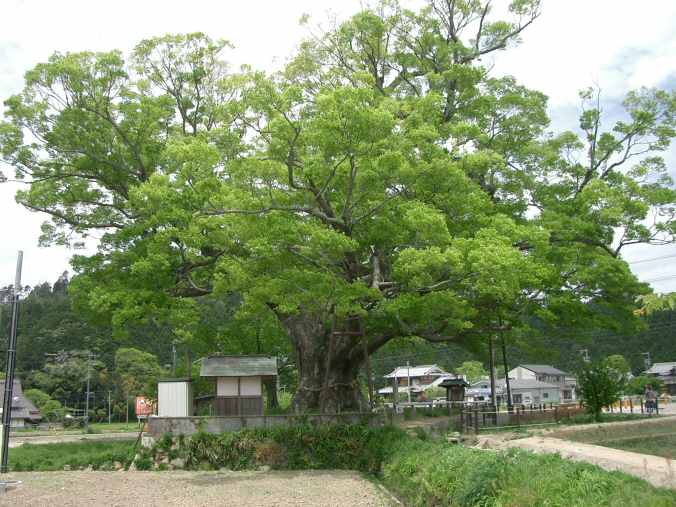
| Appearance | - Zelkova serrata is a deciduous tree with a short trunk that divides into numerous upright and spreading stems, forming a broad, rounded crown. English Wikipedia
- Its leaves are simple, ovate to oblong-ovate, and have serrated or crenate margins. English Wikipedia
- The leaves have between eight and fourteen pairs of veins. English Wikipedia
- The upper leaf surfaces are rough, while the undersides are hairless or nearly hairless. English Wikipedia
- The leaves are green to dark green during spring and summer, turning yellow, orange and red in autumn. English Wikipedia
- The bark ranges from grayish white to grayish brown and may be smooth with lenticels or exfoliate in patches to expose orange inner bark. English Wikipedia
- The tree has slender twigs with small, dark, conical buds arranged in a zigzag pattern. English Wikipedia
- The branches are usually hairless. English Wikipedia
- The branchlets are brownish-purple to brown. English Wikipedia
- The tree produces small, ovate, wingless drupes that mature from green to brown. English Wikipedia
- Its flowers are yellow-green, inconspicuous and arranged in tight groups along new stems. English Wikipedia
| |
|---|
| Size | - Its leaves can reach 5 centimetres in both length and width. English Wikipedia
- Its fruits measure approximately 2.5 to 3.5 millimetres in diameter. English Wikipedia
- The staminate flowers are approximately 3 millimetres in diameter. English Wikipedia
- The pistillate flowers are usually approximately 1.5 millimetres in diameter. English Wikipedia
| - Its documented shrub height is 2–3 metres. English Wikipedia
- Its leaves measure 10–50 millimetres in length. English Wikipedia
- Its leaves measure 5–35 millimetres in width. English Wikipedia
- The species' natural mature size remains unknown because existing specimens have been heavily browsed by goats. English Wikipedia
- The species is described as a shrub or tree reaching up to 8 metres tall. rhs.org.uk
|
|---|
| Habitat | - The tree grows in moist, well-drained soils under full or partial sunlight. English Wikipedia
| |
|---|
| Behaviour | - The tree grows rapidly when young, but its growth rate slows to a medium rate at middle age and maturity. English Wikipedia
- Zelkova serrata tolerates heat, limited water, nutrient-poor soils and a range of soil pH conditions. English Wikipedia
| |
|---|
| Reproduction | - Zelkova serrata is monoecious. English Wikipedia
- The tree produces flowers in spring at the same time as its leaves develop. English Wikipedia
- The staminate flowers occur in clusters in the axils of lower leaves, whereas the pistillate flowers occur singly or in small groups in the axils of upper leaves. English Wikipedia
- The fruits ripen from late summer through autumn. English Wikipedia
- The species can be propagated using seeds, rooted stem cuttings and grafting. English Wikipedia
- Its seeds can germinate without pretreatment, although stratification at 5 degrees Celsius for 60 days improves germination percentage. English Wikipedia
| No checked fact yet |
|---|
| Distribution | - Zelkova serrata is native to Japan, Korea, eastern China and Taiwan. English Wikipedia
| - The species is endemic to Sicily. English Wikipedia
- The species has one known population. English Wikipedia
- The species occurs in only two small populations in Sicily according to the Royal Horticultural Society. rhs.org.uk
|
|---|
| Conservation | - Colder temperatures can cause twig dieback in this species. English Wikipedia
- The species is highly resistant to Dutch elm disease. English Wikipedia
- Zelkova serrata shows good resistance to elm leaf beetle and Japanese beetle. English Wikipedia
- The tree is susceptible to the fungus Griphosphaerioma zelkovicola, which was first observed on its bark in Japan in 2003. English Wikipedia
| - The only known population comprises approximately 200–250 plants. English Wikipedia
- The known population is thought to derive from possibly one clone or, at most, a very small number of distinct individuals. English Wikipedia
- Habitat loss threatens the species. English Wikipedia
- The IUCN classifies the species as Critically Endangered. English Wikipedia
- The species is described as one of the most critically endangered tree species in the world. rhs.org.uk
|
|---|
| Uses | - Zelkova serrata is cultivated as an ornamental tree in its native range, Europe and North America. English Wikipedia
- The tree is planted in lawns and parks for its attractive bark, foliage colour and vase-shaped form. English Wikipedia
- The tree provides good shade. English Wikipedia
- Zelkova serrata is commonly cultivated as a bonsai tree. English Wikipedia
- Its wood is used in Japan to make furniture, including tansu chests. English Wikipedia
- Its wood is considered ideal for making taiko drums. English Wikipedia
| - The species has been introduced into cultivation in the United Kingdom. rhs.org.uk
|
|---|
| Similar species | - Zelkova serrata resembles elm trees but can be distinguished by its wingless fruits and symmetrical leaf bases. English Wikipedia
| No checked fact yet |
|---|
| Name origin | - The specific epithet serrata refers to the serrated margins of the leaves. English Wikipedia
| No checked fact yet |
|---|
| Other | - The variety Zelkova serrata var. tarokoensis differs from the typical variety by having smaller leaves with less deeply cut marginal serrations. English Wikipedia
| No checked fact yet |
|---|