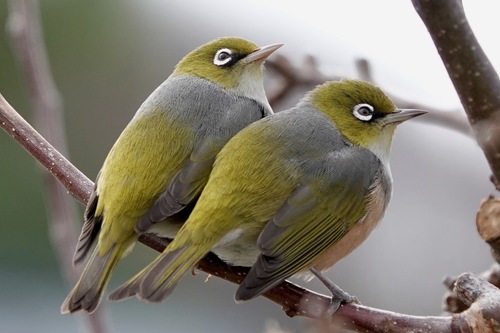
| Appearance | | - The Indian White-eye has yellowish olive upperparts, a white eye-ring, a yellow throat and vent, and a whitish-grey belly. English Wikipedia
- Male and female Indian White-eyes have similar appearances. English Wikipedia
|
|---|
| Size | | |
|---|
| Habitat | - The silvereye occurs in vegetated habitats other than open grasslands within its distribution range. English Wikipedia
- Its habitats include forests, scrub, horticultural blocks and urban gardens. English Wikipedia
| - The Indian White-eye inhabits open woodland on the Indian subcontinent. English Wikipedia
- The Indian White-eye occurs in habitats ranging from scrub to moist forest. English Wikipedia
- The Indian White-eye sometimes occurs in mangrove habitats, including the Karachi region of Pakistan. English Wikipedia
- The Indian White-eye is found in gardens and along forest edges. ebird.org
|
|---|
| Diet | - The silvereye feeds on small insects and spiders, as well as fruit and nectar. English Wikipedia
- Its diet includes berries in addition to insects, spiders, fruit and nectar. English Wikipedia
- In New Zealand, the silvereye consumes fruit from kahikatea and rimu trees. English Wikipedia
- Silvereyes consume insects that are harmful to garden and orchard produce, including aphids, scale insects and diamondback moths. English Wikipedia
| - The Indian White-eye feeds on nectar and small insects. English Wikipedia
- The Indian White-eye is mainly insectivorous but also consumes nectar and various fruits. English Wikipedia
|
|---|
| Behaviour | - Silvereyes gather into flocks in late summer. English Wikipedia
- Many Australian silvereyes migrate northwards along the coast and mountain ranges. English Wikipedia
- Migrating silvereyes forage during the day and undertake long-distance flights at night. English Wikipedia
- Most of the Tasmanian population crosses Bass Strait and disperses into Victoria, New South Wales and south-eastern Queensland. English Wikipedia
- Northernmost populations of silvereyes in Australia remain resident throughout the year. English Wikipedia
- In western Australia, silvereyes have been recorded moving between the mainland and offshore islands. English Wikipedia
| - The Indian White-eye forages in small groups. English Wikipedia
- The Indian White-eye forms sociable flocks that separate as the breeding season approaches. English Wikipedia
- The Indian White-eye spends most of its time in trees and rarely descends to the ground. English Wikipedia
- The Indian White-eye frequently calls while foraging, usually giving a soft nasal contact call. English Wikipedia
- The Indian White-eye has been observed bathing in dew collected on leaves. English Wikipedia
- The Indian White-eye sometimes steals nesting material from other birds' nests. English Wikipedia
- The Indian White-eye has been observed feeding the chicks of paradise flycatchers. English Wikipedia
- The Indian White-eye sometimes mob palm squirrels while nesting. English Wikipedia
- The Indian White-eye can be transported to new areas by winds and storms despite being a relatively weak flier. English Wikipedia
|
|---|
| Reproduction | - Silvereyes breed during spring and early summer, mainly between September and December. English Wikipedia
- Silvereyes construct small cup-shaped nests from grass, moss, hair, spiderweb and thistledown. English Wikipedia
- Silvereyes suspend their nests from branch forks in the outer portions of small trees or shrubs. English Wikipedia
- A silvereye clutch contains two to four pale blue eggs. English Wikipedia
- Silvereyes may raise two or three broods during one breeding season. English Wikipedia
- Silvereye eggs hatch after approximately 11 days of incubation. English Wikipedia
- Silvereye nestlings fledge approximately 10 days after hatching. English Wikipedia
- Juvenile silvereyes become independent at approximately three weeks of age. English Wikipedia
| - The Indian White-eye breeding season extends from February through September. English Wikipedia
- April is the peak breeding month for the Indian White-eye. English Wikipedia
- The Indian White-eye builds a compact cup-shaped nest suspended like a hammock on a branch fork. English Wikipedia
- The Indian White-eye constructs its nest using cobwebs, lichens, and plant fibres. English Wikipedia
- The Indian White-Eye completes nest construction in approximately four days. English Wikipedia
- The Indian White-Eye typically lays two pale blue eggs. English Wikipedia
- The two eggs of the Indian White-Eye are laid within a couple of days of each other. English Wikipedia
- Indian White-Eye eggs hatch approximately ten days after being laid. English Wikipedia
- Both sexes participate in brooding the Indian White-Eye chicks. English Wikipedia
- Indian White-Eye chicks fledge approximately ten days after hatching. English Wikipedia
|
|---|
| Distribution | - The silvereye is native to Australia, New Zealand and several south-west Pacific island groups. English Wikipedia
- The silvereye is common to abundant in the relatively fertile south-western and south-eastern regions of Australia. English Wikipedia
- Its Australian distribution includes Tasmania and the Bass Strait islands. English Wikipedia
- The silvereye occurs along the well-watered coastal region of tropical Queensland, including Cape York Peninsula. English Wikipedia
- The species was first recorded in New Zealand in 1832 and arrived in greater numbers in 1856. English Wikipedia
| No checked fact yet |
|---|
| Conservation | | - A feral population of the Indian White-Eye detected in San Diego, California, during the 1980s was subsequently eradicated. English Wikipedia
|
|---|
| Uses | - Silvereyes provide a beneficial service in gardens and orchards by consuming insects that damage produce. English Wikipedia
- Silvereyes can be regarded as agricultural and horticultural pests because they consume fruit crops and pass through bird netting. English Wikipedia
- Silvereyes are attracted to apples, citrus, feijoas, figs, grapes, pears and persimmons. English Wikipedia
| No checked fact yet |
|---|
| Name origin | No checked fact yet | - The scientific name palpebrosus refers to the bird's conspicuous white feather ring around its eyes. English Wikipedia
|
|---|
| Other | No checked fact yet | - The Indian White-Eye was described by Coenraad Jacob Temminck in 1824 using a specimen collected in Bengal. English Wikipedia
|
|---|