Species · Flowering plants
Aconitum flavum
Aconitum flavum has no English name on record in the checklists used here. It is a species of flowering plant in the family Ranunculaceae (crowfoot family), order Ranunculales.
- Scientific name
- Aconitum flavum Hand.-Mazz.
- Genus
- Aconitum
- Family
- Ranunculaceae (Crowfoot Family)
- Order
- Ranunculales
- Class
- Magnoliopsida
- Recorded in
- 1 country
- Name status
- accepted in the Catalogue of Life
Overview
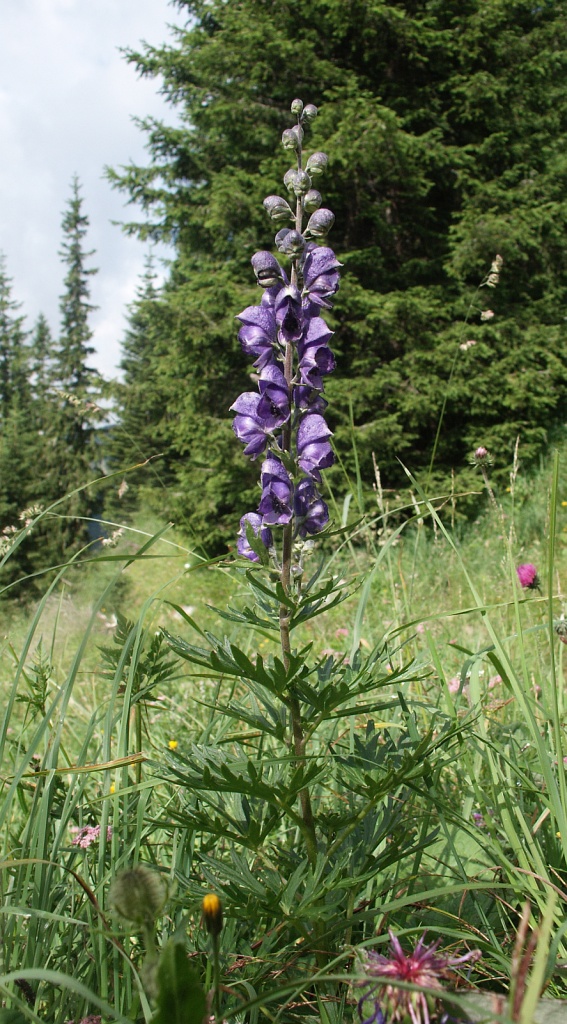
Aconitum flavum Hand.-Mazz. is a flowering plant belonging to the genus Aconitum and the family Ranunculaceae. It is native and endemic to northwestern Sichuan, northern Tibet, Qinghai, Gansu, southern Ningxia, and southern Inner Mongolia. Its roots are used medicinally for joint pain, rheumatism, bone pain, skin conditions, and other ailments.
Written 27 November 2026 from the sources listed below. Each statement was checked against the passage it cites; statements that could not be supported were removed.
Habitat
Aconitum flavum grows on grassy slopes and in sparse forests. It occurs at elevations between 2,000 and 3,700 meters.[1][2]
Its native distribution includes northwestern Sichuan, northern Tibet, Qinghai, Gansu, southern Ningxia, and southern Inner Mongolia.[3]
Uses
The roots are used medicinally for rheumatoid arthritis, joint pain, muscle soreness, numbness, rheumatism, and bone pain. They are also used to treat chronic pain following bone fractures and persistent pain caused by bruises.[4][5][6][7]
The roots are used medicinally for recurrent tinea and favus. They are traditionally used to address drunkenness and opium poisoning.[8][9]
Classification of Aconitum flavum
| Kingdom | Plantae |
|---|---|
| Subkingdom | Pteridobiotina |
| Phylum | Tracheophyta |
| Class | Magnoliopsida |
| Order | Ranunculales |
| Family | Ranunculaceae (Crowfoot Family) |
| Subfamily | Ranunculoideae |
| Tribe | Aconiteae |
| Genus | Aconitum (Monkshood) |
| Species | Aconitum flavum Hand.-Mazz. |
Where Aconitum flavum is found
Checklists and occurrence records place Aconitum flavum in 1 country across Asia. GBIF holds 329 georeferenced records of it.
Countries
Regions and cities with the most records
- Gansu, China 68
- Sichuan, China 58
- Qinghai, China 57
- Tibet, China 32
- Hezuo, China 12
- Dongchuan, China 8
- Haomen, China 8
- Labuleng, China 8
- Lanzhou, China 8
- Qingshizui, China 8
- Quankou, China 8
- Qilian, China 6
- Shaanxi, China 6
- Zhongzhai, China 6
- Yushu, China 3
- Ningxia, China
Range as the checklists state it
China (Gansu, Nei Mongol, S-Ningxia, Qinghai, NW-Sichuan); N-Tibet
A number beside a place is its count of GBIF occurrence records. A place without a number comes from a checklist alone. Records show where a species has been observed or collected, which can include escapes and vagrants.
Common names
Names in 1 other language
- Chinese
- 伏毛铁棒锤, 破叶莲, 铁棒锤, 铁棒锤茎叶, 雪上一支蒿, 雪上一枝蒿
Synonyms
3 other scientific names have been used for this species and are now treated as synonyms of Aconitum flavum.
- Aconitum anthora var. gilvum Maxim.
- Aconitum flavum var. flavum
- Aconitum gilvum (Maxim.) Hand.-Mazz.
Related species
-
 MonkshoodAconitum napellus
-
 Indian AconiteAconitum ferox
-
 Wolf's-BaneAconitum lycoctonum
- Yellow Monk's-hoodAconitum anthora
-
 Northern MonkshoodAconitum noveboracense
-
 Manchurian MonkshoodAconitum variegatum
-
 Columbia MonkshoodAconitum columbianum
-
 Aconitum firmum
Compare
Questions and answers
Sources
Passages the profile rests on
- The species grows on grassy slopes and in sparse forests. Source passage: “It grows at a grassy slope or sparse forest at an altitude of 2000–3700 meters.” — English Wikipedia
- The species occurs at elevations between 2,000 and 3,700 meters. Source passage: “It grows at a grassy slope or sparse forest at an altitude of 2000–3700 meters.” — English Wikipedia
- The species is native and endemic to northwestern Sichuan, northern Tibet, Qinghai, Gansu, southern Ningxia, and southern Inner Mongolia. Source passage: “native and endemic to northwestern Sichuan, northern Tibet, Qinghai, Gansu, southern Ningxia and southern Inner Mongolia.” — English Wikipedia
- The roots are used medicinally for rheumatoid arthritis, joint pain, muscle soreness, and numbness. Source passage: “Roots are used for rheumatoid arthritis, joint pain or partial muscle soreness and numbness” — English Wikipedia
- The roots are used to treat chronic pain following bone fractures. Source passage: “chronic pain after bone fracture” — English Wikipedia
- The roots are used to treat persistent pain caused by bruises. Source passage: “persistent pain of bruises.” — English Wikipedia
- The roots are used for rheumatism and bone pain. Source passage: “rheumatism, bone pain” — English Wikipedia
- The roots are used medicinally for recurrent tinea and favus. Source passage: “recurrent tinea, favus” — English Wikipedia
- The roots are traditionally used to address drunkenness and opium poisoning. Source passage: “Roots can eliminate drunkenness, opium poisoning” — English Wikipedia
Data
- Catalogue of Life, 2026-10-16 XR cc by
- Global Biodiversity Information Facility CC BY 4.0
- Wikidata CC0
- GeoNames CC BY 4.0
- Within the Catalogue of Life, this name comes from Synonymic Checklists of the Vascular Plants of the World cc by
References
- Hand.-Mazz. (1939). Acta Horti Gothob. 13: 86 (1939). where the name was published
This species in other databases
Page built on 29 November 2026. See how the catalog is made and all sources and licences.
Cite this page
ScientificNames.org. (2026). Aconitum flavum. Retrieved November 29, 2026, from https://scientificnames.org/species/aconitum-flavum
“Aconitum flavum.” ScientificNames.org, 2026, scientificnames.org/species/aconitum-flavum. Accessed 29 Nov. 2026.
ScientificNames.org. “Aconitum flavum.” Accessed November 29, 2026. https://scientificnames.org/species/aconitum-flavum.
@misc{scientificnames_aconitum_flavum,
  author = {{ScientificNames.org}},
  title = {Aconitum flavum},
  year = {2026},
  url = {https://scientificnames.org/species/aconitum-flavum},
  note = {Accessed 2026-11-29}
}