Species · Flowering plants
Garden Monkshood Aconitum plicatum
The scientific name of the Garden Monkshood is Aconitum plicatum. It is a species of flowering plant in the family Ranunculaceae (crowfoot family), order Ranunculales.
- Scientific name
- Aconitum plicatum Rchb.
- Common name
- Garden Monkshood
- Genus
- Aconitum
- Family
- Ranunculaceae (Crowfoot Family)
- Order
- Ranunculales
- Class
- Magnoliopsida
- Recorded in
- 5 countries
- Name status
- accepted in the Catalogue of Life

Overview
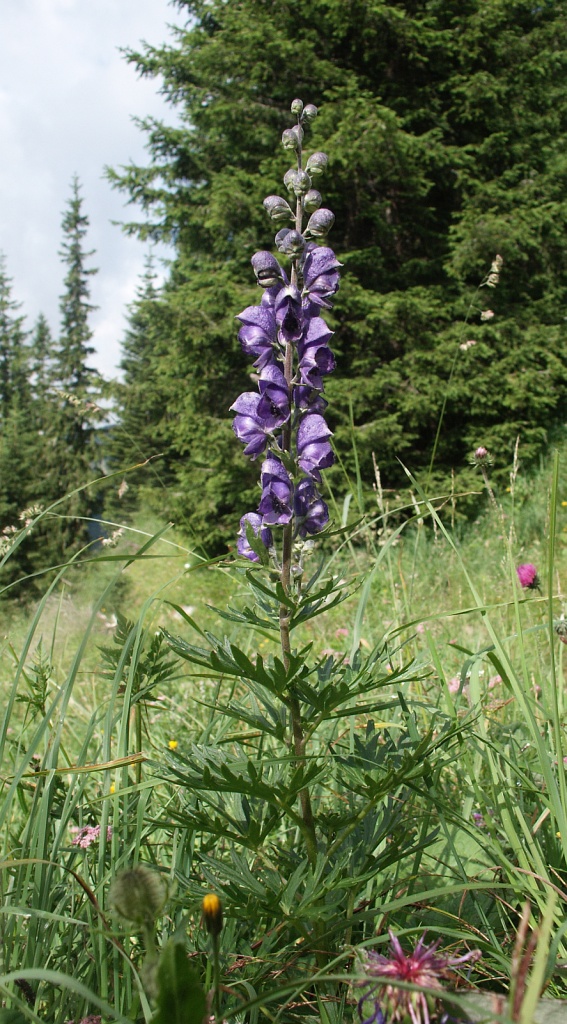
Garden monkshood (Aconitum plicatum Rchb.) is a perennial flowering plant in the family Ranunculaceae, order Ranunculales and class Magnoliopsida. It is native to Germany, the Czech Republic, and Poland. It has blue or purple flowers with perigon segments densely covered in crooked hairs on both surfaces.
Written 26 November 2026 from the sources listed below. Each statement was checked against the passage it cites; statements that could not be supported were removed.
Appearance
Garden monkshood has an erect to climbing, slender stem and divided leaves. It reaches a height of 0.3–1.5 metres.[1][2][3]
Its inflorescence is paniculate and may be simple or branched. The flowers have blue or purple perigon segments, and the perigon is densely covered with crooked hairs on both its inner and outer surfaces.[4][5][6]
The peduncle may be hairy or bare. The bracteoles range from linear to triangular and are hairless.[7][8]
Habitat
Garden monkshood occurs in tall herbaceous vegetation and ravine forests.[9][10]
Reproduction and life cycle
Garden monkshood is pollinated by insects, including bumblebees. It produces pod-like follicles as fruits.[11][12]
Uses
Garden monkshood is cultivated as an ornamental plant.[13]
Behaviour
Garden monkshood is perennial and grows from rhizomes. Its flowering period extends primarily from July through September.[14][15]
The plant is poisonous because it contains alkaloids such as aconitine.[16]
Two subspecies are currently accepted: Aconitum plicatum subsp. plicatum and Aconitum plicatum subsp. sudeticum Mitka.[17][18][19]
Classification of the Garden Monkshood
| Kingdom | Plantae |
|---|---|
| Subkingdom | Pteridobiotina |
| Phylum | Tracheophyta |
| Class | Magnoliopsida |
| Order | Ranunculales |
| Family | Ranunculaceae (Crowfoot Family) |
| Subfamily | Ranunculoideae |
| Tribe | Aconiteae |
| Genus | Aconitum (Monkshood) |
| Species | Aconitum plicatum Rchb. |
Where the Garden Monkshood is found
Checklists and occurrence records place Aconitum plicatum in 5 countries across Europe. GBIF holds 1,315 georeferenced records of it.
Countries
Regions and cities with the most records
- Bavaria, Germany 332
- Hradec Králové Region, Czechia 162
- Jelenia Góra, Poland 149
- Šumperk, Czechia 79
- Plzeň Region, Czechia 72
- Náchod, Czechia 42
- Olomouc Region, Czechia 22
- Żywiec, Poland 17
- Pardubice Region, Czechia 13
- Kamienna Góra, Poland 11
- Žilina Region, Slovakia 11
- Salzburg, Austria 9
- Trutnov, Czechia 8
- Boguszów-Gorce, Poland 5
- Wałbrzych, Poland 5
- Liberec Region, Czechia 4
- Nowa Ruda, Poland 4
- Ostrov, Czechia 4
- Annaberg-Buchholz, Germany 3
- Jablonec nad Nisou, Czechia 3
- Kopřivnice, Czechia 3
- Nový Jičín, Czechia 3
- Rožnov pod Radhoštěm, Czechia 3
- Tyrol, Austria 3
- Valašské Meziříčí, Czechia 3
- Zlín, Czechia 3
A number beside a place is its count of GBIF occurrence records. A place without a number comes from a checklist alone. Records show where a species has been observed or collected, which can include escapes and vagrants.
Common names
English
- Garden Monkshood
Names in 6 other languages
- Chinese
- 中歐烏頭
- Czech
- oměj šalamounek
- German
- Klaffender Eisenhut, Sudeten-Eisenhut
- Polish
- Tojad sudecki
- Russian
- Аконит складчатый
- Slovak
- prilbica otvorená
Synonyms
2 other scientific names have been used for this species and are now treated as synonyms of Aconitum plicatum.
- Aconitum firmum f. calliobotryon (Rchb.) Gáyer
- Aconitum napellus var. laxum Regel
Subspecies and varieties
- Aconitum plicatum subsp. plicatum subspecies
- Aconitum plicatum subsp. sudeticum subspecies
Related species
-
 MonkshoodAconitum napellus
-
 Indian AconiteAconitum ferox
-
 Wolf's-BaneAconitum lycoctonum
- Yellow Monk's-hoodAconitum anthora
-
 Northern MonkshoodAconitum noveboracense
-
 Manchurian MonkshoodAconitum variegatum
-
 Columbia MonkshoodAconitum columbianum
-
 Aconitum firmum
Compare
Questions and answers
What is the scientific name of the Garden Monkshood?
The scientific name of the Garden Monkshood is Aconitum plicatum. Written with its author, the full name is Aconitum plicatum Rchb..
Which family does the Garden Monkshood belong to?
Aconitum plicatum belongs to the family Ranunculaceae, in the order Ranunculales and the class Magnoliopsida.
Where is the Garden Monkshood found?
Checklists and occurrence records place Aconitum plicatum in 5 countries: Czechia, Germany, Poland, Austria and Slovakia.
Should I plant monkshood in my garden?
Garden monkshood is cultivated as an ornamental plant. It is poisonous because it contains alkaloids such as aconitine.[13][16]
Where does monkshood grow naturally?
Garden monkshood is native to Germany, the Czech Republic, and Poland. It occurs in tall herbaceous vegetation and ravine forests.[20][9][10]
Is Aconitum poisonous to humans?
Garden monkshood is poisonous because it contains alkaloids such as aconitine.[16]
Sources
Passages the profile rests on
- Aconitum plicatum has an erect to climbing, slender stem. Source passage: “Aconitum plicatum is a tall spindly erect to scandent forb which is perennial from rhizomes.” — English Wikipedia
- The leaves of Aconitum plicatum are divided. Source passage: “It has divided leaves.” — English Wikipedia
- Aconitum plicatum reaches a height of 0.3–1.5 metres. Source passage: “The plant reaches a stature height between 0.3 and 1.5 m.” — English Wikipedia
- The inflorescence of Aconitum plicatum is paniculate and may be simple or branched. Source passage: “The inflorescence is paniculate and simple or branched with a few or many side risps.” — English Wikipedia
- The flowers of Aconitum plicatum have blue or purple perigon segments. Source passage: “The perigon is blue or purple.” — English Wikipedia
- The perigon of Aconitum plicatum is densely covered with crooked hairs on both its inner and outer surfaces. Source passage: “The perigon is densely hairy on the outside and inside by crooked trichomes.” — English Wikipedia
- The peduncle of Aconitum plicatum may be either hairy or bare. Source passage: “The peduncle is hairy or bare.” — English Wikipedia
- The bracteoles of Aconitum plicatum range from linear to triangular and are hairless. Source passage: “The bracteoles are linear to triangular and bare.” — English Wikipedia
- Aconitum plicatum occurs in tall herbaceous vegetation. Source passage: “Inhabited biotops include tall herbaceous vegetation and ravine forests.” — English Wikipedia
- Aconitum plicatum occurs in ravine forests. Source passage: “Inhabited biotops include tall herbaceous vegetation and ravine forests.” — English Wikipedia
- Aconitum plicatum is pollinated by insects, including bumblebees. Source passage: “The pollination is done by insects (Bombus spec. and others).” — English Wikipedia
- Aconitum plicatum produces pod-like follicles as fruits. Source passage: “The fruits are pod-like follicles.” — English Wikipedia
- Aconitum plicatum is cultivated as an ornamental plant. Source passage: “Aconitum plicatum is also cultivated as ornamental plant.” — English Wikipedia
- Aconitum plicatum is perennial and grows from rhizomes. Source passage: “Aconitum plicatum is a tall spindly erect to scandent forb which is perennial from rhizomes.” — English Wikipedia
- The flowering period of Aconitum plicatum extends primarily from July through September. Source passage: “The flowering period extends primarily from July to September.” — English Wikipedia
- Aconitum plicatum is poisonous because it contains alkaloids such as aconitine. Source passage: “Aconitum plicatum is poisonous due to the presence of alkaloids like aconitine.” — English Wikipedia
- Two subspecies of Aconitum plicatum are currently accepted. Source passage: “Currently 2 subspecies are accepted:” — English Wikipedia
- The accepted subspecies include Aconitum plicatum subsp. plicatum. Source passage: “Aconitum plicatum subsp. plicatum, autonym” — English Wikipedia
- The accepted subspecies include Aconitum plicatum subsp. sudeticum Mitka. Source passage: “Aconitum plicatum subsp. sudeticum Mitka” — English Wikipedia
- Aconitum plicatum is native to Germany, the Czech Republic, and Poland. Source passage: “This wildflower is native to Europe (Germany, Czech Republic and Poland).” — English Wikipedia
Data
- Catalogue of Life, 2026-10-16 XR cc by
- Global Biodiversity Information Facility CC BY 4.0
- Wikidata CC0
- GeoNames CC BY 4.0
- Wikimedia Commons per image; credit shown with each image
- Within the Catalogue of Life, this name comes from Synonymic Checklists of the Vascular Plants of the World cc by
References
- Rchb. where the name was published
This species in other databases
Page built on 29 November 2026. See how the catalog is made and all sources and licences.
Cite this page
ScientificNames.org. (2026). Aconitum plicatum (Garden Monkshood). Retrieved November 29, 2026, from https://scientificnames.org/species/aconitum-plicatum
“Aconitum plicatum (Garden Monkshood).” ScientificNames.org, 2026, scientificnames.org/species/aconitum-plicatum. Accessed 29 Nov. 2026.
ScientificNames.org. “Aconitum plicatum (Garden Monkshood).” Accessed November 29, 2026. https://scientificnames.org/species/aconitum-plicatum.
@misc{scientificnames_aconitum_plicatum_garden_monkshood,
  author = {{ScientificNames.org}},
  title = {Aconitum plicatum (Garden Monkshood)},
  year = {2026},
  url = {https://scientificnames.org/species/aconitum-plicatum},
  note = {Accessed 2026-11-29}
}