Species · Flowering plants
Aconitum tauricum
Aconitum tauricum has no English name on record in the checklists used here. It is a species of flowering plant in the family Ranunculaceae (crowfoot family), order Ranunculales.
- Scientific name
- Aconitum tauricum Wulfen
- Genus
- Aconitum
- Family
- Ranunculaceae (Crowfoot Family)
- Order
- Ranunculales
- Class
- Magnoliopsida
- Recorded in
- 9 countries
- Name status
- accepted in the Catalogue of Life

Overview
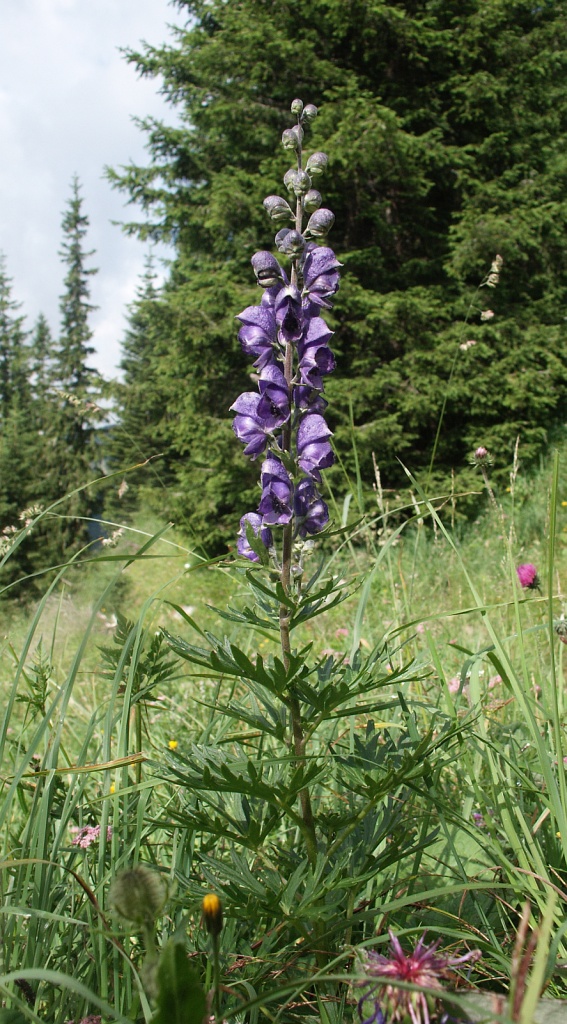
Aconitum tauricum Wulfen is a perennial flowering plant in the family Ranunculaceae. It grows in alpine and subalpine areas, including meadows and areas of tall herbaceous vegetation. It has blue or purple flowers, reaches approximately 0.8 metres in height and is poisonous because it contains alkaloids such as aconitine.
Written 27 November 2026 from the sources listed below. Each statement was checked against the passage it cites; statements that could not be supported were removed.
Similar species
Some sources classify Aconitum tauricum as a subspecies of Aconitum napellus named Aconitum napellus subsp. tauricum.[1]
Appearance
Aconitum tauricum is a tall, slender, erect or climbing herbaceous plant. It is perennial and grows from rhizomes that are not spherical.[2][3][4]
Its leaves are divided, with faintly visible net-like veins on the underside of the stem leaves. The inflorescence is paniculate and may be simple or branched with a few side clusters.[5][6]
The flowers have blue or purple perigon structures, and the floral helmet is usually wider than it is high. The outer surfaces of the tepals are hairless.[7][8][9]
The flower stems bear upright glandular hairs, although they may be hairless or have glandular hairs protruding only beneath the flower. The linear bracteoles and nectar leaves may be either hairless or hairy.[10][11][12][13]
The bracteoles are usually 3–7 mm long, with an occasional measurement of 2 mm. The plant reaches approximately 0.8 metres in height.[14][15]
The ripe seeds are black.[16]
Habitat
Aconitum tauricum grows in alpine and subalpine areas. It inhabits meadows and areas of tall herbaceous vegetation.[17][18]
It is native to Austria, Germany, Romania, Ukraine, and Yugoslavia.[19]
Reproduction and life cycle
The flowering period primarily extends from August to October. Insects, including species of Bombus, pollinate the flowers.[20][21]
The plant produces pod-like follicular fruits. Its ripe seeds are black.[22][16]
Classification of Aconitum tauricum
| Kingdom | Plantae |
|---|---|
| Subkingdom | Pteridobiotina |
| Phylum | Tracheophyta |
| Class | Magnoliopsida |
| Order | Ranunculales |
| Family | Ranunculaceae (Crowfoot Family) |
| Subfamily | Ranunculoideae |
| Tribe | Aconiteae |
| Genus | Aconitum (Monkshood) |
| Species | Aconitum tauricum Wulfen |
Where Aconitum tauricum is found
Checklists and occurrence records place Aconitum tauricum in 9 countries across Europe. GBIF holds 5,022 georeferenced records of it.
Countries
- Austria 4,075
- Croatia 3
- Germany 390
- Italy 418
- Poland 6
- Romania 30
- Slovenia 64
- Switzerland 17
- Ukraine 19
Regions and cities with the most records
- Salzburg, Austria 1,961
- Carinthia, Austria 648
- Tyrol, Austria 630
- Trentino-Alto Adige, Italy 275
- Upper Austria, Austria 267
- Bavaria, Germany 236
- Styria, Austria 233
- Veneto, Italy 90
- Bad Reichenhall, Germany 65
- Bressanone, Italy 45
- Ljubljana, Slovenia 27
- Riva del Garda, Italy 24
- Kranj, Slovenia 17
- Como, Italy 15
- Lombardy, Italy 15
- Rovereto, Italy 15
- Malnate, Italy 13
- Ticino, Switzerland 12
- Bolzano, Italy 8
- Zakarpattia, Ukraine 7
- Friuli Venezia Giulia, Italy 6
- Alzenau in Unterfranken, Germany 4
- Arges, Romania 4
- Bruchköbel, Germany 4
- Büdingen, Germany 4
- Gelnhausen, Germany 4
- Hesse, Germany 4
- Bistrița-Năsăud County, Romania 3
- Hunedoara County, Romania 3
- Lecco, Italy 3
- Merano, Italy 3
A number beside a place is its count of GBIF occurrence records. A place without a number comes from a checklist alone. Records show where a species has been observed or collected, which can include escapes and vagrants.
Common names
Names in 8 other languages
- Chinese
- 東南歐烏頭
- Czech
- oměj taurský
- German
- Tauern-Eisenhut
- Italian
- Aconito taurico
- Polish
- tojad tauryjski
- Russian
- Борец тауэрнский
- Slovak
- prilbica taurská
- Slovenian
- turska preobjeda
Subspecies and varieties
- Aconitum tauricum subsp. hayekianum subspecies
- Aconitum tauricum subsp. latemarense subspecies
- Aconitum tauricum subsp. latemarense x subsp. tauricum subspecies
- Aconitum tauricum subsp. tauricum subspecies
- Aconitum tauricum var. eustachyum variety
Related species
-
 MonkshoodAconitum napellus
-
 Indian AconiteAconitum ferox
-
 Wolf's-BaneAconitum lycoctonum
- Yellow Monk's-hoodAconitum anthora
-
 Northern MonkshoodAconitum noveboracense
-
 Manchurian MonkshoodAconitum variegatum
-
 Columbia MonkshoodAconitum columbianum
-
 Aconitum firmum
Compare
Questions and answers
Sources
Passages the profile rests on
- Some sources classify Aconitum tauricum as a subspecies of Aconitum napellus named Aconitum napellus subsp. tauricum. Source passage: “Some sources declare it as a subspecies of Aconitum napellus under the name Aconitum napellus subsp. tauricum.” — English Wikipedia
- Aconitum tauricum is a tall, slender, erect or climbing herbaceous plant. Source passage: “Aconitum tauricum is a tall spindly erect to scandent forb” — English Wikipedia
- Aconitum tauricum is a perennial plant that grows from rhizomes. Source passage: “which is perennial from rhizomes.” — English Wikipedia
- The rhizomes of Aconitum tauricum are not spherical. Source passage: “Rhizomes are not globose.” — English Wikipedia
- Aconitum tauricum has divided leaves with faintly visible net-like veins on the underside of its stem leaves. Source passage: “It has divided leaves with faintly visible net-like leaf veins on the underside (stem leafes).” — English Wikipedia
- The inflorescence of Aconitum tauricum is paniculate and may be simple or branched with a few side clusters. Source passage: “The inflorescence is paniculate and simple or branched with a few side risps.” — English Wikipedia
- The flowers of Aconitum tauricum have blue or purple perigon structures. Source passage: “The perigon is blue or purple.” — English Wikipedia
- The floral helmet of Aconitum tauricum is usually wider than it is high. Source passage: “The helmet is usually wider than high.” — English Wikipedia
- The outer surfaces of the tepals of Aconitum tauricum are hairless. Source passage: “The tepals are bare on the outside.” — English Wikipedia
- The flower stems of Aconitum tauricum bear upright glandular hairs. Source passage: “The flower stems have upright gland hairs” — English Wikipedia
- The flower stems of Aconitum tauricum may be hairless or have glandular hairs protruding only beneath the flower. Source passage: “are bare or possess only underneath the flower protruding glandular hairs.” — English Wikipedia
- The linear bracteoles of Aconitum tauricum may be hairless or hairy. Source passage: “The linear bracteoles are bald or hairy” — English Wikipedia
- The nectar leaves of Aconitum tauricum may be hairless or hairy. Source passage: “The nectar leaves may be bald or hairy.” — English Wikipedia
- The bracteoles of Aconitum tauricum are usually 3–7 mm long, with an occasional measurement of 2 mm. Source passage: “measure 3 to 7, rarely 2 mm.” — English Wikipedia
- Aconitum tauricum reaches a height of approximately 0.8 metres. Source passage: “The plant reaches a stature height of about 0,8 m.” — English Wikipedia
- The ripe seeds of Aconitum tauricum are black. Source passage: “ripe seeds are black.” — English Wikipedia
- Aconitum tauricum grows in alpine and subalpine areas. Source passage: “where it grows in alpine and subalpine areas.” — English Wikipedia
- Aconitum tauricum inhabits meadows and areas of tall herbaceous vegetation. Source passage: “Inhabited biotops include meadows and tall herbaceous vegetation.” — English Wikipedia
- Aconitum tauricum is native to Austria, Germany, Romania, Ukraine, and Yugoslavia. Source passage: “This wildflower is native to Europe (Austria, Germany, Romania, Ukraine, Yugoslavia).” — English Wikipedia
- The flowering period of Aconitum tauricum primarily extends from August to October. Source passage: “The flowering period extends primarily from August to October.” — English Wikipedia
- Insects, including species of Bombus, pollinate Aconitum tauricum. Source passage: “The pollination is done by insects (Bombus spec. and others).” — English Wikipedia
- Aconitum tauricum produces pod-like follicular fruits. Source passage: “The fruits are pod-like follicles” — English Wikipedia
Data
- Catalogue of Life, 2026-10-16 XR cc by
- Global Biodiversity Information Facility CC BY 4.0
- Wikidata CC0
- GeoNames CC BY 4.0
- Wikimedia Commons per image; credit shown with each image
- Within the Catalogue of Life, this name comes from Synonymic Checklists of the Vascular Plants of the World cc by
References
- Wulfen. where the name was published
This species in other databases
- Catalogue of Life 9GRK
- Wikidata Q3604594
- iNaturalist 515769
- World Flora Online wfo-0000518173
- GRIN 513000
Page built on 28 November 2026. See how the catalog is made and all sources and licences.
Cite this page
ScientificNames.org. (2026). Aconitum tauricum. Retrieved November 28, 2026, from https://scientificnames.org/species/aconitum-tauricum
“Aconitum tauricum.” ScientificNames.org, 2026, scientificnames.org/species/aconitum-tauricum. Accessed 28 Nov. 2026.
ScientificNames.org. “Aconitum tauricum.” Accessed November 28, 2026. https://scientificnames.org/species/aconitum-tauricum.
@misc{scientificnames_aconitum_tauricum,
  author = {{ScientificNames.org}},
  title = {Aconitum tauricum},
  year = {2026},
  url = {https://scientificnames.org/species/aconitum-tauricum},
  note = {Accessed 2026-11-28}
}