Species · Flowering plants
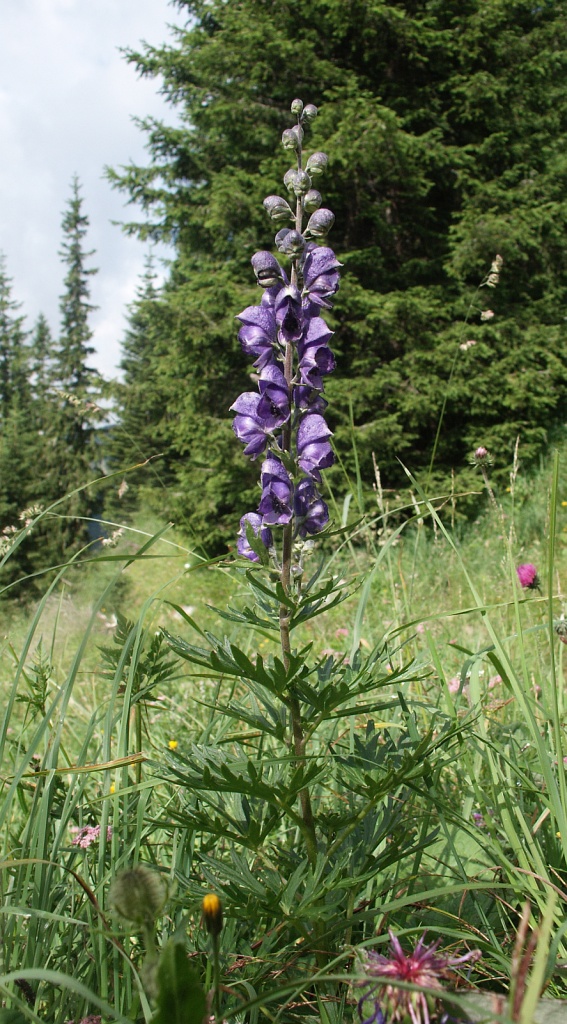
Violet Monkshood Aconitum violaceum
The scientific name of the Violet Monkshood is Aconitum violaceum. It is a species of flowering plant in the family Ranunculaceae (crowfoot family), order Ranunculales.
- Scientific name
- Aconitum violaceum Jacquem. ex Stapf
- Common name
- Violet Monkshood
- Genus
- Aconitum
- Family
- Ranunculaceae (Crowfoot Family)
- Order
- Ranunculales
- Class
- Magnoliopsida
- Red List category
- VU Vulnerable
- Recorded in
- 4 countries
- Name status
- accepted in the Catalogue of Life
Overview
Aconitum violaceum occurs on alpine slopes in the Himalayan region and is distributed across the Himalayan regions of India, Pakistan, and Nepal. The plant has a bitter taste and a cooling tendency.
Written 27 November 2026 from the sources listed below. Each statement was checked against the passage it cites; statements that could not be supported were removed.
Appearance
The plant has a bitter taste and a cooling tendency.[1]
Habitat
Violet Monkshood mainly occurs on alpine slopes in the Himalayan region. Its distribution includes the Himalayan regions of India, Pakistan, and Nepal.[2][3][4]
In India, the species has been recorded at elevations between 3,600 and 4,800 metres. It has also been reported at elevations of 3,500–4,000 metres.[5][6]
Uses
The plant is used in traditional Tibetan medicine.[7]
Classification of the Violet Monkshood
| Kingdom | Plantae |
|---|---|
| Subkingdom | Pteridobiotina |
| Phylum | Tracheophyta |
| Class | Magnoliopsida |
| Order | Ranunculales |
| Family | Ranunculaceae (Crowfoot Family) |
| Subfamily | Ranunculoideae |
| Tribe | Aconiteae |
| Genus | Aconitum (Monkshood) |
| Species | Aconitum violaceum Jacquem. ex Stapf |
Where the Violet Monkshood is found
Checklists and occurrence records place Aconitum violaceum in 4 countries across Asia. GBIF holds 212 georeferenced records of it.
Countries
Regions and cities with the most records
1 more country has a few records outside this range
These countries hold a few records of Aconitum violaceum but lie outside the range the checklists give for it. Such records are often zoo or garden specimens, museum material or vagrants, so the species is not counted as occurring there.
Range as the checklists state it
Pakistan (Chitral, Deosai, Astor, Dras, Karakorum, Baltistan); Nepal; NW-India (Himachal Pradesh, Jammu & Kashmir, Uttarakhand, ?Uttar Pradesh)
A number beside a place is its count of GBIF occurrence records. A place without a number comes from a checklist alone. Records show where a species has been observed or collected, which can include escapes and vagrants.
Common names
English
- Violet Monkshood
Names in 1 other language
- Chinese
- 堇烏頭
Synonyms
7 other scientific names have been used for this species and are now treated as synonyms of Aconitum violaceum.
- Aconitum napellus var. dissectum Duthie
- Aconitum napellus var. multifidum (Royle) Hook.fil. & Thomson
- Aconitum violaceum var. multifidum (Royle) Qureshi & Chaudhri
- Aconitum violaceum var. violaceum
- Aconitum violaceum var. weileri (Gilli) Riedl
- Aconitum weileri Gilli
- Aconitum multifidum Royle ambiguous synonym
Subspecies and varieties
- Aconitum violaceum var. robustum variety
Related species
-
 MonkshoodAconitum napellus
-
 Indian AconiteAconitum ferox
-
 Wolf's-BaneAconitum lycoctonum
- Yellow Monk's-hoodAconitum anthora
-
 Northern MonkshoodAconitum noveboracense
-
 Manchurian MonkshoodAconitum variegatum
-
 Columbia MonkshoodAconitum columbianum
-
 Aconitum firmum
Compare
Questions and answers
What is the scientific name of the Violet Monkshood?
The scientific name of the Violet Monkshood is Aconitum violaceum. Written with its author, the full name is Aconitum violaceum Jacquem. ex Stapf.
Which family does the Violet Monkshood belong to?
Aconitum violaceum belongs to the family Ranunculaceae, in the order Ranunculales and the class Magnoliopsida.
Where is the Violet Monkshood found?
Checklists and occurrence records place Aconitum violaceum in 4 countries: India, Pakistan, Nepal and China.
What is the conservation status of the Violet Monkshood?
The IUCN Red List category recorded for Aconitum violaceum is Vulnerable (VU).
Sources
Passages the profile rests on
- The plant has a bitter taste and a cooling tendency. Source passage: “It has a bitter taste and a cooling tendency.” — English Wikipedia
- The species occurs on alpine slopes in the Himalayan region. Source passage: “recorded in the alpine slopes” — English Wikipedia
- The species is distributed across the Himalayan regions of India, Pakistan, and Nepal. Source passage: “distributed in the Himalayan region of India, Pakistan, and Nepal.” — English Wikipedia
- The species mainly occurs on alpine slopes in the Himalayan region. Source passage: “is mainly distributed over the alpine slopes of the Himalayan region” — pmc.ncbi.nlm.nih.gov
- In India, the species has been recorded at elevations between 3,600 and 4,800 metres. Source passage: “in an altitude range of 3,600–4,800 m (12,000–16,000 ft).” — English Wikipedia
- In India, the species has been reported at elevations of 3,500–4,000 metres. Source passage: “at an altitude of 3500-4000m in India” — pmc.ncbi.nlm.nih.gov
- The plant is used in traditional Tibetan medicine. Source passage: “The plant is used in traditional Tibetan medicine.” — English Wikipedia
Data
- Catalogue of Life, 2026-10-16 XR cc by
- Global Biodiversity Information Facility CC BY 4.0
- Wikidata CC0
- GeoNames CC BY 4.0
- Within the Catalogue of Life, this name comes from Synonymic Checklists of the Vascular Plants of the World cc by
References
- Jacquem. ex Stapf. (1905). Ann. Roy. Bot. Gard. (Calcutta) 10: 144 (1905). where the name was published
This species in other databases
Page built on 28 November 2026. See how the catalog is made and all sources and licences.
Cite this page
ScientificNames.org. (2026). Aconitum violaceum (Violet Monkshood). Retrieved November 28, 2026, from https://scientificnames.org/species/aconitum-violaceum
“Aconitum violaceum (Violet Monkshood).” ScientificNames.org, 2026, scientificnames.org/species/aconitum-violaceum. Accessed 28 Nov. 2026.
ScientificNames.org. “Aconitum violaceum (Violet Monkshood).” Accessed November 28, 2026. https://scientificnames.org/species/aconitum-violaceum.
@misc{scientificnames_aconitum_violaceum_violet_monkshood,
  author = {{ScientificNames.org}},
  title = {Aconitum violaceum (Violet Monkshood)},
  year = {2026},
  url = {https://scientificnames.org/species/aconitum-violaceum},
  note = {Accessed 2026-11-28}
}