Species · Birds
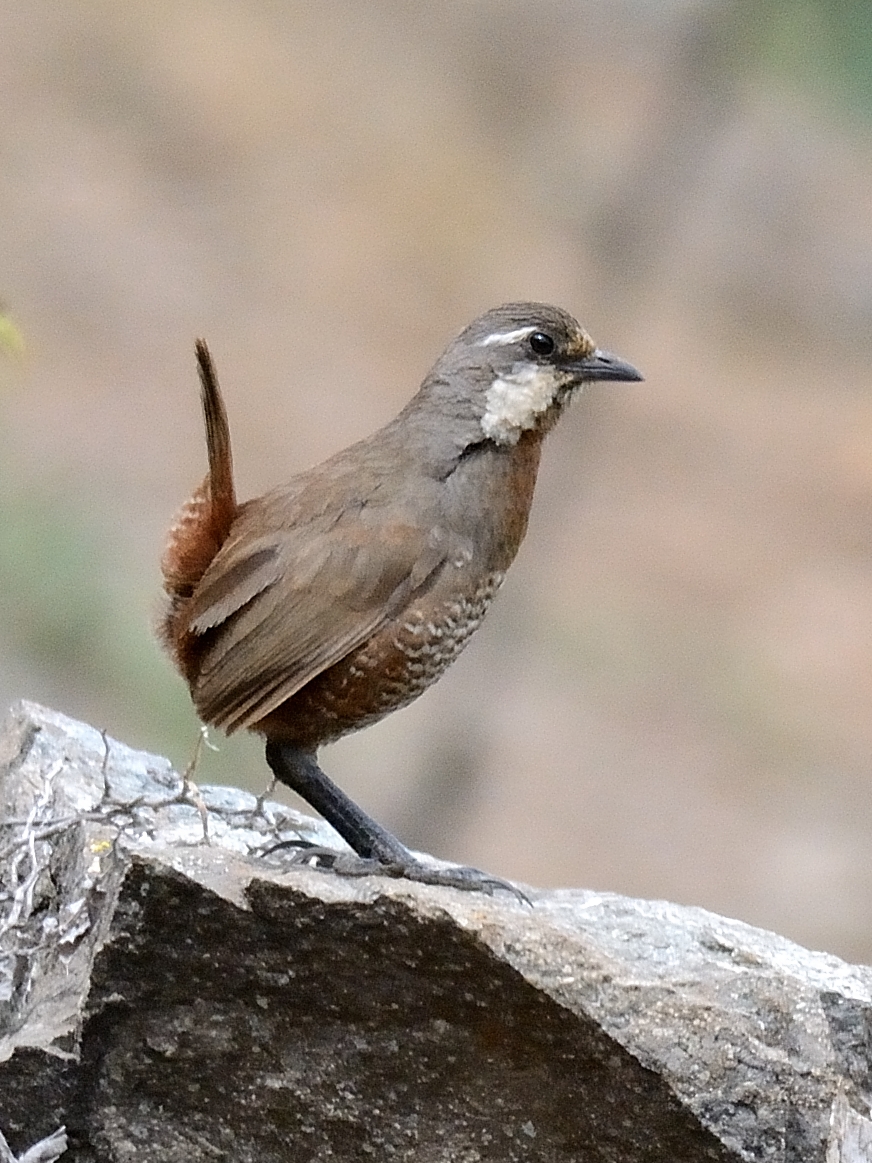
Ocellated Tapaculo Acropternis orthonyx
The scientific name of the Ocellated Tapaculo is Acropternis orthonyx. It is a species of bird in the family Rhinocryptidae (tapaculo), order Passeriformes. The name dates from 1843.
- Scientific name
- Acropternis orthonyx (Lafresnaye, 1843)
- Common name
- Ocellated Tapaculo
- Genus
- Acropternis
- Family
- Rhinocryptidae (Tapaculo)
- Order
- Passeriformes
- Class
- Aves
- Red List category
- LC Least Concern
- Recorded in
- 4 countries
- Name status
- accepted in the Catalogue of Life

Overview
Acropternis orthonyx occurs in the northern Andes of South America. It is marked by predominantly black plumage with large bright white spots, brown flanks, and a reddish head and throat.
Written 26 November 2026 from the sources listed below. Each statement was checked against the passage it cites; statements that could not be supported were removed.
Appearance
The Ocellated Tapaculo has predominantly black plumage covered with large, bright white spots. Its flanks are brown, and its head and throat are reddish.[1][2]
Adults measure approximately 21–22 cm in length and weigh approximately 80–100 grams.[3][4]
Habitat
The species favors humid, relatively low-growing forests with canopy heights of approximately 15–25 metres. Its preferred habitat has dense understory vegetation and abundant stands of South American mountain bamboo (Chusquea).[5][6]
Its forest habitat can contain Geonoma weberbaueri palms and Ericaceae shrubs alongside bamboo. The canopy may include Brunellia, Hieronyma rufa, Ocotea calophylla, Quercus, Tibouchina, and Weinmannia.[7][8]
The species' dependence on bamboo thickets growing in clearings appears to allow it to tolerate selective logging. Selective logging may benefit the species.[9][10]
Diet
The Ocellated Tapaculo consumes both plant material and arthropods. It excavates food using both feet simultaneously.[11][12]
Behaviour
Individuals are generally encountered alone or in pairs, hopping through bamboo along the forest floor. The species generally stays close to the ground and is more frequently heard than observed.[13][14]
Its loud, emphatic whistle appears to serve as a presence announcement to other members of its species. Individuals may approach recorded or imitated calls to investigate them from several kilometres away.[15][16]
Conservation
The Ocellated Tapaculo is classified as Least Concern on the IUCN Red List. It was most recently assessed in 2022.[17][18]
The species is affected by habitat destruction.[19]
Classification of the Ocellated Tapaculo
| Kingdom | Animalia |
|---|---|
| Phylum | Chordata |
| Subphylum | Vertebrata |
| Infraphylum | Gnathostomata |
| Parvphylum | Osteichthyes |
| Megaclass | Tetrapoda |
| Class | Aves (Bird) |
| Order | Passeriformes (Passerine) |
| Family | Rhinocryptidae (Tapaculo) |
| Genus | Acropternis |
| Species | Acropternis orthonyx (Lafresnaye, 1843) |
Where the Ocellated Tapaculo is found
Checklists and occurrence records place Acropternis orthonyx in 4 countries across South America. GBIF holds 10,624 georeferenced records of it.
Countries
Regions and cities with the most records
- Pichincha, Ecuador 4,602
- Caldas Department, Colombia 2,345
- Villamaría, Colombia 2,056
- Manizales, Colombia 2,043
- Pomasqui, Ecuador 1,449
- Quito, Ecuador 1,339
- Neira, Colombia 973
- Antioquia, Colombia 834
- Riosucio, Colombia 655
- Risaralda Department, Colombia 646
- Supía, Colombia 569
- Andes, Colombia 534
- Napo, Ecuador 364
- Tolima Department, Colombia 353
- Anaime, Colombia 343
- Chinchiná, Colombia 329
- Quindío Department, Colombia 301
- Loja, Ecuador 237
- Anserma, Colombia 182
- Cundinamarca, Colombia 176
- Quinchía, Colombia 169
- Medellín, Colombia 158
- Itagüí, Colombia 156
- Envigado, Colombia 155
- Circasia, Colombia 122
- Calarcá, Colombia 119
- Bello, Colombia 114
- Santa Rosa de Cabal, Colombia 106
- Chocó, Colombia 105
- Armenia, Colombia 102
- Copacabana, Colombia 98
- Zamora Chinchipe, Ecuador 91
- La Estrella, Colombia 80
- Caldas, Colombia 70
- Táchira, Venezuela 70
- Retiro, Colombia 62
Range as the checklists state it
South America
A number beside a place is its count of GBIF occurrence records. A place without a number comes from a checklist alone. Records show where a species has been observed or collected, which can include escapes and vagrants.
Common names
English
- Ocellated Tapaculo
Names in 23 other languages
- Catalan
- tapacul ocel·lat
- Chinese
- 眼斑窜鸟, 眼斑竄鳥
- Croatian
- biserasta strmorepka
- Czech
- štidlák perličkový
- Danish
- Perletapaculo
- Dutch
- Zilverpareltapaculo
- Esperanto
- ocela tapakulo
- Finnish
- helmitapakulo
- French
- Mérulaxe ocellé, Tourco ocellé
- German
- Perlen-Tapaculo, Perlenmanteltapaculo, Perlmanteltapaculo
- Italian
- Tapaculo ocellato
- Japanese
- シラボシオタテドリ
- Lithuanian
- akiniuotasis topakulas
- Norwegian
- perletapakulo
- Polish
- szponniczek
- Portuguese
- tapaculo-ocelado
- Russian
- Глазчатый тапакуло, Глазчатый топаколо
- Serbian
- Pegavi tapakulo
- Slovak
- perličkár pazúrnatý
- Spanish
- Tapaculo ocelado
- Swedish
- pärltapakul
- Turkish
- İncili Tapakola
- Ukrainian
- тапакуло цяткований
Synonyms
One other scientific name has been used for this species and is now treated as a synonym of Acropternis orthonyx.
- Merulaxis orthonyx Lafresnaye, 1843
Subspecies and varieties
- Acropternis orthonyx infuscatus subspecies
- Acropternis orthonyx orthonyx subspecies
Related species
-
 Chucao TapaculoScelorchilus rubecula
-
 Black-throated Huet-huetPteroptochos tarnii
-
 Moustached TurcaPteroptochos megapodius
-
 Magellanic TapaculoScytalopus magellanicus
-
 Slaty BristlefrontMerulaxis ater
-
 Crested GallitoRhinocrypta lanceolata
-
 Blackish TapaculoScytalopus latrans
-
 Bahia TapaculoEleoscytalopus psychopompus
Compare
Questions and answers
What is the scientific name of the Ocellated Tapaculo?
The scientific name of the Ocellated Tapaculo is Acropternis orthonyx. Written with its author, the full name is Acropternis orthonyx (Lafresnaye, 1843).
Which family does the Ocellated Tapaculo belong to?
Acropternis orthonyx belongs to the family Rhinocryptidae, in the order Passeriformes and the class Aves.
Where is the Ocellated Tapaculo found?
Checklists and occurrence records place Acropternis orthonyx in 4 countries: Ecuador, Colombia, Venezuela and Peru.
What is the conservation status of the Ocellated Tapaculo?
The IUCN Red List category recorded for Acropternis orthonyx is Least Concern (LC).
Where does the Ocellated Tapaculo occur?
The species occurs in the northern Andes of South America. The subspecies Acropternis orthonyx infuscatus occurs in the mountains of Ecuador and northern Peru, while the nominate subspecies occurs from Colombia's Cordillera Central and Cordillera Oriental northward to the mountains of northwestern Venezuela.[20][21][22]
Where does the nominate subspecies occur in Colombia?
Small populations occur in Colombia's Cordillera Occidental, including Antioquia and Páramo de Frontino. On Colombia's Cordillera Oriental, the species is known from a few locations at elevations between 2,500 and 3,000 metres above sea level.[23][24]
Does the Ocellated Tapaculo occur on Amazonian mountain slopes?
The species is generally absent from the Amazonian slopes of the East Colombian and Venezuelan mountains where it occurs.[25]
Sources
Passages the profile rests on
- The bird has predominantly black plumage marked with large white spots, brown flanks, and a reddish head and throat. Source passage: “The bird is mostly black with large white spots, a brown flank, and a reddish head and throat.” — English Wikipedia
- Its predominantly black body is covered with bright white spots. Source passage: “The body is mostly black and covered with bright white spots.” — ebird.org
- Adults measure approximately 21–22 cm in length. Source passage: “This passerine averages 8.3-8.7 in (21–22 cm) in length” — English Wikipedia
- Adults weigh approximately 80–100 grams. Source passage: “between 2.8 and 3.5 oz (80 and 100 gram).” — English Wikipedia
- The species favors humid, relatively low-growing forests with canopy heights of approximately 15–25 metres. Source passage: “It favors humid and rather low-growing forest with canopy heights of about 50–80 ft (15–25 m).” — English Wikipedia
- Its preferred habitat contains dense understory vegetation with abundant stands of South American mountain bamboo (Chusquea). Source passage: “More important is the presence of a tangled understory with abundant stands of South American mountain bamboo (Chusquea)” — English Wikipedia
- Its forest habitat can contain Geonoma weberbaueri palms and Ericaceae shrubs alongside bamboo. Source passage: “together with other plants such as Geonoma weberbaueri palms or Ericaceae shrubs.” — English Wikipedia
- The forest canopy may include Brunellia, Hieronyma rufa, Ocotea calophylla, Quercus, Tibouchina, and Weinmannia. Source passage: “Dominant trees can include for example Brunellia, Hieronyma rufa (Phyllanthaceae), Ocotea calophylla (Lauraceae), oaks (Quercus), glorytrees (Tibouchina) and Weinmannia” — English Wikipedia
- The species' dependence on bamboo thickets that grow in clearings appears to allow it to tolerate selective logging. Source passage: “Due to its dependence on bamboo thickets which only grow in clearings it seems to tolerate selective logging well” — English Wikipedia
- Selective logging may benefit the species. Source passage: “and may actually benefit from it.” — English Wikipedia
- The species consumes both plant material and arthropods. Source passage: “The ocellated tapaculo eats plant material and arthropods” — English Wikipedia
- It excavates food using both feet simultaneously. Source passage: “which it digs up using both feet simultaneously.” — English Wikipedia
- Individuals are generally encountered alone or in pairs while hopping through bamboo along the forest floor. Source passage: “It is usually encountered in pairs or alone, hopping through bamboo along the forest floor.” — English Wikipedia
- The species generally stays close to the ground and is more frequently heard than observed. Source passage: “Preferring to stay close to the ground, it is more often heard than seen.” — English Wikipedia
- Its loud, emphatic whistle appears to serve as a presence announcement to other members of its species. Source passage: “A call, apparently given by birds to announce their presence to conspecifics, is described as "loud, emphatic WHEEUW! whistle"” — English Wikipedia
- Individuals may approach recorded or imitated calls to investigate them from several kilometres away. Source passage: “which they will approach to investigate from several kilometers away.” — English Wikipedia
- The species is classified as Least Concern on the IUCN Red List. Source passage: “it is common enough to be considered a Species of least concern by the IUCN.” — English Wikipedia
- The species was most recently assessed for the IUCN Red List of Threatened Species in 2022. Source passage: “Ocellated Tapaculo Acropternis orthonyx has most recently been assessed for The IUCN Red List of Threatened Species in 2022.” — iucnredlist.org
- The species is affected by habitat destruction. Source passage: “affected by habitat destruction like all forest birds of the tropical Americas” — English Wikipedia
- The species occurs in the northern Andes of South America. Source passage: “The ocellated tapaculo (Acropternis orthonyx) is a large bird found in the northern Andes in South America.” — English Wikipedia
- The subspecies Acropternis orthonyx infuscatus occurs in the mountains of Ecuador and northern Peru. Source passage: “Acropternis orthonyx infuscatus is found in the mountains of Ecuador and northern Peru.” — English Wikipedia
- The nominate subspecies occurs from Colombia's Cordillera Central and Cordillera Oriental northward to the mountains of northwestern Venezuela. Source passage: “The nominate subspecies A. o. orthonyx ranges further north, from the Cordillera Central and Cordillera Oriental of Colombia to the mountains of northwestern Venezuela” — English Wikipedia
- Small populations of the nominate subspecies also occur in Colombia's Cordillera Occidental, including Antioquia and Páramo de Frontino. Source passage: “with small populations also present in the Cordillera Occidental (in Antioquia and the Páramo de Frontino at least).” — English Wikipedia
- On Colombia's Cordillera Oriental, the species is known from a few locations at elevations between 2,500 and 3,000 metres above sea level. Source passage: “on the Cordillera Oriental it is only known so far in a few places between 8,200 and 10,000 ft (2,500-3,000 m) ASL.” — English Wikipedia
- The species is generally absent from the Amazonian slopes of the East Colombian and Venezuelan mountains where it occurs. Source passage: “It is not usually found on the Amazonian slope of the East Colombian and Venezuelan mountains it inhabits” — English Wikipedia
- The northern and southern populations are barely distinguishable. Source passage: “The northern and southern populations are barely distinguishable” — English Wikipedia
- Some taxonomic authors do not recognize subspecies within this species. Source passage: “many authors accept no subspecies at all.” — English Wikipedia
Data
- Catalogue of Life, 2026-10-16 XR cc by
- Global Biodiversity Information Facility CC BY 4.0
- Wikidata CC0
- GeoNames CC BY 4.0
- Wikimedia Commons per image; credit shown with each image
- Within the Catalogue of Life, this name comes from The Integrated Taxonomic Information System cc0
References
- Gill, Frank, & and Minturn Wright. (2006). Birds of the World: Recommended English Names.
This species in other databases
Page built on 28 November 2026. See how the catalog is made and all sources and licences.
Cite this page
ScientificNames.org. (2026). Acropternis orthonyx (Ocellated Tapaculo). Retrieved November 28, 2026, from https://scientificnames.org/species/acropternis-orthonyx
“Acropternis orthonyx (Ocellated Tapaculo).” ScientificNames.org, 2026, scientificnames.org/species/acropternis-orthonyx. Accessed 28 Nov. 2026.
ScientificNames.org. “Acropternis orthonyx (Ocellated Tapaculo).” Accessed November 28, 2026. https://scientificnames.org/species/acropternis-orthonyx.
@misc{scientificnames_acropternis_orthonyx_ocellated_tapaculo,
  author = {{ScientificNames.org}},
  title = {Acropternis orthonyx (Ocellated Tapaculo)},
  year = {2026},
  url = {https://scientificnames.org/species/acropternis-orthonyx},
  note = {Accessed 2026-11-28}
}