Species · Flowering plants
White Baneberry Actaea pachypoda
The scientific name of the White Baneberry is Actaea pachypoda. It is a species of flowering plant in the family Ranunculaceae (crowfoot family), order Ranunculales.
- Scientific name
- Actaea pachypoda Elliott
- Common name
- White Baneberry
- Genus
- Actaea
- Family
- Ranunculaceae (Crowfoot Family)
- Order
- Ranunculales
- Class
- Magnoliopsida
- Recorded in
- 2 countries
- Name status
- accepted in the Catalogue of Life

Overview
White baneberry (Actaea pachypoda Elliott) is a herbaceous perennial flowering plant in the family Ranunculaceae, order Ranunculales and class Magnoliopsida. It is native to eastern North America, including eastern Canada and the Midwestern and Eastern United States. It produces white flowers and shiny, waxy white berries with black stigma scars, supported by stalks that become bright red as the fruits develop.
Written 26 November 2026 from the sources listed below. Each statement was checked against the passage it cites; statements that could not be supported were removed.
Appearance
White baneberry has toothed, bipinnate compound leaves. The leaves can reach 40 cm in length and 30 cm in width.[1][2]
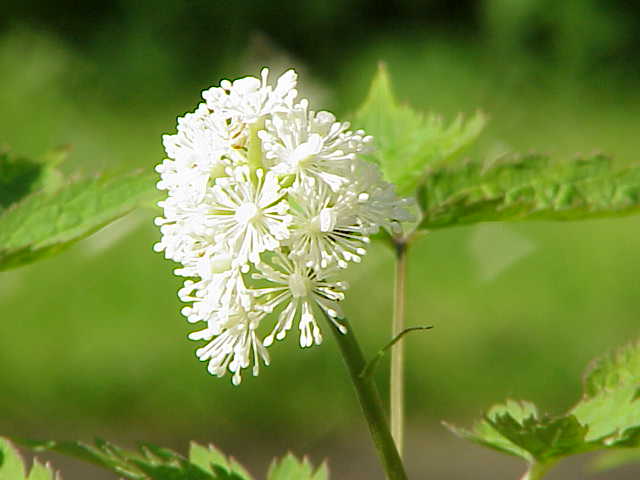
Its white flowers grow in dense racemes approximately 10 cm long. The plant produces shiny, waxy, ellipsoid white berries with black stigma scars after successful pollination.[3][4][5][6][7]
The berries measure approximately 1 cm in diameter. Their supporting stalks become thicker and bright red as the fruits develop.[4][8][9]
The plant typically reaches 46–76 cm or more in height. An uncommon red-fruited form has been described as forma rubrocarpa.[10][11]
Habitat
White baneberry occurs in hardwood and mixed forest stands, deciduous woods, and other moist habitats. It occurs in moist, nutrient-rich sites across several forest ecosystems.[12][13][14]
The species grows best in partial to full shade and moist, fertile soil containing abundant organic matter. It requires organically rich, humusy soil with excellent drainage.[15][16]
Diet
Birds consume the berries of white baneberry. Small mammals consume the seeds but not the berry pulp.[17][18]
Deer and small mammals occasionally eat the plant, but they rarely cause significant wildlife damage.[19]
Behaviour
Birds help disperse the seeds by consuming the berries. They can consume the berries without being affected by their toxins.[20][21]
Long-tongued bees collect pollen from the flowers.[22]
Reproduction and life cycle
White baneberry produces white flowers in spring. Following successful pollination, it produces berries that ripen during summer and remain on the plant until frost.[23][24][7]
The species can be propagated through division or seed sowing. Seed germination can take two or more years because the seeds have double dormancy.[25][26]
Plants take several years to become large enough to flower.[27]
Conservation
White baneberry is not edible, and the entire plant is poisonous to humans. The berries are the most poisonous part and contain cardiac toxins.[28][29][30]
Ingesting the berries can cause cardiac arrest and death.[31]
Uses
White baneberry is cultivated as an ornamental plant in traditional and wildlife gardens. It can be planted in shady borders and woodland gardens for its foliage, flowers, and conspicuous fruit.[32][33]
When planted in groups, the species can be used as a tall groundcover. Baneberry has also been used medicinally by Native Americans.[34][35]
Classification of the White Baneberry
| Kingdom | Plantae |
|---|---|
| Subkingdom | Pteridobiotina |
| Phylum | Tracheophyta |
| Class | Magnoliopsida |
| Order | Ranunculales |
| Family | Ranunculaceae (Crowfoot Family) |
| Subfamily | Ranunculoideae |
| Tribe | Helleboreae |
| Genus | Actaea (Cohosh) |
| Species | Actaea pachypoda Elliott |
Where the White Baneberry is found
Checklists and occurrence records place Actaea pachypoda in 2 countries across North America. GBIF holds 32,136 georeferenced records of it.
Countries
Regions and cities with the most records
- Ontario, Canada 6,539
- New York, United States 2,699
- Michigan, United States 2,524
- Wisconsin, United States 1,873
- Vermont, United States 1,736
- Quebec, Canada 1,549
- Ohio, United States 1,478
- Illinois, United States 1,232
- Massachusetts, United States 1,084
- Pennsylvania, United States 1,077
- Tennessee, United States 875
- Indiana, United States 803
- North Carolina, United States 751
- Connecticut, United States 694
- New Hampshire, United States 678
- Maine, United States 586
- Waterdown, Canada 456
- Burlington, Canada 428
- Kentucky, United States 417
- Minnesota, United States 410
- Virginia, United States 404
- Kitchener, Canada 403
- Ottawa, Canada 378
- Ottawa South, Canada 370
- Waterloo, Canada 366
- Aylmer, Canada 352
- Whitchurch-Stouffville, Canada 346
- Stouffville, Canada 341
- Nepean, Canada 338
- Hamilton, Canada 334
- Gatineau, Canada 332
- Vanier, Canada 332
- Aurora, Canada 315
- Gloucester, Canada 314
- Milton, Canada 309
- Ithaca, United States 305
1 more country has a few records outside this range
These countries hold a few records of Actaea pachypoda but lie outside the range the checklists give for it. Such records are often zoo or garden specimens, museum material or vagrants, so the species is not counted as occurring there.
Range as the checklists state it
Canada (New Brunswick, Nova Scotia, Ontario, Prince Edward Isl., Québec); USA (Alabama, Arkansas, Connecticut, Delaware, Florida, Georgia, Iowa, Illinois, Indiana, Kansas, Kentucky, Louisiana, Massachusetts, Maryland, Maine, Michigan, Minnesota, Missouri, Mississippi, North Carolina, Nebraska, New Hampshire, New Jersey, New York, Ohio, Oklahoma, Pennsylvania, Rhode Island, South Carolina, Tennessee, Virginia, Vermont, Wisconsin, West Virginia)
A number beside a place is its count of GBIF occurrence records. A place without a number comes from a checklist alone. Records show where a species has been observed or collected, which can include escapes and vagrants.
Common names
English
- White Baneberry
- White Doll's Eyes
- Baneberry
- Doll's Eye
- Doll's Eyes
- Doll's-eyes
- White Cohosh
Names in 10 other languages
- Chinese
- 娃眼升麻, 白果升麻
- Danish
- hvid druemunke
- Finnish
- valkokonnanmarja
- French
- actée blanche, actée à gros pédicelles
- Polish
- czerniec grubopędowy
- Portuguese
- Erva-de-São-Cristóvão
- Russian
- Воронец толстоножковый
- Swedish
- vit trolldruva
- Ukrainian
- Чернець товстоніжковий
- oji
- Weekizigun (Wapkadak)
Synonyms
6 other scientific names have been used for this species and are now treated as synonyms of Actaea pachypoda.
- Actaea alba f. rubrocarpa Killip
- Actaea brachypetala var. coerulea DC.
- Actaea brachypetala var. microcarpa DC.
- Actaea pachypoda f. microcarpa (DC.) Fassett
- Actaea pachypoda f. pachypoda
- Actaea pachypoda f. rubrocarpa (Killip) Fernald
Related species
-
 Black CohoshActaea racemosa
-
 Red BaneberryActaea rubra
-
 BaneberryActaea spicata
-
 American BugbaneActaea podocarpa
-
 Actaea elata
-
 Actaea japonica
-
 Actaea heracleifolia
-
 Appalachian Black CohoshActaea rubifolia
Compare
Questions and answers
What is the scientific name of the White Baneberry?
The scientific name of the White Baneberry is Actaea pachypoda. Written with its author, the full name is Actaea pachypoda Elliott.
Which family does the White Baneberry belong to?
Actaea pachypoda belongs to the family Ranunculaceae, in the order Ranunculales and the class Magnoliopsida.
Where is the White Baneberry found?
Checklists and occurrence records place Actaea pachypoda in 2 countries: United States and Canada.
What other names does the White Baneberry have?
Actaea pachypoda is also known in English as White Doll's Eyes, Baneberry, Doll's Eye, Doll's Eyes, Doll's-eyes and White Cohosh.
Can humans eat baneberries?
No. White baneberry is not edible, and its entire plant is poisonous to humans.[28][29]
What is the toxin in baneberry?
The berries contain cardiac toxins. The specific toxin is not identified.[30]
What if you eat a baneberry?
Ingesting white baneberry berries can cause cardiac arrest and death.[31]
Sources
Passages the profile rests on
- The plant has toothed, bipinnate compound leaves. Source passage: “It has toothed, bipinnate compound leaves up to 40 cm (16 in) long and 30 cm (12 in) broad.” — English Wikipedia
- Its compound leaves can reach 40 cm in length and 30 cm in width. Source passage: “up to 40 cm (16 in) long and 30 cm (12 in) broad.” — English Wikipedia
- Its white flowers grow in dense racemes approximately 10 cm long. Source passage: “The white flowers are produced in spring in a dense raceme about 10 cm (3.9 in) long.” — English Wikipedia
- Its white berries have a black stigma scar and measure approximately 1 cm in diameter. Source passage: “a 1 cm (1⁄2 in) diameter white berry, whose size, shape, and black stigma scar give the species its other common name, "doll's eyes".” — English Wikipedia
- The plant produces shiny, waxy, ellipsoid berries after successful pollination. Source passage: “If successfully pollinated, waxy, shiny, ellipsoid berries are formed.” — hort.extension.wisc.edu
- Its flower racemes are approximately 10 cm long. Source passage: “in a dense raceme about 10 cm (3.9 in) long.” — English Wikipedia
- The species produces berries following successful pollination. Source passage: “If successfully pollinated, waxy, shiny, ellipsoid berries are formed.” — hort.extension.wisc.edu
- The berry-supporting stalks become thicker and bright red as the fruits develop. Source passage: “The pedicels thicken and become bright red as the berries develop.” — English Wikipedia
- The species' berries measure approximately 1 cm in diameter. Source passage: “a 1 cm (1⁄2 in) diameter white berry” — English Wikipedia
- An uncommon red-fruited form of the species has been described as forma rubrocarpa. Source passage: “There are pink- and red-berried plants that have been called A. pachypoda forma rubrocarpa” — English Wikipedia
- The plant typically reaches 46–76 cm or more in height. Source passage: “This herbaceous perennial plant grows to 46–76 cm (18–30 in) or more tall.” — English Wikipedia
- The species occurs in hardwood and mixed forest stands. Source passage: “and is found in hardwood and mixed forest stands.” — English Wikipedia
- The species grows in deciduous woods. Source passage: “Habitat: Deciduous woods.” — cs.rochester.edu
- White baneberry occurs in moist, nutrient-rich sites across several forest ecosystems and other moist habitats. Source passage: “Both species are found in moist, nutrient rich sites on many soil types and in a variety of ecosystems including deciduous, coniferous, and mixed forests, and along stream banks, in swamps and in other moist locations.” — hort.extension.wisc.edu
- The species grows best in partial to full shade and moist, fertile soil containing abundant organic matter. Source passage: “Both species thrive in moist, fertile soil with lots of organic matter in partial to full shade” — hort.extension.wisc.edu
- The species requires organically rich, humusy soil with excellent drainage. Source passage: “It requires organically rich, humusy soil with excellent drainage” — English Wikipedia
- Birds consume the berries of the species. Source passage: “A variety of birds, which are not affected by the toxins, eat the berries” — English Wikipedia
- Small mammals consume the seeds but not the berry pulp. Source passage: “Small mammals will eat the seeds, but not the pulp.” — hort.extension.wisc.edu
- The species is occasionally eaten by deer and small mammals, which rarely cause significant wildlife damage. Source passage: “Baneberry is occasionally fed on by deer and small mammals but are rarely significantly damaged by wildlife.” — hort.extension.wisc.edu
- Birds help disperse the species' seeds by consuming its berries. Source passage: “eat the berries and help disperse the seeds.” — English Wikipedia
- Birds can consume the berries without being affected by their toxins. Source passage: “A variety of birds, which are not affected by the toxins, eat the berries” — English Wikipedia
- Long-tongued bees collect pollen from the flowers. Source passage: “Long-tongued bees collect pollen from the flowers.” — English Wikipedia
- The species produces white flowers in spring. Source passage: “The white flowers are produced in spring” — English Wikipedia
- Its berries ripen during summer and remain on the plant until frost. Source passage: “The berries ripen over the summer, turning into fruits that persist on the plant until frost.” — English Wikipedia
- The species can be propagated through division or seed sowing. Source passage: “Baneberry can be propagated by division in early spring or from seed sown outdoors in the fall .” — hort.extension.wisc.edu
- Seed germination can take two or more years because the seeds have double dormancy. Source passage: “Seed has double dormancy, so germination may take 2 or more years.” — hort.extension.wisc.edu
- Plants take several years to become large enough to flower. Source passage: “Plants are slow growing and take a few years to grow large enough to flower.” — hort.extension.wisc.edu
- The species is not edible. Source passage: “Edibility: Not edible” — plants.ces.ncsu.edu
- The entire plant is poisonous to humans. Source passage: “Both the berries and the entire plant are considered poisonous to humans.” — English Wikipedia
- The berries are the most poisonous part of the plant and contain cardiac toxins. Source passage: “The berries contain cardiac toxins which can have an immediate sedative effect on human cardiac muscle tissue, and are the most poisonous part of the plant.” — English Wikipedia
- Ingesting the berries can cause cardiac arrest and death. Source passage: “Ingestion of the berries can lead to cardiac arrest and death.” — English Wikipedia
- The species is cultivated as an ornamental plant in traditional and wildlife gardens. Source passage: “Actaea pachypoda is cultivated as an ornamental plant, in traditional and wildlife gardens.” — English Wikipedia
- White baneberry can be planted in shady borders and woodland gardens for its foliage, flowers, and conspicuous fruit. Source passage: “These native species can be good additions to shady borders or woodland gardens for their foliage that remains attractive through most of the growing season, pretty flowers (though not as showy as black cohosh) and the conspicuous fruit which provides ornamental interest into the fall.” — hort.extension.wisc.edu
- The species can be used as a tall groundcover when planted in groups. Source passage: “It can be used as a tall groundcover when planted in groups.” — hort.extension.wisc.edu
- Baneberry has been used medicinally by Native Americans. Source passage: “It was used medicinally by Native Americans.” — hort.extension.wisc.edu
Data
- Catalogue of Life, 2026-10-16 XR cc by
- Global Biodiversity Information Facility CC BY 4.0
- Wikidata CC0
- GeoNames CC BY 4.0
- Wikimedia Commons per image; credit shown with each image
- Within the Catalogue of Life, this name comes from Synonymic Checklists of the Vascular Plants of the World cc by
References
- Elliott. (1821). Sketch Bot. S. Carolina [Elliott] 2(1): 15 (1821). where the name was published
This species in other databases
- Catalogue of Life 9S45
- Wikidata Q2714447
- iNaturalist 63062
- World Flora Online wfo-0000519103
- GRIN 404128
Page built on 27 November 2026. See how the catalog is made and all sources and licences.
Cite this page
ScientificNames.org. (2026). Actaea pachypoda (White Baneberry). Retrieved November 27, 2026, from https://scientificnames.org/species/actaea-pachypoda
“Actaea pachypoda (White Baneberry).” ScientificNames.org, 2026, scientificnames.org/species/actaea-pachypoda. Accessed 27 Nov. 2026.
ScientificNames.org. “Actaea pachypoda (White Baneberry).” Accessed November 27, 2026. https://scientificnames.org/species/actaea-pachypoda.
@misc{scientificnames_actaea_pachypoda_white_baneberry,
  author = {{ScientificNames.org}},
  title = {Actaea pachypoda (White Baneberry)},
  year = {2026},
  url = {https://scientificnames.org/species/actaea-pachypoda},
  note = {Accessed 2026-11-27}
}