Species · Birds
Mariana Swiftlet Aerodramus bartschi
The scientific name of the Mariana Swiftlet is Aerodramus bartschi. It is a species of bird in the family Apodidae (swift), order Apodiformes. The name dates from 1909.
- Scientific name
- Aerodramus bartschi (Mearns, 1909)
- Common name
- Mariana Swiftlet
- Genus
- Aerodramus
- Family
- Apodidae (Swift)
- Order
- Apodiformes
- Class
- Aves
- Red List category
- VU Vulnerable
- Recorded in
- 4 countries
- Name status
- accepted in the Catalogue of Life
Overview
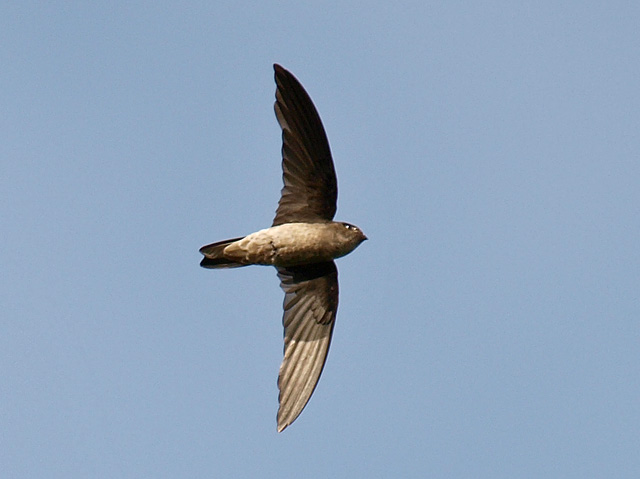
The Mariana Swiftlet (Aerodramus bartschi) is an insectivorous bird in the family Apodidae and order Apodiformes. Its native distribution is restricted to Guam, Saipan, and Aguijan in the Northern Mariana Islands. It has non-glossy plumage, a shallowly forked tail, and measures approximately 11 centimetres in length.
Written 26 November 2026 from the sources listed below. Each statement was checked against the passage it cites; statements that could not be supported were removed.
Appearance
Its plumage is non-glossy, and its tail is shallowly forked. It measures approximately 11 centimetres in length.[1][2]
Habitat
The Mariana Swiftlet inhabits tropical moist lowland forests, mangrove forests, and grasslands.[3]
It builds nests on the interior walls and ceilings of limestone caves, including areas of complete darkness.[4]
Diet
The Mariana Swiftlet captures small insects while flying over forests and other vegetation. Its diet has been investigated through guano analysis of samples collected from cave roosts.[5][6]
On Aguiguan, hymenopterans accounted for 88% of its diet by volume, while hemipterans accounted for 6%.[7][8]
Behaviour
The Mariana Swiftlet nests in colonies ranging from a few individuals to several hundred birds. It produces twittering and chirping sounds as well as echolocation clicks.[9][10]
It uses echolocation clicks to navigate inside nesting and roosting caves. Most individuals leave their caves at dawn to forage and return at sunset to roost.[11][12]
Reproduction and life cycle
The Mariana Swiftlet typically lays one egg per clutch. It may breed more than once annually.[13][14]
Conservation
The Mariana Swiftlet was listed as Endangered in 2016 and is classified as Vulnerable in the source document.[15][16]
The Guam population declined partly because of predation by brown tree snakes and agricultural pesticide use. It was estimated at approximately 900 individuals in 2006.[17][18]
The Saipan population was estimated at approximately 5,400 individuals in 2005. It is at risk if brown tree snakes become established on the island.[19][20]
The population on Aguijan was estimated at approximately 400 individuals. The only known breeding colony on Oahu contained at least 17 breeding pairs in 1997, and the introduced population there remains small.[21][22][23]
The species is locally extinct on Rota and Tinian. Mariana Swiftlets were extirpated from Rota during the 1970s.[24][25]
Proposed conservation measures include monitoring populations, limiting disturbance in caves, and preventing the establishment of brown tree snakes in the Northern Mariana Islands.[26][27]
Other proposed measures include controlling introduced mud dauber wasps and cockroaches where they damage nests, and reintroducing Mariana Swiftlets to Rota.[28][29]
Classification of the Mariana Swiftlet
| Kingdom | Animalia |
|---|---|
| Phylum | Chordata |
| Subphylum | Vertebrata |
| Infraphylum | Gnathostomata |
| Parvphylum | Osteichthyes |
| Megaclass | Tetrapoda |
| Class | Aves (Bird) |
| Order | Apodiformes (Swifts) |
| Family | Apodidae (Swift) |
| Subfamily | Apodinae |
| Genus | Aerodramus (Edible-nest Swiftlets) |
| Species | Aerodramus bartschi (Mearns, 1909) |
Where the Mariana Swiftlet is found
Checklists and occurrence records place Aerodramus bartschi in 4 countries across Oceania. GBIF holds 1,047 georeferenced records of it.
Countries
Regions and cities with the most records
- Saipan, Northern Mariana Islands 668
- Saipan, Northern Mariana Islands 660
- Hawaii, United States 295
- Honolulu, United States 290
- Joint Base Pearl Harbor Hickam, United States 290
- Kalihi Valley, United States 290
- Kaneohe, United States 290
- Makiki / Lower Punchbowl / Tantalus, United States 290
- Manoa, United States 290
- Mililani Mauka, United States 290
- Mililani Mauka / Launani Valley, United States 290
- Pearl City, United States 290
- Waikīkī, United States 290
- Aliamanu / Salt Lakes / Foster Village, United States 289
- ‘Ewa Beach, United States 289
- Mililani Town, United States 288
- Waipahu, United States 288
- ʻEwa Beach-Iroquois Point, United States 288
- Diamond Head / Kapahulu / Saint Louis Heights, United States 287
- ʻEwa Gentry-West Loch, United States 287
- Kailua, United States 283
- Kuliouou - Kalani Iki, United States 283
- ‘Ewa Gentry, United States 267
- Schofield-Wheeler, United States 265
- Wahiawā, United States 264
- Wahiawā-Whitmore, United States 262
- Kapolei, United States 257
- Makakilo-Makaīwa Hills-Kunia, United States 94
- Kapolei Villages, United States 93
- Makakilo, United States 78
- Niu Valley, United States 32
- East Honolulu, United States 29
- Hagåtña, Guam 23
- Mangilao Village, Guam 23
- Tamuning-Tumon-Harmon Village, Guam 22
- Dededo Village, Guam 10
2 more countries have a few records outside this range
These countries hold a few records of Aerodramus bartschi but lie outside the range the checklists give for it. Such records are often zoo or garden specimens, museum material or vagrants, so the species is not counted as occurring there.
Range as the checklists state it
Oceania
A number beside a place is its count of GBIF occurrence records. A place without a number comes from a checklist alone. Records show where a species has been observed or collected, which can include escapes and vagrants.
Common names
English
- Mariana Swiftlet
- Guam Swiftlet
- Vanikoro
Names in 27 other languages
- Arabic
- سمامة ماريانا
- Catalan
- salangana de l'illa de Guam
- Chinese
- 关岛金丝燕, 關島金絲燕
- Croatian
- marijanska čiopica
- Czech
- salangana marianská
- Danish
- Guamsalangan
- Dutch
- Marianensalangaan
- Esperanto
- mariana salangano
- Estonian
- mariaani salangaan
- Finnish
- guaminsalangaani
- French
- Salangane de Guam
- German
- Marianen-Salangane, Marianensalangane
- Hungarian
- mariana-szigeteki szalangána
- Italian
- Rondone delle Marianne, Rondone di Guam, Salangana delle Marianne
- Japanese
- グァムムジアナツバメ, グアムムジアナツバメ
- Lithuanian
- guaminis erodramas
- Norwegian
- marianesalangan
- Polish
- salangana mariańska
- Portuguese
- andorinhão-das-marianas, salangana-das-marianas
- Russian
- Гуамская салангана
- Serbian
- Čiopica sa ostrva Marijana
- Slovak
- salangána guamská
- Spanish
- Salangana de Guam
- Turkish
- Guam Yelyutanı
- Ukrainian
- салангана маріанська
- Welsh
- corgoblyn Ynysoedd Marianas
- cha
- Yåyaguak
Synonyms
14 other scientific names have been used for this species and are now treated as synonyms of Aerodramus bartschi.
- Aerodramus bartschi bartschi Mearns, EA, 1909
- Aerodramus inquieta bartschi Mearns, EA, 1909
- Aerodramus vanikorensis bartschi (Mearns, 1909)
- Collocalia bartschi Mearns, 1909
- Collocalia francica bartschi Mearns, EA, 1909
- Collocalia fuciphaga bartschi Mearns, EA, 1909
- Collocalia fuciphaga tachyptera Oberholser, HC, 1912
- Collocalia garmani bartschi Mearns, EA, 1909
- Collocalia germani bartschi Mearns, EA, 1909
- Collocalia inexpecta bartschi Mearns, EA, 1909
- Collocalia inexpectata bartschi Mearns, EA, 1909
- Collocalia inquieta bartschi Mearns, EA, 1909
- Collocalia unicolor bartschi Mearns, EA, 1909
- Collocalia vanikorensis bartschi Mearns, EA, 1909
Related species
-
 Edible-nest SwiftletAerodramus fuciphagus
-
 Edible-nest SwiftletAerodramus germani
-
 Black-nest SwiftletAerodramus maximus
-
 Indian SwiftletAerodramus unicolor
-
 Himalayan SwiftletAerodramus brevirostris
-
 Australian SwiftletAerodramus terraereginae
-
 White-rumped SwiftletAerodramus spodiopygius
-
 Mascarene SwiftletAerodramus francicus
Compare
Questions and answers
What is the scientific name of the Mariana Swiftlet?
The scientific name of the Mariana Swiftlet is Aerodramus bartschi. Written with its author, the full name is Aerodramus bartschi (Mearns, 1909).
Which family does the Mariana Swiftlet belong to?
Aerodramus bartschi belongs to the family Apodidae, in the order Apodiformes and the class Aves.
Where is the Mariana Swiftlet found?
Checklists and occurrence records place Aerodramus bartschi in 4 countries: Northern Mariana Islands, United States, Guam and Costa Rica.
What is the conservation status of the Mariana Swiftlet?
The IUCN Red List category recorded for Aerodramus bartschi is Vulnerable (VU).
What other names does the Mariana Swiftlet have?
Aerodramus bartschi is also known in English as Guam Swiftlet and Vanikoro.
Sources
Passages the profile rests on
- The Mariana swiftlet has a shallowly forked tail and non-glossy plumage. Source passage: “The tail has a shallow fork and the plumage lacks gloss.” — English Wikipedia
- The Mariana swiftlet measures approximately 11 centimetres in length. Source passage: “The swiftlet is about 11 centimetres (4.3 in) in length” — English Wikipedia
- The Mariana swiftlet inhabits tropical moist lowland forests, mangrove forests, and grasslands. Source passage: “Its natural habitats are tropical moist lowland forest, mangrove forest and grassland.” — English Wikipedia
- The Mariana swiftlet builds nests on the interior walls and ceilings of limestone caves, including areas of complete darkness. Source passage: “builds shallow nests high on the interior walls and ceilings of limestone caves, including sites in zones of complete darkness” — English Wikipedia
- The Mariana swiftlet captures small insects while flying over forests and other vegetation. Source passage: “They are aerial feeders that capture small insects in flight over forest and other vegetation.” — English Wikipedia
- The Mariana swiftlet diet was investigated through guano analysis conducted on samples collected from cave roosts. Source passage: “we investigated their diets using guano analysis.” — pubs.usgs.gov
- Mariana swiftlets on Aguiguan consumed diets consisting predominantly of hymenopterans, which accounted for 88% of their diet by volume. Source passage: “Swiftlets, which roosted in only one of the caves, fed mostly on hymenopterans (88%)” — pubs.usgs.gov
- Hemipterans accounted for 6% of the Mariana swiftlet diet by volume in the Aguiguan study. Source passage: “hymenopterans (88%) and hemipterans (6%).” — pubs.usgs.gov
- The Mariana swiftlet nests in colonies ranging from a few individuals to several hundred birds. Source passage: “in colonies of a few to several hundred birds.” — English Wikipedia
- Mariana swiftlets produce twittering and chirping sounds as well as echolocation clicks. Source passage: “The swiftlets utter twittering and chirping sounds as well as the echolocation clicks” — English Wikipedia
- Mariana swiftlets use echolocation clicks to navigate inside their nesting and roosting caves. Source passage: “the echolocation clicks used to navigate inside the nesting and roosting caves.” — English Wikipedia
- Most Mariana swiftlets leave their caves at dawn to forage and return at sunset to roost. Source passage: “Most birds in a colony leave their cave at dawn to forage, returning at sunset to roost.” — English Wikipedia
- The Mariana swiftlet typically lays one egg per clutch. Source passage: “A single egg constitutes a clutch” — English Wikipedia
- Mariana swiftlets may breed more than once annually. Source passage: “but the birds may breed more than once a year.” — English Wikipedia
- The Mariana swiftlet is classified as Vulnerable in the source document. Source passage: “The Mariana swiftlet is considered to be Vulnerable” — English Wikipedia
- The Mariana swiftlet was listed as Endangered in 2016. Source passage: “after being listed as an Endangered in 2016.” — English Wikipedia
- Predation by brown tree snakes and agricultural pesticide use contributed to the decline of the Guam Mariana swiftlet population. Source passage: “The population on Guam declined because of predation by brown tree snakes and the use of agricultural pesticides” — English Wikipedia
- The Guam Mariana swiftlet population was estimated at approximately 900 individuals in 2006. Source passage: “estimated 900 individuals in 2006.” — English Wikipedia
- The Saipan Mariana swiftlet population was estimated at approximately 5,400 individuals in 2005. Source passage: “The population on Saipan was estimated in 2005 to consist of about 5400 individuals” — English Wikipedia
- The Saipan Mariana swiftlet population is at risk if brown tree snakes become established on the island. Source passage: “this population is at risk if the brown tree snake becomes established on the island.” — English Wikipedia
- The Mariana swiftlet population on Aguijan was estimated at approximately 400 individuals. Source passage: “The estimated size of the Aguijan population is about 400.” — English Wikipedia
- The only known breeding colony of Mariana swiftlets on Oahu contained at least 17 breeding pairs in 1997. Source passage: “The single known breeding colony on Oahu was estimated in 1997 to contain a minimum of 17 breeding pairs.” — English Wikipedia
- The introduced Mariana swiftlet population on Oahu remains small. Source passage: “though the population there remains small.” — English Wikipedia
- The Mariana swiftlet is locally extinct on Rota and Tinian. Source passage: “and is locally extinct on Rota and Tinian.” — English Wikipedia
- Mariana swiftlets were extirpated from Rota during the 1970s. Source passage: “whence they were extirpated in the 1970s.” — English Wikipedia
- Proposed conservation measures include monitoring Mariana swiftlet populations and limiting disturbance in caves. Source passage: “continued population monitoring and limiting cave disturbance” — English Wikipedia
- Preventing the establishment of brown tree snakes in the Northern Mariana Islands is a proposed conservation measure for the Mariana swiftlet. Source passage: “the prevention of the establishment of brown tree snakes in the Northern Marianas Islands” — English Wikipedia
- Controlling introduced mud dauber wasps and cockroaches is proposed where these insects damage Mariana swiftlet nests. Source passage: “control of introduced mud dauber wasps and cockroaches where they damage nests” — English Wikipedia
- Reintroducing Mariana swiftlets to Rota is a proposed conservation measure. Source passage: “the reintroduction of birds to Rota” — English Wikipedia
Data
- Catalogue of Life, 2026-10-16 XR cc by
- Global Biodiversity Information Facility CC BY 4.0
- Wikidata CC0
- GeoNames CC BY 4.0
- Within the Catalogue of Life, this name comes from The Integrated Taxonomic Information System cc0
References
- Gill, Frank, & and Minturn Wright. (2006). Birds of the World: Recommended English Names.
This species in other databases
Page built on 28 November 2026. See how the catalog is made and all sources and licences.
Cite this page
ScientificNames.org. (2026). Aerodramus bartschi (Mariana Swiftlet). Retrieved November 28, 2026, from https://scientificnames.org/species/aerodramus-bartschi
“Aerodramus bartschi (Mariana Swiftlet).” ScientificNames.org, 2026, scientificnames.org/species/aerodramus-bartschi. Accessed 28 Nov. 2026.
ScientificNames.org. “Aerodramus bartschi (Mariana Swiftlet).” Accessed November 28, 2026. https://scientificnames.org/species/aerodramus-bartschi.
@misc{scientificnames_aerodramus_bartschi_mariana_swiftlet,
  author = {{ScientificNames.org}},
  title = {Aerodramus bartschi (Mariana Swiftlet)},
  year = {2026},
  url = {https://scientificnames.org/species/aerodramus-bartschi},
  note = {Accessed 2026-11-28}
}