Species · Birds
Black-nest Swiftlet Aerodramus maximus
The scientific name of the Black-nest Swiftlet is Aerodramus maximus. It is a species of bird in the family Apodidae (swift), order Apodiformes. The name dates from 1878.
- Scientific name
- Aerodramus maximus (Hume, 1878)
- Common name
- Black-nest Swiftlet
- Genus
- Aerodramus
- Family
- Apodidae (Swift)
- Order
- Apodiformes
- Class
- Aves
- Red List category
- LC Least Concern
- Recorded in
- 7 countries
- Name status
- accepted in the Catalogue of Life
Overview
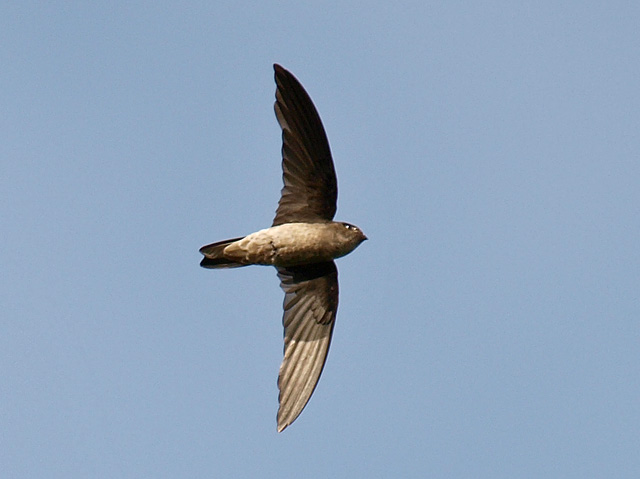
Aerodramus maximus occurs in Brunei, Indonesia, Malaysia, Myanmar, the Philippines, Singapore, Thailand, and Vietnam. It is a small, dark swiftlet belonging to the genus Aerodramus.
Written 26 November 2026 from the sources listed below. Each statement was checked against the passage it cites; statements that could not be supported were removed.
Appearance
The Black-nest Swiftlet is a small, dark swiftlet belonging to the genus Aerodramus.[1]
Habitat
The species inhabits subtropical or tropical moist lowland forests and subtropical or tropical moist montane forests.[2]
Diet
Black-nest Swiftlets are insectivorous. Dipteran insects are among the most common insect groups found in swiftlets' food boluses.[3][4]
Megaselia scalaris is considered a candidate feed insect for domestic swiftlet farming.[5]
Uses
The species' saliva is used as a source of edible nests for bird's nest soup.[6]
Behaviour
Black-nest Swiftlets are bred in captivity in specially designed buildings. Captive farming of edible-nest swiftlets has increased rapidly in Southeast Asia over the past two decades.[7][8]
Similar species
The Black-nest Swiftlet is nearly impossible to distinguish from Mossy-nest and White-nest Swiftlets.[9]
Classification of the Black-nest Swiftlet
| Kingdom | Animalia |
|---|---|
| Phylum | Chordata |
| Subphylum | Vertebrata |
| Infraphylum | Gnathostomata |
| Parvphylum | Osteichthyes |
| Megaclass | Tetrapoda |
| Class | Aves (Bird) |
| Order | Apodiformes (Swifts) |
| Family | Apodidae (Swift) |
| Subfamily | Apodinae |
| Genus | Aerodramus (Edible-nest Swiftlets) |
| Species | Aerodramus maximus (Hume, 1878) |
Where the Black-nest Swiftlet is found
Checklists and occurrence records place Aerodramus maximus in 7 countries across Asia. GBIF holds 3,151 georeferenced records of it.
Countries
Regions and cities with the most records
- Sabah, Malaysia 1,389
- Pahang, Malaysia 333
- Sarawak, Malaysia 279
- Kuala Kubu Baharu, Malaysia 162
- Raub, Malaysia 156
- Selangor, Malaysia 145
- Sandakan, Malaysia 126
- Johor, Malaysia 91
- Kuala Selangor, Malaysia 73
- Ijok, Malaysia 72
- Kampung Sungai Kajang, Malaysia 72
- Kampung Tanjung Karang, Malaysia 72
- Kampong Dungun, Malaysia 70
- Batang Berjuntai, Malaysia 69
- Kota Kinabalu, Malaysia 61
- Donggongon, Malaysia 59
- Kampung Batu Empat, Malaysia 59
- Kota Tinggi, Malaysia 59
- Putatan, Malaysia 59
- Kedah, Malaysia 57
- Petagas, Malaysia 57
- Kinarut, Malaysia 48
- Kuching, Malaysia 47
- Ciputat, Indonesia 46
- Anak Bukit, Singapore 44
- Ang Mo Kio New Town, Singapore 43
- Bukit Timah, Singapore 42
- Jakarta, Indonesia 42
- Matilda Estate, Singapore 42
- Novena, Singapore 42
- Sengkang New Town, Singapore 42
- Yio Chu Kang, Singapore 42
- Bukit Panjang New Town, Singapore 41
- Kampong Pasir Ris, Singapore 41
- MacPherson, Singapore 41
- Choa Chu Kang New Town, Singapore 40
Range as the checklists state it
Southern Asia
A number beside a place is its count of GBIF occurrence records. A place without a number comes from a checklist alone. Records show where a species has been observed or collected, which can include escapes and vagrants.
Common names
English
- Black-nest Swiftlet
Names in 29 other languages
- Arabic
- سمامة العش الأسود
- Catalan
- salangana de niu negre
- Chinese
- 大金丝燕, 黑巢金絲燕
- Croatian
- indonezijska čiopica
- Czech
- salangana černohnízdá
- Danish
- Malajsalangan, Malaysalangan
- Dutch
- Zwartnestsalangaan
- Esperanto
- nigranesta salangano
- Estonian
- sulispesa-salangaan
- Finnish
- tutkasalangaani
- French
- Salangane à nid noir
- German
- Schwarznestsalangane
- Hungarian
- feketefészkű szalangána
- Indonesian
- Walet sarang-hitam
- Italian
- Rondone dal nido nero, Salangana nidonero
- Japanese
- オオアナツバメ
- Lithuanian
- didysis erodramas
- Malay
- Burung Layang-layang Padi
- Polish
- salangana czarnogniazdowa
- Portuguese
- andorinhão-de-ninho-preto, salangana-de-ninho-preto
- Russian
- Большая салангана, Черногнёздная салангана
- Serbian
- Čiopica crnog gnezda
- Slovak
- salangána družná
- Spanish
- Salangana nidonegro
- Swedish
- svartbosalangan
- Thai
- นกแอ่นรังดำ, นกแอ่นหางสี่เหลี่ยม
- Turkish
- Siyah Çorba Yelyutanı
- Ukrainian
- салангана малазійська
- Welsh
- corgoblyn Lowe
Synonyms
One other scientific name has been used for this species and is now treated as a synonym of Aerodramus maximus.
- Collocalia maxima Hume, 1878
Subspecies and varieties
- Aerodramus maximus lowi subspecies
- Aerodramus maximus maximus subspecies
- Aerodramus maximus tichelmani subspecies
Related species
-
 Edible-nest SwiftletAerodramus fuciphagus
-
 Edible-nest SwiftletAerodramus germani
-
 Indian SwiftletAerodramus unicolor
-
 Himalayan SwiftletAerodramus brevirostris
- Mariana SwiftletAerodramus bartschi
-
 Australian SwiftletAerodramus terraereginae
-
 White-rumped SwiftletAerodramus spodiopygius
-
 Mascarene SwiftletAerodramus francicus
Compare
Questions and answers
What is the scientific name of the Black-nest Swiftlet?
The scientific name of the Black-nest Swiftlet is Aerodramus maximus. Written with its author, the full name is Aerodramus maximus (Hume, 1878).
Which family does the Black-nest Swiftlet belong to?
Aerodramus maximus belongs to the family Apodidae, in the order Apodiformes and the class Aves.
Where is the Black-nest Swiftlet found?
Checklists and occurrence records place Aerodramus maximus in 7 countries, including Malaysia, Indonesia, Brunei, Singapore, Thailand and Myanmar.
What is the conservation status of the Black-nest Swiftlet?
The IUCN Red List category recorded for Aerodramus maximus is Least Concern (LC).
Are swiftlet nests edible?
The Black-nest Swiftlet's saliva is used as a source of edible nests for bird's nest soup.[6]
Sources
Passages the profile rests on
- The black-nest swiftlet is a small, dark swiftlet belonging to the genus Aerodramus. Source passage: “A small dark Aerodramus swiftlet” — ebird.org
- The species inhabits subtropical or tropical moist lowland forests and subtropical or tropical moist montane forests. Source passage: “Its natural habitats are subtropical or tropical moist lowland forest and subtropical or tropical moist montane forest.” — English Wikipedia
- Black-nest swiftlets are insectivorous. Source passage: “Swiftlets are insectivorous,” — pmc.ncbi.nlm.nih.gov
- Dipteran insects are among the most common insect groups found in swiftlets' food boluses. Source passage: “the most common insects found in their boluses from prey composition are from the order Diptera.” — pmc.ncbi.nlm.nih.gov
- Megaselia scalaris is considered a candidate feed insect for domestic swiftlet farming. Source passage: “the Dipteran insect Megaselia scalaris (Loew) is a good candidate for a domestic swiftlet feed” — pmc.ncbi.nlm.nih.gov
- The species' saliva is used as a source of edible nests for bird's nest soup. Source passage: “Its saliva is one of the main sources of edible nests for bird's nest soup.” — English Wikipedia
- Black-nest swiftlets are bred in captivity in specially designed buildings. Source passage: “black-nest swiftlets (Aerodramus maximus), are bred in captivity in a specially designed building that is not their natural habitat” — pmc.ncbi.nlm.nih.gov
- Captive farming of edible-nest swiftlets has increased rapidly in Southeast Asia over the past two decades. Source passage: “Over the past 2 decades, swiftlet captive farming has rapidly increased in Southeast Asia” — pmc.ncbi.nlm.nih.gov
- The black-nest swiftlet is nearly impossible to distinguish from Mossy-nest and White-nest Swiftlets. Source passage: “nearly impossible to distinguish from closely-related species such as Mossy-nest and White-nest Swiftlets.” — ebird.org
Data
- Catalogue of Life, 2026-10-16 XR cc by
- Global Biodiversity Information Facility CC BY 4.0
- Wikidata CC0
- GeoNames CC BY 4.0
- Wikimedia Commons per image; credit shown with each image
- Within the Catalogue of Life, this name comes from The Integrated Taxonomic Information System cc0
References
- Gill, Frank, & and Minturn Wright. (2006). Birds of the World: Recommended English Names.
This species in other databases
Page built on 27 November 2026. See how the catalog is made and all sources and licences.
Cite this page
ScientificNames.org. (2026). Aerodramus maximus (Black-nest Swiftlet). Retrieved November 27, 2026, from https://scientificnames.org/species/aerodramus-maximus
“Aerodramus maximus (Black-nest Swiftlet).” ScientificNames.org, 2026, scientificnames.org/species/aerodramus-maximus. Accessed 27 Nov. 2026.
ScientificNames.org. “Aerodramus maximus (Black-nest Swiftlet).” Accessed November 27, 2026. https://scientificnames.org/species/aerodramus-maximus.
@misc{scientificnames_aerodramus_maximus_black_nest_swiftlet,
  author = {{ScientificNames.org}},
  title = {Aerodramus maximus (Black-nest Swiftlet)},
  year = {2026},
  url = {https://scientificnames.org/species/aerodramus-maximus},
  note = {Accessed 2026-11-27}
}