Species · Birds
Grey-headed Lovebird Agapornis canus
The scientific name of the Grey-headed Lovebird is Agapornis canus. It is a species of bird in the family Psittaculidae (lories), order Psittaciformes. The name dates from 1788.
- Scientific name
- Agapornis canus (J. F. Gmelin, 1788)
- Common name
- Grey-headed Lovebird
- Genus
- Agapornis
- Family
- Psittaculidae (Lories)
- Order
- Psittaciformes
- Class
- Aves
- Red List category
- LC Least Concern
- Recorded in
- 5 countries
- Name status
- accepted in the Catalogue of Life

Overview
The species is native to Madagascar. It is sexually dimorphic, with adult males having pale grey heads and upper chests and adult females being entirely green.
Written 26 November 2026 from the sources listed below. Each statement was checked against the passage it cites; statements that could not be supported were removed.
Appearance
Adult male Grey-headed Lovebirds have pale grey heads and upper chests, while adult females are entirely green. The species has pale grey beaks and feet.[1][2]
The species is sexually dimorphic, with grey-headed males and plain green females.[3][4]
Habitat
The Grey-headed Lovebird is most commonly found in dry forests at low elevations in northern and western Madagascar.[5]
Behaviour
Grey-headed Lovebirds are strong fliers and can gain flying speed quickly and effortlessly. Their aerial manoeuvrability is lower than that of Peach-faced Lovebirds.[6][7][8]
Captive Grey-headed Lovebirds tend to be nervous and easily frightened in aviaries.[9]
Diet
In captivity, Grey-headed Lovebirds prefer finch and canary seed to sunflower and safflower seed mixtures.[10]
Reproduction and life cycle
Grey-headed Lovebirds prefer to breed during autumn. Breeding in captivity is generally unsuccessful because the species tolerates cold weather poorly.[11][12]
Only a few captive breeders have successfully reproduced more than one or two generations of Grey-headed Lovebirds.[13]
Conservation
The Grey-headed Lovebird was listed as Least Concern in its most recent IUCN Red List assessment, conducted in 2018. The number of mature individuals in the species population is unknown.[14][15][16]
Uses
Grey-headed Lovebirds have been imported for European aviculture since the second half of the nineteenth century. The species is rarely kept in captivity.[17][18]
Hand-fed captive individuals remain too shy and nervous to make good pets.[19]
Classification of the Grey-headed Lovebird
| Kingdom | Animalia |
|---|---|
| Phylum | Chordata |
| Subphylum | Vertebrata |
| Infraphylum | Gnathostomata |
| Parvphylum | Osteichthyes |
| Megaclass | Tetrapoda |
| Class | Aves (Bird) |
| Order | Psittaciformes (Parrot) |
| Family | Psittaculidae (Lories) |
| Genus | Agapornis (Lovebird) |
| Species | Agapornis canus (J. F. Gmelin, 1788) |
Where the Grey-headed Lovebird is found
Checklists and occurrence records place Agapornis canus in 5 countries across Africa. GBIF holds 4,249 georeferenced records of it.
Countries
Regions and cities with the most records
- Amboasary, Madagascar 336
- Toliara, Madagascar 287
- Ambalavao, Madagascar 212
- Ambato Boeny, Madagascar 75
- Sakaraha, Madagascar 68
- Mahajanga, Madagascar 44
- Ambohidratrimo, Madagascar 37
- Antananarivo, Madagascar 35
- Ivato, Madagascar 35
- Morondava, Madagascar 32
- Antsiranana, Madagascar 28
- Tôlanaro, Madagascar 25
- Ambilobe, Madagascar 19
- Antsohimbondrona, Madagascar 18
- Grande Comore, Comoros 18
- Hell-Ville, Madagascar 16
- Moramanga, Madagascar 11
- Ambohitrolomahitsy, Madagascar 10
- Ambositra, Madagascar 10
- Belo sur Tsiribihina, Madagascar 10
- Dzaoudzi, Mayotte 10
- Kaouéni, Mayotte 10
- Koungou, Mayotte 10
- Labattoir, Mayotte 10
- Mamoudzou, Mayotte 10
- Soalala, Madagascar 10
- Maevatanana, Madagascar 9
- Moroni, Comoros 9
- Toamasina, Madagascar 9
- Imerintsiatosika, Madagascar 8
- Maroantsetra, Madagascar 7
- Antsirabe, Madagascar 6
- Fianarantsoa, Madagascar 6
- Marovoay, Madagascar 6
- Ambodifotatra, Madagascar 5
- Antsohihy, Madagascar 5
4 more countries have a few records outside this range
These countries hold a few records of Agapornis canus but lie outside the range the checklists give for it. Such records are often zoo or garden specimens, museum material or vagrants, so the species is not counted as occurring there.
Range as the checklists state it
Africa
A number beside a place is its count of GBIF occurrence records. A place without a number comes from a checklist alone. Records show where a species has been observed or collected, which can include escapes and vagrants.
Common names
English
- Grey-headed Lovebird
- GHLO
- Gray-headed Lovebird
Names in 29 other languages
- Arabic
- ببغاء الحب رمادي الوجه
- Bulgarian
- Сива неразделка
- Catalan
- inseparable capgrís
- Chinese
- 灰头牡丹鹦鹉, 灰頭情侶鸚鵡
- Croatian
- sivoglava papigica
- Czech
- agapornis šedohlavý
- Danish
- Gråhovedet Dværgpapegøje
- Dutch
- Grijskopagapornis, Grijskopdwergpapegaai
- Esperanto
- grizkapa ampapago
- Estonian
- hallpea-lembelind (hallpea-lembepapagoi)
- Finnish
- madagaskarinkaijanen
- French
- Inséparable à tête grise, Inséparable à tête grise de Madagascar
- German
- Grauköpfchen
- Hungarian
- szürkefejű törpepapagáj
- Italian
- Inseparabile del Madagascar, Inseparabile testagrigia
- Japanese
- カルカヤインコ
- Lithuanian
- pilkagalvis agapornis
- Malagasy
- Karako, Karaoka, Kitrehoky, Sarivazo, Sarovazo
- Norwegian
- gråhodeamorpapitt
- Norwegian Bokmål
- gråhodet dvergpapegøye
- Polish
- nierozłączka siwogłowa
- Portuguese
- inseparável-de-cabeça-cinzenta, inseparável-de-faces-cinzentas, inseparável-malgaxe
- Russian
- Сероголовый неразлучник
- Serbian
- Sivoglavi agapornis
- Slovak
- agapornis sivý
- Spanish
- Inseparable malgache
- Swedish
- gråhuvad dvärgpapegoja
- Turkish
- Gri Başlı Cennet Papağanı
- Ukrainian
- нерозлучник сизий
Synonyms
2 other scientific names have been used for this species and are now treated as synonyms of Agapornis canus.
- Agapornis cana (J. F. Gmelin, 1788)
- Psittacus canus J. F. Gmelin, 1788
Subspecies and varieties
- Agapornis canus ablectaneus (Blue-washed Grey-headed Lovebird) subspecies
- Agapornis canus canus (Grey-headed Lovebird) subspecies
Related species
-
 Rosy-faced LovebirdAgapornis roseicollis
-
 Fischer's LovebirdAgapornis fischeri
-
 Yellow-collared LovebirdAgapornis personatus
-
 Lilian's LovebirdAgapornis lilianae
-
 Black-cheeked LovebirdAgapornis nigrigenis
-
 Black-collared LovebirdAgapornis swindernianus
-
 Black-winged LovebirdAgapornis taranta
-
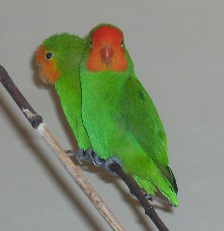 Red-headed LovebirdAgapornis pullarius
Compare
Questions and answers
What is the scientific name of the Grey-headed Lovebird?
The scientific name of the Grey-headed Lovebird is Agapornis canus. Written with its author, the full name is Agapornis canus (J. F. Gmelin, 1788).
Which family does the Grey-headed Lovebird belong to?
Agapornis canus belongs to the family Psittaculidae, in the order Psittaciformes and the class Aves.
Where is the Grey-headed Lovebird found?
Checklists and occurrence records place Agapornis canus in 5 countries: Madagascar, Comoros, Mauritius, Mayotte and Seychelles.
What is the conservation status of the Grey-headed Lovebird?
The IUCN Red List category recorded for Agapornis canus is Least Concern (LC).
What other names does the Grey-headed Lovebird have?
Agapornis canus is also known in English as GHLO and Gray-headed Lovebird.
What habitat do lovebirds live in?
The Grey-headed Lovebird is most commonly found in dry forests at low elevations in northern and western Madagascar.[5]
Sources
Passages the profile rests on
- Adult male Grey-headed Lovebirds have a pale grey head and upper chest, while adult females are entirely green. Source passage: “the adult female is entirely green, with a dark green back and wings, a bright green rump, and a paler green chest; the adult male are similarly colored, except that their entire head and upper chest are a pale grey.” — English Wikipedia
- The species has pale grey beaks and feet. Source passage: “Its beak and feet are pale grey.” — English Wikipedia
- Adult males have grey heads, whereas females are plain green. Source passage: “Males have a gray head, while females are plain green.” — ebird.org
- The species is sexually dimorphic. Source passage: “The species is sexually dimorphic” — English Wikipedia
- The species is most commonly found in dry forests at low elevations in northern and western Madagascar. Source passage: “Found most commonly in dry forest at low elevation in the north and west of Madagascar.” — ebird.org
- Grey-headed Lovebirds are strong fliers. Source passage: “Grey-headed lovebirds are strong fliers” — English Wikipedia
- The species can gain flying speed quickly and effortlessly. Source passage: “They can develop good speed quite quickly and effortlessly” — English Wikipedia
- Their aerial manoeuvrability is lower than that of Peach-faced Lovebirds. Source passage: “though they are not as nimble in the air as the peach-faced lovebirds.” — English Wikipedia
- Captive Grey-headed Lovebirds tend to be nervous and easily frightened in aviaries. Source passage: “They tend to be nervous and easily frightened in an aviary.” — English Wikipedia
- In captivity, Grey-headed Lovebirds prefer finch and canary seed to sunflower and safflower seed mixtures. Source passage: “Grey-headed lovebirds prefer finch and canary seed over the sunflower/safflower mixes that most other lovebirds eat.” — English Wikipedia
- Grey-headed Lovebirds prefer to breed during autumn. Source passage: “They prefer to breed in the autumn” — English Wikipedia
- Breeding Grey-headed Lovebirds in captivity is generally unsuccessful because they tolerate cold weather poorly. Source passage: “because they have poor tolerance for cold weather breeding in aviculture is generally unsuccessful.” — English Wikipedia
- Only a few captive breeders have successfully reproduced more than one or two generations of Grey-headed Lovebirds. Source passage: “with only a very few breeders having successfully reproduced more than one or two generations.” — English Wikipedia
- The species was listed as Least Concern in its most recent IUCN Red List assessment mentioned in the document. Source passage: “Agapornis canus is listed as Least ...” — iucnredlist.org
- The most recent IUCN Red List assessment mentioned for this species was conducted in 2018. Source passage: “has most recently been assessed for The IUCN Red List of Threatened Species in 2018.” — iucnredlist.org
- The number of mature individuals in the species population is unknown. Source passage: “Number of mature individuals Unknown Population.” — datazone.birdlife.org
- Grey-headed Lovebirds have been imported for European aviculture since the second half of the nineteenth century. Source passage: “Grey-headed lovebirds were first imported for European aviculture in the second half of the nineteenth century.” — English Wikipedia
- The species is rarely kept in captivity. Source passage: “It is quite rare in captivity” — English Wikipedia
- Hand-fed captive individuals remain too shy and nervous to make good pets. Source passage: “even hand-fed birds remain too shy and nervous to make good pets” — English Wikipedia
Data
- Catalogue of Life, 2026-10-16 XR cc by
- Global Biodiversity Information Facility CC BY 4.0
- Wikidata CC0
- GeoNames CC BY 4.0
- Wikimedia Commons per image; credit shown with each image
- Within the Catalogue of Life, this name comes from The Integrated Taxonomic Information System cc0
References
- Dickinson, Edward C., ed. (2003). The Howard and Moore Complete Checklist of the Birds of the World, 3rd Edition.
- Gill, Frank, & and Minturn Wright. (2006). Birds of the World: Recommended English Names.
- Dickinson, E. C., and L. Christidis, eds. (2014). The Howard and Moore Complete Checklist of the Birds of the World, 4th Edition, Vol. 2 Passerines.
This species in other databases
Page built on 28 November 2026. See how the catalog is made and all sources and licences.
Cite this page
ScientificNames.org. (2026). Agapornis canus (Grey-headed Lovebird). Retrieved November 28, 2026, from https://scientificnames.org/species/agapornis-canus
“Agapornis canus (Grey-headed Lovebird).” ScientificNames.org, 2026, scientificnames.org/species/agapornis-canus. Accessed 28 Nov. 2026.
ScientificNames.org. “Agapornis canus (Grey-headed Lovebird).” Accessed November 28, 2026. https://scientificnames.org/species/agapornis-canus.
@misc{scientificnames_agapornis_canus_grey_headed_lovebird,
  author = {{ScientificNames.org}},
  title = {Agapornis canus (Grey-headed Lovebird)},
  year = {2026},
  url = {https://scientificnames.org/species/agapornis-canus},
  note = {Accessed 2026-11-28}
}