Species · Birds
Black-winged Lovebird Agapornis taranta
The scientific name of the Black-winged Lovebird is Agapornis taranta. It is a species of bird in the family Psittaculidae (lories), order Psittaciformes. The name dates from 1814.
- Scientific name
- Agapornis taranta (Stanley, 1814)
- Common name
- Black-winged Lovebird
- Genus
- Agapornis
- Family
- Psittaculidae (Lories)
- Order
- Psittaciformes
- Class
- Aves
- Red List category
- LC Least Concern
- Recorded in
- 2 countries
- Name status
- accepted in the Catalogue of Life

Overview
Agapornis taranta is native to Eritrea and Ethiopia. Both sexes are predominantly green, with adult males having a red forehead and red feathers around the eyes, while adult females have an entirely green head.
Written 26 November 2026 from the sources listed below. Each statement was checked against the passage it cites; statements that could not be supported were removed.
Appearance
The Black-winged Lovebird is mostly dark green and has a short, black-tipped tail with yellowish feathers beneath it. Its rump and feathers above the tail are light green.[1][2][3]
Adult males have a red forehead, a red patch above the bill and a ring of red feathers around their eyes. Adult females have an entirely green head.[4][5][6]
Males typically have black feathers beneath their wings, while females typically have greenish or brownish-black feathers in this area. Both sexes have red bills and grey feet.[7][8][9]
The species measures approximately 16–16.5 cm in length and is the largest species in the lovebird genus.[10][11]
Habitat
The Black-winged Lovebird typically inhabits high plains and mountainous regions.[12]
Diet
Its typical diet includes sunflower seeds, corn, apples and mission figs.[13]
Reproduction and life cycle
Black-winged Lovebirds nest in tree cavities. Nesting sites include tree hollows, wall crevices and potentially weavers' nests, and nests are furnished with plant debris and feathers.[14][15][16]
The species lays white eggs, usually producing three or four eggs per clutch. Females incubate the eggs for approximately 23 days.[17][18]
Chicks leave the nest approximately 45 days after hatching. The species reproduces between March and November.[19][20]
Behaviour
Sexual differences in juvenile plumage become apparent after the first molt at approximately eight or nine months of age.[21]
Conservation
The Black-winged Lovebird is classified as Least Concern on the IUCN Red List.[22]
Uses
The species is uncommon as a pet and has not become well established as a breeding bird in aviculture. Captive breeding occurs on a small scale.[23][24][25]
Classification of the Black-winged Lovebird
| Kingdom | Animalia |
|---|---|
| Phylum | Chordata |
| Subphylum | Vertebrata |
| Infraphylum | Gnathostomata |
| Parvphylum | Osteichthyes |
| Megaclass | Tetrapoda |
| Class | Aves (Bird) |
| Order | Psittaciformes (Parrot) |
| Family | Psittaculidae (Lories) |
| Genus | Agapornis (Lovebird) |
| Species | Agapornis taranta (Stanley, 1814) |
Where the Black-winged Lovebird is found
Checklists and occurrence records place Agapornis taranta in 2 countries across Africa. GBIF holds 3,433 georeferenced records of it.
Countries
Regions and cities with the most records
- Oromiya, Ethiopia 1,581
- Burayu, Ethiopia 704
- Addis Ababa, Ethiopia 702
- Addis Ababa, Ethiopia 690
- Sebeta, Ethiopia 524
- Amhara, Ethiopia 469
- Awasa, Ethiopia 460
- Bishoftu, Ethiopia 266
- Shashamane, Ethiopia 194
- Kofelē, Ethiopia 170
- Fichē, Ethiopia 132
- Bahir Dar, Ethiopia 128
- Ziway, Ethiopia 117
- Lalibela, Ethiopia 114
- Leku, Ethiopia 88
- Gonder, Ethiopia 77
- Tigray, Ethiopia 59
- Arsi Negele, Ethiopia 43
- Adwa, Ethiopia 34
- Goba, Ethiopia 33
- Aksum, Ethiopia 32
- ‘Alem T’ēna, Ethiopia 30
- Genet, Ethiopia 26
- Mojo, Ethiopia 21
- Ādīs ‘Alem, Ethiopia 20
- Wenjī, Ethiopia 19
- Wonji, Ethiopia 19
- Nazrēt, Ethiopia 16
- Debub, Eritrea 15
- Mek’ī, Ethiopia 14
- T’īs Isat, Ethiopia 14
- Āfar, Ethiopia 14
- Kuyera, Ethiopia 13
- Metahāra, Ethiopia 12
- Āwash, Ethiopia 9
- Dēra, Ethiopia 8
1 more country has a few records outside this range
These countries hold a few records of Agapornis taranta but lie outside the range the checklists give for it. Such records are often zoo or garden specimens, museum material or vagrants, so the species is not counted as occurring there.
Range as the checklists state it
Africa
A number beside a place is its count of GBIF occurrence records. A place without a number comes from a checklist alone. Records show where a species has been observed or collected, which can include escapes and vagrants.
Common names
English
- Black-winged Lovebird
- BWLO
Names in 29 other languages
- Arabic
- ببغاء الحب أسود الجناحين
- Bulgarian
- Планинска неразделка
- Catalan
- inseparable d'Etiòpia
- Chinese
- 黑翅情侶鸚鵡, 黑翅牡丹鹦鹉
- Croatian
- etiopska papigica
- Czech
- agapornis etiopský
- Danish
- Tarantadværgpapegøje
- Dutch
- Zwartvleugelagapornis
- Esperanto
- nigraflugila ampapago
- Estonian
- kadaka-lembelind (kadaka-lembepapagoi)
- Finnish
- isokaijanen
- French
- Inséparable d'Abyssinie, Inséparable d’Abyssinie
- German
- Bergpapagei, Taranta-Rotstirnchen, Tarantapapagei, Tarantinerpapagei
- Hungarian
- hegyi törpepapagáj
- Italian
- Inseparabile alinere
- Japanese
- ハツハナインコ
- Lithuanian
- juodasparnis agapornis
- Norwegian
- svartvingeamorpapitt
- Norwegian Bokmål
- svartvinget dvergpapegøye
- Polish
- nierozłączka czarnoskrzydła
- Portuguese
- inseparável-abissínio, inseparável-de-asa-preta
- Russian
- Чернокрылый неразлучник
- Serbian
- Brdski agapornis
- Slovak
- agapornis tmavokrídly
- Spanish
- Inseparable abisinio
- Swedish
- svartvingad dvärgpapegoja
- Turkish
- Kara Kanatlı Cennet Papağanı
- Ukrainian
- нерозлучник чорнокрилий
- Welsh
- Aderyn Cariad Adeinddu
Synonyms
4 other scientific names have been used for this species and are now treated as synonyms of Agapornis taranta.
- Agapomis taranta nana Neumann, OR, 1931
- Agapornis taranta nana Neumann, OR, 1931
- Agapornis taranta taranta Stanley, ES, 1814
- Psittacus taranta Stanley, 1814
Related species
-
 Rosy-faced LovebirdAgapornis roseicollis
-
 Fischer's LovebirdAgapornis fischeri
-
 Yellow-collared LovebirdAgapornis personatus
-
 Lilian's LovebirdAgapornis lilianae
-
 Black-cheeked LovebirdAgapornis nigrigenis
-
 Black-collared LovebirdAgapornis swindernianus
-
 Grey-headed LovebirdAgapornis canus
-
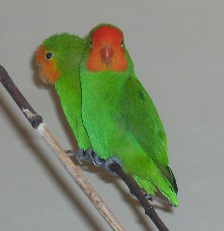 Red-headed LovebirdAgapornis pullarius
Compare
Questions and answers
What is the scientific name of the Black-winged Lovebird?
The scientific name of the Black-winged Lovebird is Agapornis taranta. Written with its author, the full name is Agapornis taranta (Stanley, 1814).
Which family does the Black-winged Lovebird belong to?
Agapornis taranta belongs to the family Psittaculidae, in the order Psittaciformes and the class Aves.
Where is the Black-winged Lovebird found?
Checklists and occurrence records place Agapornis taranta in 2 countries: Ethiopia and Eritrea.
What is the conservation status of the Black-winged Lovebird?
The IUCN Red List category recorded for Agapornis taranta is Least Concern (LC).
What other names does the Black-winged Lovebird have?
Agapornis taranta is also known in English as BWLO.
What habitat do lovebirds live in?
The Black-winged Lovebird typically inhabits high plains and mountainous regions.[12]
What kind of diet do birds have?
The typical diet of the Black-winged Lovebird includes sunflower seeds, corn, apples and mission figs.[13]
Sources
Passages the profile rests on
- The species has a black-tipped tail and yellowish feathers beneath the tail. Source passage: “The tail is black tipped and feathers below the tail show a yellowish colour.” — English Wikipedia
- The rump and feathers above the tail are light green. Source passage: “The rump and feathers above the tail are light green.” — English Wikipedia
- The species is mostly dark green and has a short tail. Source passage: “A small, short-tailed parrot that is mostly dark green.” — ebird.org
- Adult male Black-winged Lovebirds have a red forehead and a ring of red feathers around their eyes. Source passage: “only the adult male black-winged lovebird has a red forehead and a ring of red feathers around its eyes.” — English Wikipedia
- Adult females have an entirely green head. Source passage: “the adult female by its all-green head.” — English Wikipedia
- Males have a red patch above the bill and distinctive black underwings in flight. Source passage: “Males have a red patch above the bill and black underwings that are distinctive in flight.” — ebird.org
- Male Black-winged Lovebirds typically have black feathers beneath their wings. Source passage: “In the male, feathers under the wing are typically black” — English Wikipedia
- Females typically have greenish or brownish-black feathers beneath their wings. Source passage: “in the female the feathers under the wing are typically greenish or brownish black.” — English Wikipedia
- Both sexes have red bills and grey feet. Source passage: “Both sexes have a red beak and gray feet.” — English Wikipedia
- The species measures approximately 16–16.5 cm in length. Source passage: “The black-winged lovebird, with a length of about 16–16.5 cm (6.3–6.5 inches)” — English Wikipedia
- The Black-winged Lovebird is the largest species in the lovebird genus. Source passage: “is the largest species of lovebird.” — English Wikipedia
- The species typically inhabits high plains and mountainous regions. Source passage: “they normally live in either high plains or mountainous regions.” — English Wikipedia
- Its typical diet includes sunflower seeds, corn, apples and mission figs. Source passage: “Sunflower seeds, corn, apples and mission figs are typical of an Abyssinian lovebird diet.” — English Wikipedia
- Black-winged Lovebirds nest in tree cavities. Source passage: “The black-winged lovebird nests in a tree cavity.” — English Wikipedia
- Nesting sites include tree hollows, wall crevices and potentially weavers' nests. Source passage: “nesting takes place in tree hollows, crevices in walls, and potentially in weavers' nests.” — English Wikipedia
- Nests are furnished with plant debris and feathers. Source passage: “The nests are furnished with a combination of plant debris and feathers.” — English Wikipedia
- The species lays white eggs, usually producing three or four eggs per clutch. Source passage: “The eggs are white and there are usually three or four eggs in a clutch.” — English Wikipedia
- Females incubate their eggs for approximately 23 days. Source passage: “The female incubates the eggs for 23 days” — English Wikipedia
- Chicks leave the nest approximately 45 days after hatching. Source passage: “the chicks fledge from the nest about 45 days after hatching.” — English Wikipedia
- The species reproduces between March and November. Source passage: “Black-winged lovebirds reproduce from March to November;” — English Wikipedia
- Sexual differences in juvenile plumage become apparent after the first molt at approximately eight or nine months of age. Source passage: “The dimorphism becomes apparent in juvenile birds after their first molt at about eight or nine months of age.” — English Wikipedia
- The Black-winged Lovebird is classified as Least Concern on the IUCN Red List. Source passage: “the black-winged lovebird is evaluated as Least Concern on the IUCN Red List of Threatened Species.” — English Wikipedia
- The species is uncommon as a pet. Source passage: “they are uncommon as pets.” — English Wikipedia
- The species has not become well established as a breeding bird in aviculture. Source passage: “In aviculture the black-winged lovebird has not become well established as a breeding bird” — English Wikipedia
- Captive breeding of the species occurs on a small scale. Source passage: “Breeding in aviculture is on a small scale” — English Wikipedia
Data
- Catalogue of Life, 2026-10-16 XR cc by
- Global Biodiversity Information Facility CC BY 4.0
- Wikidata CC0
- GeoNames CC BY 4.0
- Wikimedia Commons per image; credit shown with each image
- Within the Catalogue of Life, this name comes from The Integrated Taxonomic Information System cc0
References
- Gill, Frank, & and Minturn Wright. (2006). Birds of the World: Recommended English Names.
- Dickinson, E. C., and L. Christidis, eds. (2014). The Howard and Moore Complete Checklist of the Birds of the World, 4th Edition, Vol. 2 Passerines.
This species in other databases
Page built on 27 November 2026. See how the catalog is made and all sources and licences.
Cite this page
ScientificNames.org. (2026). Agapornis taranta (Black-winged Lovebird). Retrieved November 27, 2026, from https://scientificnames.org/species/agapornis-taranta
“Agapornis taranta (Black-winged Lovebird).” ScientificNames.org, 2026, scientificnames.org/species/agapornis-taranta. Accessed 27 Nov. 2026.
ScientificNames.org. “Agapornis taranta (Black-winged Lovebird).” Accessed November 27, 2026. https://scientificnames.org/species/agapornis-taranta.
@misc{scientificnames_agapornis_taranta_black_winged_lovebird,
  author = {{ScientificNames.org}},
  title = {Agapornis taranta (Black-winged Lovebird)},
  year = {2026},
  url = {https://scientificnames.org/species/agapornis-taranta},
  note = {Accessed 2026-11-27}
}