Species · Other invertebrates
Orange Elephant Ear Sponge Agelas clathrodes
The scientific name of the Orange Elephant Ear Sponge is Agelas clathrodes. It is a species of animal in the family Agelasidae, order Agelasida. The name dates from 1870.
- Scientific name
- Agelas clathrodes (Schmidt, 1870)
- Common name
- Orange Elephant Ear Sponge
- Genus
- Agelas
- Family
- Agelasidae
- Order
- Agelasida
- Class
- Demospongiae
- Environment
- marine
- Recorded in
- 18 countries
- Name status
- accepted in the Catalogue of Life
Overview
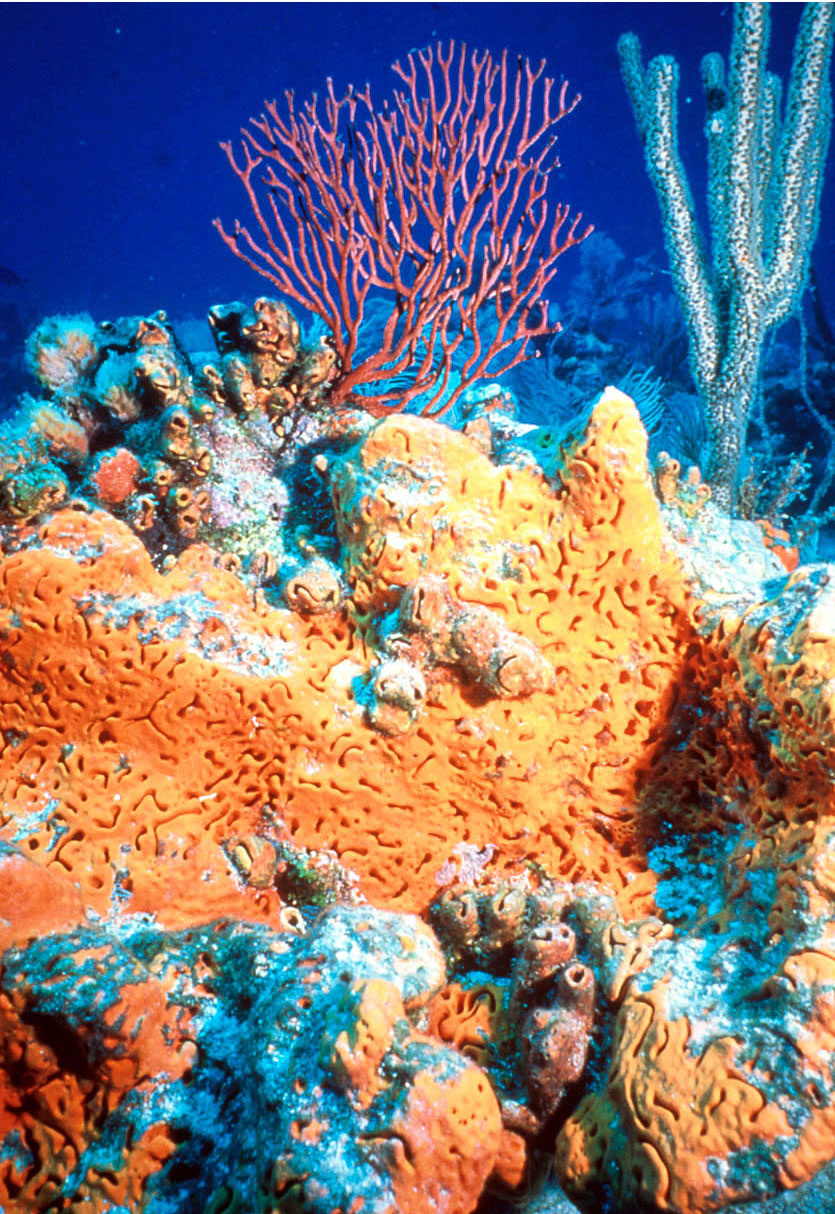
The orange elephant ear sponge inhabits reefs in the Caribbean Sea, the Bahamas, and Florida. It has reddish orange coloration, a tough body covered by thick, rough skin, and several possible growth forms.
Written 26 November 2026 from the sources listed below. Each statement was checked against the passage it cites; statements that could not be supported were removed.
Appearance
The orange elephant ear sponge is reddish orange, with coloration ranging from yellow and orange to brick red or brown. It can grow as an encrusting form, lobes, fans, tubes, or ridges.[1][2][3]
Its surface contains small circular and irregularly elongated openings, particularly on the side facing away from the current. Its body is tough, firm, resilient, and covered by thick, rough skin.[4][5]
The encrusting form can reach a thickness of 10 cm.[6]
Habitat
The species inhabits reefs in the Caribbean, generally at depths exceeding 10 metres. It occurs on reef slopes and vertical rock surfaces, especially in areas with strong currents.[7][8]
The species is most likely to occur on mesophotic reefs at depths of 30–150 metres. These habitats have limited light and intense competition for space.[9][10]
Diet
The orange elephant ear sponge is a filter feeder that obtains food particles, mostly bacteria, from circulating water.[11]
Behaviour
Water enters the sponge through fine pores and exits through larger openings.[12]
The species contains secondary metabolites that are distasteful to predatory fish, including the blue-headed wrasse.[13]
Reproduction and life cycle
The species is hermaphroditic. Individuals within a population synchronize their spawning activity.[14][15]
In Curaçao, spawning usually occurs on an afternoon in the second half of July during the moon's fourth quarter.[16]
The eggs are surrounded by nurse cells that may supply nutrients to developing larvae.[17]
Conservation
The orange elephant ear sponge provides habitat for reef fish.[18]
Uses
The species produces natural products.[19]
Similar species
Agelas citrina resembles the orange elephant ear sponge but is usually pinkish or creamy yellow.[20]
Agelas sventres also resembles the species but has round openings with noticeable rims on its exposed side.[21]
Classification of the Orange Elephant Ear Sponge
| Kingdom | Animalia |
|---|---|
| Phylum | Porifera |
| Class | Demospongiae (Demosponge) |
| Subclass | Heteroscleromorpha |
| Order | Agelasida |
| Family | Agelasidae |
| Genus | Agelas |
| Species | Agelas clathrodes (Schmidt, 1870) |
Where the Orange Elephant Ear Sponge is found
Checklists and occurrence records place Agelas clathrodes in 18 countries. GBIF holds 1,171 georeferenced records of it.
Countries
- Bahamas 18
- Barbados 3
- Belize 9
- Bonaire, Saint Eustatius and Saba 183
- Cayman Islands 66
- Cuba 50
- Curacao 23
- Dominica 25
- Guadeloupe 330
- Honduras 5
- Jamaica 10
- Martinique 97
- Mexico 173
- Puerto Rico 33
- Trinidad and Tobago 3
- Turks and Caicos Islands 5
- U.S. Virgin Islands 22
- United States 116
Regions and cities with the most records
- Kralendijk, Bonaire, Saint Eustatius and Saba 178
- Basse-Terre, Guadeloupe 166
- Sainte-Rose, Guadeloupe 66
- George Town, Cayman Islands 61
- West Bay, Cayman Islands 61
- Bonaire, Bonaire, Saint Eustatius and Saba 41
- Ducos, Martinique 36
- Fort-de-France, Martinique 36
- Le Lamentin, Martinique 36
- Allende, Mexico 30
- Coatzacoalcos, Mexico 30
- Fraccionamiento Ciudad Olmeca, Mexico 30
- Minatitlán, Mexico 30
- Nanchital de Lázaro Cárdenas del Río, Mexico 30
- Roseau, Dominica 24
- Cozumel, Mexico 19
- Saint-Joseph, Martinique 19
- Les Abymes, Guadeloupe 18
- Bandariba, Curacao 16
- Willemstad, Curacao 16
- Baie-Mahault, Guadeloupe 14
- Capesterre-Belle-Eau, Guadeloupe 12
- Pointe-à-Pitre, Guadeloupe 11
- Saint Croix, U.S. Virgin Islands 10
- Sainte-Anne, Guadeloupe 9
- Charlotte Amalie, U.S. Virgin Islands 8
- Le Gosier, Guadeloupe 8
- Le François, Martinique 7
- Ponce, Puerto Rico 7
- Le Moule, Guadeloupe 6
- Petit-Bourg, Guadeloupe 6
- Cockburn Town, Turks and Caicos Islands 5
- Playa del Carmen, Mexico 5
- Fort Lauderdale, United States 4
- Lauderdale Lakes, United States 4
- Lauderhill, United States 4
2 more countries have a few records outside this range
These countries hold a few records of Agelas clathrodes but lie outside the range the checklists give for it. Such records are often zoo or garden specimens, museum material or vagrants, so the species is not counted as occurring there.
A number beside a place is its count of GBIF occurrence records. A place without a number comes from a checklist alone. Records show where a species has been observed or collected, which can include escapes and vagrants.
Common names
English
- Orange Elephant Ear Sponge
- Elephant Ear Sponge
- Orange Wall Sponge
Names in 2 other languages
- French
- Eponge orange
- German
- Elefantenohr-Schwamm, Elefantenohrschwamm
Synonyms
One other scientific name has been used for this species and is now treated as a synonym of Agelas clathrodes.
- Chalinopsis clathrodes Schmidt, 1870
Related species
- Agelas flabelliformis
-
 Brown Tube SpongeAgelas conifera
-
 Citron SpongeAgelas citrina
- Agelas dispar
-
 Agelas tubulata
- Agelas gracilis
- Agelas schmidtii
-
 Maltese SpongeAgelas oroides
Compare
Questions and answers
What is the scientific name of the Orange Elephant Ear Sponge?
The scientific name of the Orange Elephant Ear Sponge is Agelas clathrodes. Written with its author, the full name is Agelas clathrodes (Schmidt, 1870).
Which family does the Orange Elephant Ear Sponge belong to?
Agelas clathrodes belongs to the family Agelasidae, in the order Agelasida and the class Demospongiae.
Where is the Orange Elephant Ear Sponge found?
Checklists and occurrence records place Agelas clathrodes in 18 countries, including Guadeloupe, Bonaire, Saint Eustatius and Saba , Mexico, United States, Martinique and Cayman Islands.
What other names does the Orange Elephant Ear Sponge have?
Agelas clathrodes is also known in English as Elephant Ear Sponge and Orange Wall Sponge.
Sources
Passages the profile rests on
- The sponge is reddish orange in its general coloration. Source passage: “its color is reddish orange.” — English Wikipedia
- Its coloration ranges from yellow and orange to brick red or brown. Source passage: “The colour can vary from yellow, through orange to brick red or brown.” — English Wikipedia
- The sponge can grow as an encrusting form, lobes, fans, tubes, or ridges. Source passage: “It may be encrusting, developing a thickness up to 10 cm (4 in) thick or have large, flabby lobes or be fan-, tube- or ridge-shaped.” — English Wikipedia
- Its surface contains small circular and irregularly elongated openings, particularly on the side facing away from the current. Source passage: “The surfaces are perforated by small holes, both circular and irregularly elongate, especially on the side away from the current.” — English Wikipedia
- Its body is tough, firm, resilient, and covered by thick, rough skin. Source passage: “The flesh is tough, firm and resilient and the thick surface skin is rough to the touch.” — English Wikipedia
- The encrusting form can reach a thickness of 10 cm. Source passage: “developing a thickness up to 10 cm (4 in) thick” — English Wikipedia
- The species inhabits reefs in the Caribbean, generally at depths exceeding 10 metres. Source passage: “It lives on reefs in the Caribbean, usually more than 10 metres (33 ft) below the surface of the ocean.” — English Wikipedia
- It occurs on reef slopes and vertical rock surfaces, especially in areas with strong currents. Source passage: “It is found on reefs and reef slopes and on vertical rock surfaces, particularly where the current is strong” — English Wikipedia
- The species is most likely to occur on mesophotic reefs at depths of 30–150 metres. Source passage: “This specie is most likely found in mesophotic reefs, with depth ranging from 30-150 meters.” — English Wikipedia
- Its mesophotic reef habitat has limited light and intense competition for space. Source passage: “At this area, light is limited and the competition for space is very high.” — English Wikipedia
- The species is a filter feeder that obtains food particles, mostly bacteria, from circulating water. Source passage: “Oxygen and food particles (mostly bacteria) are removed from the water as it passes through the sponge” — English Wikipedia
- Water enters the sponge through fine pores and exits through larger openings. Source passage: “Water circulates through the sponge, entering through fine pores and leaving through the larger holes.” — English Wikipedia
- The species contains secondary metabolites that are distasteful to predatory fish, including the blue-headed wrasse. Source passage: “The sponge contains secondary metabolites that are distasteful to predatory fish such as the blue-headed wrasse (Thalassoma bifasciatum).” — English Wikipedia
- The species is hermaphroditic. Source passage: “The orange elephant ear sponge is a hermaphrodite;” — English Wikipedia
- Individuals within a population synchronize their spawning activity. Source passage: “different individuals in a particular population synchronise their spawning activity.” — English Wikipedia
- In Curaçao, spawning usually occurs on an afternoon in the second half of July during the moon's fourth quarter. Source passage: “In Curaçao, they usually choose an afternoon in the second half of July when the moon is in its fourth quarter.” — English Wikipedia
- The eggs are surrounded by nurse cells that may supply nutrients to developing larvae. Source passage: “The eggs are surrounded by a mass of nurse cells which may provide nutrients to the developing larvae.” — English Wikipedia
- The species provides habitat for reef fish. Source passage: “The sponge provides habitat for reef fish” — oceanexplorer.noaa.gov
- The species produces natural products. Source passage: “The sponge provides habitat for reef fish and produces known natural products.” — oceanexplorer.noaa.gov
- Agelas citrina resembles this species but is usually pinkish or creamy yellow. Source passage: “It may be encrusting, developing a thickness up to 10 cm (4 in) thick or have large, flabby lobes or be fan-, tube- or ridge-shaped. Large specimens may combine several of these forms. The surfaces are perforated by small holes, both circular and irregularly elongate, especially on the side away from the current. The flesh is tough, firm and resilient and the thick surface skin is rough to the touch. The colour can vary from yellow, through orange to brick red or brown. This sponge can be confused with Agelas citrina but that species is usually pinkish or creamy yellow.” — English Wikipedia
- Agelas sventres resembles this species but has round openings with noticeable rims on its exposed side. Source passage: “Another similar species is Agelas sventres but that has round holes on the exposed side, each with a noticeable rim.” — English Wikipedia
Data
- Catalogue of Life, 2026-10-16 XR cc by
- Global Biodiversity Information Facility CC BY 4.0
- Wikidata CC0
- GeoNames CC BY 4.0
- Wikimedia Commons per image; credit shown with each image
- Within the Catalogue of Life, this name comes from World Porifera Database cc by
This species in other databases
- Catalogue of Life 662G2
- Wikidata Q1074242
- iNaturalist 131680
- WoRMS urn:lsid:marinespecies.org:taxname:164823
Page built on 27 November 2026. See how the catalog is made and all sources and licences.
Cite this page
ScientificNames.org. (2026). Agelas clathrodes (Orange Elephant Ear Sponge). Retrieved November 27, 2026, from https://scientificnames.org/species/agelas-clathrodes
“Agelas clathrodes (Orange Elephant Ear Sponge).” ScientificNames.org, 2026, scientificnames.org/species/agelas-clathrodes. Accessed 27 Nov. 2026.
ScientificNames.org. “Agelas clathrodes (Orange Elephant Ear Sponge).” Accessed November 27, 2026. https://scientificnames.org/species/agelas-clathrodes.
@misc{scientificnames_agelas_clathrodes_orange_elephant_ear_sponge,
  author = {{ScientificNames.org}},
  title = {Agelas clathrodes (Orange Elephant Ear Sponge)},
  year = {2026},
  url = {https://scientificnames.org/species/agelas-clathrodes},
  note = {Accessed 2026-11-27}
}