Species · Other invertebrates
Agelas dispar
Agelas dispar has no English name on record in the checklists used here. It is a species of animal in the family Agelasidae, order Agelasida. The name dates from 1864.
- Scientific name
- Agelas dispar Duchassaing & Michelotti, 1864
- Genus
- Agelas
- Family
- Agelasidae
- Order
- Agelasida
- Class
- Demospongiae
- Environment
- marine
- Recorded in
- 15 countries
- Name status
- accepted in the Catalogue of Life
Overview
Agelas dispar inhabits shallow-water reefs in the Caribbean Sea and around the West Indies. It forms massive, irregularly shaped mounds and has a smooth, brown-toned surface, a firm consistency and a fibrous skeleton.
Written 27 November 2026 from the sources listed below. Each statement was checked against the passage it cites; statements that could not be supported were removed.
Appearance
Agelas dispar grows in massive, irregularly shaped mounds that may be bulbous or encrusting. It can reach a maximum width of approximately 30 cm.[1][2]
Its consistency is spongy but firm. The smooth surface contains numerous exhalent pores of irregular shapes and sizes, frequently located in shallow pits.[3][4]
Its external coloration ranges from pinkish-brown and reddish-brown to deep brown. The interior contains large cavities, primary canals measuring 2–8 mm across, and narrow secondary canals.[5][6]
Its skeleton is fibrous and tightly meshed, composed of spongin with ascending and tangential fibres. Its spicules consist of bundles of acanthostyles with one blunt end and one pointed end covered in 7–12 whorls of spines.[7][8]
Habitat
Agelas dispar inhabits shallow-water reefs. It occurs in the Caribbean Sea and around the West Indies.[9][10]
Classification of Agelas dispar
| Kingdom | Animalia |
|---|---|
| Phylum | Porifera |
| Class | Demospongiae (Demosponge) |
| Subclass | Heteroscleromorpha |
| Order | Agelasida |
| Family | Agelasidae |
| Genus | Agelas |
| Species | Agelas dispar Duchassaing & Michelotti, 1864 |
Where Agelas dispar is found
Checklists and occurrence records place Agelas dispar in 15 countries. GBIF holds 412 georeferenced records of it.
Countries
- Bahamas 17
- Belize 16
- Brazil 57
- Cayman Islands 46
- Colombia 8
- Cuba 38
- Dominica 22
- Guadeloupe 9
- Jamaica 24
- Martinique 39
- Mexico 24
- Puerto Rico 75
- Saint Martin 5
- U.S. Virgin Islands 5
- United States 27
Regions and cities with the most records
- George Town, Cayman Islands 38
- West Bay, Cayman Islands 38
- Ponce, Puerto Rico 24
- Roseau, Dominica 20
- Ducos, Martinique 18
- Fort-de-France, Martinique 17
- Le Lamentin, Martinique 17
- Yauco, Puerto Rico 17
- Saint-Joseph, Martinique 14
- Aguadilla, Puerto Rico 8
- Petit-Bourg, Guadeloupe 6
- Baie-Mahault, Guadeloupe 5
- Les Abymes, Guadeloupe 5
- Marigot, Saint Martin 5
- Philipsburg, Sint Maarten 5
- Pointe-à-Pitre, Guadeloupe 5
- Guantánamo Province, Cuba 4
- Basse-Terre, Guadeloupe 3
- Cancún, Mexico 3
- Cozumel, Mexico 3
- Pernambuco, Brazil 3
- Sainte-Rose, Guadeloupe 3
- The Valley, Anguilla 3
A number beside a place is its count of GBIF occurrence records. A place without a number comes from a checklist alone. Records show where a species has been observed or collected, which can include escapes and vagrants.
Common names
Names in 1 other language
- French
- Éponge-havane
Synonyms
6 other scientific names have been used for this species and are now treated as synonyms of Agelas dispar.
- Agelas clavaeformis (Carter, 1883)
- Agelas sparsus (Gray, 1867)
- Agelas sparsus var. clavaeformis (Carter, 1883)
- Ectyon clavaeformis Carter, 1883
- Ectyon sparsus Gray, 1867
- Ectyon sparsus var. clavaeformis Carter, 1883
Related species
-
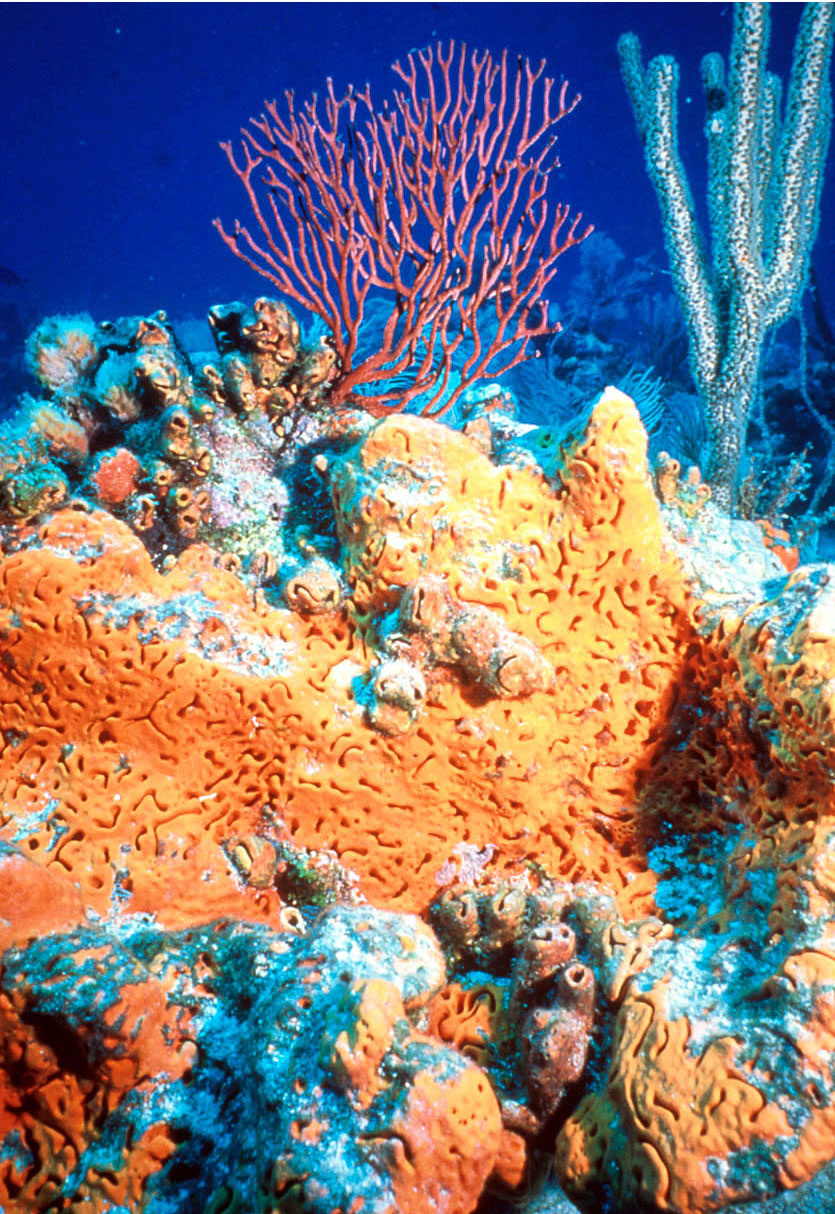 Orange Elephant Ear SpongeAgelas clathrodes
- Agelas flabelliformis
-
 Brown Tube SpongeAgelas conifera
-
 Citron SpongeAgelas citrina
-
 Agelas tubulata
- Agelas gracilis
- Agelas schmidtii
-
 Maltese SpongeAgelas oroides
Compare
Questions and answers
What is the habitat of sponges?
Agelas dispar inhabits shallow-water reefs.[9]
Sources
Passages the profile rests on
- Agelas dispar grows in massive, irregularly shaped mounds that may be bulbous or encrusting. Source passage: “Agelas dispar forms massive irregularly-shaped, sometimes bulbous mounds or may be encrusting.” — English Wikipedia
- Agelas dispar can reach a maximum width of approximately 30 cm. Source passage: “It can grow to as much as 30 cm (12 in) across.” — English Wikipedia
- Agelas dispar has a spongy but firm consistency. Source passage: “The consistency is spongy but firm;” — English Wikipedia
- The surface of Agelas dispar is smooth and contains numerous exhalent pores of irregular shapes and sizes, frequently located in shallow pits. Source passage: “the surface is smooth with many exhalent pores of irregular shape and size, often in shallow pits.” — English Wikipedia
- The external coloration of Agelas dispar ranges from pinkish-brown and reddish-brown to deep brown. Source passage: “The colour externally is pinkish-brown, reddish-brown or deep brown.” — English Wikipedia
- The interior of Agelas dispar contains large cavities, primary canals measuring 2–8 mm across, and narrow secondary canals. Source passage: “Internally there are large cavities, many primary canals 2 to 8 mm (0.1 to 0.3 in) across and narrow secondary canals.” — English Wikipedia
- Agelas dispar possesses a fibrous, tightly meshed skeleton composed of spongin with ascending and tangential fibres. Source passage: “There is a fibrous, tightly-meshed skeleton made of spongin with ascending and tangential fibres.” — English Wikipedia
- The spicules of Agelas dispar consist of bundles of acanthostyles with one blunt end and one pointed end covered in 7–12 whorls of spines. Source passage: “The spicules consist of bundles of acanthostyles (one end blunt, one end pointed and covered with 7 to 12 whorls of spines).” — English Wikipedia
- Agelas dispar inhabits shallow-water reefs. Source passage: “its preferred habitat is shallow-water reefs.” — English Wikipedia
- Agelas dispar occurs in the Caribbean Sea and around the West Indies. Source passage: “Agelas dispar is found in the Caribbean Sea and around the West Indies” — English Wikipedia
Data
- Catalogue of Life, 2026-10-16 XR cc by
- Global Biodiversity Information Facility CC BY 4.0
- Wikidata CC0
- GeoNames CC BY 4.0
- Within the Catalogue of Life, this name comes from World Porifera Database cc by
References
- Duchassaing de Fonbressin, P., & Michelotti, G. (1864). Spongiaires de la mer Caraibe. Natuurkundige Verhandelingen van de Hollandsche Maatschappij Der Wetenschappen Te Haarlem, 21. https://doi.org/10.5962/bhl.title.11943 Link where the name was published
This species in other databases
- Catalogue of Life 662F7
- Wikidata Q2458488
- iNaturalist 131681
- WoRMS urn:lsid:marinespecies.org:taxname:164827
- ITIS 47954
Page built on 28 November 2026. See how the catalog is made and all sources and licences.
Cite this page
ScientificNames.org. (2026). Agelas dispar. Retrieved November 28, 2026, from https://scientificnames.org/species/agelas-dispar
“Agelas dispar.” ScientificNames.org, 2026, scientificnames.org/species/agelas-dispar. Accessed 28 Nov. 2026.
ScientificNames.org. “Agelas dispar.” Accessed November 28, 2026. https://scientificnames.org/species/agelas-dispar.
@misc{scientificnames_agelas_dispar,
  author = {{ScientificNames.org}},
  title = {Agelas dispar},
  year = {2026},
  url = {https://scientificnames.org/species/agelas-dispar},
  note = {Accessed 2026-11-28}
}