Species · Birds
Violet-tailed Sylph Aglaiocercus coelestis
The scientific name of the Violet-tailed Sylph is Aglaiocercus coelestis. It is a species of bird in the family Trochilidae (hummingbird), order Apodiformes. The name dates from 1861.
- Scientific name
- Aglaiocercus coelestis (Gould, 1861)
- Common name
- Violet-tailed Sylph
- Genus
- Aglaiocercus
- Family
- Trochilidae (Hummingbird)
- Order
- Apodiformes
- Class
- Aves
- Red List category
- LC Least Concern
- Recorded in
- 4 countries
- Name status
- accepted in the Catalogue of Life
Overview
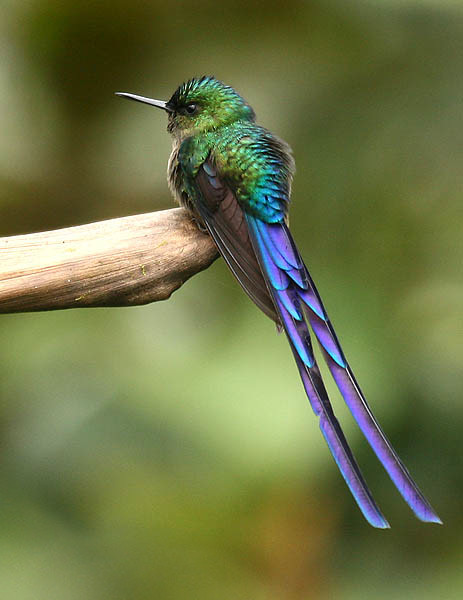
The Violet-tailed Sylph (Aglaiocercus coelestis) is a bird in the family Trochilidae, order Apodiformes, and class Aves. It occurs in Colombia and Ecuador. Males are mostly emerald green and have elongated, iridescent violet-and-blue forked tail feathers.
Written 26 November 2026 from the sources listed below. Each statement was checked against the passage it cites; statements that could not be supported were removed.
Conservation
The IUCN classifies the Violet-tailed Sylph as Least Concern. Its population size is unknown but is believed to be decreasing.[1][2]
The species is a common resident of cloudforests and occurs in several protected areas. It tolerates human-modified habitats when forest patches remain.[3][4]
Similar species
The genus Aglaiocercus includes the long-tailed sylph and Venezuelan sylph in addition to the Violet-tailed Sylph.[5]
Appearance
Adult males of the nominate subspecies have a shining green crown and back transitioning to violet-blue on the rump, a violet-blue gorget, and green underparts. Both subspecies have short black bills.[6][7][8]
Male Violet-tailed Sylphs have elongated outer tail feathers with iridescent metallic violet coloration and blue tips. They are mostly emerald green, with blue-green throats and iridescent purple-and-blue forked tails.[9][10]
Female nominate Violet-tailed Sylphs have a glittering blue crown and a whitish spot behind the eye. Their throats are white with green spots, and their underparts are cinnamon-rufous.[11][12]
Female nominate Violet-tailed Sylphs have short, unforked bluish-green tails with white tips on the outer feathers. Juveniles have dull green upperparts, buffy green underparts, and buffy fringes on their head feathers.[13][14]
Males of the subspecies A. c. aethereus have green gorgets, while females have lightly spotted throats.[15]
Habitat
Violet-tailed Sylphs inhabit cloudforests and semi-open landscapes, including forest-to-grassland transitions and grasslands containing trees and shrubs.[16]
The species occurs across an elevation range of approximately 300–2,100 metres and is found most frequently at approximately 1,000 metres.[17][18]
The nominate subspecies occurs from the Pacific slope of Colombia's Western Andes into northern and central Ecuador. A. c. aethereus occurs on the Pacific slope of the Andes in southwestern Ecuador, between El Oro and Loja provinces.[19][20]
Diet
The Violet-tailed Sylph feeds on nectar and small insects.[21]
Behaviour
The species generally forages close to the ground but also ascends into the canopy. It forages along circuits of flowering plants using trap-lining.[22][23]
Male Violet-tailed Sylphs defend specific feeding territories. They usually hover while feeding at flowers but frequently cling to them.[24][25]
The species captures insects by hawking from perches or gleaning them from vegetation.[26]
Violet-tailed Sylphs are generally sedentary but undertake seasonal elevational movements in response to flowering events. In southwestern Colombia, they dominate during the January–April dry season, while long-tailed sylphs largely replace them during the wet season.[27][28][29]
Outside the breeding season, Violet-tailed Sylphs use their nests as nighttime roosts.[30]
Reproduction and life cycle
The breeding season of Violet-tailed Sylphs extends from October through February. Both sexes participate in building the nest.[31][32]
The nest is a moss-and-spiderweb dome with a side entrance, placed in a clump of moss or epiphytes.[33]
Females incubate clutches of two white eggs. Chicks fledge approximately 26–30 days after hatching.[34][35]
Classification of the Violet-tailed Sylph
| Kingdom | Animalia |
|---|---|
| Phylum | Chordata |
| Subphylum | Vertebrata |
| Infraphylum | Gnathostomata |
| Parvphylum | Osteichthyes |
| Megaclass | Tetrapoda |
| Class | Aves (Bird) |
| Order | Apodiformes (Swifts) |
| Family | Trochilidae (Hummingbird) |
| Subfamily | Trochilinae |
| Genus | Aglaiocercus (Sylphs) |
| Species | Aglaiocercus coelestis (Gould, 1861) |
Where the Violet-tailed Sylph is found
Checklists and occurrence records place Aglaiocercus coelestis in 4 countries across South America. GBIF holds 40,500 georeferenced records of it.
Countries
Regions and cities with the most records
- Pichincha, Ecuador 25,141
- Risaralda Department, Colombia 7,964
- Chocó, Colombia 1,751
- Ciudad Bolívar, Colombia 1,566
- Nariño, Colombia 1,475
- Valle del Cauca Department, Colombia 1,382
- Belén de Umbría, Colombia 1,274
- El Oro, Ecuador 1,220
- Anserma, Colombia 1,206
- Piñas, Ecuador 1,205
- Quinchía, Colombia 1,103
- Antioquia, Colombia 206
- Cali, Colombia 203
- Imbabura, Ecuador 198
- Carchi, Ecuador 196
- Yumbo, Colombia 183
- Santo Domingo de los Tsáchilas, Ecuador 141
- Andes, Colombia 133
- Darien, Colombia 103
- Buenaventura, Colombia 89
- La Troncal, Ecuador 89
- Bolívar, Ecuador 88
- Canar, Ecuador 86
- Chimborazo Province, Ecuador 74
- Azuay, Ecuador 72
- Cauca Department, Colombia 58
- Guayas, Ecuador 52
- Frontino, Colombia 41
- Villa Rica, Colombia 40
- Pomasqui, Ecuador 33
- Cotopaxi, Ecuador 30
- Quito, Ecuador 28
- Naranjal, Ecuador 24
- Riosucio, Colombia 23
- Urrao, Colombia 17
- Supía, Colombia 15
Range as the checklists state it
South America
A number beside a place is its count of GBIF occurrence records. A place without a number comes from a checklist alone. Records show where a species has been observed or collected, which can include escapes and vagrants.
Common names
English
- Violet-tailed Sylph
Names in 26 other languages
- Arabic
- سيلف بنفسجي الذيل
- Catalan
- colibrí silf celest
- Chinese
- 紫長尾蜂鳥, 紫长尾蜂鸟
- Croatian
- ljubičastorepi kolibrić
- Czech
- sylfa fialovoocasá
- Danish
- Violethalet Sylfide
- Dutch
- Violetstaartnimf
- Esperanto
- violvosta silfkolibro
- Finnish
- säihkyhännyskolibri
- French
- Sylphe à queue violette
- German
- Langschwanzsylphe, Langschwanzsylve
- Hungarian
- kékfarkú fecskekolibri
- Italian
- Silfide codaviola
- Japanese
- ムラサキフタオハチドリ
- Lithuanian
- violetinis silfas
- Norwegian
- celestsylfe
- Polish
- komecik fioletowosterny
- Portuguese
- Beija-flor-de-cauda-violeta, silfo-de-cauda-violeta, silfo-ocidental
- Russian
- Длиннохвостый сильф, Фиолетовохвостый сильф
- Serbian
- Silfa kolibri ljubičastog repa
- Slovak
- vrchárik fialovec
- Spanish
- Cometa colivioleta, Silfo celeste, Silfo colivioleta
- Swedish
- violettstjärtad sylf
- Turkish
- Mor Kuyruklu Ormanperisi
- Ukrainian
- колібрі-сильф довгохвостий
- Welsh
- sylff gynffon fioled
Synonyms
One other scientific name has been used for this species and is now treated as a synonym of Aglaiocercus coelestis.
- Cynanthus coelestis Gould, 1861
Subspecies and varieties
- Aglaiocercus coelestis aethereus subspecies
- Aglaiocercus coelestis coelestis subspecies
Related species
-
 Long-tailed SylphAglaiocercus kingii
- Venezuelan SylphAglaiocercus berlepschi
-
 Bee HummingbirdMellisuga helenae
-
 Anna's HummingbirdCalypte anna
-
 Ruby-throated HummingbirdArchilochus colubris
-
 Rufous HummingbirdSelasphorus rufus
-
 White-booted Racket-tailOcreatus underwoodii
-
 Red-billed StreamertailTrochilus polytmus
Compare
Questions and answers
What is the scientific name of the Violet-tailed Sylph?
The scientific name of the Violet-tailed Sylph is Aglaiocercus coelestis. Written with its author, the full name is Aglaiocercus coelestis (Gould, 1861).
Which family does the Violet-tailed Sylph belong to?
Aglaiocercus coelestis belongs to the family Trochilidae, in the order Apodiformes and the class Aves.
Where is the Violet-tailed Sylph found?
Checklists and occurrence records place Aglaiocercus coelestis in 4 countries: Ecuador, Colombia, Venezuela and Peru.
What is the conservation status of the Violet-tailed Sylph?
The IUCN Red List category recorded for Aglaiocercus coelestis is Least Concern (LC).
What is the name of a purple bird?
The Violet-tailed Sylph is a bird with iridescent metallic violet outer tail feathers and blue tips in males.[9]
What is the scientific name for the bird species?
The scientific name of the Violet-tailed Sylph is Aglaiocercus coelestis (Gould, 1861).[36]
Sources
Passages the profile rests on
- The IUCN classifies the violet-tailed sylph as Least Concern. Source passage: “The IUCN has assessed the violet-tailed sylph as being of Least Concern.” — English Wikipedia
- The population size of the species is unknown but is believed to be decreasing. Source passage: “its population size is not known, but is believed to be decreasing.” — English Wikipedia
- The species is a common resident of cloudforests and occurs in several protected areas. Source passage: “It is a common cloudforest resident, occurs in several protected areas” — English Wikipedia
- The species tolerates human-modified habitats when forest patches remain. Source passage: “will tolerate areas of man-made habitats as long as patches of forest remain.” — English Wikipedia
- The genus Aglaiocercus includes the long-tailed sylph and Venezuelan sylph in addition to the violet-tailed sylph. Source passage: “The genus also includes two other sylphs, the long-tailed (A. kingii) and Venezuelan (A. berlepschi)” — English Wikipedia
- Adult males of the nominate subspecies have a shining green crown and back that transitions to violet-blue on the rump. Source passage: “Males of the nominate subspecies have a shining green crown and back, that becomes violet-blue on the rump.” — English Wikipedia
- Adult males of the nominate subspecies have a violet-blue gorget and green underparts. Source passage: “They have a buffy spot behind the eye, a violet-blue gorget, and green underparts.” — English Wikipedia
- Both subspecies have short black bills. Source passage: “Both subspecies have a short black bill.” — English Wikipedia
- Male violet-tailed sylphs have elongated outer tail feathers with iridescent metallic violet coloration and blue tips. Source passage: “The inner tail feathers are short and the outer ones very long, and the feathers are iridescent metallic violet with blue tips.” — English Wikipedia
- Male violet-tailed sylphs are mostly emerald green with blue-green throats and iridescent purple-and-blue forked tails. Source passage: “Male is mostly emerald green with blue-green throat. Long forked tail is iridescent purple and blue.” — ebird.org
- Female nominate violet-tailed sylphs have a glittering blue crown and a whitish spot behind the eye. Source passage: “Nominate females have a glittering blue crown and a whitish spot behind the eye;” — English Wikipedia
- Female nominate violet-tailed sylphs have white throats with green spots and cinnamon-rufous underparts. Source passage: “Their throat is white with green spots and is separated by a white band from the cinnamon-rufous underparts.” — English Wikipedia
- Female nominate violet-tailed sylphs have short, unforked bluish-green tails with white tips on the outer feathers. Source passage: “Their tail is short and unforked, bluish green with white tips on the outer feathers.” — English Wikipedia
- Juveniles have dull green upperparts, buffy green underparts, and buffy fringes on their head feathers. Source passage: “Juveniles have dull green upperparts, buffy green underparts, and buffy fringes on the head feathers.” — English Wikipedia
- The subspecies A. c. aethereus has males with green gorgets and females with lightly spotted throats. Source passage: “Males of subspecies A. c. aethereus have a green gorget and females a lightly spotted throat” — English Wikipedia
- Violet-tailed sylphs inhabit cloudforests and semi-open landscapes, including forest-to-grassland transitions and grasslands containing trees and shrubs. Source passage: “The species inhabits cloudforest and semi-open landscapes like the transition of forest to grassland and grassland with trees and shrubs.” — English Wikipedia
- The species occurs most frequently at approximately 1,000 metres elevation. Source passage: “It is most numerous at about 1,000 m (3,300 ft) of elevation” — English Wikipedia
- The species occurs across an elevation range of approximately 300–2,100 metres. Source passage: “but occurs as low as 300 m (980 ft) and as high as 2,100 m (6,900 ft).” — English Wikipedia
- The nominate subspecies occurs from the Pacific slope of Colombia's Western Andes into northern and central Ecuador. Source passage: “The nominate subspecies of violet-tailed sylph is found from the Pacific slope of Colombia's Western Andes into north and central Ecuador.” — English Wikipedia
- The subspecies A. c. aethereus occurs on the Pacific slope of the Andes in southwestern Ecuador, between El Oro and Loja provinces. Source passage: “A. c. aethereus is found on the Andes' Pacific slope in southwestern Ecuador between El Oro and Loja provinces.” — English Wikipedia
- The violet-tailed sylph feeds on nectar and small insects. Source passage: “The violet-tailed sylph's diet is nectar and small insects.” — English Wikipedia
- The species generally forages close to the ground but also ascends into the canopy. Source passage: “It mostly forages near the ground but does ascend to the canopy.” — English Wikipedia
- Violet-tailed sylphs forage along circuits of flowering plants using trap-lining. Source passage: “It uses trap-lining around a circuit of flowering plants” — English Wikipedia
- Male violet-tailed sylphs defend specific feeding territories. Source passage: “males also will defend specific feeding territories.” — English Wikipedia
- Violet-tailed sylphs usually hover while feeding at flowers but frequently cling to the flowers. Source passage: “It usually hovers at flowers to feed but often clings to them.” — English Wikipedia
- The species captures insects by hawking from perches or gleaning them from vegetation. Source passage: “It catches insects by hawking from a perch or by gleaning from vegetation.” — English Wikipedia
- Violet-tailed sylphs are generally sedentary but undertake seasonal elevational movements in response to flowering events. Source passage: “The violet-tailed sylph is generally sedentary but makes some seasonal elevational movements to follow flowering events.” — English Wikipedia
- In southwestern Colombia, violet-tailed sylphs dominate during the January–April dry season. Source passage: “In southwestern Colombia it is dominant during the dry season of January to April” — English Wikipedia
- In southwestern Colombia, long-tailed sylphs largely replace violet-tailed sylphs during the wet season. Source passage: “but is largely replaced by the long-tailed sylph during the wet season.” — English Wikipedia
- Outside the breeding season, violet-tailed sylphs use their nests as nighttime roosts. Source passage: “Nests are used for night roosts outside the breeding season.” — English Wikipedia
- The breeding season of violet-tailed sylphs extends from October through February. Source passage: “The violet-tailed sylph's breeding season spans from October to February.” — English Wikipedia
- Both sexes participate in building the nest. Source passage: “Both sexes build the nest” — English Wikipedia
- The nest is a moss-and-spiderweb dome with a side entrance, placed in a clump of moss or epiphytes. Source passage: “a dome of moss and spiderweb with a side entrance placed in a clump of moss or epiphytes.” — English Wikipedia
- Female violet-tailed sylphs incubate clutches of two white eggs. Source passage: “The female incubates the two white eggs” — English Wikipedia
- Violet-tailed sylph chicks fledge approximately 26–30 days after hatching. Source passage: “fledging occurs 26 to 30 days after hatch.” — English Wikipedia
- The violet-tailed sylph has two recognized subspecies, A. c. coelestis and A. c. aethereus. Source passage: “The violet-tailed sylph has two subspecies, the nominate A. c. coelestis and A. c. aethereus.” — English Wikipedia
Data
- Catalogue of Life, 2026-10-16 XR cc by
- Global Biodiversity Information Facility CC BY 4.0
- Wikidata CC0
- GeoNames CC BY 4.0
- Wikimedia Commons per image; credit shown with each image
- Within the Catalogue of Life, this name comes from The Integrated Taxonomic Information System cc0
References
- Gill, Frank, & and Minturn Wright. (2006). Birds of the World: Recommended English Names.
This species in other databases
Page built on 29 November 2026. See how the catalog is made and all sources and licences.
Cite this page
ScientificNames.org. (2026). Aglaiocercus coelestis (Violet-tailed Sylph). Retrieved November 29, 2026, from https://scientificnames.org/species/aglaiocercus-coelestis
“Aglaiocercus coelestis (Violet-tailed Sylph).” ScientificNames.org, 2026, scientificnames.org/species/aglaiocercus-coelestis. Accessed 29 Nov. 2026.
ScientificNames.org. “Aglaiocercus coelestis (Violet-tailed Sylph).” Accessed November 29, 2026. https://scientificnames.org/species/aglaiocercus-coelestis.
@misc{scientificnames_aglaiocercus_coelestis_violet_tailed_sylph,
  author = {{ScientificNames.org}},
  title = {Aglaiocercus coelestis (Violet-tailed Sylph)},
  year = {2026},
  url = {https://scientificnames.org/species/aglaiocercus-coelestis},
  note = {Accessed 2026-11-29}
}