Species · Birds
Long-tailed Sylph Aglaiocercus kingii
The scientific name of the Long-tailed Sylph is Aglaiocercus kingii. It is a species of bird in the family Trochilidae (hummingbird), order Apodiformes. The name dates from 1832.
- Scientific name
- Aglaiocercus kingii (R. Lesson, 1832)
- Common name
- Long-tailed Sylph
- Genus
- Aglaiocercus
- Family
- Trochilidae (Hummingbird)
- Order
- Apodiformes
- Class
- Aves
- Red List category
- LC Least Concern
- Recorded in
- 6 countries
- Name status
- accepted in the Catalogue of Life

Overview
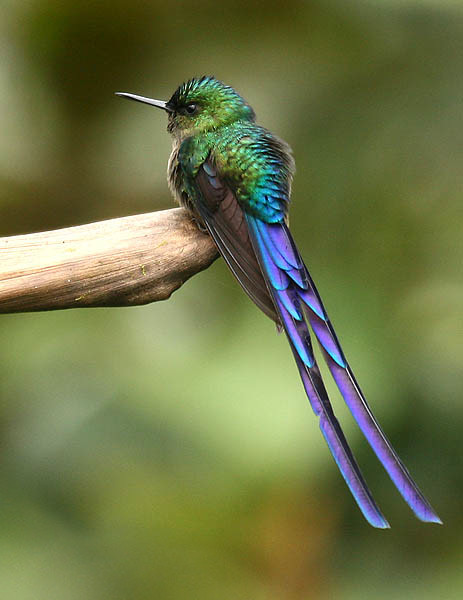
The Long-tailed Sylph (Aglaiocercus kingii) is a bird in the family Trochilidae, order Apodiformes, and class Aves. The species occurs in Bolivia, Colombia, Ecuador, Peru, and Venezuela. Males have very long outer tail feathers, which measure 12 cm.
Written 26 November 2026 from the sources listed below. Each statement was checked against the passage it cites; statements that could not be supported were removed.
Similar species
The genus Aglaiocercus includes the violet-tailed sylph and Venezuelan sylph in addition to the Long-tailed Sylph. Taxonomists have generally adopted a three-species treatment of the genus since at least the early 2000s.[1][2]
Appearance
All subspecies have a short black bill. Males measure 16–19 cm in total length, including outer tail feathers measuring 12 cm, and weigh 5–6 g.[3][4][5]
Females measure 9.7–11.7 cm in length and weigh 4.5–4.7 g.[6][7]
Males of the nominate subspecies have an emerald-green crown and metallic bronzy-green upperparts. Their underparts are duller green with an olive cast, and their throat is blue or violet.[8][9]
The nominate male has very short inner tail feathers and very long outer tail feathers. The upper surface of the tail is iridescent blue, green, and violet, while its underside is bluish black.[10][11][12]
Nominate females have a short, somewhat forked tail with dark-blue outer feathers broadly tipped with white. Their head is metallic green with a white malar stripe, and their white to buffy throat has green speckles.[13][14][15]
Nominate females have cinnamon-colored underparts.[16]
Male A. k. margarethae individuals have paler green upperparts than nominate males. Male A. k. caudatus individuals lack the blue throat characteristic of nominate males.[17][18]
A. k. emmae individuals have a somewhat longer bill than nominate individuals. Males have paler, duller green plumage and a bright-green throat, while females have more green spots on their white throat than nominate females.[19][20][21]
A. k. mocoa individuals have shinier green upperparts and a sapphire-blue to purple throat. A. k. smaragdinus individuals have a shorter tail than nominate individuals and a greenish-blue throat.[22][23][24]
Habitat
The Long-tailed Sylph inhabits scrublands, clearings, forest edges, gardens, and secondary forests. It also occurs in high-elevation grassland.[25][26][27]
The species occurs at elevations between 900 and 3,000 m and is associated with subtropical or tropical moist natural habitats.[28][29]
Diet
The Long-tailed Sylph feeds on nectar and insects. It uses trap-lining along circuits of flowering plants to feed on nectar and also defends specific nectar-feeding territories.[30][31][32]
The species usually hovers at flowers while feeding but sometimes clings to them. It sometimes obtains nectar by piercing the base of flowers.[33][34][35]
The species catches insects by hawking from a perch.[36]
Behaviour
At lower elevations, the species feeds mainly in treetops. In elfin forest and high-elevation grassland, it feeds closer to the ground.[37][38]
Andean populations make seasonal movements between lower and higher elevations. A. k. caudatus is thought to migrate between Venezuela and Colombia.[39][40]
On the Pacific side of southwestern Colombia, A. k. emmae apparently occurs only during the wet season.[41]
The species' apparent song consists of a continuous series of buzzy notes. It has a repeated short, buzzy or raspy call, a drawn-out, higher-pitched vocalization, and a thin, high-pitched rising twitter.[42][43][44][45]
Reproduction and life cycle
The known breeding season extends from February through October, although the species is believed to breed throughout the year.[46][47]
Males construct bulky dome-shaped nests from moss and plant fibers. Each nest has a side entrance and is attached to a branch or twig, concealed by leaves.[48][49][50]
Females incubate two white eggs for 15–17 days. Young birds fledge 21–24 days after hatching.[51][52]
Conservation
The Long-tailed Sylph is classified as Least Concern by the IUCN and has a very large geographic range. It is common to abundant across much of its range and occurs in several protected areas.[53][54][55][56]
The population size is unknown and is believed to be decreasing. Habitat clearing for cattle raising in Colombia and Ecuador is a potential threat.[57][58]
The species was assessed for the IUCN Red List in 2024.[59]
Classification of the Long-tailed Sylph
| Kingdom | Animalia |
|---|---|
| Phylum | Chordata |
| Subphylum | Vertebrata |
| Infraphylum | Gnathostomata |
| Parvphylum | Osteichthyes |
| Megaclass | Tetrapoda |
| Class | Aves (Bird) |
| Order | Apodiformes (Swifts) |
| Family | Trochilidae (Hummingbird) |
| Subfamily | Trochilinae |
| Genus | Aglaiocercus (Sylphs) |
| Species | Aglaiocercus kingii (R. Lesson, 1832) |
Where the Long-tailed Sylph is found
Checklists and occurrence records place Aglaiocercus kingii in 6 countries across South America. GBIF holds 57,058 georeferenced records of it.
Countries
Regions and cities with the most records
- Napo, Ecuador 13,852
- Caldas Department, Colombia 7,566
- Villamaría, Colombia 6,321
- Manizales, Colombia 6,313
- Valle del Cauca Department, Colombia 5,291
- Cali, Colombia 4,729
- Neira, Colombia 4,575
- Cuzco Department, Peru 4,467
- Yumbo, Colombia 4,425
- Tolima Department, Colombia 2,627
- Amazonas, Peru 2,573
- Cundinamarca, Colombia 2,394
- Antioquia, Colombia 2,383
- Chinchiná, Colombia 1,610
- Quindío Department, Colombia 1,540
- Riosucio, Colombia 1,389
- Manzanares, Colombia 1,261
- Supía, Colombia 1,254
- Circasia, Colombia 1,224
- Zamora Chinchipe, Ecuador 1,131
- Sibaté, Colombia 1,030
- Anserma, Colombia 914
- Padua, Colombia 910
- Risaralda Department, Colombia 883
- Quinchía, Colombia 877
- Andes, Colombia 861
- Fresno, Colombia 861
- Cauca Department, Colombia 788
- Tungurahua Province, Ecuador 786
- Huila Department, Colombia 752
- Soacha, Colombia 748
- Mariara, Venezuela 714
- Madrid, Colombia 712
- El Limón, Venezuela 711
- Putumayo Department, Colombia 710
- Maracay, Venezuela 703
1 more country has a few records outside this range
These countries hold a few records of Aglaiocercus kingii but lie outside the range the checklists give for it. Such records are often zoo or garden specimens, museum material or vagrants, so the species is not counted as occurring there.
Range as the checklists state it
South America
A number beside a place is its count of GBIF occurrence records. A place without a number comes from a checklist alone. Records show where a species has been observed or collected, which can include escapes and vagrants.
Common names
English
- Long-tailed Sylph
Names in 25 other languages
- Arabic
- سيلف طويل الذيل
- Catalan
- colibrí silf de King
- Chinese
- 長尾蜂鳥, 长尾蜂鸟
- Croatian
- azurnorepi kolibrić
- Czech
- sylfa Kingova, sylfa dlouhoocasá
- Danish
- Langhalet Sylfide
- Dutch
- Langstaartnimf
- Esperanto
- bluvosta silfkolibro
- Finnish
- turkoosihännyskolibri
- French
- Sylphe à queue d'azur, Sylphe à queue d’azur
- German
- Himmelssylphe
- Hungarian
- fecskekolibri
- Italian
- Silfide codalunga
- Japanese
- アオフタオハチドリ
- Lithuanian
- ilgauodegis silfas
- Norwegian
- andessylfe
- Polish
- komecik długosterny
- Portuguese
- silfo-de-cauda-azul, silfo-rabilongo
- Russian
- Небесный сильф
- Serbian
- Dugorepi silfa kolibri
- Slovak
- vrchárik zelený
- Spanish
- Colibrí Coludo Azul, Cometa verdiazul, Silfo de Cola Larga, Silfo de King
- Swedish
- grönstjärtad sylf
- Turkish
- Gök Kuyruklu Ormanperisi
- Ukrainian
- колібрі-сильф королівський
Synonyms
3 other scientific names have been used for this species and are now treated as synonyms of Aglaiocercus kingii.
- Aglaiocercus kingi (R. Lesson, 1832)
- Heliangelus zusii G. R. Graves, 1993
- Trochilus kingi R. Lesson, 1832
Subspecies and varieties
- Aglaiocercus kingii caudatus subspecies
- Aglaiocercus kingii emmae subspecies
- Aglaiocercus kingii kingii subspecies
- Aglaiocercus kingii margarethae subspecies
- Aglaiocercus kingii mocoa subspecies
- Aglaiocercus kingii smaragdinus subspecies
Related species
-
 Violet-tailed SylphAglaiocercus coelestis
- Venezuelan SylphAglaiocercus berlepschi
-
 Bee HummingbirdMellisuga helenae
-
 Anna's HummingbirdCalypte anna
-
 Ruby-throated HummingbirdArchilochus colubris
-
 Rufous HummingbirdSelasphorus rufus
-
 White-booted Racket-tailOcreatus underwoodii
-
 Red-billed StreamertailTrochilus polytmus
Compare
Questions and answers
What is the scientific name of the Long-tailed Sylph?
The scientific name of the Long-tailed Sylph is Aglaiocercus kingii. Written with its author, the full name is Aglaiocercus kingii (R. Lesson, 1832).
Which family does the Long-tailed Sylph belong to?
Aglaiocercus kingii belongs to the family Trochilidae, in the order Apodiformes and the class Aves.
Where is the Long-tailed Sylph found?
Checklists and occurrence records place Aglaiocercus kingii in 6 countries: Colombia, Ecuador, Peru, Venezuela, Bolivia and Brazil.
What is the conservation status of the Long-tailed Sylph?
The IUCN Red List category recorded for Aglaiocercus kingii is Least Concern (LC).
Sources
Passages the profile rests on
- The genus Aglaiocercus includes the violet-tailed sylph and Venezuelan sylph in addition to the long-tailed sylph. Source passage: “The genus also includes two other sylphs, the violet-tailed (A. coelestis) and Venezuelan (A. berlepschi)” — English Wikipedia
- Taxonomists have generally adopted a three-species treatment of the genus since at least the early 2000s. Source passage: “Since at least the early 2000s taxonomists have settled on the three-species treatment.” — English Wikipedia
- All subspecies have a short black bill. Source passage: “All subspecies have a short black bill.” — English Wikipedia
- Males measure 16–19 cm in total length, including outer tail feathers measuring 12 cm. Source passage: “The male long-tailed sylphs are 16 to 19 cm (6.3 to 7.5 in) long including the 12 cm (4.7 in) outer tail feathers” — English Wikipedia
- Male individuals weigh 5–6 g. Source passage: “and weigh 5 to 6 g (0.18 to 0.21 oz).” — English Wikipedia
- Females measure 9.7–11.7 cm in length. Source passage: “Females are 9.7 to 11.7 cm (3.8 to 4.6 in) long” — English Wikipedia
- Female individuals weigh 4.5–4.7 g. Source passage: “and weigh 4.5 to 4.7 g (0.16 to 0.17 oz).” — English Wikipedia
- Males of the nominate subspecies have an emerald-green crown and metallic bronzy-green upperparts. Source passage: “Males of the nominate subspecies A. k. kingii have a shining emerald green crown, metallic bronzy green upperparts” — English Wikipedia
- Males of the nominate subspecies have duller green underparts with an olive cast and a blue or violet throat. Source passage: “duller green underparts with an olive cast, and a blue or violet throat.” — English Wikipedia
- The nominate male has very short inner tail feathers and very long outer tail feathers. Source passage: “The inner tail feathers are very short and the outer ones very long.” — English Wikipedia
- The upper surface of the nominate male's tail is iridescent blue, green, and violet. Source passage: “The tail's upper surface is iridescent blue, green, and violet” — English Wikipedia
- The underside of the nominate male's tail is bluish black. Source passage: “and the underside bluish black.” — English Wikipedia
- Nominate females have a short, somewhat forked tail with dark-blue outer feathers broadly tipped with white. Source passage: “Their tail is short and somewhat forked, with dark blue outer feathers broadly tipped with white.” — English Wikipedia
- Nominate females have a metallic-green head with a white malar stripe. Source passage: “The head is metallic green with a white malar stripe” — English Wikipedia
- Nominate females have a white to buffy throat marked with green speckles. Source passage: “and a white to buffy throat with green speckles.” — English Wikipedia
- Nominate females have cinnamon-colored underparts. Source passage: “The underparts are cinnamon.” — English Wikipedia
- Male A. k. margarethae individuals have paler green upperparts than nominate males. Source passage: “Males of subspecies A. k. margarethae have paler green upperparts than the nominate” — English Wikipedia
- Male A. k. caudatus individuals lack the blue throat characteristic of nominate males. Source passage: “A. k. caudatus does not have the nominate's blue throat” — English Wikipedia
- A. k. emmae individuals have a somewhat longer bill than nominate individuals. Source passage: “A. k. emmae has a somewhat longer bill than the nominate.” — English Wikipedia
- Male A. k. emmae individuals have paler, duller green plumage and a bright-green throat. Source passage: “Males are a paler and duller green and have a bright green throat” — English Wikipedia
- Female A. k. emmae individuals have more green spots on their white throat than nominate females. Source passage: “females have more green spots on a white throat.” — English Wikipedia
- A. k. mocoa individuals have shinier green upperparts and a sapphire-blue to purple throat. Source passage: “A. k. mocoa's upperparts are a shinier green than the nominate and a sapphire blue to purple throat.” — English Wikipedia
- A. k. smaragdinus individuals have a shorter tail than nominate individuals. Source passage: “A. k. smaragdinus has a shorter tail than the nominate” — English Wikipedia
- A. k. smaragdinus individuals have a greenish-blue throat. Source passage: “and a greenish blue throat.” — English Wikipedia
- The species inhabits scrublands, clearings, and forest edges. Source passage: “scrublands, clearings and edges of forest” — English Wikipedia
- The species also inhabits gardens and secondary forests. Source passage: “gardens, secondary forest” — English Wikipedia
- The species occurs in high-elevation grassland. Source passage: “and high-elevation grassland.” — English Wikipedia
- The species occurs at elevations between 900 and 3,000 m. Source passage: “In elevation it ranges between 900 and 3,000 m (3,000 and 9,800 ft).” — English Wikipedia
- The species is associated with subtropical or tropical moist natural habitats. Source passage: “Its natural habitat is subtropical or tropical moist ...” — inaturalist.org
- The species feeds on nectar and insects. Source passage: “The long-tailed sylph's diet is nectar and insects.” — English Wikipedia
- The species uses trap-lining along circuits of flowering plants to feed on nectar. Source passage: “It uses trap-lining around a circuit of flowering plants” — English Wikipedia
- The species also defends specific nectar-feeding territories. Source passage: “but also will defend specific feeding territories.” — English Wikipedia
- The species usually hovers at flowers while feeding. Source passage: “It usually hovers at flowers to feed” — English Wikipedia
- The species sometimes clings to flowers while feeding. Source passage: “but sometimes clings to them” — English Wikipedia
- The species sometimes obtains nectar by piercing the base of flowers. Source passage: “and also "robs" nectar by piercing the base of a flower.” — English Wikipedia
- The species catches insects by hawking from a perch. Source passage: “It catches insects by hawking from a perch.” — English Wikipedia
- At lower elevations, the species feeds mainly in treetops. Source passage: “At lower elevations it feeds mostly in the treetops” — English Wikipedia
- In elfin forest and high-elevation grassland, the species feeds closer to the ground. Source passage: “and lower to the ground at elfin forest and high-elevation grassland.” — English Wikipedia
- Andean populations make seasonal movements between lower and higher elevations. Source passage: “Populations in the Andes make seasonal movements between lower and higher elevations.” — English Wikipedia
- A. k. caudatus is thought to migrate between Venezuela and Colombia. Source passage: “A. k. caudatus is thought to migrate between Venezuela and Colombia.” — English Wikipedia
- On the Pacific side of southwestern Colombia, A. k. emmae apparently occurs only during the wet season. Source passage: “On the Pacific side of southwestern Colombia, A. k. emmae apparently is present only in the wet season” — English Wikipedia
- The species' apparent song consists of a continuous series of buzzy notes. Source passage: “a continuous series of buzzy notes 'bzzt...bzzt...bzzt...'.” — English Wikipedia
- The species has a repeated short, buzzy or raspy call. Source passage: “a repeated, short, buzzy or raspy 'dzzrt'” — English Wikipedia
- One of the species' calls is a drawn-out, higher-pitched vocalization. Source passage: “a more drawn-out, higher-pitched 'bzzeeew'” — English Wikipedia
- The species also produces a thin, high-pitched rising twitter. Source passage: “a thin high-pitched rising twittering.” — English Wikipedia
- The known breeding season extends from February through October. Source passage: “The long-tailed sylph's breeding season is known to span February to October” — English Wikipedia
- The species is believed to breed throughout the year. Source passage: “but the species is believed to breed at any time of year.” — English Wikipedia
- Males construct bulky dome-shaped nests from moss and plant fibers. Source passage: “Males build the nest, a bulky dome of moss and plant fibers” — English Wikipedia
- The nest has a side entrance. Source passage: “with a side entrance.” — English Wikipedia
- The nest is attached to a branch or twig and concealed by leaves. Source passage: “It is attached to a branch or twig where hidden by leaves.” — English Wikipedia
- Females incubate two white eggs for 15–17 days. Source passage: “The female incubates the two white eggs for 15 to 17 days” — English Wikipedia
- Young birds fledge 21–24 days after hatching. Source passage: “fledging occurs 21 to 24 days after hatch.” — English Wikipedia
- The species is classified as Least Concern by the IUCN. Source passage: “The IUCN has assessed the long-tailed sylph as being of Least Concern.” — English Wikipedia
- The species has a very large geographic range. Source passage: “It has a very large range” — English Wikipedia
- The species is common to abundant across much of its range. Source passage: “It is common to abundant in much of its range” — English Wikipedia
- The species occurs in several protected areas. Source passage: “and occurs in several protected areas.” — English Wikipedia
- The population size is unknown and is believed to be decreasing. Source passage: “but its population size is not known and is believed to be decreasing.” — English Wikipedia
- Habitat clearing for cattle raising in Colombia and Ecuador is a potential threat to the species. Source passage: “habitat clearing for cattle raising in Colombia and Ecuador is a potential threat.” — English Wikipedia
- The species was assessed for the IUCN Red List in 2024. Source passage: “Long-tailed Sylph Aglaiocercus kingii has most recently been assessed for The IUCN Red List of Threatened Species in 2024.” — iucnredlist.org
Data
- Catalogue of Life, 2026-10-16 XR cc by
- Global Biodiversity Information Facility CC BY 4.0
- Wikidata CC0
- GeoNames CC BY 4.0
- Wikimedia Commons per image; credit shown with each image
- Within the Catalogue of Life, this name comes from The Integrated Taxonomic Information System cc0
This species in other databases
Page built on 26 November 2026. See how the catalog is made and all sources and licences.
Cite this page
ScientificNames.org. (2026). Aglaiocercus kingii (Long-tailed Sylph). Retrieved November 26, 2026, from https://scientificnames.org/species/aglaiocercus-kingii
“Aglaiocercus kingii (Long-tailed Sylph).” ScientificNames.org, 2026, scientificnames.org/species/aglaiocercus-kingii. Accessed 26 Nov. 2026.
ScientificNames.org. “Aglaiocercus kingii (Long-tailed Sylph).” Accessed November 26, 2026. https://scientificnames.org/species/aglaiocercus-kingii.
@misc{scientificnames_aglaiocercus_kingii_long_tailed_sylph,
  author = {{ScientificNames.org}},
  title = {Aglaiocercus kingii (Long-tailed Sylph)},
  year = {2026},
  url = {https://scientificnames.org/species/aglaiocercus-kingii},
  note = {Accessed 2026-11-26}
}