Species · Insects
Lined Click Beetle Agriotes lineatus
The scientific name of the Lined Click Beetle is Agriotes lineatus. It is a species of insect in the family Elateridae (click beetle), order Coleoptera.
- Scientific name
- Agriotes lineatus (Linnaeus)
- Common name
- Lined Click Beetle
- Genus
- Agriotes
- Family
- Elateridae (Click Beetle)
- Order
- Coleoptera
- Class
- Insecta
- Recorded in
- 29 countries
- Name status
- accepted in the Catalogue of Life

Overview
Agriotes lineatus is native and common across most of Europe and occurs in parts of western Asia and the Near East. It is distinguished by alternating brown-black and lighter brown longitudinal stripes on its elytra.
Written 26 November 2026 from the sources listed below. Each statement was checked against the passage it cites; statements that could not be supported were removed.
Appearance
Adult lined click beetles are typically brownish black. Their elytra have alternating brown-black and lighter brown longitudinal stripes.[1][2]
The pronotum is domed and usually as long as or slightly longer than it is wide. The antennae and the portions of the legs beyond the tibiae are usually lighter brown.[3][4]
Adult beetles measure approximately 7.5–11 mm in length.[5]
Habitat
The species naturally occurs in non-farmed areas and grasslands.[6]
In Austria, larvae have mainly been found at elevations of 400–500 metres above sea level. Their occurrence is associated with lower temperatures, higher winter precipitation, and acidic, humus-rich soils.[7][8]
In Croatia, soil humus content was the strongest predictor of the species' abundance.[9]
Diet
Adult lined click beetles feed on grass leaves.[10]
The larvae feed on plant roots, seeds, and tubers. Their food includes the roots and seeds of cereals such as maize and wheat, as well as the tubers of sugar beet and potatoes.[11][12][13]
Behaviour
Adult beetles emerge in spring and begin laying eggs in the soil near its surface. Adults and other Agriotes beetles invade agricultural fields from nearby grasslands and non-farmed areas.[14][15]
Reproduction and life cycle
In central Germany, egg laying begins in April and peaks in May and June. Larvae emerge from the eggs approximately three weeks after they are laid.[16][17]
The larvae undergo approximately 12 instars before pupating in the soil. The pupal stage lasts approximately three to four weeks.[18][19]
Similar species
Agriotes proximus is the most similar species to Agriotes lineatus. The two species share more than 99% similarity in their mitochondrial cytochrome c oxidase subunit I gene.[20][21]
The larvae of Agriotes lineatus and Agriotes proximus cannot be distinguished morphologically. Agriotes lineatus larvae are also very similar to those of Agriotes obscurus and are often difficult to distinguish.[22][23]
Classification of the Lined Click Beetle
| Kingdom | Animalia |
|---|---|
| Phylum | Arthropoda |
| Subphylum | Hexapoda |
| Class | Insecta (Insect) |
| Order | Coleoptera (Beetle) |
| Suborder | Polyphaga |
| Series | Elateriformia |
| Superfamily | Elateroidea |
| Family | Elateridae (Click Beetle) |
| Subfamily | Elaterinae |
| Tribe | Agriotini |
| Subtribe | Agriotina |
| Genus | Agriotes |
| Species | Agriotes lineatus (Linnaeus) |
This name was added to the Catalogue of Life from a contributing dataset by automated merging and has not yet been reviewed by its editors.
Where the Lined Click Beetle is found
Checklists and occurrence records place Agriotes lineatus in 29 countries. GBIF holds 7,877 georeferenced records of it.
Countries
- Aland Islands 7
- Austria 71
- Belarus 5
- Belgium 54
- Canada 339
- Czechia 6
- Denmark 58
- Estonia 344
- Finland 221
- France 903
- Germany 463
- Greece 5
- Hungary 29
- Ireland 19
- Italy 9
- Latvia 45
- Lithuania 52
- Luxembourg 44
- Norway 186
- Poland 55
- Russia 212
- Serbia 8
- Spain 11
- Sweden 914
- Switzerland 635
- The Netherlands 1,209
- Ukraine 63
- United Kingdom 1,821
- United States 89
Regions and cities with the most records
- England, United Kingdom 1,448
- Île-de-France, France 327
- Wales, United Kingdom 315
- British Columbia, Canada 303
- Centre-Val de Loire, France 176
- Västra Götaland, Sweden 175
- Pijnacker, The Netherlands 172
- Rambouillet, France 170
- Benthuizen, The Netherlands 167
- Maurepas, France 165
- Berkel en Rodenrijs, The Netherlands 163
- Zoetermeer, The Netherlands 161
- Nootdorp, The Netherlands 159
- Bergschenhoek, The Netherlands 158
- Delft, The Netherlands 153
- Vaud, Switzerland 150
- Ypenburg, The Netherlands 150
- Voorschoten, The Netherlands 145
- Voorburg, The Netherlands 144
- Skåne, Sweden 143
- Élancourt, France 142
- Waddinxveen, The Netherlands 140
- Tartu, Estonia 138
- Rijswijk, The Netherlands 135
- Wassenaar, The Netherlands 133
- Tartu, Estonia 132
- The Hague, The Netherlands 132
- Leiderdorp, The Netherlands 131
- Utrecht, The Netherlands 131
- Alphen aan den Rijn, The Netherlands 129
- Biel/Bienne, Switzerland 127
- Bodegraven, The Netherlands 125
- Boskoop, The Netherlands 124
- Rotterdam, The Netherlands 122
- Plaisir, France 121
- Maarssen, The Netherlands 120
1 more country has a few records outside this range
These countries hold a few records of Agriotes lineatus but lie outside the range the checklists give for it. Such records are often zoo or garden specimens, museum material or vagrants, so the species is not counted as occurring there.
A number beside a place is its count of GBIF occurrence records. A place without a number comes from a checklist alone. Records show where a species has been observed or collected, which can include escapes and vagrants.
Common names
English
- Lined Click Beetle
Names in 15 other languages
- Bulgarian
- Обикновен полски ковач
- Czech
- kovařík obilní
- Danish
- Almindelig kornsmælder, Gul smælder, Kornsmælder, Stribet kornsmælder, Stribet sædsmælder
- Dutch
- Gestreepte akkerkniptor, Gestreepte kniptor
- Finnish
- juovaviljaseppä
- French
- Agriote rayé, Taupin des moissons, taupin rayé
- German
- Saat-Schnellkäfer, Saatschnellkäfer
- Hungarian
- vetési pattanó
- Lithuanian
- Juostuotasis dirvaspragšis, Juostuotasis dirvasprakšis
- Norwegian Bokmål
- Stripet kornsmeller, stripesmeller
- Polish
- Osiewnik rolowiec
- Russian
- Полосатый посевной щелкун, Щелкун линованный, Щелкун посевной полосатый
- Slovak
- kováčik obilný
- Swedish
- randig sädesknäppare
- Turkish
- Pamuk Telkurdu
Synonyms
6 other scientific names have been used for this species and are now treated as synonyms of Agriotes lineatus.
- Agriotes segetis (Bierkander, 1779)
- Elater lineatus Linnaeus, 1767
- Elater segetis Bjerkander, 1779
- Elater striatus Fabricius, 1775
- Elater striolatus Fabricius, 1803
- Elater suecicus Gmelin, 1790
Related species
-
 Spitting Click BeetleAgriotes sputator
-
 Dusky WirewormAgriotes obscurus
-
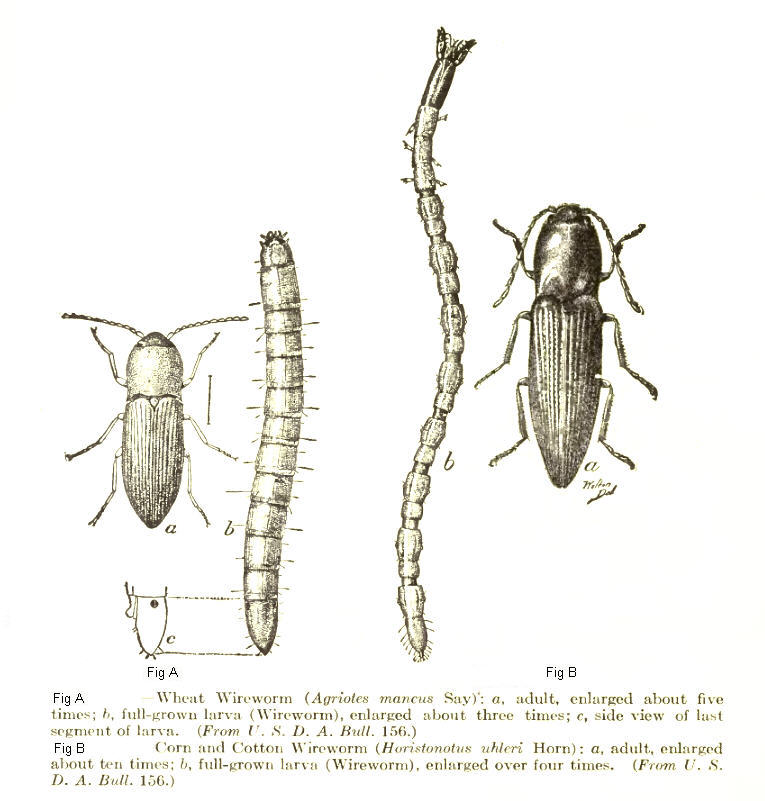 Wheat WirewormAgriotes mancus
-
 Agriotes sordidus
- Western Click BeetleAgriotes ustulatus
-
 Agriotes pallidulus
- Agriotes proximus
- Agriotes brevis
Compare
Questions and answers
What is the scientific name of the Lined Click Beetle?
The scientific name of the Lined Click Beetle is Agriotes lineatus. Written with its author, the full name is Agriotes lineatus (Linnaeus).
Which family does the Lined Click Beetle belong to?
Agriotes lineatus belongs to the family Elateridae, in the order Coleoptera and the class Insecta.
Where is the Lined Click Beetle found?
Checklists and occurrence records place Agriotes lineatus in 29 countries, including United Kingdom, The Netherlands, Sweden, France, Switzerland and Germany.
What do click beetles eat?
Adult lined click beetles feed on grass leaves. Their larvae feed on plant roots, seeds, and tubers, including those of maize, wheat, sugar beet, and potatoes.[10][11][12][13]
Where do click beetles live?
The lined click beetle naturally occurs in non-farmed areas and grasslands. It is common across most of Europe, occurs in parts of western Asia and the Near East, and has been introduced into parts of Canada and recorded in Washington State.[6][24][25][26][27][28][29][30]
Sources
Passages the profile rests on
- Adult beetles are typically brownish black. Source passage: “Most often, the body is brownish black in color.” — English Wikipedia
- The elytra have alternating brown-black and lighter brown longitudinal stripes. Source passage: “The species is named after the longitudinal stripes on its elytra that are alternating brown-black and lighter brown.” — English Wikipedia
- The pronotum is domed and usually as long as or slightly longer than it is wide. Source passage: “The pronotum is domed and usually as long as or slightly longer than wide” — English Wikipedia
- The antennae and the portions of the legs beyond the tibiae are usually lighter brown. Source passage: “The antennae and the parts of the legs distad from the tibiae are usually lighter brown.” — English Wikipedia
- Adult beetles measure approximately 7.5–11 mm in length. Source passage: “Agriotes lineatus adult beetles are typically 7.5–11 millimetres (0.30–0.43 in) in length.” — English Wikipedia
- The species naturally occurs in non-farmed areas and grasslands. Source passage: “the natural habitat of Agriotes lineatus appears to be non-farmed areas and grasslands” — English Wikipedia
- In Austria, larvae have mainly been found at elevations of 400–500 metres above sea level. Source passage: “In Austria A. lineatus larvae were mainly found at higher altitude (400–500 m ASL)” — English Wikipedia
- In Austria, larval occurrence is associated with lower temperatures, higher winter precipitation, and acidic, humus-rich soils. Source passage: “characterized by lower temperatures, higher precipitation during the winter and acidic, humus-rich soils.” — English Wikipedia
- Soil humus content was the strongest predictor of the species' abundance in Croatia. Source passage: “Also in Croatia, the amount of humus in the soil was the best predictor for the abundance of A. lineatus.” — English Wikipedia
- Adult beetles feed on grass leaves. Source passage: “the adult beetles feed on the leaves of grasses” — English Wikipedia
- The larvae feed on plant roots, seeds, and tubers. Source passage: “the polyphagous larvae (wireworms) on plant roots, seeds and tubers.” — English Wikipedia
- Larvae feed on the roots and seeds of cereals such as maize and wheat. Source passage: “roots and seeds of cereals like maize or wheat” — English Wikipedia
- Larvae feed on the tubers of sugar beet and potatoes. Source passage: “the tubers of sugar beet and potatoes.” — English Wikipedia
- Adult beetles emerge in spring and begin laying eggs in the soil near its surface. Source passage: “In spring, the adult beetles emerge and start laying eggs in the soil, close to the surface.” — English Wikipedia
- Adults and other Agriotes beetles invade agricultural fields from nearby grasslands and non-farmed areas. Source passage: “Crops are often attacked when Agriotes lineatus adult beetles and other Agriotes species invade agricultural fields from nearby non-farmed areas and grasslands.” — English Wikipedia
- In central Germany, egg laying begins in April and peaks in May and June. Source passage: “In central Germany, egg laying starts in April and reaches a peak in May and June.” — English Wikipedia
- Larvae emerge from eggs approximately three weeks after they are laid. Source passage: “The larvae emerge from the eggs after around 3 weeks” — English Wikipedia
- Larvae undergo approximately 12 instars before pupating in the soil. Source passage: “go through about 12 instars before pupating in the soil.” — English Wikipedia
- The pupal stage lasts approximately three to four weeks. Source passage: “The pupal stage lasts around 3 to 4 weeks.” — English Wikipedia
- Agriotes proximus is the most similar species to Agriotes lineatus. Source passage: “The most similar species to Agriotes lineatus is Agriotes proximus” — English Wikipedia
- Agriotes lineatus and Agriotes proximus share more than 99% similarity in their mitochondrial cytochrome c oxidase subunit I gene. Source passage: “The mitochondrial cytochrome c oxidase subunit I gene of both species show >99% similarity.” — English Wikipedia
- The larvae of Agriotes lineatus and Agriotes proximus cannot be distinguished morphologically. Source passage: “Further, there are no morphological differences between the larvae of A. lineatus and A. proximus.” — English Wikipedia
- Agriotes lineatus larvae are very similar to those of Agriotes obscurus and are often difficult to distinguish. Source passage: “The larval features of Agriotes lineatus are very similar to those of A. obscurus and larvae from both species are often difficult to separate.” — English Wikipedia
- The species is native and common across most of Europe. Source passage: “A. lineatus is native and common in most parts of Europe” — English Wikipedia
- Its European distribution excludes the northern parts of Norway, Sweden, Finland, and Russia. Source passage: “it seems to be only absent in the northern parts of Norway, Sweden, Finland and Russia.” — English Wikipedia
- The species is believed to have been accidentally introduced into western Canada around 1900. Source passage: “It is believed that Agriotes lineatus was accidentally introduced into western Canada around 1900” — English Wikipedia
- In western Canada, the species occurs on Vancouver Island and in southern British Columbia. Source passage: “In western Canada, it is now found on Vancouver Island and on the mainland in the southern parts of British Columbia.” — English Wikipedia
- The species has been recorded in Washington State in the western United States. Source passage: “Further, it has been recorded from western parts In Washington State (U.S.A.)” — English Wikipedia
- The species has also been introduced into Nova Scotia in eastern Canada. Source passage: “In addition, it has been introduced into Nova Scotia in eastern Canada.” — English Wikipedia
- The species is native to parts of western Asia and the Near East. Source passage: “and is also found in parts of western Asia and the Near East.” — English Wikipedia
Data
- Catalogue of Life, 2026-10-16 XR cc by
- Global Biodiversity Information Facility CC BY 4.0
- Wikidata CC0
- GeoNames CC BY 4.0
- Wikimedia Commons per image; credit shown with each image
- Within the Catalogue of Life, this name comes from The Integrated Taxonomic Information System cc0
References
- Linnaeus, C. (1758) Systema naturae per regna tria naturae, secundum classes, ordines, genera, species, cum characteribus, differentiis, synonymis, locis. Tomus I. Editio decima, reformata. Laurentii Salvii, Holmiae, 823 pp. https: // doi. org / 10.5962 / bhl. title. 542 where the name was published
This species in other databases
Page built on 26 November 2026. See how the catalog is made and all sources and licences.
Cite this page
ScientificNames.org. (2026). Agriotes lineatus (Lined Click Beetle). Retrieved November 26, 2026, from https://scientificnames.org/species/agriotes-lineatus
“Agriotes lineatus (Lined Click Beetle).” ScientificNames.org, 2026, scientificnames.org/species/agriotes-lineatus. Accessed 26 Nov. 2026.
ScientificNames.org. “Agriotes lineatus (Lined Click Beetle).” Accessed November 26, 2026. https://scientificnames.org/species/agriotes-lineatus.
@misc{scientificnames_agriotes_lineatus_lined_click_beetle,
  author = {{ScientificNames.org}},
  title = {Agriotes lineatus (Lined Click Beetle)},
  year = {2026},
  url = {https://scientificnames.org/species/agriotes-lineatus},
  note = {Accessed 2026-11-26}
}