Species · Insects
Agriotes sordidus
Agriotes sordidus has no English name on record in the checklists used here. It is a species of insect in the family Elateridae (click beetle), order Coleoptera. The name dates from 1807.
- Scientific name
- Agriotes sordidus (Illiger, 1807)
- Genus
- Agriotes
- Family
- Elateridae (Click Beetle)
- Order
- Coleoptera
- Class
- Insecta
- Recorded in
- 6 countries
- Name status
- accepted in the Catalogue of Life

Overview
Written 27 November 2026 from the sources listed below. Each statement was checked against the passage it cites; statements that could not be supported were removed.
Appearance
Adult beetles have a blackish-brown dorsal coloration, sometimes with a reddish scutellum or a lighter-brown body. Their bodies are broad and somewhat more elongated than those of Agriotes obscurus, and they measure 8–9 mm in length.[1][2][3]
The head and pronotum are densely punctured. The pronotum is domed with a rounded anterior margin, and male antennae are no longer than the pronotum.[4][5][6]
The elytra are more than twice as long as they are wide, with deep gaps between ridges and dense punctures.[7]
The ninth abdominal segment of the larva is subconical and narrows abruptly in its apical fourth. The base of the abdominal apical spike has a square, bulge-like structure.[8][9]
The angle between the larval mandible's apical tip and subapical tooth averages approximately 150 degrees, with a reported range of 130–170 degrees. The indicated angle on the larval frontoclypeus is a right angle.[10][11]
Diet
Larvae feed on the roots and lower stems of maize and other cereals. Agricultural crops included in their diet are maize, barley, and alfalfa.[12][13]
Reported crops damaged by the larvae include lettuce, sunflower, and potatoes. Adult beetles feed on leaves.[14][15]
Behaviour
In Italy, adults emerge from the soil between late March and early April. In a central Italian monitoring study, adults emerged after Agriotes brevis but before Agriotes litigiosus.[16][17]
Adult males are active from April through August in Italy, with peak activity in May. Adults can overwinter and survive for several months.[18][19]
Larvae begin actively feeding on plant roots in spring as soil temperatures increase. During autumn, they burrow deeper into the soil to overwinter and return to active feeding in spring.[20][21]
Larvae are attracted to carbon dioxide and volatile compounds released by host plant roots. They develop faster than most other pest species in the genus Agriotes.[22][23]
Reproduction and life cycle
Females lay eggs during May or June, and adults can lay eggs over an extended period.[24][25]
Females produce geranyl hexanoate and (E,E)-farnesyl hexanoate in their pheromone glands. The pheromone release consists mainly of geranyl hexanoate, with only traces of (E,E)-farnesyl hexanoate.[26][27]
Classification of Agriotes sordidus
| Kingdom | Animalia |
|---|---|
| Phylum | Arthropoda |
| Subphylum | Hexapoda |
| Class | Insecta (Insect) |
| Order | Coleoptera (Beetle) |
| Suborder | Polyphaga |
| Series | Elateriformia |
| Superfamily | Elateroidea |
| Family | Elateridae (Click Beetle) |
| Subfamily | Elaterinae |
| Tribe | Agriotini |
| Subtribe | Agriotina |
| Genus | Agriotes |
| Species | Agriotes sordidus (Illiger, 1807) |
This name was added to the Catalogue of Life from a contributing dataset by automated merging and has not yet been reviewed by its editors.
Where Agriotes sordidus is found
Checklists and occurrence records place Agriotes sordidus in 6 countries across Europe. GBIF holds 443 georeferenced records of it.
Countries
Regions and cities with the most records
- Provence-Alpes-Côte d'Azur, France 100
- Occitanie, France 70
- England, United Kingdom 42
- Centre-Val de Loire, France 41
- Manosque, France 27
- Lunel, France 23
- Auvergne-Rhône-Alpes, France 21
- El Ejido, Spain 20
- Roquetas de Mar, Spain 20
- Vícar, Spain 20
- Île-de-France, France 20
- Castelnau-le-Lez, France 16
- Lattes, France 16
- Mauguio, France 16
- Montpellier, France 16
- Frontignan, France 15
- Cavaillon, France 13
- Wales, United Kingdom 13
- Hyères, France 12
- La Crau, France 12
- La Garde, France 12
- La Valette-du-Var, France 12
- Corsica, France 11
- Salon-de-Provence, France 11
- L'Isle-sur-la-Sorgue, France 10
- Bourges, France 9
- Draguignan, France 9
- Istres, France 8
- Rheinland-Pfalz, Germany 8
- Avignon, France 7
- Le Pontet, France 7
- Pays de la Loire, France 7
- Southend-on-Sea, United Kingdom 7
- Moulins, France 6
- Sorgues, France 6
- Cahors, France 5
A number beside a place is its count of GBIF occurrence records. A place without a number comes from a checklist alone. Records show where a species has been observed or collected, which can include escapes and vagrants.
Synonyms
One other scientific name has been used for this species and is now treated as a synonym of Agriotes sordidus.
- Elater sordidus Illiger, 1807
Related species
-
 Lined Click BeetleAgriotes lineatus
-
 Spitting Click BeetleAgriotes sputator
-
 Dusky WirewormAgriotes obscurus
-
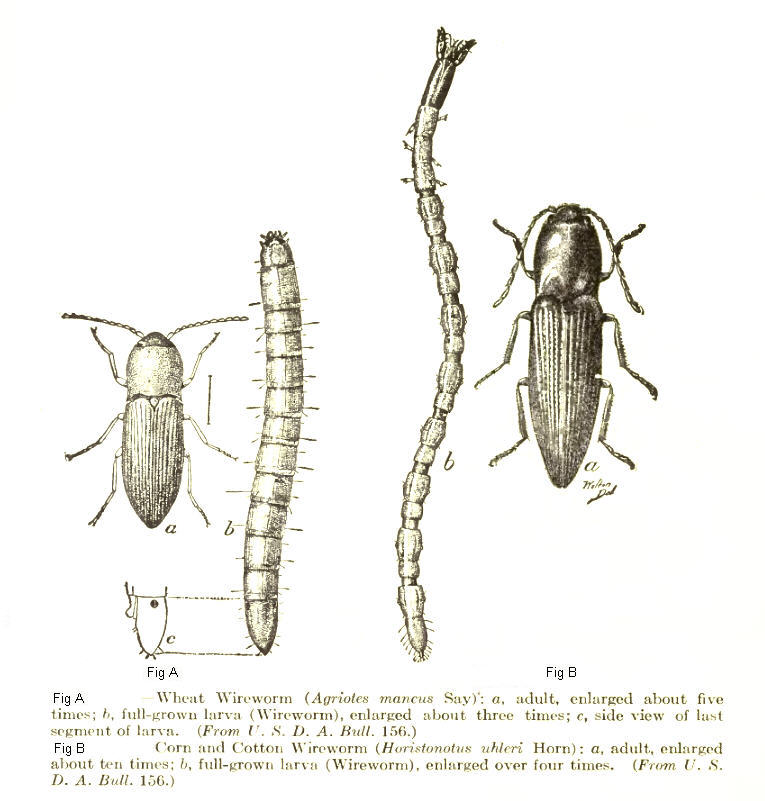 Wheat WirewormAgriotes mancus
- Western Click BeetleAgriotes ustulatus
-
 Agriotes pallidulus
- Agriotes proximus
- Agriotes brevis
Compare
Sources
Passages the profile rests on
- Adult beetles have a blackish-brown dorsal coloration, sometimes with a reddish scutellum or lighter-brown body. Source passage: “dorsal side blackish brown, scutellum reddish or anterior margin of pronotum lighter or in some specimens the whole body lighter brown” — English Wikipedia
- The adult has a broad body that is somewhat more elongated than that of Agriotes obscurus. Source passage: “body broad, similar to Agriotes obscurus but somewhat more elongated” — English Wikipedia
- Adult beetles measure 8–9 mm in length. Source passage: “The adult beetles of Agriotes sordidus are 8–9 mm long.” — English Wikipedia
- The head and pronotum of adults are densely punctured. Source passage: “head and pronotum densely punctured,” — English Wikipedia
- The pronotum is domed and has a rounded anterior margin. Source passage: “pronotum domed, anterior margin rounded,” — English Wikipedia
- Male antennae are no longer than the pronotum. Source passage: “antennae broad, in males not longer than pronotum,” — English Wikipedia
- The elytra are more than twice as long as they are wide, with deep gaps between ridges and dense punctures. Source passage: “elytra more than double as long as wide, gaps between ridges deep with dense punctures.” — English Wikipedia
- The ninth abdominal segment of the larva has a subconical shape and narrows abruptly in its apical fourth. Source passage: “The tip of the abdomen, the ninth segment, has a subconical shape, shrinking abruptly in the apical fourth.” — English Wikipedia
- The base of the larval abdominal apical spike has a square, bulge-like structure. Source passage: “The base of the apical spike has a square, bulge-like structure.” — English Wikipedia
- The angle between the larval mandible's apical tip and subapical tooth averages approximately 150 degrees, with a reported range of 130–170 degrees. Source passage: “on average around 150° with a range of 130° to 170°.” — English Wikipedia
- The indicated angle on the larval frontoclypeus is a right angle. Source passage: “The indicated angle on the frontoclypeus is a right angle.” — English Wikipedia
- Larvae feed on the roots and lower stems of maize and other cereals. Source passage: “feeding on the roots and the lower stems of various grasses and other plants.” — English Wikipedia
- The larvae feed on agricultural crops including maize, barley, and alfalfa. Source passage: “Agriculturally important food plants include cereal crops like maize and barley as well as forage crops like alfalfa.” — English Wikipedia
- Reported crops damaged by the larvae include lettuce, sunflower, and potatoes. Source passage: “Damage to other crops like alfalfa, lettuce, sunflower and potatoes has been also reported.” — English Wikipedia
- Adult beetles feed on leaves. Source passage: “The adults feed on the leaves, but cause little damage.” — English Wikipedia
- In the central Italian monitoring study, adults emerged after Agriotes brevis but before Agriotes litigiosus. Source passage: “Adult emergence displayed species-specific timing, occurring earliest in A. brevis, followed by A. sordidus and subsequently A. litigiosus.” — pmc.ncbi.nlm.nih.gov
- In Italy, adults emerge from the soil between late March and early April. Source passage: “A. sordidus from late March to early April” — pmc.ncbi.nlm.nih.gov
- Adult males are active from April through August in Italy, with peak activity in May. Source passage: “the males are active from April to August and have a distinct activity peak in May.” — English Wikipedia
- Adults can overwinter and survive for several months. Source passage: “A. brevis and A. sordidus can overwinter as adults, surviving for several months” — pmc.ncbi.nlm.nih.gov
- Larvae begin actively feeding on plant roots in spring as soil temperatures increase. Source passage: “In spring, when soil temperatures increase, wireworms start actively feeding on the roots of both wild and cultivated plants” — pmc.ncbi.nlm.nih.gov
- Larvae burrow deeper into the soil during autumn to overwinter and return to active feeding in spring. Source passage: “In autumn, they burrow deep into the soil to overwinter and re-emerge in spring to resume their active feeding.” — pmc.ncbi.nlm.nih.gov
- Larvae are attracted to carbon dioxide and volatile compounds released by host plant roots. Source passage: “Agriotes sordidus larvae are attracted by CO2 and other volatiles emitted by the roots of the host plant.” — English Wikipedia
- Larvae develop faster than most other pest species in the genus Agriotes. Source passage: “Agriotes sordidus larvae develop faster than most other pest species in the genus Agriotes.” — English Wikipedia
- Females lay eggs during May or June. Source passage: “Eggs are laid in May or June” — English Wikipedia
- Adults of this species can lay eggs over an extended period. Source passage: “laying eggs over an extended period” — pmc.ncbi.nlm.nih.gov
- Females produce geranyl hexanoate and (E,E)-farnesyl hexanoate in their pheromone glands. Source passage: “Agriotes sordidus females produce geranyl hexanoate and (E,E)-farnesyl hexanoate in their pheromone glands.” — English Wikipedia
- The female pheromone release consists mainly of geranyl hexanoate, with only traces of (E,E)-farnesyl hexanoate. Source passage: “The released volatiles consist mainly of the former compound with only traces of the latter.” — English Wikipedia
Data
- Catalogue of Life, 2026-10-16 XR cc by
- Global Biodiversity Information Facility CC BY 4.0
- Wikidata CC0
- GeoNames CC BY 4.0
- Wikimedia Commons per image; credit shown with each image
- Within the Catalogue of Life, this name comes from Swiss National Coleoptera Databank (Checklist) cc by
This species in other databases
Page built on 28 November 2026. See how the catalog is made and all sources and licences.
Cite this page
ScientificNames.org. (2026). Agriotes sordidus. Retrieved November 28, 2026, from https://scientificnames.org/species/agriotes-sordidus
“Agriotes sordidus.” ScientificNames.org, 2026, scientificnames.org/species/agriotes-sordidus. Accessed 28 Nov. 2026.
ScientificNames.org. “Agriotes sordidus.” Accessed November 28, 2026. https://scientificnames.org/species/agriotes-sordidus.
@misc{scientificnames_agriotes_sordidus,
  author = {{ScientificNames.org}},
  title = {Agriotes sordidus},
  year = {2026},
  url = {https://scientificnames.org/species/agriotes-sordidus},
  note = {Accessed 2026-11-28}
}