Species · Insects
Aiolocaria hexaspilota
Aiolocaria hexaspilota has no English name on record in the checklists used here. It is a species of insect in the family Coccinellidae (ladybird beetles), order Coleoptera. The name dates from 1831.
- Scientific name
- Aiolocaria hexaspilota (Hope, 1831)
- Genus
- Aiolocaria
- Family
- Coccinellidae (Ladybird Beetles)
- Order
- Coleoptera
- Class
- Insecta
- Recorded in
- 7 countries
- Name status
- accepted in the Catalogue of Life

Overview
Aiolocaria hexaspilota (Hope, 1831) is an insect in the family Coccinellidae, order Coleoptera, and class Insecta. It is a specialized predator of leaf beetles in the family Chrysomelidae.
Written 26 November 2026 from the sources listed below. Each statement was checked against the passage it cites; statements that could not be supported were removed.
Appearance
Adult beetles can reach a length of 13 mm.[1]
Diet
Aiolocaria hexaspilota is a specialized predator of leaf beetles in the family Chrysomelidae.[2]
Behaviour
Individuals actively pursue their larval prey.[3]
Reproduction and life cycle
The species produces one brood per year. Adults mate in spring before dispersing.[4][5]
Similar species
Aiolocaria mirabilis is a later name applied to the same species by Victor Motschulsky in 1860.[6]
Classification of Aiolocaria hexaspilota
| Kingdom | Animalia |
|---|---|
| Phylum | Arthropoda |
| Subphylum | Hexapoda |
| Class | Insecta (Insect) |
| Order | Coleoptera (Beetle) |
| Suborder | Polyphaga |
| Series | Cucujiformia |
| Superfamily | Coccinelloidea |
| Family | Coccinellidae (Ladybird Beetles) |
| Subfamily | Coccinellinae |
| Tribe | Coccinellini |
| Genus | Aiolocaria |
| Species | Aiolocaria hexaspilota (Hope, 1831) |
This name was added to the Catalogue of Life from a contributing dataset by automated merging and has not yet been reviewed by its editors.
Where Aiolocaria hexaspilota is found
Checklists and occurrence records place Aiolocaria hexaspilota in 7 countries across Asia. GBIF holds 2,420 georeferenced records of it.
Countries
Regions and cities with the most records
- Gangwon-do, South Korea 163
- Gyeonggi-do, South Korea 113
- Gyeongsangbuk-do, South Korea 90
- Hokkaido, Japan 81
- Gyeongsangnam-do, South Korea 63
- Chungcheongnam-do, South Korea 60
- Tachikawa, Japan 53
- Akishima, Japan 52
- Minawa, Japan 52
- Tama, Japan 50
- Aihara, Japan 49
- Fussa, Japan 49
- Hino, Japan 49
- Inagi, Japan 49
- Fuchū, Japan 48
- Seongnam-si, South Korea 48
- Kokubunji, Japan 47
- Machida, Japan 47
- Noborito, Japan 47
- Hachiōji, Japan 46
- Kunitachi, Japan 46
- Sagamihara, Japan 46
- Minamirinkan, Japan 45
- Zama, Japan 45
- Gunpo, South Korea 44
- Uiwang, South Korea 44
- Anyang-si, South Korea 42
- Asan, South Korea 42
- Azamino, Japan 42
- Yokota, Japan 42
- Beijing, China 41
- Musashimurayama, Japan 41
- Taiwan, Taiwan 41
- Hakonegasaki, Japan 40
- Tokyo, Japan 40
- Yamato, Japan 40
1 more country has a few records outside this range
These countries hold a few records of Aiolocaria hexaspilota but lie outside the range the checklists give for it. Such records are often zoo or garden specimens, museum material or vagrants, so the species is not counted as occurring there.
A number beside a place is its count of GBIF occurrence records. A place without a number comes from a checklist alone. Records show where a species has been observed or collected, which can include escapes and vagrants.
Common names
Names in 4 other languages
- Chinese
- 六斑異瓢蟲, 大龜紋瓢蟲
- Japanese
- カメノコテントウ
- Korean
- 남생이무당벌레
- Russian
- Божья коровка удивительная
Synonyms
5 other scientific names have been used for this species and are now treated as synonyms of Aiolocaria hexaspilota.
- Aeolocaria hexaspilota Barovsky, 1928
- Aiolocaria mirabilis : Korschefsky, 1932
- Caria sexspilota Mulsant, 1850
- Coccinella hexaspilota Hope, 1831
- Leis mirabilis Motschulsky, 1860
Related species
- Harmonia axyridis
-
 Seven-spot LadybirdCoccinella septempunctata
-
 Twice-stabbed Lady BeetleChilocorus stigma
-
 Pink Spotted Lady BeetleColeomegilla maculata
-
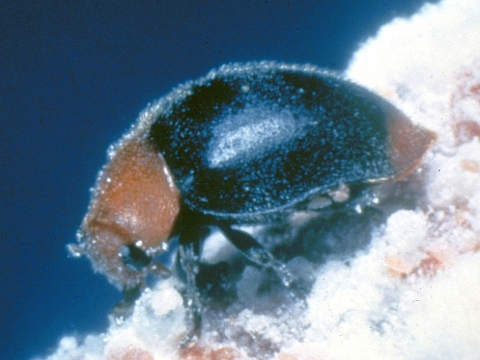 Mealybug DestroyerCryptolaemus montrouzieri
-
 22-spot LadybirdPsyllobora vigintiduopunctata
-
 Steelblue Lady BeetleHalmus chalybeus
-
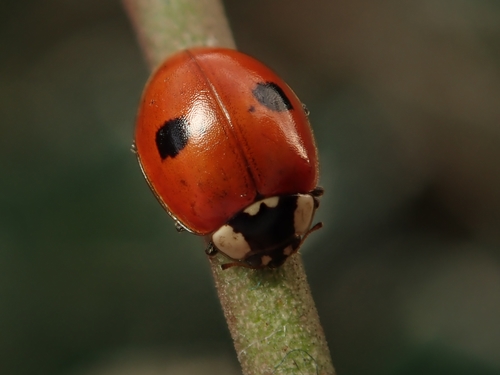 Two-spot LadybirdAdalia bipunctata
Compare
Questions and answers
How large is Aiolocaria hexaspilota?
Adult beetles can reach a length of 13 mm.[1]
What does Aiolocaria hexaspilota eat?
It is a specialized predator of leaf beetles in the family Chrysomelidae.[2]
How many broods does the species produce each year?
The species produces one brood per year.[4]
When do adults mate?
Adults mate in spring before dispersing.[5]
What is the origin of the scientific name?
The scientific name Aiolocaria hexaspilota was first published in 1831 by Frederick William Hope.[7]
What is another name applied to this species?
Aiolocaria mirabilis is a later name applied to the same species by Victor Motschulsky in 1860.[6]
Sources
Passages the profile rests on
- Adult Aiolocaria hexaspilota beetles can reach a length of 13 mm. Source passage: “adults can be as large as 13mm long.” — English Wikipedia
- Aiolocaria hexaspilota is a specialized predator of leaf beetles in the family Chrysomelidae. Source passage: “a specialized predator of chrysomelids.” — English Wikipedia
- Individuals of this species actively pursue their larval prey. Source passage: “Aiolocaria hexaspilota actively pursuing larval prey.” — English Wikipedia
- The species produces one brood per year. Source passage: “described the species as univoltine” — English Wikipedia
- Adults mate in spring before dispersing. Source passage: “in the spring the adults mate and disperse.” — English Wikipedia
- Aiolocaria mirabilis is a later name applied to the same species by Victor Motschulsky in 1860. Source passage: “Victor Motschulsky was later to call the same species as Aiolocaria mirabilis (in 1860).” — English Wikipedia
- The scientific name Aiolocaria hexaspilota was first published in 1831 by Frederick William Hope. Source passage: “The species’ scientific name was first given in an 1831 publication by Frederick William Hope.” — English Wikipedia
Data
- Catalogue of Life, 2026-10-16 XR cc by
- Global Biodiversity Information Facility CC BY 4.0
- Wikidata CC0
- GeoNames CC BY 4.0
- Wikimedia Commons per image; credit shown with each image
- Within the Catalogue of Life, this name comes from The National Checklist of Taiwan (Catalogue of Life in Taiwan, TaiCOL) cc by
References
- Korschefsky, R. (1932) Coleopterorum Catalogus. Pars 120. Coccinellidae II. W. Junk, Berlin, 435 pp. where the name was published
This species in other databases
Page built on 27 November 2026. See how the catalog is made and all sources and licences.
Cite this page
ScientificNames.org. (2026). Aiolocaria hexaspilota. Retrieved November 27, 2026, from https://scientificnames.org/species/aiolocaria-hexaspilota
“Aiolocaria hexaspilota.” ScientificNames.org, 2026, scientificnames.org/species/aiolocaria-hexaspilota. Accessed 27 Nov. 2026.
ScientificNames.org. “Aiolocaria hexaspilota.” Accessed November 27, 2026. https://scientificnames.org/species/aiolocaria-hexaspilota.
@misc{scientificnames_aiolocaria_hexaspilota,
  author = {{ScientificNames.org}},
  title = {Aiolocaria hexaspilota},
  year = {2026},
  url = {https://scientificnames.org/species/aiolocaria-hexaspilota},
  note = {Accessed 2026-11-27}
}