Species · Fishes
African Threadfish Alectis alexandrina
The scientific name of the African Threadfish is Alectis alexandrina. It is a species of fish in the family Carangidae (jacks), order Carangiformes. The name dates from 1817.
- Scientific name
- Alectis alexandrina (Geoffroy Saint-Hilaire, 1817)
- Common name
- African Threadfish
- Genus
- Alectis
- Family
- Carangidae (Jacks)
- Order
- Carangiformes
- Class
- Teleostei
- Red List category
- LC Least Concern
- Environment
- marine
- Recorded in
- 24 countries
- Name status
- accepted in the Catalogue of Life

Overview
Alectis alexandrina occurs primarily in the tropical eastern Atlantic Ocean along the West African coast from Morocco to Angola and has also been recorded in the Mediterranean Sea. It has a strongly compressed body, an angular profile and long, trailing filamentous spines on its first dorsal and anal fins.
Written 26 November 2026 from the sources listed below. Each statement was checked against the passage it cites; statements that could not be supported were removed.
Similar species
The African Threadfish resembles the African pompano, which occurs in the same geographical range. The head profile has a slight concavity near the eyes, distinguishing the African Threadfish from the African pompano.[1][2]
Appearance
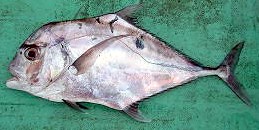
The African Threadfish has a strongly compressed body with a distinctly angular profile. Its dorsal profile is more curved than its ventral profile, and its head profile has a slight concavity near the eyes.[3][1][4]
The first dorsal fin section has between five and seven visible spines. The second dorsal fin section contains one spine and between 20 and 22 soft rays, while the anal fin has two spines followed by another spine and 18 or 19 soft rays.[5][6][7]
The pectoral fin is long and curved, extending beyond the junction of the two lateral-line sections. Two flattened keels occur on each side of the line of scutes anterior to the caudal fin.[8][9]
The body appears scaleless but has minute scales embedded deeply in its surface. The lateral line curves strongly toward the front and has between six and eleven scutes near the tail.[10][11]
Juveniles and often adults possess long, trailing filamentous spines on their first dorsal and anal fins. Juveniles may display two dark bands on their lower bodies.[12][13]
The species is silver-coloured, sometimes displaying blue and greenish tints and reflections. Its fins are pale silvery green to blue or translucent.[14][15]
The species reaches at least one metre in length.[16]
Habitat
Adults predominantly inhabit coastal waters at depths shallower than 70 metres. They occupy the lower portions of the water column at depths reaching at least 70 metres.[17][18]
Juveniles are usually pelagic and may enter estuarine environments.[19]
Diet
The African Threadfish feeds on squid and other fishes.[20]
Behaviour
Adults are generally solitary in coastal waters but may sometimes form small schools.[21][22]
Juveniles drift with ocean currents.[23]
Reproduction and life cycle
The reproductive biology of the African Threadfish remains largely unknown. Observations of Alectis ciliaris suggest that individual fish in the genus may pair before spawning.[24][25]
Conservation
The African Threadfish is considered relatively rare among fish targeted by anglers.[26]
Uses
The species has minor commercial importance in fisheries throughout its distribution range. It can command high prices at markets compared with many other members of Carangidae.[27][28]
The African Threadfish is regarded as a game fish, particularly when individuals are large. The recorded IGFA world-record specimen weighed 8.10 kilograms and was caught off Daklha, Morocco, in 1993.[29][30]
Classification of the African Threadfish
| Kingdom | Animalia |
|---|---|
| Phylum | Chordata |
| Subphylum | Vertebrata |
| Infraphylum | Gnathostomata |
| Parvphylum | Osteichthyes |
| Gigaclass | Actinopterygii |
| Superclass | Actinopteri |
| Class | Teleostei (Teleost) |
| Order | Carangiformes |
| Family | Carangidae (Jacks) |
| Genus | Alectis (Cockfishes) |
| Species | Alectis alexandrina (Geoffroy Saint-Hilaire, 1817) |
Where the African Threadfish is found
Checklists and occurrence records place Alectis alexandrina in 24 countries. GBIF holds 825 georeferenced records of it.
Countries
- Angola 21
- Benin 18
- Cameroon 46
- Democratic Republic of the Congo 11
- Egypt 9
- Equatorial Guinea 21
- Gabon 82
- Ghana 80
- Guinea 34
- Guinea-Bissau 33
- India 9
- Indonesia 12
- Israel 40
- Ivory Coast 93
- Japan 3
- Lebanon 9
- Liberia 64
- Mauritania 10
- Nigeria 122
- Republic of the Congo 14
- Senegal 33
- Sierra Leone 44
- Togo 12
- Turkey 5
Regions and cities with the most records
- Abidjan, Ivory Coast 19
- Koumassi, Ivory Coast 19
- Marcory, Ivory Coast 19
- Fatick, Senegal 17
- Judeida Makr, Israel 15
- Nesher, Israel 14
- Acre, Israel 13
- Daliyat al Karmel, Israel 13
- Godomè, Benin 13
- Qiryat Tiv‘on, Israel 13
- Rekhasim, Israel 13
- Amanfrom, Ghana 12
- Buchanan, Liberia 12
- Buduburam, Ghana 12
- Esim, Ghana 12
- Haifa, Israel 12
- Kasoa, Ghana 12
- Lekki, Nigeria 12
- Monrovia, Liberia 12
- Ogooué-Maritime, Gabon 12
- Qiryat Bialik, Israel 12
- Qiryat Motsqin, Israel 12
- Qiryat Yam, Israel 12
- Sekondi, Ghana 12
- Sekondi-Takoradi, Ghana 12
- Shama Junction, Ghana 12
- Takoradi, Ghana 12
- Tirat Karmel, Israel 12
- Badagry, Nigeria 11
- Kouandé, Benin 11
- Ouidah, Benin 11
- Qiryat Ata, Israel 11
- Shefar‘am, Israel 11
- Tamra, Israel 11
- Anloga, Ghana 10
- Cape Coast, Ghana 10
A number beside a place is its count of GBIF occurrence records. A place without a number comes from a checklist alone. Records show where a species has been observed or collected, which can include escapes and vagrants.
Common names
English
- African Threadfish
- Alexandria Pompano
- Carangue
- Pomp
- Pompano
- Threadfin Horse Mackerel
Names in 5 other languages
- French
- Cordonnier Bossu, Hynnis de Gorée, Mussolini, Scyris D'Alexandrie, Vomer de Gorée
- Greek
- Πλατυκοκκάλι
- Hebrew
- דבשתן ים-תיכוני
- Spanish
- Jurel de Alejandría
- Turkish
- iskender baligi
Synonyms
20 other scientific names have been used for this species and are now treated as synonyms of Alectis alexandrina.
- Alectis alexandrinus (Geoffroy Saint-Hilaire, 1817)
- Alepes djeddaba Darom & Tsurnamal, 1992
- Alepes djeddaba Spanier, 1995
- Atule djeddaba Ben-Tuvia, 1966
- Blepharis alexandrinus (Geoffroy Saint-Hilaire, 1817)
- Caranx alexandrinus (Geoffroy Saint-Hilaire, 1817)
- Caranx cala Liebman, 1934
- Caranx calla W. Steinitz, 1927
- Caranx djeddaba Ben-Tuvia, 1953
- Caranx gallus W. Steinitz, 1927
- Caranx goreensis (Cuvier, 1833)
- Gallichthys aegyptiacus Cuvier, 1833
- Gallichtys aegyptiacus Cuvier, 1833
- Gallus alexandrinus Geoffroy Saint-Hilaire, 1817
- Hynnis goreensis Cuvier, 1833
- Scyris alexandrina (Geoffroy Saint-Hilaire, 1817)
- Scyris alexandrina Ben-Tuvia, 1953
- Scyris alexandrinus (Geoffroy Saint-Hilaire, 1817)
- Vomer alexandrinus (Geoffroy Saint-Hilaire, 1817)
- Selene goreensis (Cuvier, 1833) ambiguous synonym
Related species
-
 African PompanoAlectis ciliaris
-
 Giant TrevallyCaranx ignobilis
-
 Japanese AmberjackSeriola quinqueradiata
-
 Yellowtail AmberjackSeriola lalandi
-
 Pilot FishNaucrates ductor
-
 Greater AmberjackSeriola dumerili
-
 Crevalle JackCaranx hippos
-
 Atlantic Horse MackerelTrachurus trachurus
Compare
Questions and answers
What is the scientific name of the African Threadfish?
The scientific name of the African Threadfish is Alectis alexandrina. Written with its author, the full name is Alectis alexandrina (Geoffroy Saint-Hilaire, 1817).
Which family does the African Threadfish belong to?
Alectis alexandrina belongs to the family Carangidae, in the order Carangiformes and the class Teleostei.
Where is the African Threadfish found?
Checklists and occurrence records place Alectis alexandrina in 24 countries, including Nigeria, Ivory Coast, Gabon, Ghana, Liberia and Cameroon.
What is the conservation status of the African Threadfish?
The IUCN Red List category recorded for Alectis alexandrina is Least Concern (LC).
What other names does the African Threadfish have?
Alectis alexandrina is also known in English as Alexandria Pompano, Carangue, Pomp, Pompano and Threadfin Horse Mackerel.
Sources
Passages the profile rests on
- The head profile has a slight concavity near the eyes, distinguishing the species from the African pompano. Source passage: “having a slight concavity near the eyes which distinguishes it from the African pompano.” — English Wikipedia
- The African threadfish resembles the African pompano, which occurs in the same geographical range. Source passage: “The African threadfish is similar in appearance to the closely related and co-occurring African pompano” — English Wikipedia
- The species has a strongly compressed body with a distinctly angular profile. Source passage: “a distinctly angular, strongly compressed body.” — English Wikipedia
- The dorsal profile is more curved than the ventral profile. Source passage: “The dorsal profile of the fish is more curved than the ventral profile” — English Wikipedia
- The first dorsal fin section has between five and seven visible spines. Source passage: “The first section of the dorsal fin consists of 5 to 7 visible spines” — English Wikipedia
- The second dorsal fin section contains one spine and between 20 and 22 soft rays. Source passage: “the second section having one spine and 20 to 22 soft rays.” — English Wikipedia
- The anal fin has two spines followed by another spine and 18 or 19 soft rays. Source passage: “The anal fin has two spines followed by a single spine and 18 or 19 soft rays.” — English Wikipedia
- The pectoral fin is long and curved, extending beyond the junction of the two lateral-line sections. Source passage: “The pectoral fin is long and curved, extending beyond the junction of the straight and curved sections of the lateral line.” — English Wikipedia
- Two flattened keels occur on each side of the line of scutes anterior to the caudal fin. Source passage: “Anterior to the caudal fin are two oblate keels on each side of the line of scutes.” — English Wikipedia
- The body appears scaleless but has minute scales embedded deeply in its surface. Source passage: “The body appears to be scaleless, but on closer inspection has minute, deeply embedded scales.” — English Wikipedia
- The lateral line curves strongly toward the front and has between six and eleven scutes near the tail. Source passage: “The lateral line is strongly curved anteriorly, with a section of 6 to 11 scutes toward the tail.” — English Wikipedia
- Juveniles and often adults possess long, trailing filamentous spines on their first dorsal and anal fins. Source passage: “Juveniles and often adults have long, filamentous trailing first anal and dorsal fin spines” — English Wikipedia
- Juveniles may display two dark bands on their lower bodies. Source passage: “Juveniles may show two dark bands on their lower bodies.” — English Wikipedia
- The species is silver-coloured, sometimes displaying blue and greenish tints and reflections. Source passage: “The African threadfish is silver in colour, often with blue and greenish tints and reflection” — English Wikipedia
- Its fins are pale silvery green to blue or translucent. Source passage: “The fins are all a pale silvery green to blue colour, or hyaline.” — English Wikipedia
- The species reaches at least one metre in length. Source passage: “The species grows to at least 1 m in length.” — English Wikipedia
- Adults predominantly inhabit coastal waters at depths shallower than 70 metres. Source passage: “Adults live predominantly in waters shallower than 70 m deep” — English Wikipedia
- Adults occupy the lower portions of the water column at depths reaching at least 70 metres. Source passage: “occupying lower parts of the water column, down to at least 70 m.” — English Wikipedia
- Juveniles are usually pelagic and may enter estuarine environments. Source passage: “Juveniles are usually pelagic and drift with ocean currents, sometimes ending up in estuarine environments.” — English Wikipedia
- The species feeds on squid and other fishes. Source passage: “The African threadfish feeds on squid and other fishes.” — English Wikipedia
- Adults are generally solitary in coastal waters. Source passage: “Adults are generally solitary in coastal waters” — English Wikipedia
- Adults may sometimes form small schools. Source passage: “often forming small schools.” — English Wikipedia
- Juveniles drift with ocean currents. Source passage: “Juveniles are usually pelagic and drift with ocean currents” — English Wikipedia
- The reproductive biology of the species remains largely unknown. Source passage: “The reproduction in the species is largely unknown” — English Wikipedia
- Observations of Alectis ciliaris suggest that individual fish in the genus may pair before spawning. Source passage: “observations on Alectis ciliaris suggest individual fish may pair and then spawn.” — English Wikipedia
- The species is considered relatively rare among fish targeted by anglers. Source passage: “The species is rarely targeted by anglers though, due to its comparative rarity.” — English Wikipedia
- The species has minor commercial importance in fisheries throughout its distribution range. Source passage: “The species is of minor importance to local fisheries throughout its range” — English Wikipedia
- The species can command high prices at markets compared with many other members of Carangidae. Source passage: “The fish also fetches high prices at market, unlike many other members of the Carangidae.” — English Wikipedia
- The species is regarded as a game fish, particularly when individuals are large. Source passage: “is also considered a good game fish, especially in larger sizes.” — English Wikipedia
- The recorded IGFA world-record specimen weighed 8.10 kilograms and was caught off Daklha, Morocco, in 1993. Source passage: “The IGFA world record for the species stands at 8.10 kg (17 lb 14 oz) caught off of Daklha, Morocco in 1993.” — English Wikipedia
- The species occurs in the tropical eastern Atlantic Ocean along the West African coast from Morocco to Angola. Source passage: “inhabiting the waters of West Africa from Morocco around to Angola.” — English Wikipedia
- The species is primarily distributed throughout the tropical eastern Atlantic Ocean. Source passage: “The African threadfish is primarily distributed throughout the tropical eastern Atlantic Ocean” — English Wikipedia
Data
- Catalogue of Life, 2026-10-16 XR cc by
- Global Biodiversity Information Facility CC BY 4.0
- Wikidata CC0
- GeoNames CC BY 4.0
- Wikimedia Commons per image; credit shown with each image
- Within the Catalogue of Life, this name comes from World Register of Marine Species cc by
This species in other databases
- Catalogue of Life BLPD
- Wikidata Q765602
- WoRMS urn:lsid:marinespecies.org:taxname:401555
- ITIS 1228199-1228703
Page built on 27 November 2026. See how the catalog is made and all sources and licences.
Cite this page
ScientificNames.org. (2026). Alectis alexandrina (African Threadfish). Retrieved November 27, 2026, from https://scientificnames.org/species/alectis-alexandrina
“Alectis alexandrina (African Threadfish).” ScientificNames.org, 2026, scientificnames.org/species/alectis-alexandrina. Accessed 27 Nov. 2026.
ScientificNames.org. “Alectis alexandrina (African Threadfish).” Accessed November 27, 2026. https://scientificnames.org/species/alectis-alexandrina.
@misc{scientificnames_alectis_alexandrina_african_threadfish,
  author = {{ScientificNames.org}},
  title = {Alectis alexandrina (African Threadfish)},
  year = {2026},
  url = {https://scientificnames.org/species/alectis-alexandrina},
  note = {Accessed 2026-11-27}
}