Species · Birds
Arabian Partridge Alectoris melanocephala
The scientific name of the Arabian Partridge is Alectoris melanocephala. It is a species of bird in the family Phasianidae (quail), order Galliformes. The name dates from 1835.
- Scientific name
- Alectoris melanocephala (Rüppell, 1835)
- Common name
- Arabian Partridge
- Genus
- Alectoris
- Family
- Phasianidae (Quail)
- Order
- Galliformes
- Class
- Aves
- Red List category
- LC Least Concern
- Recorded in
- 5 countries
- Name status
- accepted in the Catalogue of Life

Overview
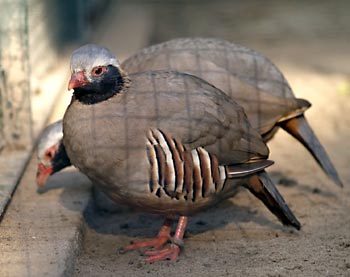
Alectoris melanocephala is native to the southern Arabian Peninsula, including southern Saudi Arabia, Yemen, and western Oman, and has been introduced to the United Arab Emirates. It has a black crown and nape, a broad white band above the eye, and a bluish-grey body, wings, and tail.
Written 26 November 2026 from the sources listed below. Each statement was checked against the passage it cites; statements that could not be supported were removed.
Appearance
Males and females have similar overall appearances, although males are slightly larger. The crown and nape are black, and a broad white band above the eye is separated from the white chin and upper throat by a narrow black line.[1][2][3]
The narrow black facial line begins at the beak's corner, passes beneath the eye, and forms a V-shaped marking on the neck. The sides of the neck are pale brown.[4][5]
The body, wings, and tail are bluish-grey, and the flanks have extensive dark barring. The legs and beak are pink.[6][7]
Males possess a knob on the tarsus.[8]
The Arabian Partridge reaches an approximate body length of 41 centimetres. Adult males weigh an average of 724 grams, while adult females weigh an average of 522 grams.[9][10][11]
Habitat
The Arabian Partridge inhabits grassy slopes and stony ground with a reasonable amount of vegetation cover. It occurs from near sea level to approximately 1,400 metres in elevation.[12][13]
The species is native to the southern Arabian Peninsula, including southern Saudi Arabia, Yemen, and western Oman. It has been introduced to the United Arab Emirates.[14][15]
A population was discovered in Harrat Uwayrid Biosphere Reserve in Saudi Arabia in 2022, approximately 100 kilometres north of all previously known populations.[16]
Diet
The Arabian Partridge feeds on seeds, other plant material, and small invertebrates. Mediterranean grass and cudweed are among the plant materials it eats.[17][18]
Behaviour
The Arabian Partridge is a ground-dwelling bird.[19]
Reproduction and life cycle
The breeding season begins in March. The species lays clutches containing five to eight eggs in a shallow depression on the ground.[20][21][22]
The eggs are pale buff with brown flecking. Egg incubation lasts approximately 25 days.[23][24]
The chicks are precocial and can leave the nest soon after hatching.[25]
Conservation
The Arabian Partridge has a wide geographical range and is common in many parts of it. Its total population size is unknown, and its population trend appears to be stable.[26][27][28]
The Arabian Partridge is classified as Least Concern by the International Union for Conservation of Nature.[29]
Similar species
The Arabian Partridge sometimes hybridises with Philby's Partridge (Alectoris philbyi) and the Rock Partridge (Alectoris graeca).[30][31]
Two subspecies are recognised: A. m. melanocephala and A. m. guichardi. A. m. guichardi occurs in eastern Hadramut and eastern Yemen, while A. m. melanocephala occupies the remainder of the species' range.[32][33][34]
Classification of the Arabian Partridge
| Kingdom | Animalia |
|---|---|
| Phylum | Chordata |
| Subphylum | Vertebrata |
| Infraphylum | Gnathostomata |
| Parvphylum | Osteichthyes |
| Megaclass | Tetrapoda |
| Class | Aves (Bird) |
| Order | Galliformes (Fowls) |
| Family | Phasianidae (Quail) |
| Genus | Alectoris (Chukars) |
| Species | Alectoris melanocephala (Rüppell, 1835) |
Where the Arabian Partridge is found
Checklists and occurrence records place Alectoris melanocephala in 5 countries. GBIF holds 6,393 georeferenced records of it.
Countries
Regions and cities with the most records
- Abu Dhabi, United Arab Emirates 4,112
- Al Ain City, United Arab Emirates 3,944
- Al Buraymī, Oman 3,901
- Dhofar, Oman 1,438
- 'Asir Region, Saudi Arabia 447
- Abha, Saudi Arabia 319
- Şalālah, Oman 98
- Mecca Region, Saudi Arabia 45
- Al Bahah Region, Saudi Arabia 26
- Abyan Governorate, Yemen 23
- Al Mahwit Governorate, Yemen 21
- Jazan Region, Saudi Arabia 21
- Zinjibār, Yemen 21
- Sanaa Governorate, Yemen 17
- Al Bahah, Saudi Arabia 15
- ‘Amrān, Yemen 14
- Ad Dakhiliyah, Oman 13
- Laḩij, Yemen 11
- Ta’if, Saudi Arabia 10
- Al Mahrah Governorate, Yemen 9
- Al Batinah South, Oman 7
- Shabwah, Yemen 7
- Abu Dhabi, United Arab Emirates 6
- Dubai, United Arab Emirates 6
- Ibb Governorate, Yemen 6
- Khalifah A City, United Arab Emirates 6
- Bur Dubai, United Arab Emirates 5
- Dubai, United Arab Emirates 5
- Halwan, United Arab Emirates 5
- Muscat, Oman 5
- Sanaa, Yemen 5
- Sharjah, United Arab Emirates 5
- Tabuk Region, Saudi Arabia 5
- Warīsān, United Arab Emirates 5
- Dhamār, Yemen 4
- Fayfā’, Saudi Arabia 4
Range as the checklists state it
Europe & Northern Asia (excluding China)
A number beside a place is its count of GBIF occurrence records. A place without a number comes from a checklist alone. Records show where a species has been observed or collected, which can include escapes and vagrants.
Common names
English
- Arabian Partridge
- Arabian Red-legged Partridge
Names in 30 other languages
- Arabic
- حجل عربي
- Breton
- Klujar Arabia
- Catalan
- perdiu de coroneta negra
- Chinese
- 阿拉伯石雞, 阿拉伯石鸡
- Croatian
- arabijska jarebica
- Czech
- orebice černohlavá
- Danish
- Arabisk Stenhøne
- Dutch
- Arabische Steenpatrijs
- Esperanto
- arabia perdriko
- Estonian
- araabia kivikana
- Finnish
- mustalakkipyy
- French
- Bartavelle à tête noire, Perdrix à tête noire
- German
- Schwarzkopf-Steinhuhn, Schwarzkopfsteinhuhn
- Hungarian
- arab szirtifogoly
- Irish
- Patraisc cheanndubh
- Italian
- Coturnice testanera, Pernice d'Arabia
- Japanese
- アラビアイワシャコ
- Latvian
- Arābijas irbe
- Lithuanian
- juodagalvis keklikas
- Norwegian
- araberhøne
- Polish
- góropatwa arabska
- Portuguese
- perdiz-arábica, perdiz-árabe
- Russian
- Черноголовый кеклик
- Serbian
- Arabijska kamenjarka
- Slovak
- kuropta čiernohlavá
- Spanish
- Perdiz árabe
- Swedish
- arabisk rödhöna, arabrödhöna
- Turkish
- Arabistan Kekliği, Arap Kınalı Kekliği
- Ukrainian
- кеклик чорноголовий
- Welsh
- petrisen goesgoch Arabia
Subspecies and varieties
- Alectoris melanocephala guichardi subspecies
- Alectoris melanocephala melanocephala subspecies
Related species
-
 Chukar PartridgeAlectoris chukar
-
 Red-legged PartridgeAlectoris rufa
-
 Rock PartridgeAlectoris graeca
-
 Barbary PartridgeAlectoris barbara
-
 Philby's PartridgeAlectoris philbyi
-
 Przevalski's PartridgeAlectoris magna
-
 Red JunglefowlGallus gallus
-
 Wild TurkeyMeleagris gallopavo
Compare
Questions and answers
What is the scientific name of the Arabian Partridge?
The scientific name of the Arabian Partridge is Alectoris melanocephala. Written with its author, the full name is Alectoris melanocephala (Rüppell, 1835).
Which family does the Arabian Partridge belong to?
Alectoris melanocephala belongs to the family Phasianidae, in the order Galliformes and the class Aves.
Where is the Arabian Partridge found?
Checklists and occurrence records place Alectoris melanocephala in 5 countries: United Arab Emirates, Oman, Saudi Arabia, Yemen and Germany.
What is the conservation status of the Arabian Partridge?
The IUCN Red List category recorded for Alectoris melanocephala is Least Concern (LC).
What other names does the Arabian Partridge have?
Alectoris melanocephala is also known in English as Arabian Red-legged Partridge.
How rare is it to see a partridge?
The Arabian Partridge is common in many parts of its wide geographical range.[26]
Sources
Passages the profile rests on
- Males and females have similar overall appearances, although males are slightly larger. Source passage: “The sexes are similar in appearance but males are a little larger than females” — English Wikipedia
- The crown and nape are black. Source passage: “The crown and nape are black” — English Wikipedia
- A broad white band above the eye is separated from the white chin and upper throat by a narrow black line. Source passage: “there is a broad white band above the eye, separated from the white chin and upper throat by a narrow black line.” — English Wikipedia
- The narrow black facial line begins at the beak's corner, passes beneath the eye, and forms a V-shaped marking on the neck. Source passage: “This starts at the corner of the beak, passes below the eye and forms a "V" shape on the neck.” — English Wikipedia
- The sides of the neck are pale brown. Source passage: “The sides of the neck are pale brown” — English Wikipedia
- The body, wings, and tail are bluish-grey and the flanks have extensive dark barring. Source passage: “the body, wings and tail are bluish-grey with much dark barring on the flanks.” — English Wikipedia
- The legs and beak are pink. Source passage: “The legs and beak are pink.” — English Wikipedia
- Males possess a knob on the tarsus. Source passage: “Males have a knob on the tarsus (lower leg).” — English Wikipedia
- The Arabian Partridge reaches an approximate body length of 41 centimetres. Source passage: “the Arabian partridge reaches a length of about 41 cm (16 in).” — English Wikipedia
- Adult males weigh an average of 724 grams. Source passage: “males are a little larger than females weighing on average 724 grams (25.5 oz)” — English Wikipedia
- Adult females weigh an average of 522 grams. Source passage: “against the female's 522 grams (18.4 oz).” — English Wikipedia
- The species inhabits grassy slopes and stony ground with a reasonable amount of vegetation cover. Source passage: “It is found on grassy slopes and stony ground with a reasonable amount of vegetation cover” — English Wikipedia
- The species occurs from near sea level to approximately 1,400 metres in elevation. Source passage: “from near sea level to an altitude of about 1,400 metres (4,600 ft).” — English Wikipedia
- The Arabian Partridge is native to the southern Arabian Peninsula, including southern Saudi Arabia, Yemen, and western Oman. Source passage: “The Arabian partridge is native to southern Saudi Arabia, Yemen and western Oman.” — English Wikipedia
- The species has been introduced to the United Arab Emirates. Source passage: “It has been introduced to United Arab Emirates.” — English Wikipedia
- A population was discovered in Harrat Uwayrid Biosphere Reserve in Saudi Arabia in 2022, approximately 100 kilometres north of all previously known populations. Source passage: “In 2022, a population of the birds was found in Harrat Uwayrid Biosphere Reserve in Saudi Arabia, around 100 kilometres (62 mi) further north than all other known populations.” — English Wikipedia
- The species feeds on seeds, other plant material, and small invertebrates. Source passage: “it feeds on seeds, other plant material such as Mediterranean grass and cudweed, and small invertebrates.” — English Wikipedia
- Mediterranean grass and cudweed are among the plant materials eaten by the species. Source passage: “other plant material such as Mediterranean grass and cudweed” — English Wikipedia
- The Arabian Partridge is a ground-dwelling bird. Source passage: “A ground-dwelling bird” — English Wikipedia
- The breeding season begins in March. Source passage: “The breeding season starts in March” — English Wikipedia
- The species lays clutches containing five to eight eggs. Source passage: “a clutch of five to eight eggs is laid” — English Wikipedia
- Eggs are laid in a shallow depression on the ground. Source passage: “is laid in a shallow scoop on the ground.” — English Wikipedia
- The eggs are pale buff with brown flecking. Source passage: “The eggs are pale buff flecked with brown” — English Wikipedia
- Egg incubation lasts approximately 25 days. Source passage: “are incubated for about 25 days” — English Wikipedia
- The chicks are precocial and can leave the nest soon after hatching. Source passage: “before hatching into precocial young that are soon able to leave the nest.” — English Wikipedia
- The Arabian Partridge has a wide geographical range and is common in many parts of it. Source passage: “The Arabian partridge has a wide range and is common in many parts of this.” — English Wikipedia
- The total population size of the Arabian Partridge is unknown. Source passage: “The total size of the population is unknown” — English Wikipedia
- The population trend of the Arabian Partridge appears to be stable. Source passage: “the population trend appears to be steady.” — English Wikipedia
- The Arabian Partridge is classified as Least Concern by the International Union for Conservation of Nature. Source passage: “the International Union for Conservation of Nature has assessed the bird's conservation status as being of "least concern".” — English Wikipedia
- The Arabian Partridge sometimes hybridises with Philby's Partridge (Alectoris philbyi). Source passage: “It sometimes hybridises with Philby's partridge (Alectoris philbyi)” — English Wikipedia
- The Arabian Partridge sometimes hybridises with the Rock Partridge (Alectoris graeca). Source passage: “and with the rock partridge (Alectoris graeca).” — English Wikipedia
- Two subspecies are recognised: A. m. melanocephala and A. m. guichardi. Source passage: “Two subspecies are recognised, A. m. melanocephala and A. m. guichardi.” — English Wikipedia
- The subspecies A. m. guichardi occurs in eastern Hadramut and eastern Yemen. Source passage: “The subspecies A. m. guichardi occurs in eastern Hadramut and eastern Yemen” — English Wikipedia
- The subspecies A. m. melanocephala occupies the remainder of the species' range. Source passage: “A. m. melanocephala occurs in the rest of the range.” — English Wikipedia
Data
- Catalogue of Life, 2026-10-16 XR cc by
- Global Biodiversity Information Facility CC BY 4.0
- Wikidata CC0
- GeoNames CC BY 4.0
- Wikimedia Commons per image; credit shown with each image
- Within the Catalogue of Life, this name comes from The Integrated Taxonomic Information System cc0
References
- Dickinson, Edward C., ed. (2003). The Howard and Moore Complete Checklist of the Birds of the World, 3rd Edition.
- Gill, Frank, & and Minturn Wright. (2006). Birds of the World: Recommended English Names.
- Dickinson, E. C., and J. V. Remsen Jr., eds. (2013). The Howard and Moore Complete Checklist of the Birds of the World, 4th Edition, Vol. 1 Non-Passerines.
This species in other databases
Page built on 26 November 2026. See how the catalog is made and all sources and licences.
Cite this page
ScientificNames.org. (2026). Alectoris melanocephala (Arabian Partridge). Retrieved November 26, 2026, from https://scientificnames.org/species/alectoris-melanocephala
“Alectoris melanocephala (Arabian Partridge).” ScientificNames.org, 2026, scientificnames.org/species/alectoris-melanocephala. Accessed 26 Nov. 2026.
ScientificNames.org. “Alectoris melanocephala (Arabian Partridge).” Accessed November 26, 2026. https://scientificnames.org/species/alectoris-melanocephala.
@misc{scientificnames_alectoris_melanocephala_arabian_partridge,
  author = {{ScientificNames.org}},
  title = {Alectoris melanocephala (Arabian Partridge)},
  year = {2026},
  url = {https://scientificnames.org/species/alectoris-melanocephala},
  note = {Accessed 2026-11-26}
}