Overview
Alinea lanceolata, the Barbados skink, is a species of skink found in Barbados. It is classified by the IUCN as being critically endangered, possibly extinct. Last recorded in 1889, it was probably driven to extinction by invasive mammalian predators, especially mongoose.
Classification of the Barbados Skink
| Kingdom | Animalia |
|---|---|
| Phylum | Chordata |
| Subphylum | Vertebrata |
| Infraphylum | Gnathostomata |
| Parvphylum | Osteichthyes |
| Megaclass | Tetrapoda |
| Class | Reptilia (Reptile) |
| Order | Squamata (Snakes) |
| Suborder | Autarchoglossa |
| Family | Scincidae (Skink) |
| Subfamily | Mabuyinae |
| Genus | Alinea (Caribbean Stripeless Skinks) |
| Species | Alinea lanceolata (Cope, 1863) |
Where the Barbados Skink is found
Checklists and occurrence records place Alinea lanceolata in 1 country across North America. GBIF holds 2 georeferenced records of it.
Countries
Range as the checklists state it
Barbados
A number beside a place is its count of GBIF occurrence records. A place without a number comes from a checklist alone. Records show where a species has been observed or collected, which can include escapes and vagrants.
Common names
English
- Barbados Skink
Synonyms
One other scientific name has been used for this species and is now treated as a synonym of Alinea lanceolata.
- Mabuia lanceolata Cope, 1863
Related species
- Saint Lucia SkinkAlinea luciae
-
 ShinglebackTiliqua rugosa
-
 Five-lined SkinkPlestiodon fasciatus
- Common Garden SkinkLampropholis guichenoti
-
 Blue-tailed Snake-eyed SkinkCryptoblepharus egeriae
-
 Red-eyed Crocodile SkinkTribolonotus gracilis
-
 Common BluetongueTiliqua scincoides
-
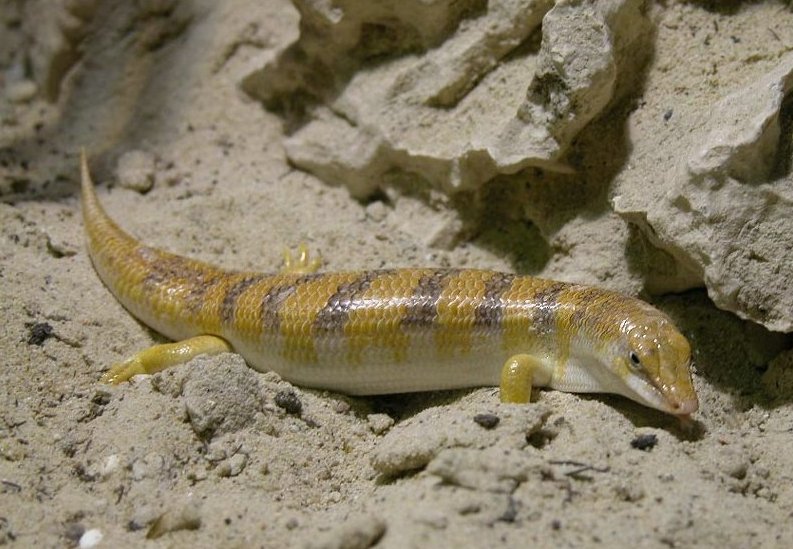 Sandfish SkinkScincus scincus
Compare
Questions and answers
What is the scientific name of the Barbados Skink?
The scientific name of the Barbados Skink is Alinea lanceolata. Written with its author, the full name is Alinea lanceolata (Cope, 1863).
Which family does the Barbados Skink belong to?
Alinea lanceolata belongs to the family Scincidae, in the order Squamata and the class Reptilia.
Where is the Barbados Skink found?
Checklists and occurrence records place Alinea lanceolata in 1 country: Barbados.
What is the conservation status of the Barbados Skink?
The IUCN Red List category recorded for Alinea lanceolata is Critically Endangered (CR).
Sources
Data
- Catalogue of Life, 2026-10-16 XR cc by
- Global Biodiversity Information Facility CC BY 4.0
- Wikidata CC0
- English Wikipedia CC BY-SA 4.0
- GeoNames CC BY 4.0
- Within the Catalogue of Life, this name comes from The Reptile Database cc by
References
- Cope, E. D. (1863). Contributions to Neotropical saurology. Proc. Acad. Nat. Sci. Philadelphia 14 [1862]: 176-188.
- Bocourt, M. F. (1879). Etudes sur les reptiles, p. i-xiv, 1-1012. In Recherches Zoologiques pour servir a l’Histoire de Ia Faune de l’Amérique Centrale et du Mexique. Mission Scientifique au Mexique et dans l’Amérique Centrale, Recherches zoologiques. Part 2, sect. 1; In A. Duméril, M. F. Bocourt, and F. Mocquard, (1870-1909). Imprimerie Impériale, Paris [3, Pt. 6], Pp. 360–440.
- Barbour, & Thomas. (1914). A Contribution to the Zoögeography of the West Indies, with Especial Reference to Amphibians and Reptiles. Memoirs of the Museum of Comparative Zoölogy 44 (2): 205-359.
- Barbour, & Thomas. (1930). A list of Antillean Reptiles and Amphibians. Zoologica 11 (4): 61-116.
- Barbour, & Thomas. (1930). Some faunistic changes in the Lesser Antilles. Proc. New England Zool. Club 11: 73-85.
- Barbour, T. (1935). A second list of Antillean reptiles and amphibians. Zoologica 19 (3): 77-141.
- Barbour, T. (1937). Third list of Antillean reptiles and amphibians. Bull. Mus. Comp. Zool. Harvard 82 (2): 77-166.
- Grant, C. (1959). Herpetology of Barbados, B.W.I. Herpetologica 15 (2): 97-101.
- Peters, James A. & Donoso-Barros, Roberto. (1970). Catalogue of the Neotropical Squamata: Part II. Lizards and Amphisbaenians. Bull. US Natl. Mus. 297: 293 Pp.
- Schwartz, A. and R. Thomas. (1975). A checklist of West Indian amphibians and reptiles. Carnegie Mus. Nat. Hist. Spec. Publ. 1:1-216.
- Schwartz, A., & Henderson, R. W. (1988). West Indian Amphibian and Reptiles: A Checklist. Milwaukee Publ. Mus. Contr. Biol. Geol. No. 74: 264 Pp.
- Schwartz, A., & Henderson, R. W. (1991). Amphibians and Reptiles of the West Indies. University of Florida Press, Gainesville, 720 Pp.
- Powell, R., R. W. Henderson, K. Adler, & H. A. Dundee. (1996). An annotated checklist of West Indian amphibians and reptiles. In R. Powell and R. W. Henderson (eds.), Contributions to West Indian Herpetology: A Tribute to Albert Schwartz, p.51-93. Society for the Study of Amphibians and Reptiles, Ithaca (New York). Contributions to Herpetology, Volume 12. [Book Review in Salamandra 36 (2): 136].
- Malhotra, A., & Thorpe, R. S. (1999). Reptiles & Amphibians of the Eastern Caribbean. MacMillan, London & Oxford.
- Mayer, G. C., & Lazell, J. (2000). A new species of Mabuya (Sauria: Scincidae) from the British Virgin Islands. Proc. Biol. Soc. Washington 113 (4): 871-886.
- Breuil, H. (2002). Histoire Naturelle des Amphibiens et Reptiles de l’Archipel Guadeloupéen: Guadeloupe, Saint-Martin, Saint-Barthélemy. Patrimoines Naturels 54: 339 Pp.
- Miralles, A. (2005). The identity of Lacertus mabouya LACÉPÈDE 1788, with description of a neotype: an approach toward the taxonomy of new world Mabuya. Herpetologica 61 (1): 46-53.
- Hedges, S. B., & Conn, C. E. (2012). A new skink fauna from Caribbean islands (Squamata, Mabuyidae, Mabuyinae). Zootaxa 3288: 1–244.
- Pinto-Sánchez, Nelsy Rocío; Martha L. Calderón-Espinosa, Aurelien Miralles, Andrew J. Crawford, Martha Patricia Ramírez-Pinilla. (2015). Molecular phylogenetics and biogeography of the Neotropical skink genus Mabuya Fitzinger (Squamata: Scincidae) with emphasis on Colombian populations. Molecular Phylogenetics and Evolution, Doi:10.1016/J.Ympev.2015.07.016.
- Meiri, Shai; Aaron M. Bauer, Allen Allison, Fernando Castro-Herrera, Laurent Chirio, Guarino Colli, Indraneil Das, Tiffany M. Doan, Frank Glaw, Lee L. Grismer, Marinus Hoogmoed, Fred Kraus, Matthew LeBreton, Danny Meirte, Zoltán T. Nagy, Cristiano de C. Nogueira, Paul Oliver, Olivier S. G. Pauwels, Daniel Pincheira-Donoso, Glenn Shea, Roberto Sindaco, Oliver J. S. Tallowin, Omar Torres-Carvajal, Jean-Francois Trape, Peter Uetz, Philipp Wagner, Yuezhao Wang, Thomas Ziegler, and Uri Roll. (2017). Extinct, obscure or imaginary: the lizard species with the smallest ranges. Diversity and Distributions 24 (2): 262-273.
- Zimin, A., Zimin, S. V., Shine, R., Avila, L., Bauer, A., Böhm, M., Brown, R., Barki, G., de Oliveira Caetano, G. H., Castro Herrera, F., Chapple, D. G., Chirio, L., Colli, G. R., Doan, T. M., Glaw, F., Grismer, L. L., Itescu, Y., Kraus, F., LeBreton, M.; [...] Uetz, P.; Wagner, P.; Roll, U. & Meiri, S. (2022). A global analysis of viviparity in squamates highlights its prevalence in cold climates. Global Ecology and Biogeography, 00, 1–16.
- Thorpe, R. S. (2022). Reptiles of the Lesser Antilles. Chimaira, Frankfurt, 608 Pp.
This species in other databases
Page built on 26 November 2026. See how the catalog is made and all sources and licences.
Cite this page
ScientificNames.org. (2026). Alinea lanceolata (Barbados Skink). Retrieved November 26, 2026, from https://scientificnames.org/species/alinea-lanceolata
“Alinea lanceolata (Barbados Skink).” ScientificNames.org, 2026, scientificnames.org/species/alinea-lanceolata. Accessed 26 Nov. 2026.
ScientificNames.org. “Alinea lanceolata (Barbados Skink).” Accessed November 26, 2026. https://scientificnames.org/species/alinea-lanceolata.
@misc{scientificnames_alinea_lanceolata_barbados_skink,
  author = {{ScientificNames.org}},
  title = {Alinea lanceolata (Barbados Skink)},
  year = {2026},
  url = {https://scientificnames.org/species/alinea-lanceolata},
  note = {Accessed 2026-11-26}
}