Species · Reptiles
Sandfish Skink Scincus scincus
The scientific name of the Sandfish Skink is Scincus scincus. It is a species of reptile in the family Scincidae (skink), order Squamata. The name dates from 1758.
- Scientific name
- Scincus scincus (Linnaeus, 1758)
- Common name
- Sandfish Skink
- Genus
- Scincus
- Family
- Scincidae (Skink)
- Order
- Squamata
- Class
- Reptilia
- Red List category
- LC Least Concern
- Recorded in
- 21 countries
- Name status
- accepted in the Catalogue of Life
Overview
Scincus scincus inhabits desert environments and burrows into loose, soft sand. It moves through sand in a swimming-like manner.
Written 26 November 2026 from the sources listed below. Each statement was checked against the passage it cites; statements that could not be supported were removed.
Appearance
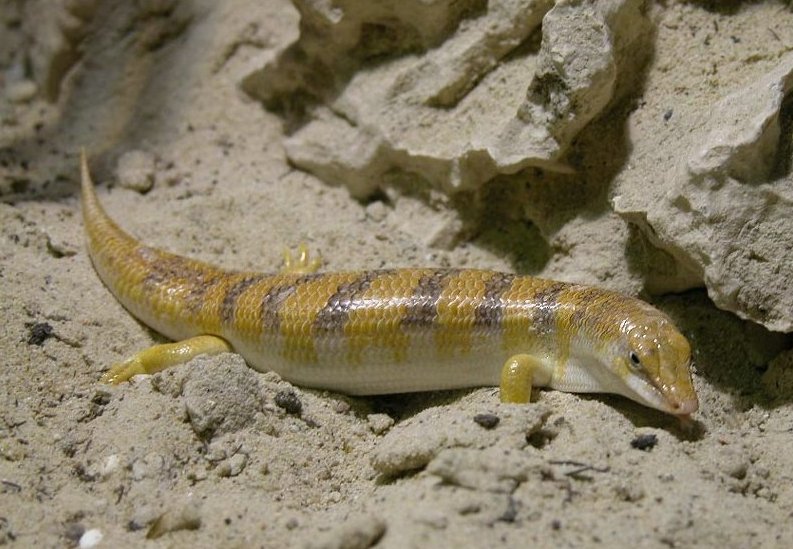
The Sandfish Skink has a long, wedge-shaped snout and a countersunk lower jaw. Its compact, tapered body is covered with smooth, shiny scales.[1][2]
Its legs are short and sturdy, with long, flattened, fringed feet adapted for digging. Its tail is short and tapers to a fine point.[3][4]
Its coloration is yellow-caramel with brown-black cross bands. It has bead-like eyes that can close to prevent sand from entering them, and very small nostrils that help prevent sand from entering its respiratory system.[5][6][7]
Habitat
The Sandfish Skink inhabits desert environments and burrows into loose, soft sand.[8][9]
Diet
The Sandfish Skink is insectivorous. Its recorded food items include dubias, crickets, and mealworms.[10][11]
Behaviour
The Sandfish Skink burrows into and moves through sand in a swimming-like manner. Its movements through sand generate vibrations at a consistent frequency of 3 Hz.[12][13]
It dives into sand to avoid overheating and escape potential predators. During movement through sand, it uses an undulatory gait with its limbs tucked against its sides.[14][15]
The Sandfish Skink detects vibrations produced by nearby moving insects to locate and ambush prey.[16]
Reproduction and life cycle
Sandfish skinks breed once per year. The recorded breeding season extends from May to June.[17][18]
Uses
The Sandfish Skink is kept as a pet outside its native range.[19]
Similar species
Peters's banded skink resembles the Sandfish Skink but has a less wedge-shaped snout and differently shaped hands.[20]
Classification of the Sandfish Skink
| Kingdom | Animalia |
|---|---|
| Phylum | Chordata |
| Subphylum | Vertebrata |
| Infraphylum | Gnathostomata |
| Parvphylum | Osteichthyes |
| Megaclass | Tetrapoda |
| Class | Reptilia (Reptile) |
| Order | Squamata (Snakes) |
| Suborder | Autarchoglossa |
| Family | Scincidae (Skink) |
| Subfamily | Scincinae |
| Genus | Scincus (Sandfishes) |
| Species | Scincus scincus (Linnaeus, 1758) |
Where the Sandfish Skink is found
Checklists and occurrence records place Scincus scincus in 21 countries across Africa and Asia. GBIF holds 1,054 georeferenced records of it.
Countries
- Algeria 170
- Bahrain 3
- Chad 3
- Egypt 509
- Iran 38
- Iraq 5
- Israel 141
- Jordan 4
- Kuwait 2
- Libya 9
- Mali 2
- Mauritania 4
- Morocco 7
- Niger 2
- Nigeria 5
- Saudi Arabia 37
- Senegal 12
- Tunisia 98
- United Arab Emirates 3
- Western Sahara
- Yemen
Regions and cities with the most records
- Giza, Egypt 193
- Kirdāsah, Egypt 190
- Awsīm, Egypt 189
- Ash-Shaykh Zāyid, Egypt 177
- Manshīyat al Qanāţir, Egypt 163
- Al Qanāţir al Khayrīyah, Egypt 143
- Southern District, Israel 127
- Giza, Egypt 119
- Qalyub, Egypt 119
- Cairo, Egypt 111
- Abū an Numrus, Egypt 107
- Shubrā al Khaymah, Egypt 74
- Ashmūn, Egypt 53
- Al Ḩawāmidīyah, Egypt 37
- Al Badrashayn, Egypt 29
- 6th of October City, Egypt 27
- Tozeur Governorate, Tunisia 25
- Illizi, Algeria 24
- Khuzestan, Iran 22
- Kebili Governorate, Tunisia 19
- Segev Shalom, Israel 17
- Beersheba, Israel 15
- Tel Sheva‘, Israel 15
- Dimona, Israel 14
- ‘Ar‘ara BaNegev, Israel 14
- Mecca Region, Saudi Arabia 13
- Al Khuşūş, Egypt 12
- Alexandria, Egypt 12
- Alexandria, Egypt 12
- Jeddah, Saudi Arabia 11
- Beheira, Egypt 9
- Ḩalwān, Egypt 9
- Cairo, Egypt 8
- Tozeur, Tunisia 7
- Bushehr, Iran 6
- Bushehr, Iran 6
Range as the checklists state it
Tunisia, Algeria, SE Libya, Egypt, Sinai, Israel, Jordan, Yemen, , Bahrain, Kuwait, Iraq, Iran, Western Sahara ?, Mauritania ?, Senegal, Mali, Niger, Nigeria, Saudi Arabia, C Sudan (Jumhūriyyat)
A number beside a place is its count of GBIF occurrence records. A place without a number comes from a checklist alone. Records show where a species has been observed or collected, which can include escapes and vagrants.
Common names
English
- Sandfish Skink
- Burrowing Sand Skink
- Common Sandfish
- Common Skink
- Desert Skink
- Egyptian Skink
- Sand Fish
- Sand Skink
Names in 19 other languages
- Arabic
- سقنقور سمكة الرمال, سمكة الرمال
- Basque
- Eskinko arrunt
- Czech
- scink obecný
- Dutch
- Apothekersskink
- Finnish
- Hiekkaskinkki
- French
- Poisson de sable, Scinque des boutiques, Scinque des sables, Scinque officinal
- German
- Apothekerskink, Meerstinz, Stinzeidechse
- Hebrew
- חומט מצרי, חומט רפואי
- Italian
- Pesce delle sabbie, Scinco delle sabbie
- Japanese
- サンドフィッシュスキンク
- Korean
- 도루묵도마뱀, 샌드피시 스킨크
- Norwegian Bokmål
- Apotekerskink
- Polish
- Scynk aptekarski
- Russian
- Аптечный сцинк, Обыкновенный сцинк
- Spanish
- Pez de arena
- Swedish
- Apotekarskink
- Thai
- จิ้งเหลนทรายธรรมดา
- Ukrainian
- Аптечний сцинк
- nav
- Séiyiʼ oołkǫ́ǫłii noodǫ́zígíí
Synonyms
7 other scientific names have been used for this species and are now treated as synonyms of Scincus scincus.
- Lacerta scincus Linnaeus, 1758
- Lacerta stincus Linnaeus, 1758
- Scincus deserti Haas, 1957
- Scincus meccensis Wiegmann, 1837
- Scincus officinalis Laurenti, 1768
- Scincus officinalis lineolata Werner, 1914
- Scincus officinalis var. cucullata Werner, 1914
Subspecies and varieties
- Scincus scincus cucullatus subspecies
- Scincus scincus meccensis subspecies
- Scincus scincus scincus subspecies
Related species
- Eastern SkinkScincus mitranus
-
 Sandfish SkinkScincus conirostris
-
 Western SandfishScincus albifasciatus
- Arabian SandfishScincus hemprichii
-
 ShinglebackTiliqua rugosa
-
 Five-lined SkinkPlestiodon fasciatus
- Common Garden SkinkLampropholis guichenoti
-
 Blue-tailed SkinkCryptoblepharus egeriae
Compare
Questions and answers
What is the scientific name of the Sandfish Skink?
The scientific name of the Sandfish Skink is Scincus scincus. Written with its author, the full name is Scincus scincus (Linnaeus, 1758).
Which family does the Sandfish Skink belong to?
Scincus scincus belongs to the family Scincidae, in the order Squamata and the class Reptilia.
Where is the Sandfish Skink found?
Checklists and occurrence records place Scincus scincus in 21 countries, including Egypt, Algeria, Israel, Tunisia, Iran and Saudi Arabia.
What is the conservation status of the Sandfish Skink?
The IUCN Red List category recorded for Scincus scincus is Least Concern (LC).
What other names does the Sandfish Skink have?
Scincus scincus is also known in English as Burrowing Sand Skink, Common Sandfish, Common Skink, Desert Skink, Egyptian Skink and Sand Fish.
How big do sandfish skinks get?
Adults usually reach approximately 20 cm in total length, including the tail.[21]
Sources
Passages the profile rests on
- The species has a long, wedge-shaped snout and a countersunk lower jaw. Source passage: “This skink has a long, wedge-shaped snout with a countersunk lower jaw, shaped much like a basket.” — English Wikipedia
- Its compact, tapered body is covered with smooth, shiny scales. Source passage: “Its compact, tapered body is covered with smooth, shiny scales” — English Wikipedia
- Its legs are short and sturdy, with long, flattened, fringed feet adapted for digging. Source passage: “its legs are short and sturdy with long, flattened and fringed shovel-like feet.” — English Wikipedia
- Its tail is short and tapers to a fine point. Source passage: “The tail is short, tapering to a fine point.” — English Wikipedia
- Its coloration is yellow-caramel with brown-black cross bands. Source passage: “The coloration of this species is considered attractive, being yellow-caramel with brown-black cross bands.” — English Wikipedia
- It has bead-like eyes that can close to prevent sand from entering them. Source passage: “This lizard also has bead-like eyes so it can close them to keep sand out of its eyes.” — English Wikipedia
- Its nostrils are very small, helping prevent sand from entering its respiratory system. Source passage: “its nostrils are very small to keep all of the sand out of its nose and lungs.” — English Wikipedia
- The species inhabits desert environments. Source passage: “It is native to the Sahara Desert and the Arabian Peninsula” — English Wikipedia
- It burrows into loose, soft sand. Source passage: “it can dive into loose, soft sand.” — English Wikipedia
- The species is insectivorous. Source passage: “The sandfish skink is an insectivore.” — English Wikipedia
- Its recorded food items include dubias, crickets, and mealworms. Source passage: “Sandfish have a diet of dubias, crickets, and mealworms.” — English Wikipedia
- The species burrows into and moves through sand in a swimming-like manner. Source passage: “Scincus scincus (sandfish) is a species of skink that burrows into the sand and swims through it.” — inaturalist.org
- Its movements through sand generate vibrations at a consistent frequency of 3 Hz. Source passage: “Its winding movements produce vibrations in the sand, with a consistent frequency of 3 Hz.” — English Wikipedia
- It dives into sand to avoid overheating and escape potential predators. Source passage: “It does this to prevent its body from overheating and to escape potential predators” — English Wikipedia
- During movement through sand, it uses an undulatory gait with its limbs tucked against its sides. Source passage: “the lizard swims within sand using an undulatory gait with its limbs tucked against its sides” — English Wikipedia
- It detects vibrations produced by nearby moving insects to locate and ambush prey. Source passage: “It can detect vibrations that nearby insects create while moving, using those vibrations to locate, ambush, and consume them.” — English Wikipedia
- Sandfish skinks breed once per year. Source passage: “Breeding interval: Sandfish skinks breed once a year.” — animaldiversity.org
- The recorded breeding season extends from May to June. Source passage: “Breeding season: May to June.” — animaldiversity.org
- The species is kept as a pet outside its native range. Source passage: “but is also kept as a pet elsewhere.” — English Wikipedia
- Peters's banded skink is described as a species resembling the sandfish, but with a less wedge-shaped snout and differently shaped hands. Source passage: “The sandfish is very similar to Peters's banded skink, a less wedge-nosed skink with different hands” — English Wikipedia
- Adults usually reach approximately 20 cm in total length, including the tail. Source passage: “Adult common skinks usually reach about 20 cm (7.9 inches) in length, including the short tail.” — English Wikipedia
Data
- Catalogue of Life, 2026-10-16 XR cc by
- Global Biodiversity Information Facility CC BY 4.0
- Wikidata CC0
- GeoNames CC BY 4.0
- Wikimedia Commons per image; credit shown with each image
- Within the Catalogue of Life, this name comes from The Reptile Database cc by
References
- Linné, C. [= Linnaeus, C.]. (1758). Systema naturæ per regna tria naturæ, secundum classes, ordines, genera, species, cum characteribus, differentiis, synonymis, locis. Tomus I. Editio decima, reformata. Laurentii Salvii, Holmiæ. 10th Edition: 824 Pp.
- Meyer, F. A. A. (1795). Synopsis Reptilium, novam ipsorum sistens generum methodum, nec non Gottingensium huius ordinis animalium enumerationem. Vandenhoeck Und Ruprecht, Göttingen, 32 Pp [for Current Names See Rösler & Böhme 2021].
- Shaw, George & Nodder, Frederick P. (Eds.). (1813). The Naturalist’s Miscellany [...], Vol. XXIV. London, Nodder & Co., Plates 1021-1064, 170 Unnumbered Pages [Published in Monthly Issues between August 1, 1812, and July 1, 1813].
- Wiegmann, A. F. A. (1837). Herpetologische Notizen. Archiv Für Naturgeschichte 3: 123-136.
- Duméril, A. M. C. and G. Bibron. (1839). Erpétologie Générale on Histoire Naturelle Complète des Reptiles. Vol. 5. Roret/Fain et Thunot, Paris, 871 Pp.
- Gravenhorst, J. L. C. (1851). Über die im Zoologischen Museum der Universität Breslau Befindlichen Wirtelschleichen (Pseudosaura), Krüppelfüssler (Brachypoda), und einige andere, Denselben verwandte Reptilien aus den Zünften der Schleichen und Dickzüngler [Euprepes striolatus]. Acta Acad. Caes. Leop. Carol. Nat. Cur. 23 (1): 291-394 [1847].
- Boettger, O. [as O. Böttger]. (1880). Die Reptilien und Amphibien von Syrien, Palaestina und Cypern. Ber. Senckenb. Naturforsch. Ges., Frankfurt/M., 1879-1880: 132-219.
- Blanford, W. T. (1881). On a collection of Persian reptiles recently added to the British Museum. Proc. Zool. Soc. London 1881: 671-682.
- Boulenger, George A. (1891). Catalogue of the reptiles and batrachians of Barbary (Morocco, Algeria, Tunisia), based chiefly upon the notes and collections made in 1880-1884 by M. Fernand Lataste. Tr. Zool. Soc. 13: 93-164.
- Werner, F. (1894). Zweiter Beitrag zur Herpetologie von Ost-Algerien. Verh. Zool.-Bot. Ges. Wien 44: 75-87.
- Siebenrock, & Friedrich. (1895). Zur Kenntnis des Rumpfskeletes der Scincoiden, Anguiden und Gerrhosauriden. Annalen Des Königlichen Kaiserlichen Naturhistorischen Hofmuseum in Wien (Wien), 10 (1): 17-41.
- Anderson, & John. (1896). A Contribution to the Herpetology of Arabia, with a preliminary list of the reptiles and batrachians of Egypt. London, R. H. Porter, 124 Pp.
- Tornier, G. (1899). Reptilia. In: Carlgren,O., Hilgendorf,F., Martens, E. von, Matschie, P., Tornier, G., & Weltner, W. (eds.). Symbolae physicae seu icones adhuc ineditae corporum naturalium novorum aut minus cognitorum quae ex itineribus per Libyam, Aegyptum, Nubiam,k Dongalam, Syriam, Arabiam et Habessiniam publico institutis sumptu F.G. Hemprich et C.G. Ehrenberg. Zoologica 1, Amphibia. G. Reimer, Berlin.
- Zulueta, & de, A. (1909). Nota sobre reptiles de Cabo Juby (N.W. de Africa). Bol. Real Sociedad Esp. Hist. Nat. 9: 354-355.
- Werner, F. (1914). Ergebnisse einer von Prof. F. Werner im Sommer 1910 mit Unterstützung aus dem Legate Wedl ausgeführten zoologsichen Forschungsreise nach Algerien. II. Vertebrata. Sitz.-Ber. Akad. Wiss., Wien, Math.-Naturwiss. Kl., Abt. 1, 123 (1/10): 331-357.
- Loveridge, A. (1936). African reptiles and amphibians in the Field Museum of Natural History. Zool. Ser. Field Mus. Nat. Hist., Chicago, 22 (1): 1-122.
- El-Toubi, M. R. (1938). The osteology of the lizard Scincus scincus (Linn.). Bull. Fac. Sci., Cairo. Fouad I University 14:5-38.
- Schmidt, K. P. (1939). Reptiles and amphibians from Southwestern Asia. Publ. Field Mus. Nat. Hist., Zool. Ser., 24: 49-92.
- Grandison, A. G. C. (1956). On a collection of lizards from West Africa. Bull. Inst. Fr. Afr. Noire, 18 (1): 224-245 [235].
- Schmidt, K. P., & Marx, H. (1956). The herpetology of Sinai. Fieldiana 39 (4): 21-40.
- Haas, & Georg. (1957). Some amphibians and reptiles from Arabia. Proc. Cal. Acad. Sci. 29 (3): 47-86.
- Bons, J. (1959). Les lacertiliens du sud-ouest Marocain; systematique, repartition geographique, ethologie, ecologie. Instit. Sci. Cherifien, Rabat, Trav. (Ser. Zool.) No. 18 130 Pp.
- Anderson, S. C. (1963). Amphibians and Reptiles from Iran. Proc. Cal. Acad. Sci. Ser. 4, 31(16): 417-498.
- Eissa, S. M., & EL ASSY, Y. S. (1975). Record of certain reptilian species found in Kuwait. Jour. Univ. Kuwait (Sci.), 2: 123-146.
- Arnold, Edwin Nicholas & Leviton, Alan E. (1977). A revision of the lizard genus Scincus (Reptilia: Scincidae). Bulletin of the British Museum (Natural History) 31 (5): 187-248.
This species in other databases
Page built on 27 November 2026. See how the catalog is made and all sources and licences.
Cite this page
ScientificNames.org. (2026). Scincus scincus (Sandfish Skink). Retrieved November 27, 2026, from https://scientificnames.org/species/scincus-scincus
“Scincus scincus (Sandfish Skink).” ScientificNames.org, 2026, scientificnames.org/species/scincus-scincus. Accessed 27 Nov. 2026.
ScientificNames.org. “Scincus scincus (Sandfish Skink).” Accessed November 27, 2026. https://scientificnames.org/species/scincus-scincus.
@misc{scientificnames_scincus_scincus_sandfish_skink,
  author = {{ScientificNames.org}},
  title = {Scincus scincus (Sandfish Skink)},
  year = {2026},
  url = {https://scientificnames.org/species/scincus-scincus},
  note = {Accessed 2026-11-27}
}