Species · Fishes
Skipjack Shad Alosa chrysochloris
The scientific name of the Skipjack Shad is Alosa chrysochloris. It is a species of fish in the family Alosidae (shads and sardines), order Clupeiformes. The name dates from 1820.
- Scientific name
- Alosa chrysochloris (Rafinesque, 1820)
- Common name
- Skipjack Shad
- Genus
- Alosa
- Family
- Alosidae (Shads and Sardines)
- Order
- Clupeiformes
- Class
- Teleostei
- Red List category
- LC Least Concern
- Environment
- brackish, freshwater, marine
- Recorded in
- 1 country
- Name status
- accepted in the Catalogue of Life

Overview
Alosa chrysochloris inhabits freshwater rivers and occasionally coastal marine estuaries, with a current distribution restricted to Gulf of Mexico drainage basins in the United States. It has a slender, compressed body, a large mouth, and a saw-tooth margin formed by scutes around its belly.
Written 26 November 2026 from the sources listed below. Each statement was checked against the passage it cites; statements that could not be supported were removed.
Appearance
Skipjack Shad has a slender, compressed body. Its back is gray, while its sides and belly are silver or white, and its sides can display a blue reflection.[1][2][3]
It has a large mouth, pointed snout, and protruding lower jaw. Teeth occur in both jaws, with two to four rows of teeth on its tongue.[4][5]
Its eyes are yellow and have protective eyelid covers. Modified scales called scutes form a saw-tooth margin around its belly.[6][7]
Juveniles can reach lengths of 75 to 150 mm during their first year.[8]
Habitat
Skipjack Shad prefers clear, deep, swiftly flowing rivers over gravel or sand. It generally avoids muddy or cloudy water and is frequently found in swift currents below dams.[9][10][11]
Spawning is thought to occur in deep river channels over coarse gravel or underwater sandbars.[12]
Diet
Juveniles consume zooplankton, insect larvae, and small fishes. Its diet becomes increasingly fish-based as it grows.[13][14]
It has been observed consuming threadfin shad, gizzard shad, and young herring.[15]
Behaviour
Skipjack Shad is migratory and commonly travels in schools. It frequently leaps out of the water while feeding.[16][17]
Schools drive minnows toward the surface before capturing them. Individuals also migrate vertically through the water column daily while searching for food.[18][19]
Reproduction and life cycle
Females produce approximately 100,000 to 300,000 eggs annually and generally reach sexual maturity at approximately three years of age. Males are thought to reach sexual maturity at approximately two years of age.[20][21][22]
In the southern part of its range, spawning occurs from early March through late April. In the upper Mississippi River drainage, spawning occurs from early May through early July.[23][24]
Spawning temperatures range from 16 to 21 degrees Celsius. Females release eggs while males fertilize them simultaneously, and the eggs are released over the substrate rather than attached to it.[25][26][27]
Larvae hatch approximately 58 hours after fertilization at 17.2 degrees Celsius. Newly hatched larvae measure approximately 3.4 to 3.6 mm.[28][29]
The species provides no parental care after hatching.[30]
The oldest reported specimen was four years old. Approximately 90% of individuals die within their first year.[31][32]
Conservation
Dams impede Skipjack Shad's upstream migration and restrict its distribution. Lock and dam structures hinder its early spring migration.[33][34]
Fish passage facilities such as ladders or lifts are identified as necessary for restoring migration in Minnesota and Wisconsin.[35]
Uses
Skipjack Shad serves as a host for the larval stages of the ebony shell mussel.[36]
Classification of the Skipjack Shad
| Kingdom | Animalia |
|---|---|
| Phylum | Chordata |
| Subphylum | Vertebrata |
| Infraphylum | Gnathostomata |
| Parvphylum | Osteichthyes |
| Gigaclass | Actinopterygii |
| Superclass | Actinopteri |
| Class | Teleostei (Teleost) |
| Order | Clupeiformes |
| Suborder | Clupeoidei |
| Family | Alosidae (Shads and Sardines) |
| Genus | Alosa (River Herrings) |
| Species | Alosa chrysochloris (Rafinesque, 1820) |
Where the Skipjack Shad is found
Checklists and occurrence records place Alosa chrysochloris in 1 country. GBIF holds 2,421 georeferenced records of it.
Countries
Regions and cities with the most records
- Georgia, United States 286
- Louisiana, United States 282
- Florida, United States 260
- Illinois, United States 215
- Alabama, United States 210
- Kentucky, United States 162
- Ohio, United States 160
- Groves, United States 122
- Port Arthur, United States 120
- Texas, United States 109
- Mississippi, United States 80
- Tennessee, United States 79
- Arkansas, United States 47
- Missouri, United States 45
- Portsmouth, United States 43
- Indiana, United States 42
- Orange, United States 42
- Ensley, United States 38
- Nederland, United States 38
- Pace, United States 36
- Oklahoma, United States 32
- West Virginia, United States 28
- Ferry Pass, United States 27
- Brent, United States 25
- Shorewood, United States 24
- Bellview, United States 23
- Burlington, United States 22
- Fort Thomas, United States 22
- West Pensacola, United States 22
- Alexandria, United States 21
- Pensacola, United States 21
- Slidell, United States 21
- White Oak, United States 21
- Covington, United States 20
- Newport, United States 20
- Norwood, United States 20
A number beside a place is its count of GBIF occurrence records. A place without a number comes from a checklist alone. Records show where a species has been observed or collected, which can include escapes and vagrants.
Common names
English
- Skipjack Shad
- Blue Herring
- Golden Shad
- Green Herring
- River Herring
- Skipjack
- Skipjack Herring
Names in 2 other languages
- Czech
- placka mississippská
- Russian
- Зеленоспинка
Synonyms
One other scientific name has been used for this species and is now treated as a synonym of Alosa chrysochloris.
- Pomolobus chrysochloris Rafinesque, 1820
Related species
-
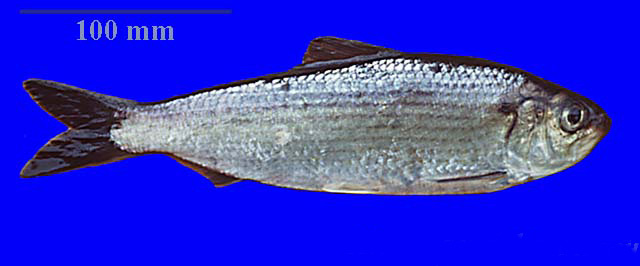 AlewifeAlosa pseudoharengus
-
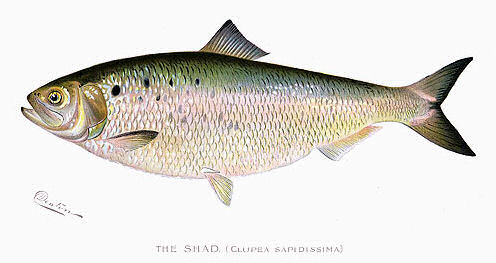 American ShadAlosa sapidissima
-
 Allis ShadAlosa alosa
-
 Blueback HerringAlosa aestivalis
-
 Twait ShadAlosa fallax
- Killarney ShadAlosa killarnensis
-
 Mediterranean ShadAlosa agone
-
 Pontic ShadAlosa immaculata
Compare
Questions and answers
What is the scientific name of the Skipjack Shad?
The scientific name of the Skipjack Shad is Alosa chrysochloris. Written with its author, the full name is Alosa chrysochloris (Rafinesque, 1820).
Which family does the Skipjack Shad belong to?
Alosa chrysochloris belongs to the family Alosidae, in the order Clupeiformes and the class Teleostei.
Where is the Skipjack Shad found?
Checklists and occurrence records place Alosa chrysochloris in 1 country: United States.
What is the conservation status of the Skipjack Shad?
The IUCN Red List category recorded for Alosa chrysochloris is Least Concern (LC).
What other names does the Skipjack Shad have?
Alosa chrysochloris is also known in English as Blue Herring, Golden Shad, Green Herring, River Herring, Skipjack and Skipjack Herring.
Sources
Passages the profile rests on
- The species has a slender, compressed body. Source passage: “Skipjack herring have a slender, compressed body” — animaldiversity.org
- Its back is gray, while its sides and belly are silver or white. Source passage: “They are gray dorsally and silver or white laterally and ventrally.” — animaldiversity.org
- Its sides can display a blue reflection. Source passage: “At times, skipjack herring can appear to have a blue reflection coming from their sides.” — animaldiversity.org
- It has a large mouth, pointed snout, and protruding lower jaw. Source passage: “These fish have a large mouth and pointed snout with a protruding lower jaw” — animaldiversity.org
- It has teeth in both jaws and two to four rows of teeth on its tongue. Source passage: “Skipjack herring have teeth in both jaws as well as two to four rows on their tongue.” — animaldiversity.org
- Its eyes are yellow and have protective eyelid covers. Source passage: “These fish also have yellow eyes with protective eye lid covers.” — animaldiversity.org
- Modified scales called scutes form a saw-tooth margin around its belly. Source passage: “These scales are referred to as "scutes" and form a saw-tooth margin around the belly” — animaldiversity.org
- Juveniles can reach lengths of 75 to 150 mm during their first year. Source passage: “Juvenile skipjack herring reach lengths of 75 to 150 mm during their first year of life.” — animaldiversity.org
- The species prefers clear, deep, swiftly flowing rivers over gravel or sand. Source passage: “Skipjack herring are large river fish that prefer to reside in clear, deep, and swift waters over gravel or sand.” — animaldiversity.org
- It generally avoids muddy or cloudy water. Source passage: “they avoid muddy or cloudy waters whenever possible.” — biokids.umich.edu
- It is frequently found in swift currents below dams. Source passage: “Skipjack herring are known to congregate in swift currents below dams.” — animaldiversity.org
- Spawning is thought to occur in deep river channels over coarse gravel or underwater sandbars. Source passage: “skipjack herring are thought to spawn in the deepest channels over coarse gravel or underwater sandbars.” — biokids.umich.edu
- Juveniles consume zooplankton, insect larvae, and small fishes. Source passage: “Juveniles feed on zooplankton, insect larvae, and small fishes” — animaldiversity.org
- Its diet becomes increasingly fish-based as it grows. Source passage: “Juveniles eat zooplankton, insect larvae, and small fishes and continue eating more fish as they grow.” — biokids.umich.edu
- It has been observed consuming threadfin shad, gizzard shad, and young herring. Source passage: “skipjack herring have been found to feed on other shad/herring species such as the threadfin shad, the gizzard shad and young of the year herring species.” — English Wikipedia
- The species is migratory and commonly travels in schools. Source passage: “Skipjack herring are a migratory schooling species.” — English Wikipedia
- It frequently leaps out of the water while feeding. Source passage: “The name skipjack shad comes from the fact that it is commonly seen leaping out of the water while feeding.” — English Wikipedia
- Schools drive minnows toward the surface before capturing them. Source passage: “Schools of skipjack herring drive minnows to the surface for easy capture” — animaldiversity.org
- Individuals migrate vertically through the water column daily while searching for food. Source passage: “Skipjack herring vertically migrate daily, this means they move up and down the water column at certain times of the day in search of food.” — biokids.umich.edu
- Females produce approximately 100,000 to 300,000 eggs annually. Source passage: “Females produce about 100,000 to 300,000 eggs per year” — English Wikipedia
- Females generally reach sexual maturity at approximately three years of age. Source passage: “Female skipjack herring reach sexual maturity in approximately three years” — animaldiversity.org
- Males are thought to reach sexual maturity at approximately two years of age. Source passage: “while males are thought to mature in two years.” — animaldiversity.org
- In the southern part of its range, spawning occurs from early March through late April. Source passage: “The spawning season for skipjack herring is from early March to late April in the southern extent of its range.” — English Wikipedia
- In the upper Mississippi River drainage, spawning occurs from early May through early July. Source passage: “In the upper Mississippi river drainage spawning time is from early May to early July.” — English Wikipedia
- Spawning temperatures range from 16 to 21 degrees Celsius. Source passage: “Spawning temperature range is between 16 and 21 °C (61 and 70 °F).” — English Wikipedia
- Eggs are released over the substrate rather than attached to it. Source passage: “Eggs are broadcast over the substrate.” — English Wikipedia
- Females release eggs while males fertilize them simultaneously. Source passage: “Females drop their eggs in moderately deep, to very deep areas over gravel, while males simultaneously fertilize them with sperm.” — animaldiversity.org
- Larvae hatch approximately 58 hours after fertilization at 17.2 degrees Celsius. Source passage: “Larvae hatch in 58 hours at 17.2° Celsius.” — animaldiversity.org
- Newly hatched larvae measure approximately 3.4 to 3.6 mm. Source passage: “The average larval length after hatching is roughly 3.4 to 3.6 mm.” — animaldiversity.org
- The species provides no parental care after hatching. Source passage: “Right after spawning, skipjack herring leave the spawning grounds and return to their original habitat, giving no parental care to their young.” — biokids.umich.edu
- The oldest reported specimen was four years old. Source passage: “The oldest specimen of skipjack herring reported was four years old.” — English Wikipedia
- Approximately 90% of individuals die within their first year. Source passage: “Most skipjack herring do not live past the first few months of life, around 90% die within the first year of life.” — animaldiversity.org
- Dams impede the species' upstream migration and restrict its distribution. Source passage: “Because this fish is a migratory species, dams have diminished its distribution.” — English Wikipedia
- Lock and dam structures hinder its early spring migration. Source passage: “It is known that lock and dam structures hinder migration of skipjack herring during the early spring.” — English Wikipedia
- Fish passage facilities such as ladders or lifts are identified as necessary for restoring migration in Minnesota and Wisconsin. Source passage: “fish passage features such as ladders or lifts will be required on Mississippi River lock and dams.” — English Wikipedia
- The species serves as a host for the larval stages of the ebony shell mussel. Source passage: “the ebony shell (Fusconaia ebena) and elephant ear (Elliptio crassidens), both state endangered mussels for which the skipjack is the sole host during their larval stages, are threatened to be extirpated as well.” — English Wikipedia
Data
- Catalogue of Life, 2026-10-16 XR cc by
- Global Biodiversity Information Facility CC BY 4.0
- Wikidata CC0
- GeoNames CC BY 4.0
- Wikimedia Commons per image; credit shown with each image
- Within the Catalogue of Life, this name comes from World Register of Marine Species cc by
This species in other databases
- Catalogue of Life C5LX
- Wikidata Q610121
- iNaturalist 56942
- WoRMS urn:lsid:marinespecies.org:taxname:272250
- ITIS 161707
Page built on 29 November 2026. See how the catalog is made and all sources and licences.
Cite this page
ScientificNames.org. (2026). Alosa chrysochloris (Skipjack Shad). Retrieved November 29, 2026, from https://scientificnames.org/species/alosa-chrysochloris
“Alosa chrysochloris (Skipjack Shad).” ScientificNames.org, 2026, scientificnames.org/species/alosa-chrysochloris. Accessed 29 Nov. 2026.
ScientificNames.org. “Alosa chrysochloris (Skipjack Shad).” Accessed November 29, 2026. https://scientificnames.org/species/alosa-chrysochloris.
@misc{scientificnames_alosa_chrysochloris_skipjack_shad,
  author = {{ScientificNames.org}},
  title = {Alosa chrysochloris (Skipjack Shad)},
  year = {2026},
  url = {https://scientificnames.org/species/alosa-chrysochloris},
  note = {Accessed 2026-11-29}
}