Species · Fishes
Pontic Shad Alosa immaculata
The scientific name of the Pontic Shad is Alosa immaculata. It is a species of fish in the family Alosidae (shads and sardines), order Clupeiformes. The name dates from 1835.
- Scientific name
- Alosa immaculata Bennett, 1835
- Common name
- Pontic Shad
- Genus
- Alosa
- Family
- Alosidae (Shads and Sardines)
- Order
- Clupeiformes
- Class
- Teleostei
- Red List category
- LC Least Concern
- Environment
- brackish, freshwater, marine
- Recorded in
- 5 countries
- Name status
- accepted in the Catalogue of Life

Overview
The Pontic Shad is a clupeid fish in the family Alosidae. It typically inhabits the Black Sea and Sea of Azov and also occurs in the Sea of Marmara. It is an anadromous, pelagic fish that migrates into rivers to spawn.
Written 26 November 2026 from the sources listed below. Each statement was checked against the passage it cites; statements that could not be supported were removed.
Appearance
The Pontic Shad belongs to the clupeid fishes.[1]
Habitat
The species typically inhabits the Black Sea and Sea of Azov. It also occurs in the Sea of Marmara.[2][3]
It uses large rivers connected to the sea as spawning habitats.[4]
Diet
The Pontic Shad preferentially feeds on small fishes and crustaceans.[5]
Behaviour
Adult individuals migrate upstream into rivers to spawn.[6]
Reproduction and life cycle
Spawning takes place between May and August. The species enters large rivers connected to the sea for spawning.[7][8]
Conservation
The species is regionally extinct in Hungary. Dams have restricted its upstream spawning migrations.[9][10]
Excessive fishing and pollution are identified as possible contributors to its decline. It was classified as vulnerable in the IUCN Red List assessment cited in the study.[11][12]
The species was included in Annexes 2 and 4 of the Bulgarian Biodiversity Act and Annex 2 of the Habitats Directive 92/43/EEC.[13][14]
Average annual catches in the Bulgarian Black Sea sector and the Danube River declined approximately 3.5-fold between 2003 and 2011.[15]
Uses
The Pontic Shad is an economically important fish species.[16]
Classification of the Pontic Shad
| Kingdom | Animalia |
|---|---|
| Phylum | Chordata |
| Subphylum | Vertebrata |
| Infraphylum | Gnathostomata |
| Parvphylum | Osteichthyes |
| Gigaclass | Actinopterygii |
| Superclass | Actinopteri |
| Class | Teleostei (Teleost) |
| Order | Clupeiformes |
| Suborder | Clupeoidei |
| Family | Alosidae (Shads and Sardines) |
| Genus | Alosa (River Herrings) |
| Species | Alosa immaculata Bennett, 1835 |
Where the Pontic Shad is found
Checklists and occurrence records place Alosa immaculata in 5 countries. GBIF holds 202 georeferenced records of it.
Countries
Regions and cities with the most records
- Odesa, Ukraine 20
- Tulcea County, Romania 15
- Volgograd Oblast, Russia 15
- Kalach-na-Donu, Russia 10
- Bilhorod-Dnistrovskyi, Ukraine 7
- Henichesk, Ukraine 6
- Rostov, Russia 6
- Krasnodar Krai, Russia 5
- Pivdenne, Ukraine 5
- Cheremushky, Ukraine 4
- Chornomors’k, Ukraine 4
- Kherson, Ukraine 4
- Kiliya, Ukraine 4
- Reni, Ukraine 4
- Zaporizhzhya, Ukraine 4
- Adygeya Republic, Russia 3
- Negotin, Serbia 3
- Odesa, Ukraine 3
- Skadovsk, Ukraine 3
- Taganrog, Russia 3
A number beside a place is its count of GBIF occurrence records. A place without a number comes from a checklist alone. Records show where a species has been observed or collected, which can include escapes and vagrants.
Common names
English
- Pontic Shad
- Black Sea Herring
- Black Sea Shad
- Kerch Black Sea Shad
- Kerch Shad
Names in 19 other languages
- Bulgarian
- dunavska skumriya, dunаvskа skumriya, karagyoz, kаrаgyoz, Дунавска скумрия, Карагьоз
- Croatian
- Dunavska haringa
- Czech
- placka bezeskvrnná
- Finnish
- sarmatiansilli
- French
- alose, alose de la Mer Noire
- Georgian
- პონტოური ქაშაყი
- German
- Donauhering, Schwarzmeer-Maifisch
- Greek
- Σαρδελομάνα Πόντου
- Hungarian
- Dunai hering, Dunai nagyhering, Kaszpi-tengeri vándorhering
- Italian
- alosa nerica
- Korean
- 흑해대서양전어
- Lithuanian
- juodosios jūros perpelė, pontinė perpelė
- Polish
- Sledź czarnomorski, śledź czarnomorski
- Romanian
- scrumbia de Dunăre, scrumbie de Dunare
- Russian
- Сельдь черноморско-азовская проходная, донская сельдь, черноморско-азовская проходная сельдь, черноморско-азовская сельдь
- Slovenian
- Črnomorska čepa
- Spanish
- alosa pontica, sábalo del Mar Negro
- Turkish
- Karadeniz Tirsisi, Ringa balığı, tirsi
- Ukrainian
- Оселедець чорноморський, Оселедець чорноморсько-азовський, Оселедець чорноморсько-азовський прохiдний, Оселедець чорноморсько-азовський прохідний, Чорноморсько-азовський оселедець
Synonyms
23 other scientific names have been used for this species and are now treated as synonyms of Alosa immaculata.
- Alosa kessleri natio borysthenis Pavlov, 1959
- Alosa kessleri natio issatschenkovi Pavlov, 1959
- Alosa kessleri natio moriaac Pavlov, 1959
- Alosa kessleri pontica (Eichwald, 1838)
- Alosa pontica (Eichwald, 1838)
- Alosa pontica (Eichwald, 1938)
- Alosa pontica danubii Antipa, 1904
- Alosa pontica moriac Antipa, 1909
- Alosa pontica nigrescens Antipa, 1904
- Alosa pontica pontica (Eichwald, 1838)
- Alosa pontica russac Antipa, 1904
- Alosa pontica var. danubii Antipa, 1904
- Alosa pontica var. moriac Antipa, 1909
- Alosa pontica var. nigrescens Antipa, 1904
- Alosa pontica var. russac Antipa, 1904
- Caspialosa kessleri pontica (Eichwald, 1838)
- Caspialosa pontica (Eichwald, 1838)
- Caspialosa pontica chtamalocephala Isachenko, 1925
- Caspialosa pontica hypselocephala Isachenko, 1925
- Caspialosa pontica hypselocephala Fowler, 1973
- Clupea eichwaldi Grimm, 1901
- Clupea eichwaldii Grimm, 1901
- Clupea pontica Eichwald, 1838
Related species
-
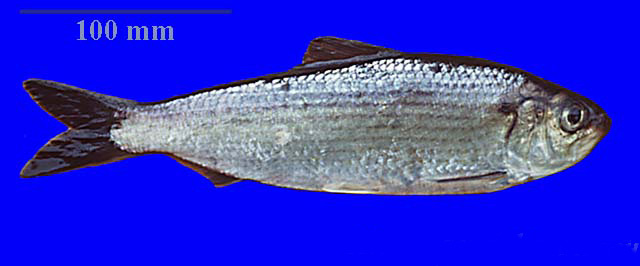 AlewifeAlosa pseudoharengus
-
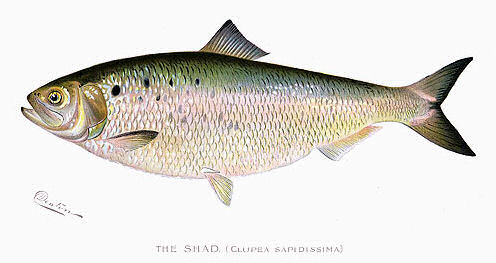 American ShadAlosa sapidissima
-
 Allis ShadAlosa alosa
-
 Blueback HerringAlosa aestivalis
-
 Twait ShadAlosa fallax
-
 Skipjack ShadAlosa chrysochloris
- Killarney ShadAlosa killarnensis
-
 Mediterranean ShadAlosa agone
Compare
Questions and answers
What is the scientific name of the Pontic Shad?
The scientific name of the Pontic Shad is Alosa immaculata. Written with its author, the full name is Alosa immaculata Bennett, 1835.
Which family does the Pontic Shad belong to?
Alosa immaculata belongs to the family Alosidae, in the order Clupeiformes and the class Teleostei.
Where is the Pontic Shad found?
Checklists and occurrence records place Alosa immaculata in 5 countries: Ukraine, Romania, Russia, Turkey and Serbia.
What is the conservation status of the Pontic Shad?
The IUCN Red List category recorded for Alosa immaculata is Least Concern (LC).
What other names does the Pontic Shad have?
Alosa immaculata is also known in English as Black Sea Herring, Black Sea Shad, Kerch Black Sea Shad and Kerch Shad.
What kind of fish is shad?
The Pontic Shad belongs to the clupeid fishes.[1]
What do shad fish eat?
The Pontic Shad preferentially feeds on small fishes and crustaceans.[5]
Sources
Passages the profile rests on
- The Pontic shad belongs to the clupeid fishes. Source passage: “is a species of clupeid fish in the genus Alosa” — English Wikipedia
- The species typically inhabits the Black Sea and Sea of Azov. Source passage: “typically inhabits the Black Sea and the Azov Sea.” — pmc.ncbi.nlm.nih.gov
- The species also occurs in the Sea of Marmara. Source passage: “Since 2001 it was also reported in the Sea of Marmara” — pmc.ncbi.nlm.nih.gov
- The species uses large rivers connected to the sea as spawning habitats. Source passage: “For spawning, the Pontic shad enters big rivers connected to the sea.” — pmc.ncbi.nlm.nih.gov
- The species preferentially feeds on small fishes and crustaceans. Source passage: “prefers to feed on small fishes and crustaceans.” — English Wikipedia
- Adult individuals migrate upstream into rivers to spawn. Source passage: “adults migrate up rivers to spawn.” — English Wikipedia
- Spawning takes place between May and August. Source passage: “Spawning occurs between the warmer months of May and August.” — English Wikipedia
- The species enters large rivers connected to the sea for spawning. Source passage: “For spawning, the Pontic shad enters big rivers connected to the sea.” — pmc.ncbi.nlm.nih.gov
- The species is regionally extinct in Hungary. Source passage: “It is now regionally extinct in Hungary.” — English Wikipedia
- Dams have restricted the upstream spawning migrations of the species. Source passage: “now dams are restricting the migrations.” — English Wikipedia
- Excessive fishing and pollution are identified as possible contributors to the species' decline. Source passage: “Excessive fishing and pollution might also be responsible for their decline.” — English Wikipedia
- The species was classified as vulnerable in the IUCN Red List assessment cited in the study. Source passage: “A. immaculatа was classified as a vulnerable species according to the IUCN red list of threatened species” — pmc.ncbi.nlm.nih.gov
- The species was included in Annexes 2 and 4 of the Bulgarian Biodiversity Act. Source passage: “included also in Annex 2 and 4 of the Bulgarian Biodiversity Act” — pmc.ncbi.nlm.nih.gov
- The species was included in Annex 2 of the Habitats Directive 92/43/EEC. Source passage: “and Annex 2 of the Habitats Directive 92/43ЕЕС.” — pmc.ncbi.nlm.nih.gov
- Average annual catches in the Bulgarian Black Sea sector and the Danube River declined approximately 3.5-fold between 2003 and 2011. Source passage: “annual catches in the Bulgarian sector of the Black Sea and the Danube River have dropped on average 3.5 times between 2003 and 2011” — pmc.ncbi.nlm.nih.gov
- The Pontic shad is an economically important fish species. Source passage: “It is an economically important fish species” — pmc.ncbi.nlm.nih.gov
Data
- Catalogue of Life, 2026-10-16 XR cc by
- Global Biodiversity Information Facility CC BY 4.0
- Wikidata CC0
- GeoNames CC BY 4.0
- Wikimedia Commons per image; credit shown with each image
- Within the Catalogue of Life, this name comes from World Register of Marine Species cc by
References
- Bennett, E. T. (1835). [A letter...to the Secretary by Keith E. Abbott, Esq.,...a collection of skins of mammals and birds, and of preserved reptiles, fishes, and insects]. Proceedings of the Zoological Society of London, 1835 (pt 3): 89–92. [Fishes on pp. 91–92.]. where the name was published
This species in other databases
- Catalogue of Life C5M9
- Wikidata Q747783
- iNaturalist 93705
- WoRMS urn:lsid:marinespecies.org:taxname:272251
- ITIS 572646
Page built on 28 November 2026. See how the catalog is made and all sources and licences.
Cite this page
ScientificNames.org. (2026). Alosa immaculata (Pontic Shad). Retrieved November 28, 2026, from https://scientificnames.org/species/alosa-immaculata
“Alosa immaculata (Pontic Shad).” ScientificNames.org, 2026, scientificnames.org/species/alosa-immaculata. Accessed 28 Nov. 2026.
ScientificNames.org. “Alosa immaculata (Pontic Shad).” Accessed November 28, 2026. https://scientificnames.org/species/alosa-immaculata.
@misc{scientificnames_alosa_immaculata_pontic_shad,
  author = {{ScientificNames.org}},
  title = {Alosa immaculata (Pontic Shad)},
  year = {2026},
  url = {https://scientificnames.org/species/alosa-immaculata},
  note = {Accessed 2026-11-28}
}