Species · Flowering plants
Canada Serviceberry Amelanchier canadensis
The scientific name of the Canada Serviceberry is Amelanchier canadensis. It is a species of flowering plant in the family Rosaceae (rose family), order Rosales.
- Scientific name
- Amelanchier canadensis (L.) Medik.
- Common name
- Canada Serviceberry
- Genus
- Amelanchier
- Family
- Rosaceae (Rose Family)
- Order
- Rosales
- Class
- Magnoliopsida
- Red List category
- LC Least Concern
- Recorded in
- 17 countries
- Name status
- accepted in the Catalogue of Life
Overview
Amelanchier canadensis produces white flowers in early spring and dark-purple edible fruits that ripen during June and July in its native range.
Written 26 November 2026 from the sources listed below. Each statement was checked against the passage it cites; statements that could not be supported were removed.
Appearance
Canada serviceberry is a deciduous shrub or small tree with a narrow, fastigiate crown. It can reach a maximum height of approximately 8 metres.[1][2]
Young stems are hairy and become smooth with age, developing a brown or copper coloration. The bark is initially smooth and ash-gray but develops long dark ridges and shallow furrows as it ages.[3][4]
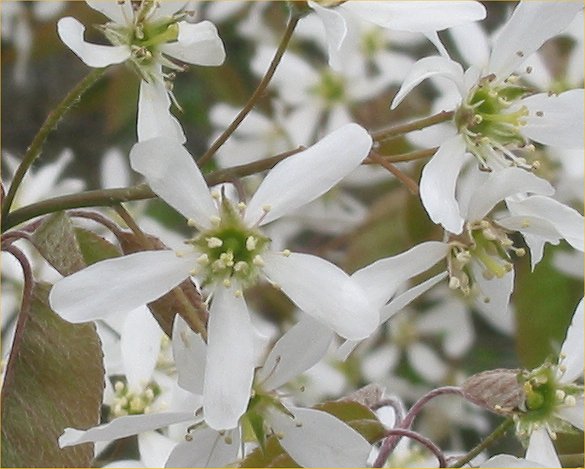
The flowers have five white petals and 20 stamens. The fruit is a dark-purple pome measuring 7–10 mm in diameter when ripe.[5][6]
The species has a shrubby tree form with multiple upright stems and a rounded crown. Its berries occur in clusters during mid-summer and change from red to purple as they mature.[7][8]
Habitat
Canada serviceberry is largely restricted to wet habitats, particularly on the Atlantic coastal plain. It occurs at elevations ranging from sea level to 200 metres.[9][10]
In the wild, the species grows in the understory of deciduous forests. It can grow in full sun or partial shade.[11][12]
Well-drained loamy soil supports better growth than less suitable soil conditions. Heavy clay soil can cause root rot.[13][14]
Diet
The ripe fruits are edible and sweet. They provide food for cardinals, woodpeckers, robins, orioles, chipmunks, and squirrels.[15][16]
Its berries are consumed by cardinals, waxwings, hairy woodpeckers, thrushes, catbirds, orioles, robins, squirrels, and chipmunks.[17]
The flowers provide nectar for butterflies and bees. Its early-spring flowers also provide food for butterflies and honeybees.[18][19]
Behaviour
Deer do not usually feed on Canada serviceberry. The species occasionally serves as a larval host for viceroy, Canadian tiger swallowtail, and striped hairstreak butterflies.[20][21]
Reproduction and life cycle
Its white flowers grow in nodding, pyramidal spikes and appear in mid-April before the leaves emerge. Flowers and fruits develop on wood that is two to four years old.[22][23]
The flowers can be pollinated by blossoms on the same individual plant. Stem cuttings are the most common method of propagating serviceberry.[24][25]
The fruits ripen during June and July in the species' native range.[26]
Uses
Its wood is used to manufacture fishing rods, walking sticks, and wooden handles.[27]
The fruit can be used to prepare pies, cobblers, and crisps. It can also be processed into juice and sauces.[28][29]
Conservation
Canada serviceberry is classified as Vulnerable in Canadian provinces and Georgia. It is considered critically imperiled in Pennsylvania and Secure in the other states within its native range.[30][31][32]
Classification of the Canada Serviceberry
| Kingdom | Plantae |
|---|---|
| Subkingdom | Pteridobiotina |
| Phylum | Tracheophyta |
| Class | Magnoliopsida |
| Order | Rosales |
| Family | Rosaceae (Rose Family) |
| Subfamily | Amygdaloideae |
| Tribe | Maleae |
| Subtribe | Malinae |
| Genus | Amelanchier (Shadbush) |
| Species | Amelanchier canadensis (L.) Medik. |
Where the Canada Serviceberry is found
Checklists and occurrence records place Amelanchier canadensis in 17 countries across Europe and North America. GBIF holds 5,329 georeferenced records of it.
Countries where it is native or its origin is not stated
Countries where it has been introduced
- Austria 5
- Belarus
- Belgium 7
- Czechia 1
- Denmark
- Estonia 7
- Finland 3
- France 11
- Germany 14
- Latvia 10
- Lithuania
- Norway
- Poland 10
- Slovakia
- Sweden 9
Regions and cities with the most records
- Connecticut, United States 260
- Maryland, United States 180
- New Jersey, United States 180
- Massachusetts, United States 173
- Quebec, Canada 162
- New York, United States 153
- North Carolina, United States 92
- Virginia, United States 87
- Mount Pleasant, United States 82
- Brightwood, United States 79
- Petworth, United States 79
- Adams Morgan, United States 78
- Central 14th Street / Spring Road, United States 78
- Columbia Heights, United States 78
- Langley Park, United States 77
- New Hampshire, United States 77
- Pleasant Plains, United States 77
- Silver Spring, United States 77
- Kennedy Street, United States 76
- Park View, United States 76
- Adelphi, United States 75
- Foggy Bottom, United States 75
- H Street NE, United States 75
- Mount Vernon Triangle, United States 75
- NoMa, United States 75
- Northwest One, United States 75
- Shaw, United States 75
- Arlington, United States 74
- College Park, United States 74
- Golden Triangle, United States 74
- Takoma Park, United States 74
- Wheaton, United States 74
- Hyattsville, United States 73
- Washington, United States 73
- Chillum, United States 72
- East Riverdale, United States 72
9 more countries have a few records outside this range
These countries hold a few records of Amelanchier canadensis but lie outside the range the checklists give for it. Such records are often zoo or garden specimens, museum material or vagrants, so the species is not counted as occurring there.
Range as the checklists state it
Denmark [I]; Norway [I]; Sweden [I]; Finland [I]; Netherlands [I]; Belgium [I]; Germany [I]; Austria [I]; Poland [I]; Czech Republic [I]; Slovakia [I]; France [I]; Estonia [I]; Latvia [I]; Lithuania [I]; Belarus [I]; Canada (New Brunswick, Nova Scotia, Ontario, Prince Edward Isl., Québec); USA (Alabama, Connecticut, District of Columbia, Delaware, Georgia, Massachusetts, Maryland, Maine, Mississippi, North Carolina, New Hampshire, New Jersey, New York, Pennsylvania, Rhode Island, South Carolina, Tennessee, Virginia, West Virginia)
A number beside a place is its count of GBIF occurrence records. A place without a number comes from a checklist alone. Records show where a species has been observed or collected, which can include escapes and vagrants.
Common names
English
- Canada Serviceberry
- Canadian Serviceberry
- Eastern Serviceberry
- Juneberry
- Shadblow
- Shadbush
- Snowy-mespilus
- Swamp Shadbush
- Thicket Serviceberry
Names in 3 other languages
- French
- amélanchier canadien, amélanchier du Canada
- German
- kanadische Felsenbirne
- Swedish
- kanadensisk häggmispel
Synonyms
51 other scientific names have been used for this species and are now treated as synonyms of Amelanchier canadensis.
- Amelanchier botryapium var. conferta Farw.
- Amelanchier botryapium var. obovalis Farw.
- Amelanchier canadensis subvar. lancifolia (Dippel) Asch. & Graebn.
- Amelanchier canadensis var. canadensis
- Amelanchier canadensis var. fernaldii (Wiegand) P.Landry
- Amelanchier canadensis var. oblongifolia Torr. & A.Gray
- Amelanchier canadensis var. semiintegrifolia Farw.
- Amelanchier canadensis var. subintegra Fernald
- Amelanchier fernaldii Wiegand
- Amelanchier lancifolia Zabel
- Amelanchier longifolia M.Roem. ex Stapf
- Amelanchier lucida (Fernald) Fernald
- Amelanchier neumanniana (Tausch) M.Roem.
- Amelanchier oblongifera Ashe
- Amelanchier oblongifolia var. walteri M.Roem.
- Amelanchier ovalis G.B.Emers.
- Amelanchier sera Ashe
- Amelanchier spicata Decne.
- Amelanchier stolonifera var. lucida Fernald
- Aronia affinis J.C.Neumann ex Tausch.
- Aronia botryapium var. racemosa (Lam.) Pers.
- Aronia canadensis (L.) Farw.
- Aronia latifolia Riddell
- Crataegus racemosa Lam.
- Mespilus amelanchier var. canadensis (L.) Castigl.
- Mespilus amelanchier var. nivea (Marshall) Castigl.
- Mespilus arbutifolia var. virginiana (Mill.) Castigl.
- Mespilus canadensis var. canadensis
- Mespilus nivea Marshall
- Mespilus virginiana Mill.
- Pyrus canadensis (L.) Farw.
- Pyrus canadensis (L.) Billb.
- Pyrus neumanniana Tausch
- Pyrus tenuifolia Stokes
- Amelanchier amelanchier (L.fil.) Voss ambiguous synonym
- Amelanchier amelanchier (L.fil.) H.Karst. ambiguous synonym
- Amelanchier austromontana Fernald ambiguous synonym
- Amelanchier botryapium (L.fil.) Borkh. ambiguous synonym
- Amelanchier canadensis var. alnifolia Farw. ambiguous synonym
- Amelanchier canadensis var. botryapium (L.fil.) Torr. & A.Gray ambiguous synonym
Showing 40 of 51.
Related species
-
 SaskatoonAmelanchier alnifolia
-
 Downy ServiceberryAmelanchier arborea
-
 JuneberryAmelanchier × lamarckii
-
 Allegheny ServiceberryAmelanchier laevis
-
 Snowy MespilusAmelanchier ovalis
-
 Utah ServiceberryAmelanchier utahensis
-
 Low JuneberryAmelanchier × spicata
-
 Low ServiceberryAmelanchier humilis
Compare
Questions and answers
What is the scientific name of the Canada Serviceberry?
The scientific name of the Canada Serviceberry is Amelanchier canadensis. Written with its author, the full name is Amelanchier canadensis (L.) Medik..
Which family does the Canada Serviceberry belong to?
Amelanchier canadensis belongs to the family Rosaceae, in the order Rosales and the class Magnoliopsida.
Where is the Canada Serviceberry found?
Checklists and occurrence records place Amelanchier canadensis in 17 countries, including United States and Canada.
What is the conservation status of the Canada Serviceberry?
The IUCN Red List category recorded for Amelanchier canadensis is Least Concern (LC).
What other names does the Canada Serviceberry have?
Amelanchier canadensis is also known in English as Canadian Serviceberry, Eastern Serviceberry, Juneberry, Shadblow, Shadbush and Snowy-mespilus.
How big does a shadblow serviceberry get?
Canada serviceberry reaches a maximum height of approximately 8 metres.[2]
Can humans eat service berries?
Yes. The ripe fruits of Canada serviceberry are edible and sweet. They can be used to prepare pies, cobblers, and crisps, or processed into juice and sauces.[15][28][29]
What are the downsides of serviceberry trees?
Heavy clay soil can cause root rot in Canada serviceberry.[14]
Sources
Passages the profile rests on
- Amelanchier canadensis is a deciduous shrub or small tree with a narrow, fastigiate crown. Source passage: “It is a deciduous shrub or small tree growing to 0.5–8 metres (1.6–26.2 ft) tall with one to many stems and a narrow, fastigiate crown.” — English Wikipedia
- The species reaches a maximum height of approximately 8 metres. Source passage: “It is a deciduous shrub or small tree growing to 0.5–8 metres (1.6–26.2 ft) tall” — English Wikipedia
- Young stems are hairy and become smooth with age, developing a brown or copper coloration. Source passage: “The stems are hairy when they are young and become glabrous over time. They have a brown or copper color.” — English Wikipedia
- The bark is initially smooth and ash-gray but develops long dark ridges and shallow furrows with age. Source passage: “The bark is smooth and ash gray color when it is younger but the bark begins to form long, dark ridges and shallow furrows as it grows older.” — English Wikipedia
- The flowers have five white petals and 20 stamens. Source passage: “The flower has five white petals 7.6–11 mm (0.30–0.43 in) long and 2–4 mm broad, and 20 stamens.” — English Wikipedia
- Its fruit is a dark-purple pome measuring 7–10 mm in diameter when ripe. Source passage: “The fruit is a pome, 7–10 mm (0.28–0.39 in) diameter, dark purple when ripe” — English Wikipedia
- The species has a shrubby tree form with multiple upright stems and a rounded crown. Source passage: “Form: a shrubby tree, with multiple upright stems forming a rounded crown” — extension.umaine.edu
- The berries occur in clusters during mid-summer and change from red to purple as they mature. Source passage: “clusters of mid-summer berries that change color from red to purple” — extension.umaine.edu
- The species is largely restricted to wet habitats, particularly on the Atlantic coastal plain. Source passage: “It is largely restricted to wet sites, particularly on the Atlantic coastal plain” — English Wikipedia
- It occurs at elevations ranging from sea level to 200 metres. Source passage: “growing at altitudes from sea level up to 200 m (660 ft).” — English Wikipedia
- In the wild, the species grows in the understory of deciduous forests. Source passage: “In the wild, shadblow serviceberry grows in the deciduous forest understory” — extension.umaine.edu
- The species can grow in full sun or partial shade. Source passage: “Serviceberry should be planted in full sun to part shade.” — extension.psu.edu
- Well-drained loamy soil supports better growth than less suitable soil conditions. Source passage: “but performs better in well-drained loamy soil.” — extension.psu.edu
- Heavy clay soil can cause root rot. Source passage: “Heavy clay soil may lead to root rot.” — extension.psu.edu
- The ripe fruits are edible and sweet. Source passage: “it is edible and sweet.” — English Wikipedia
- Its fruits provide food for cardinals, woodpeckers, robins, orioles, chipmunks, and squirrels. Source passage: “including cardinals, woodpeckers, robins, orioles, chipmunks, and squirrels.” — English Wikipedia
- Its berries are consumed by cardinals, waxwings, hairy woodpeckers, thrushes, catbirds, orioles, robins, squirrels, and chipmunks. Source passage: “The berries are relished by cardinals, waxwings, hairy woodpeckers, thrushes, catbirds, orioles, and robins, as well as squirrels and chipmunks.” — extension.umaine.edu
- Its early-spring flowers provide food for butterflies and honeybees. Source passage: “it is an important food source for pollinators like butterflies and honeybees.” — English Wikipedia
- The flowers provide nectar for butterflies and bees. Source passage: “The early white flowers are a source of nectar for butterflies and bees.” — extension.psu.edu
- Deer do not usually feed on this species. Source passage: “Deer do not usually feed on this species.” — English Wikipedia
- The species occasionally serves as a larval host for viceroy, Canadian tiger swallowtail, and striped hairstreak butterflies. Source passage: “The shrub is a larval host, occasionally, for viceroy, Canadian tiger swallowtail, and striped hairstreak butterflies.” — extension.psu.edu
- Its white flowers grow in nodding, pyramidal spikes and appear in mid-April before the leaves emerge. Source passage: “nodding, pyramidal spikes of white flowers in mid April, before the leaves appear” — extension.umaine.edu
- Flowers and fruits develop on wood that is two to four years old. Source passage: “flowers (and therefore fruit) are found on two-to-four-year-old wood.” — extension.psu.edu
- The flowers can be pollinated by blossoms on the same individual plant. Source passage: “It is self-fruitful, meaning that the flowers can be pollinated by blossoms on the same tree.” — extension.psu.edu
- Stem cuttings are the most common method of propagating serviceberry. Source passage: “Propagation is accomplished most often through stem cuttings.” — extension.psu.edu
- The fruits ripen during June and July in the species' native range. Source passage: “Fruits become ripe in June and July in its native range.” — English Wikipedia
- Its wood is used to manufacture fishing rods, walking sticks, and wooden handles. Source passage: “can be used to make fishing rods, walking sticks, and wooden handles.” — English Wikipedia
- The fruit can be used to prepare pies, cobblers, and crisps. Source passage: “the fruit makes wonderful pies, cobblers, and crisps.” — extension.psu.edu
- The fruit can also be processed into juice and sauces. Source passage: “It can be juiced. It makes a great sauce for pouring over ice cream, yogurt, or pound cake.” — extension.psu.edu
- The species is classified as Vulnerable in Canadian provinces and Georgia. Source passage: “The species is classified as Vulnerable in Canadian provinces and Georgia” — English Wikipedia
- The species is considered critically imperiled in Pennsylvania. Source passage: “critically imperiled in Pennsylvania” — English Wikipedia
- The species is considered Secure in the other states within its native range. Source passage: “considered Secure in all other states within its native range.” — English Wikipedia
Data
- Catalogue of Life, 2026-10-16 XR cc by
- Global Biodiversity Information Facility CC BY 4.0
- Wikidata CC0
- GeoNames CC BY 4.0
- Wikimedia Commons per image; credit shown with each image
- Within the Catalogue of Life, this name comes from Synonymic Checklists of the Vascular Plants of the World cc by
References
- Medik. Gesch. Bot. [Medikus] 79 (1793), Fl. N. Amer. [Torrey & A.Gray] 1: 473. where the name was published
This species in other databases
Page built on 27 November 2026. See how the catalog is made and all sources and licences.
Cite this page
ScientificNames.org. (2026). Amelanchier canadensis (Canada Serviceberry). Retrieved November 27, 2026, from https://scientificnames.org/species/amelanchier-canadensis
“Amelanchier canadensis (Canada Serviceberry).” ScientificNames.org, 2026, scientificnames.org/species/amelanchier-canadensis. Accessed 27 Nov. 2026.
ScientificNames.org. “Amelanchier canadensis (Canada Serviceberry).” Accessed November 27, 2026. https://scientificnames.org/species/amelanchier-canadensis.
@misc{scientificnames_amelanchier_canadensis_canada_serviceberry,
  author = {{ScientificNames.org}},
  title = {Amelanchier canadensis (Canada Serviceberry)},
  year = {2026},
  url = {https://scientificnames.org/species/amelanchier-canadensis},
  note = {Accessed 2026-11-27}
}