Species · Flowering plants
Utah Serviceberry Amelanchier utahensis
The scientific name of the Utah Serviceberry is Amelanchier utahensis. It is a species of flowering plant in the family Rosaceae (rose family), order Rosales.
- Scientific name
- Amelanchier utahensis Koehne
- Common name
- Utah Serviceberry
- Genus
- Amelanchier
- Family
- Rosaceae (Rose Family)
- Order
- Rosales
- Class
- Magnoliopsida
- Red List category
- LC Least Concern
- Recorded in
- 2 countries
- Name status
- accepted in the Catalogue of Life

Overview
Utah serviceberry is a many-branched, deciduous shrub in the family Rosaceae. It occurs from Washington south to Baja California and east to Montana, Colorado, and Texas. It produces fragrant white flowers and purplish fruits approximately one centimetre long.
Written 26 November 2026 from the sources listed below. Each statement was checked against the passage it cites; statements that could not be supported were removed.
Similar species
Utah serviceberry hybridizes with Saskatoon serviceberry. It has sometimes been classified as a variety or subspecies of Saskatoon serviceberry.[1][2]
Two subspecies are recognized: A. utahensis ssp. covillei and A. utahensis ssp. utahensis.[3]
Appearance
Utah serviceberry has rounded or spade-shaped green leaves that are often toothed. The leaves measure 1–2.5 centimetres long and fall in autumn.[4][5][6]
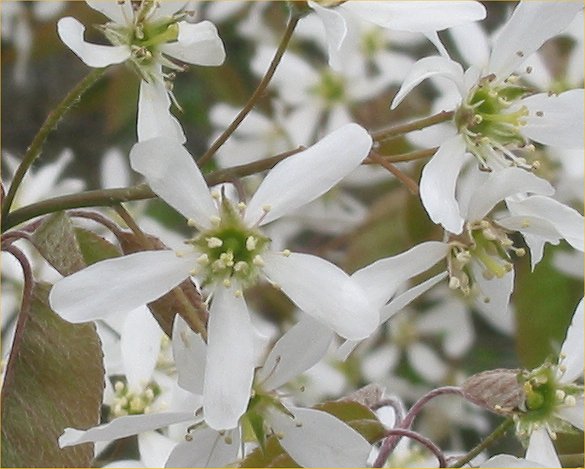
Its flowers are white, with five showy, fragrant, widely spaced, narrow petals. They are radially symmetrical and have a cup-like base.[7][8][9]
Its fruits are purplish pomes measuring approximately one centimetre in length.[10]
The shrub grows approximately 1–4 metres tall and can spread approximately 4.5 metres across.[11][12]
The species has deep, spreading roots.[13]
Habitat
Utah serviceberry grows on dry, open, rocky slopes. In Texas, it occurs on limestone slopes, in canyons, and on rocks, frequently beneath conifers.[14][15]
In Arches National Park, the species grows in riparian areas, dry slopes, desert shrublands, grasslands, and pinyon-juniper communities.[16]
It grows in coarse to medium-textured, well-drained soils with a pH between 6.5 and 7.5.[17]
The species is associated with sagebrush, pinyon pines, ponderosa pine, quaking aspen, junipers, and Gambel oak. Older, taller, and denser stands in Utah occur at high elevations on moist northern slopes with deep soils.[18][19]
The species is recorded in Arizona, California, Colorado, Idaho, Montana, New Mexico, Nevada, Oregon, Utah, Washington, and Wyoming. It also occurs in the Sierra Nevada and California chaparral and woodland regions.[20][21]
The species grows from Washington south to Baja California and east to Montana, Colorado, and Texas.[22]
Diet
Desert bighorn sheep, elk, and mule deer browse Utah serviceberry. It also provides good browse for domestic sheep, domestic goats, and mule deer.[23][24]
Many birds prefer its fruits. Sage grouse in Nevada eat the fruits, which can remain on the shrub throughout winter and provide an important seasonal food source for birds.[25][26][27]
The fruits are edible but have an insipid flavour.[28]
Behaviour
Utah serviceberry generally tolerates fire and can sprout from its root crown after fire damage. Established plants tolerate drought well.[29][30]
The species is not shade tolerant. It grows most actively in autumn when sufficient moisture is available.[31][32]
The species is not tolerant of saline soil conditions.[33]
Reproduction and life cycle
Utah serviceberry reproduces through seeds or by sprouting from its root crown. It can produce abundant quantities of seeds in some years.[34][35]
The seeds require stratification to germinate, and the species grows slowly from seed.[36][37]
The species flowers from April through June. Seeds mature after August 25 in Utah.[38][39]
Uses
Utah serviceberry has been used to revegetate winter ranges for big game animals and for surface stabilization. It is also used as browse by livestock and wildlife.[40][41][42]
Native Americans and early European explorers used its fruits as food and medicine.[43]
The species has been cultivated as an ornamental plant for its spring flowers and purplish autumn fruits.[44]
Classification of the Utah Serviceberry
| Kingdom | Plantae |
|---|---|
| Subkingdom | Pteridobiotina |
| Phylum | Tracheophyta |
| Class | Magnoliopsida |
| Order | Rosales |
| Family | Rosaceae (Rose Family) |
| Subfamily | Amygdaloideae |
| Tribe | Maleae |
| Subtribe | Malinae |
| Genus | Amelanchier (Shadbush) |
| Species | Amelanchier utahensis Koehne |
Where the Utah Serviceberry is found
Checklists and occurrence records place Amelanchier utahensis in 2 countries across North America. GBIF holds 9,179 georeferenced records of it.
Countries
Regions and cities with the most records
- California, United States 1,957
- Utah, United States 1,715
- Colorado, United States 593
- Nevada, United States 590
- Arizona, United States 581
- Idaho, United States 231
- New Mexico, United States 179
- Oregon, United States 123
- Truckee, United States 99
- Cottonwood Heights, United States 84
- East Millcreek, United States 83
- Holladay, United States 81
- Millcreek, United States 76
- South Salt Lake, United States 76
- Salt Lake City, United States 71
- Murray, United States 70
- South Lake Tahoe, United States 69
- North Salt Lake, United States 65
- Pleasant Grove, United States 64
- Bountiful, United States 63
- Centerville, United States 61
- Midvale, United States 61
- Taylorsville, United States 59
- American Fork, United States 53
- Highland, United States 53
- West Valley City, United States 53
- Wyoming, United States 53
- Kearns, United States 51
- Summerlin South, United States 49
- Orem, United States 48
- Sandy, United States 45
- Grand Junction, United States 44
- Baja California, Mexico 43
- Hurricane, United States 40
- San Rafael, United States 37
- Reno, United States 36
Range as the checklists state it
USA (Arizona, California, Colorado, Idaho, Montana, New Mexico, Nevada, Oregon, Texas, Utah, Washington State, Wyoming); Mexico (Baja California Norte, Chihuahua)
A number beside a place is its count of GBIF occurrence records. A place without a number comes from a checklist alone. Records show where a species has been observed or collected, which can include escapes and vagrants.
Common names
English
- Utah Serviceberry
- Coville's Serviceberry
- Utah Service-berry
Names in 6 other languages
- Chinese
- 猶他唐棣
- Czech
- muchovník utažský
- German
- Utah-Felsenbirne
- Polish
- Świdośliwa utahska
- Russian
- Ирга ютская
- nav
- Dídzéi dit’odi
Synonyms
26 other scientific names have been used for this species and are now treated as synonyms of Amelanchier utahensis.
- Amelanchier alnifolia Coville
- Amelanchier alnifolia subsp. utahensis (Koehne) A.E.Murray
- Amelanchier alnifolia var. elliptica C.K.Schneid.
- Amelanchier alnifolia var. nitens (Tidestr.) Munz
- Amelanchier alnifolia var. oreophila (A.Nelson) R.J.Davis
- Amelanchier alnifolia var. utahensis (Koehne) M.E.Jones
- Amelanchier alnifolia var. venulosa (Greene) Jeps.
- Amelanchier australis Standl.
- Amelanchier bakeri Greene
- Amelanchier crenata Greene
- Amelanchier elliptica A.Nelson
- Amelanchier florida var. oreophila (A.Nelson) R.J.Davis
- Amelanchier goldmanii Wooton & Standl.
- Amelanchier jonesiana C.K.Schneid.
- Amelanchier mormonica C.K.Schneid.
- Amelanchier nitens Tidestr.
- Amelanchier oreophila A.Nelson
- Amelanchier plurinervis Koehne
- Amelanchier prunifolia Greene
- Amelanchier purpusii Koehne
- Amelanchier rubescens Greene
- Amelanchier rubescens var. cinerea Goodd.
- Amelanchier utahensis subsp. oreophila (A.Nelson) Clokey
- Amelanchier utahensis subsp. utahensis
- Amelanchier utahensis var. utahensis
- Amelanchier venulosa Greene
Subspecies and varieties
Related species
-
 SaskatoonAmelanchier alnifolia
-
 Downy ServiceberryAmelanchier arborea
-
 Canada ServiceberryAmelanchier canadensis
-
 JuneberryAmelanchier × lamarckii
-
 Allegheny ServiceberryAmelanchier laevis
-
 Snowy MespilusAmelanchier ovalis
-
 Low JuneberryAmelanchier × spicata
-
 Low ServiceberryAmelanchier humilis
Compare
Questions and answers
What is the scientific name of the Utah Serviceberry?
The scientific name of the Utah Serviceberry is Amelanchier utahensis. Written with its author, the full name is Amelanchier utahensis Koehne.
Which family does the Utah Serviceberry belong to?
Amelanchier utahensis belongs to the family Rosaceae, in the order Rosales and the class Magnoliopsida.
Where is the Utah Serviceberry found?
Checklists and occurrence records place Amelanchier utahensis in 2 countries: United States and Mexico.
What is the conservation status of the Utah Serviceberry?
The IUCN Red List category recorded for Amelanchier utahensis is Least Concern (LC).
What other names does the Utah Serviceberry have?
Amelanchier utahensis is also known in English as Coville's Serviceberry and Utah Service-berry.
How big does an Utah serviceberry get?
The shrub grows approximately 1–4 metres tall and can spread approximately 4.5 metres across.[11][12]
What is special about serviceberry?
Utah serviceberry produces five showy, fragrant white petals and purplish fruits that can remain on the shrub throughout winter, providing an important seasonal food source for birds.[8][27]
Can humans eat service berries?
The fruits are edible but have an insipid flavour. Native Americans and early European explorers used them as food and medicine.[28][43]
How much room does a serviceberry need?
Utah serviceberry can spread approximately 4.5 metres across.[12]
Where do serviceberry trees grow naturally?
Utah serviceberry occurs from Washington south to Baja California and east to Montana, Colorado, and Texas. It grows in dry, open, rocky slopes and in other habitats including riparian areas, grasslands, desert shrublands, and pinyon-juniper communities.[22][14][16]
Sources
Passages the profile rests on
- Utah serviceberry hybridizes with Saskatoon serviceberry. Source passage: “Utah serviceberry hybridizes with Saskatoon serviceberry” — fs.usda.gov
- Utah serviceberry has sometimes been classified as a variety or subspecies of Saskatoon serviceberry. Source passage: “A. utahensis occasionally considered to be a variety or subspecies of Saskatoon serviceberry” — research.fs.usda.gov
- The species has two recognized subspecies: A. utahensis ssp. covillei and A. utahensis ssp. utahensis. Source passage: “There are 2 subspecies of Utah serviceberry: A. utahensis ssp. covillei (Standley) Clokey [18,23,24] and A. utahensis ssp. utahensis Koehne [23].” — fs.usda.gov
- The plant has rounded or spade-shaped green leaves that are often toothed. Source passage: “bearing rounded or spade-shaped often toothed green leaves” — English Wikipedia
- Its leaves are 1–2.5 centimetres long. Source passage: “green leaves 1–2.5 centimetres (1⁄2–1 in) long” — English Wikipedia
- The leaves fall in autumn. Source passage: “these fall in autumn.” — English Wikipedia
- The species produces white flowers with five widely spaced, narrow petals. Source passage: “each with five widely spaced, 1-cm-long, narrow petals.” — English Wikipedia
- Its flowers have five showy, fragrant white petals. Source passage: “5 white petals which are showy and fragrant” — nps.gov
- Its flowers are radially symmetrical and have a cup-like base. Source passage: “radially symmetrical; cup-like base to flower” — nps.gov
- Its fruits are purplish pomes measuring approximately one centimetre in length. Source passage: “The fruits are 1-cm-long purplish pomes.” — English Wikipedia
- The shrub grows approximately 1–4 metres tall. Source passage: “grows from 2 to 15 feet (1-4 m) tall” — research.fs.usda.gov
- The plant can spread approximately 4.5 metres across. Source passage: “The plant can spread up to 15 feet (4.5 m) across” — research.fs.usda.gov
- The species has deep, spreading roots. Source passage: “The roots of Utah serviceberry are deep and spreading.” — research.fs.usda.gov
- The species grows on dry, open, rocky slopes. Source passage: “Utah serviceberry grows on dry, open, rocky slopes” — research.fs.usda.gov
- In Texas, the species occurs on limestone slopes, in canyons, and on rocks, frequently beneath conifers. Source passage: “In Texas, Utah serviceberry grows on limestone slopes, in canyons, on rocks, and frequently under conifers” — research.fs.usda.gov
- The species grows in riparian areas, dry slopes, desert shrublands, grasslands, and pinyon-juniper communities in Arches National Park. Source passage: “Habitat in Arches National Park: riparian areas, dry slopes, desert shrub, grassland and pinyon-juniper communities” — nps.gov
- The species grows in coarse to medium-textured, well-drained soils with a pH between 6.5 and 7.5. Source passage: “Utah serviceberry grows best on coarse to medium well-drained soils, with a pH of 6.5 to 7.5” — research.fs.usda.gov
- The species is associated with sagebrush, pinyon pines, ponderosa pine, quaking aspen, junipers, and Gambel oak. Source passage: “Utah serviceberry is associated with a variety of shrubs and trees including sagebrush (Artemisia spp.), pinyon pines (Pinus spp.), ponderosa pine (P. ponderosa), quaking aspen (Populus tremuloides), junipers (Juniperus spp.), and Gambel oak (Quercus gambelii).” — research.fs.usda.gov
- Older, taller, and denser stands in Utah occur at high elevations on moist northern slopes with deep soils. Source passage: “In Utah, the older, taller, and densest stands occur at high-elevation sites with moist northern slopes and deep soils” — research.fs.usda.gov
- The species is recorded in Arizona, California, Colorado, Idaho, Montana, New Mexico, Nevada, Oregon, Utah, Washington, and Wyoming. Source passage: “United States: AZ, CA, CO, ID, MT, NM, NV, OR, UT, WA, WY” — research.fs.usda.gov
- The species occurs in the Sierra Nevada and California chaparral and woodland regions. Source passage: “extending west to the Sierra Nevada and chaparral and woodlands in California” — English Wikipedia
- The species occurs from Washington south to Baja California and east to Montana, Colorado, and Texas. Source passage: “Utah serviceberry occurs from Washington to Baja California, east to Montana, Colorado, and Texas” — fs.usda.gov
- Desert bighorn sheep, elk, and mule deer browse the plant. Source passage: “The plant is browsed by desert bighorns, elk, and mule deer” — English Wikipedia
- The species provides good browse for domestic sheep, domestic goats, and mule deer. Source passage: “The plant provides good browse for domestic sheep, domestic goats and mule deer” — fs.usda.gov
- Many birds prefer the fruits of Utah serviceberry. Source passage: “Utah serviceberry fruit is preferred by many birds” — fs.usda.gov
- Sage grouse in Nevada eat the fruits of the species. Source passage: “In Nevada, sage grouse eat the fruit of Utah serviceberry” — fs.usda.gov
- The fruits can remain on the shrub throughout winter and provide an important seasonal food source for birds. Source passage: “It can be an important winter food for birds since berries stay on the shrub throughout the winter” — fs.usda.gov
- The fruits are edible but have an insipid flavour. Source passage: “The berries are edible but insipid in flavor.” — English Wikipedia
- The species generally tolerates fire and can sprout from its root crown after fire damage. Source passage: “The Utah serviceberry is generally fire tolerant and sprouts from the root crown when damaged by fire.” — English Wikipedia
- Established plants tolerate drought well. Source passage: “Once the plant is established, Utah serviceberry tolerates drought well” — research.fs.usda.gov
- The species is not shade tolerant. Source passage: “Utah serviceberry is a seral species [7,44] and is not shade tolerant” — research.fs.usda.gov
- The species grows most actively in autumn when sufficient moisture is available. Source passage: “Utah serviceberry seedlings grow most actively in the fall if moisture is available” — research.fs.usda.gov
- The species is not tolerant of saline soil conditions. Source passage: “Utah serviceberry is not salt tolerant” — research.fs.usda.gov
- The species reproduces through seeds or by sprouting from its root crown. Source passage: “Utah serviceberry reproduces from seeds or by sprouting from the root crown.” — research.fs.usda.gov
- The species can produce abundant quantities of seeds in some years. Source passage: “In some years, Utah serviceberry is a prolific seed producer.” — research.fs.usda.gov
- The seeds require stratification to germinate. Source passage: “Utah serviceberry seeds require stratification to germinate.” — research.fs.usda.gov
- The species grows slowly from seed. Source passage: “Utah serviceberry grows slowly from seed” — research.fs.usda.gov
- Seeds mature after August 25 in Utah. Source passage: “Seeds mature after August 25 in Utah” — research.fs.usda.gov
- The species flowers from April through June. Source passage: “Utah serviceberry flowers from April to June” — research.fs.usda.gov
- The species has been used to revegetate winter ranges for big game animals. Source passage: “Utah serviceberry has been used to revegetate big game winter range” — fs.usda.gov
- The species has been used for surface stabilization. Source passage: “and for surface stabilization.” — fs.usda.gov
- The species is used as browse by livestock and wildlife. Source passage: “Utah serviceberry is highly palatable to birds, small mammals, livestock and other animals throughout its range” — fs.usda.gov
- Native Americans and early European explorers used the fruits as food and medicine. Source passage: “Utah serviceberry fruits were used by Native Americans and early European explorers in North America for food [24,34] and medicine” — fs.usda.gov
- The species has been cultivated as an ornamental plant for its spring flowers and purplish autumn fruits. Source passage: “Utah serviceberry has been used as an ornamental plant, due to its pink or white flowers in the spring and purplish fruit in the fall.” — fs.usda.gov
Data
- Catalogue of Life, 2026-10-16 XR cc by
- Global Biodiversity Information Facility CC BY 4.0
- Wikidata CC0
- GeoNames CC BY 4.0
- Wikimedia Commons per image; credit shown with each image
- Within the Catalogue of Life, this name comes from Synonymic Checklists of the Vascular Plants of the World cc by
References
- Koehne. Wissensch. Progr. Falk. Realgymnas. Berlin 25 (1890). where the name was published
This species in other databases
Page built on 28 November 2026. See how the catalog is made and all sources and licences.
Cite this page
ScientificNames.org. (2026). Amelanchier utahensis (Utah Serviceberry). Retrieved November 28, 2026, from https://scientificnames.org/species/amelanchier-utahensis
“Amelanchier utahensis (Utah Serviceberry).” ScientificNames.org, 2026, scientificnames.org/species/amelanchier-utahensis. Accessed 28 Nov. 2026.
ScientificNames.org. “Amelanchier utahensis (Utah Serviceberry).” Accessed November 28, 2026. https://scientificnames.org/species/amelanchier-utahensis.
@misc{scientificnames_amelanchier_utahensis_utah_serviceberry,
  author = {{ScientificNames.org}},
  title = {Amelanchier utahensis (Utah Serviceberry)},
  year = {2026},
  url = {https://scientificnames.org/species/amelanchier-utahensis},
  note = {Accessed 2026-11-28}
}