Species · Flowering plants
Red Ammannia Ammannia senegalensis
The scientific name of the Red Ammannia is Ammannia senegalensis. It is a species of flowering plant in the family Lythraceae (loosestrife family), order Myrtales.
- Scientific name
- Ammannia senegalensis Lam.
- Common name
- Red Ammannia
- Genus
- Ammannia
- Family
- Lythraceae (Loosestrife Family)
- Order
- Myrtales
- Class
- Magnoliopsida
- Red List category
- LC Least Concern
- Recorded in
- 33 countries
- Name status
- accepted in the Catalogue of Life

Overview
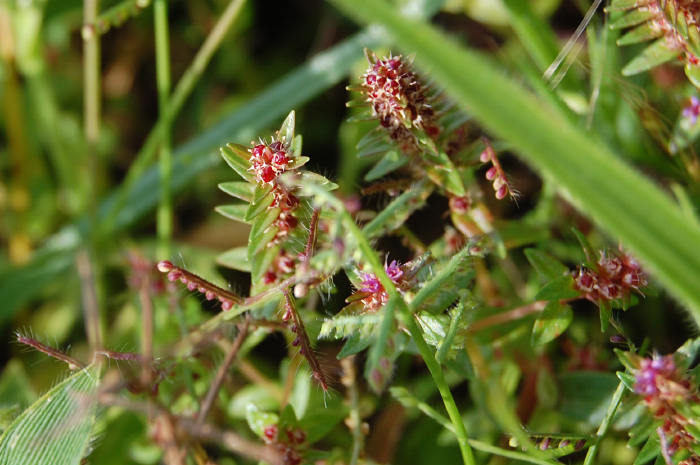
The species is native to western Senegal, occurs in inundatable areas and has a documented geographic range extending from Senegal to East Africa. It is distinguished by opposite leaves that become narrower and reddish, particularly under intense light.
Written 27 November 2026 from the sources listed below. Each statement was checked against the passage it cites; statements that could not be supported were removed.
Habitat
Red Ammannia frequently grows as a weed in rice paddies and occurs in inundatable areas. It can grow in flooded conditions when the water is sufficiently shallow.[1][2][3]
Soft and acidic water provides ideal growing conditions for the species.[4]
Appearance
The plant has opposite leaves along its stems. Its leaves initially appear green and relatively broad before becoming narrower and reddish, with particularly red coloration under intense light.[5][6][7]
Several varieties differ in leaf shape and colour. The flowers are inconspicuous and grow from the leaf axils of plants growing above water.[8][9]
Behaviour
Red Ammannia prefers intense light for optimal growth and can grow rapidly under suitable conditions. It grows very well when additional carbon dioxide is supplied to the water.[10][11][12]
The plant is generally hardy and adaptable to most moderate growing conditions. Good growth in aquariums requires the addition of an iron micronutrient.[13][14]
Reproduction and life cycle
Red Ammannia can be propagated by inserting stem cuttings into the growing substrate.[15]
Classification of the Red Ammannia
| Kingdom | Plantae |
|---|---|
| Subkingdom | Pteridobiotina |
| Phylum | Tracheophyta |
| Class | Magnoliopsida |
| Order | Myrtales |
| Family | Lythraceae (Loosestrife Family) |
| Subfamily | Lythroideae |
| Genus | Ammannia (Redstem) |
| Species | Ammannia senegalensis Lam. |
Where the Red Ammannia is found
Checklists and occurrence records place Ammannia senegalensis in 33 countries across Africa and Europe. GBIF holds 349 georeferenced records of it.
Countries where it is native or its origin is not stated
- Angola 9
- Benin 19
- Botswana 28
- Burkina Faso 5
- Burundi 3
- Cameroon 3
- Central African Republic 1
- Chad 5
- Democratic Republic of the Congo 6
- Egypt 18
- Eswatini 4
- Ethiopia
- Gambia
- Ghana 12
- Ivory Coast 14
- Kenya 1
- Libya
- Madagascar 10
- Malawi 5
- Mali 10
- Mauritania 44
- Mozambique 13
- Namibia 19
- Niger 6
- Nigeria 9
- Senegal 31
- Sierra Leone 2
- South Africa 43
- Sudan 4
- Tanzania 7
- Zambia 10
- Zimbabwe 8
Countries where it has been introduced
Regions and cities with the most records
- Trarza, Mauritania 34
- Limpopo, South Africa 15
- Plateau, Benin 11
- Kétou, Benin 10
- Mpumalanga, South Africa 9
- North-West, Botswana 9
- Central, Botswana 7
- Abomey-Calavi, Benin 5
- Cotonou, Benin 5
- Ekpé, Benin 5
- Ganvié, Benin 5
- Godomè, Benin 5
- Littoral, Benin 5
- Kaédi, Mauritania 4
- Kolia, Ivory Coast 4
- KwaZulu-Natal, South Africa 4
- Saint-Louis, Senegal 4
- Savanes District, Ivory Coast 4
- Abomey, Benin 3
- Bohicon, Benin 3
- Djidja, Benin 3
- Gorgol, Mauritania 3
- Hodh El Gharbi, Mauritania 3
- Koulikoro, Mali 3
- Kunene Region, Namibia 3
- Lephalale, South Africa 3
- Louga, Senegal 3
- Ségou, Mali 3
- Zou, Benin 3
- Tibesti, Chad
8 more countries have a few records outside this range
These countries hold a few records of Ammannia senegalensis but lie outside the range the checklists give for it. Such records are often zoo or garden specimens, museum material or vagrants, so the species is not counted as occurring there.
Range as the checklists state it
Greece [I] (Peloponnisos [I]); Libya; Egypt (Desert Oases, Nile Delta, NW-coastal Egypt); Mauritania; Senegal; Gambia; Sierra Leone; Mali; Burkina Faso; Ivory Coast; Benin; Niger; Nigeria; Central African Republic; SE-D. R. Congo [Zaire]; N-Chad (Tibesti, Ennedi); Ethiopia; Kenya; Tanzania; Angola; Zambia; Malawi; Zimbabwe; Mozambique; Namibia; Botswana; South Africa (Limpopo, Mpulamanga, KwaZulu-Natal); Eswatini [Swaziland]; Sinai peninsula (N-Sinai)
A number beside a place is its count of GBIF occurrence records. A place without a number comes from a checklist alone. Records show where a species has been observed or collected, which can include escapes and vagrants.
Common names
English
- Red Ammannia
Names in 6 other languages
- Chinese
- 塞内加尔水苋菜
- Czech
- Tuhanka senegalská
- Finnish
- kiehkura-ammannia
- French
- Ammania d'Afrique
- Slovak
- amánia senegalská
- Swedish
- bronslånke
Synonyms
15 other scientific names have been used for this species and are now treated as synonyms of Ammannia senegalensis.
- Ammannia diffusa Willd.
- Ammannia salsuginosa Guill. & Perr.
- Ammannia senegalensis f. confertiflora Koehne
- Ammannia senegalensis f. diffusa (Willd.) Koehne
- Ammannia senegalensis f. perrottetiana Koehne
- Ammannia senegalensis f. salsuginosa (Guill. & Perr.) Koehne
- Ammannia senegalensis f. typica Koehne
- Ammannia senegalensis var. filiformis (DC.) Hiern
- Ammannia senegalensis var. floribunda (Guill. & Perr.) Koehne
- Lythrum filiforme Perr. ex DC.
- Lythrum multiflorum Perr. ex DC.
- Lythrum ramosum Perr. ex DC.
- Lythrum semiamplexans Ruiz ex Koehne
- Ammannia filiformis DC. ambiguous synonym
- Ammannia floribunda Guill. & Perr. ambiguous synonym
Subspecies and varieties
Related species
-
 Scarlet ToothcupAmmannia coccinea
-
 Monarch RedstemAmmannia baccifera
-
 Red AmmaniaAmmannia gracilis
-
 Grand RedstemAmmannia robusta
- Eared RedstemAmmannia auriculata
- Ammannia crinipes
- Ammannia muelleri
- Ammannia arnhemica
Compare
Questions and answers
What is the scientific name of the Red Ammannia?
The scientific name of the Red Ammannia is Ammannia senegalensis. Written with its author, the full name is Ammannia senegalensis Lam..
Which family does the Red Ammannia belong to?
Ammannia senegalensis belongs to the family Lythraceae, in the order Myrtales and the class Magnoliopsida.
Where is the Red Ammannia found?
Checklists and occurrence records place Ammannia senegalensis in 33 countries, including Mauritania, South Africa, Senegal, Botswana, Benin and Namibia.
What is the conservation status of the Red Ammannia?
The IUCN Red List category recorded for Ammannia senegalensis is Least Concern (LC).
Sources
Passages the profile rests on
- Ammannia senegalensis frequently grows as a weed in rice paddies. Source passage: “It often grows as a weed in rice paddies.” — English Wikipedia
- The species occurs in inundatable areas. Source passage: “habitat: inundatable areas” — deepblue.lib.umich.edu
- The plant can grow in flooded conditions when the water is sufficiently shallow. Source passage: “will grow in flooded conditions, if the water is shallow enough.” — English Wikipedia
- Soft and acidic water provides ideal growing conditions for the species. Source passage: “Ideal water conditions are soft and acidic” — English Wikipedia
- The plant has opposite leaves along its stems. Source passage: “The stem presents opposite leaves” — English Wikipedia
- Its leaves initially appear green and relatively broad before becoming narrower and reddish. Source passage: “leaves that start out green and rather broad and, later, become more narrow and reddish in colour.” — English Wikipedia
- The leaves become particularly red under intense light. Source passage: “The leaves especially become red under intense light.” — English Wikipedia
- Several varieties of the plant differ in leaf shape and colour. Source passage: “There are several varieties, of unknown status, that differ in leaf shape and colour.” — English Wikipedia
- The flowers are inconspicuous and grow from the leaf axils of plants growing above water. Source passage: “The flowers are inconspicuous, growing from the leaf axils of emersed plants.” — English Wikipedia
- The plant prefers intense light for optimal growth. Source passage: “These plants prefer intense light for optimum growth.” — English Wikipedia
- The plant can grow rapidly under suitable conditions. Source passage: “They can grow quickly in the right conditions” — English Wikipedia
- The plant grows very well when additional carbon dioxide is supplied to the water. Source passage: “They also grow very well with additional carbon dioxide added to the water.” — English Wikipedia
- The plant is generally hardy and adaptable to most moderate growing conditions. Source passage: “these plants are generally hardy and adaptable in most moderate conditions.” — English Wikipedia
- Good growth in aquariums requires the addition of an iron micronutrient. Source passage: “To grow well, they need a good iron micronutrient to be added to an aquarium.” — English Wikipedia
- The plant can be propagated by inserting stem cuttings into the growing substrate. Source passage: “They can be easily propagated by pushing cuttings into the substrate.” — English Wikipedia
Data
- Catalogue of Life, 2026-10-16 XR cc by
- Global Biodiversity Information Facility CC BY 4.0
- Wikidata CC0
- GeoNames CC BY 4.0
- Wikimedia Commons per image; credit shown with each image
- Within the Catalogue of Life, this name comes from Synonymic Checklists of the Vascular Plants of the World cc by
References
- Lam. (1792). Tabl. Encycl. 1: 312, t. 77, f. 2 (1792). where the name was published
This species in other databases
- Catalogue of Life CT6Q
- Wikidata Q4747162
- iNaturalist 189208
- World Flora Online wfo-0000531090
- GRIN 404449
Page built on 29 November 2026. See how the catalog is made and all sources and licences.
Cite this page
ScientificNames.org. (2026). Ammannia senegalensis (Red Ammannia). Retrieved November 29, 2026, from https://scientificnames.org/species/ammannia-senegalensis
“Ammannia senegalensis (Red Ammannia).” ScientificNames.org, 2026, scientificnames.org/species/ammannia-senegalensis. Accessed 29 Nov. 2026.
ScientificNames.org. “Ammannia senegalensis (Red Ammannia).” Accessed November 29, 2026. https://scientificnames.org/species/ammannia-senegalensis.
@misc{scientificnames_ammannia_senegalensis_red_ammannia,
  author = {{ScientificNames.org}},
  title = {Ammannia senegalensis (Red Ammannia)},
  year = {2026},
  url = {https://scientificnames.org/species/ammannia-senegalensis},
  note = {Accessed 2026-11-29}
}