Species · Flowering plants
Bishop's Weed Ammi majus
The scientific name of the Bishop's Weed is Ammi majus. It is a species of flowering plant in the family Apiaceae (umbellifer), order Apiales.
- Scientific name
- Ammi majus L.
- Common name
- Bishop's Weed
- Genus
- Ammi
- Family
- Apiaceae (Umbellifer)
- Order
- Apiales
- Class
- Magnoliopsida
- Recorded in
- 79 countries
- Name status
- accepted in the Catalogue of Life

Overview
Bishop's Weed (Ammi majus L.) is a flowering plant in the family Apiaceae, order Apiales and class Magnoliopsida. The species occurs across Southern Europe, North Africa, West and Central Asia, and the British Isles. It produces compound umbels of white, umbrella-shaped flowers and has pinnate or bipinnate leaves.
Written 26 November 2026 from the sources listed below. Each statement was checked against the passage it cites; statements that could not be supported were removed.
Appearance
Bishop's Weed has white, lace-like flower clusters arranged in compound umbels of umbrella-shaped flowers.[1][2]
The lower leaves are pinnate or bipinnate. The upper leaves are twice or occasionally three times pinnate, with serrated lobes.[3][4]
Habitat
Bishop's Weed occurs in gardens, where it is grown from seed annually.[5]
Reproduction and life cycle
Bishop's Weed is a herbaceous annual or biennial that behaves as an annual under cultivation. It is grown annually from seed in gardens.[6][7]
The species fruits from July to August.[8]
Uses
Bishop's Weed contains the furanocoumarins bergapten and xanthotoxin. It is cultivated as a source of furanocoumarins used in the treatment of skin diseases.[9][10]
Bishop's Weed is cultivated in medicinal farms in China. Its seed powder is referred to by the trade name Aatrillal.[11][12]
Similar species
Bishop's Weed is described as a close relative of Ammi visnaga.[13]
Classification of the Bishop's Weed
| Kingdom | Plantae |
|---|---|
| Subkingdom | Pteridobiotina |
| Phylum | Tracheophyta |
| Class | Magnoliopsida |
| Order | Apiales |
| Family | Apiaceae (Umbellifer) |
| Subfamily | Apioideae |
| Tribe | Apieae |
| Genus | Ammi |
| Species | Ammi majus L. |
Where the Bishop's Weed is found
Checklists and occurrence records place Ammi majus in 79 countries across Africa, Asia, Europe, North America, Oceania and South America. GBIF holds 22,597 georeferenced records of it.
Countries where it is native or its origin is not stated
- Albania 3
- Algeria 59
- Andorra 3
- Austria 79
- Belgium 2,193
- Croatia 31
- Cyprus 16
- Czechia 8
- Denmark 86
- Egypt 68
- Eritrea 2
- Ethiopia 33
- Finland 63
- France 8,311
- Greece 163
- Iran 33
- Iraq 78
- Isle of Man 22
- Israel 1,138
- Italy 485
- Jordan 18
- Kenya 9
- Lebanon 7
- Libya 6
- Luxembourg 16
- Montenegro
- Morocco 168
- Norway 41
- Oman 34
- Palestinian Territory 36
- Poland 14
- Portugal 843
- Russia 26
- Saudi Arabia 11
- Slovakia 4
- Slovenia 2
- Spain 1,731
- Switzerland 666
- Syria 25
- The Netherlands 1,870
- Tunisia 16
- Turkey 34
- Yemen 1
Countries where it has been introduced
- Argentina 154
- Australia 834
- Bahamas 3
- Bolivia 4
- Brazil 60
- Chile 2
- China 5
- Colombia 17
- Costa Rica 3
- Cuba 3
- Dominican Republic 1
- Ecuador 4
- El Salvador 2
- Estonia 2
- Germany 305
- Guatemala 6
- Haiti
- Honduras 7
- India 13
- Ireland 6
- Japan 16
- Kuwait 3
- Mexico 103
- New Caledonia 13
- New Zealand 47
- Pakistan 12
- Qatar 3
- South Africa 131
- Sweden 295
- Tajikistan
- Ukraine 7
- United Arab Emirates 3
- United Kingdom 1,515
- United States 532
- Uruguay 30
- Venezuela 4
Regions and cities with the most records
- Grand Est, France 1,426
- England, United Kingdom 1,196
- Hauts-de-France, France 1,036
- Île-de-France, France 1,022
- Geleen, The Netherlands 912
- Maastricht, The Netherlands 864
- Hoensbroek, The Netherlands 855
- Sittard, The Netherlands 854
- Maasmechelen, Belgium 827
- Mechelen-aan-de-Maas, Belgium 825
- Lanaken, Belgium 820
- Occitanie, France 774
- Riemst, Belgium 704
- Bilzen, Belgium 665
- Limburg, The Netherlands 656
- Genk, Belgium 642
- Visé, Belgium 609
- Brunssum, The Netherlands 592
- New South Wales, Australia 557
- Tienen, Belgium 548
- Sint-Truiden, Belgium 472
- Catalonia, Spain 452
- Northern District, Israel 433
- Heerlen, The Netherlands 419
- Auvergne-Rhône-Alpes, France 407
- Tongeren, Belgium 407
- Diepenbeek, Belgium 392
- Oupeye, Belgium 370
- Gelderland, The Netherlands 369
- Provence-Alpes-Côte d'Azur, France 362
- Épinay-sur-Seine, France 324
- La Courneuve, France 312
- Beuningen, The Netherlands 310
- Pierrefitte-sur-Seine, France 310
- Stains, France 310
- Vitry-sur-Seine, France 309
4 more countries have a few records outside this range
These countries hold a few records of Ammi majus but lie outside the range the checklists give for it. Such records are often zoo or garden specimens, museum material or vagrants, so the species is not counted as occurring there.
Range as the checklists state it
England [I] (England [I], Wales [I], Isle of Man [I], Scotland [I], Isles of Scilly [I]); Ireland [I] (E-Ireland [I], Northern Ireland [I]); Sweden [I]; Germany [I]; Portugal; Spain; Baleares (Mallorca, Menorca); France; Channel Isl. [I]; Corsica; Sardinia; Italy; Sicily; Pantelleria; Isole Pelagie (Lampedusa); Slovenia; Croatia; Bosnia & Hercegovina; Montenegro; Albania; European Turkey; Greece (widespread, incl. Kiklades, Limnos); Crete; Estonia [I]; European Russia [I]; Ukraine; Crimea [I]; Morocco; Algeria; Tunisia; Libya; Egypt (Desert Oases, Great Southwestern Desert, Nile Delta, Nile Valley); Canary Isl. (Hierro, La Palma, Gomera, Tenerife, Gran Canaria, Fuerteventura, Lanzarote); Ethiopia; Eritrea; South Africa [I] (widespread); Tajikistan [I]; East Aegaean Isl. (Lesvos, Chios, Samos, Kos, Tilos, Symi, Karpathos, Rhodos); Turkey (NW-Anatolia: Bithynia, S-Anatolia, SE-Anatolia, SSW-Anatolia, SW-Anatolia, W-Anatolia, WN-Anatolia); Iraq (NW-Iraq, SE-Iraq: Mesopotamia, W-Iraq: Desert); Iran (NE-Iran: Mts., N-Iran, S-Iran, W-Iran); Cyprus (C-Mountains, E-Cyprus, E-Cyprus, N-Cyprus, S-Cyprus, W-Cyprus); Lebanon (C-Lebanon, coastal W-Lebanon); Syria (C-Syrian Desert, Jazira, NW-Syria); Israel (coastal W-Israel, Rift Valley, N-Israel, N-Negev Desert); Sinai peninsula (N-Sinai, S-Sinai); Jordania (S-Jordania, W-Jordania); Saudi Arabia (C-Saudi Arabia, NE-Saudi Arabia, N-Saudi Arabia, Asir, Nejd Desert); Kuwait [I]; Qatar [I]; United Arab Emirates [I]; Oman (Dhofar, Mascat & Oman); Yemen (SW-Yemen, W-Yemen); China [I]; Japan [I]; Pakistan [I] (Baluchistan [I], Pakistani Punjab [I]); India [I] (Meghalaya [I], Odisha [I], Rajasthan [I], Tamil Nadu [I], Uttarakhand [I], Uttar Pradesh [I], West Bengal [I]); Australia [I] (Western Australia [I], South Australia [I], Queensland [I], New South Wales [I], Victoria [I]); New Zealand [I]; New Caledonia [I]; USA [I] (Alabama [I], Arizona [I], California [I], Florida [I], Georgia [I], Louisiana [I], Missouri [I], Mississippi [I], Oregon [I], Pennsylvania [I], South Carolina [I], South Dakota [I], Texas [I]); Mexico [I]; Guatemala [I]; El Salvador [I]; Honduras [I]; Costa Rica [I]; Bahamas [I]; Cuba [I]; Dominican Republic [I]; Haiti [I]; Colombia [I]; Venezuela [I]; Galápagos [I]; Bolivia [I]; Brazil [I]; Uruguay [I]; Argentina [I] (Buenos Aires [I], Chaco [I], Chubut [I], Entre Rios [I], Formosa Prov. [I], La Pampa [I], Salta [I], Santiago del Estero [I], Santa Fe Prov. [I]); Chile [I] (Metropolitana de Santiago [I], Los Rios [I], Los Lagos [I])
A number beside a place is its count of GBIF occurrence records. A place without a number comes from a checklist alone. Records show where a species has been observed or collected, which can include escapes and vagrants.
Common names
English
- Bishop's Weed
- Bullwort
- Large Bullwort
- Queen Anne's Lace
- Bishop's-weed
- False Bishop's-weed
- Greater Ammi
- Laceflower
- Lady's-lace
Names in 25 other languages
- Afrikaans
- Kantblom
- Arabic
- khillah, خلة شيطانية
- Catalan
- Siscla
- Chinese
- 白緞帶花, 雪珠花
- Czech
- morač větší
- Dutch
- Groot akkerscherm
- Estonian
- suur ammi
- Finnish
- isosudenporkkana
- French
- ammi élevé
- German
- Bischofskraut, große Knorpelmöhre, großes Ammei
- Greek
- Άμμι το μέγα, Ασπροκέφαλο, Γαριζόνι, Κλινοκέρι
- Hebrew
- אמיתה גדולה
- Italian
- rizzomolo, visnaga maggiore
- Japanese
- イトバドクゼリモドキ
- Lithuanian
- Didysis amis
- Norwegian Bokmål
- narregulrot
- Polish
- Aminek Większy
- Portuguese
- ami, bisnaguinha-do-campo, cicuta-negra, âmio-maior, âmio-vulgar
- Russian
- Амми большая
- Slovak
- parasca väčšia
- Slovenian
- velika peščenica
- Spanish
- Apio Cimarrón, Espuma de mar, Espuma del Mar, ameo bastardo, ameo mayor, encaje
- Swedish
- slöjsilja
- Turkish
- Kürdanotu, Yabani diş otu
- Welsh
- Esgoblys
Synonyms
55 other scientific names have been used for this species and are now treated as synonyms of Ammi majus.
- Aethusa ammi Spreng.
- Ammi apiifolium Hoffmanns. & Link
- Ammi boeberi Hoffm.
- Ammi broussonetii DC.
- Ammi cicutifolium Willd. ex Schult.
- Ammi diversifolium var. daucifolium Noulet
- Ammi diversifolium var. glaucifolium (L.) Noulet
- Ammi elatum Salisb.
- Ammi intermedium DC.
- Ammi majus f. minimum (Kuntze) Thell.
- Ammi majus subsp. glaucifolium (L.) Nyman
- Ammi majus subsp. intermedium (DC.) Arcang.
- Ammi majus var. apiifolium (Hoffmanns. & Link) Cout.
- Ammi majus var. daucifolium (Noulet) Litard.
- Ammi majus var. genuinum Gren. & Godr.
- Ammi majus var. glaucifolium (L.) Boiss.
- Ammi majus var. glaucifolium (L.) Mérat
- Ammi majus var. glaucifolium (L.) Noulet
- Ammi majus var. glaucifolium (L.) Godr.
- Ammi majus var. intermedium (DC.) Godr.
- Ammi majus var. laciniatum Godr.
- Ammi majus var. majus
- Ammi majus var. serratum Mutel
- Ammi majus var. tenue Ball
- Ammi pauciradiatum Hochst. ex A.Rich.
- Ammi topalii Beauverd
- Anethum pinnatum Ruiz & Pav. ex Urban
- Apium ammi-maius Crantz
- Apium candollei M.Hiroe
- Apium elatum (Willk.) Calest.
- Apium petraeum Crantz
- Cuminum aethiopicum Royle
- Cuminum regium Royle
- Daucus parsae M.Hiroe
- Pimpinella capillacea Poit. ex Urb.
- Selinum ammoides E.H.L.Krause
- Sison fasciculatum Pohl ex DC.
- Sison haenkei C.Presl ex DC.
- Sison lateriflorum Bertol.
- Sison majus (L.) Eaton & Wright
Showing 40 of 55.
Subspecies and varieties
- Ammi majus subsp. majus subspecies
Related species
-
 Trifoliate AmmiAmmi trifoliatum
- Seubert's AmmiAmmi seubertianum
- Ammi procerum
-
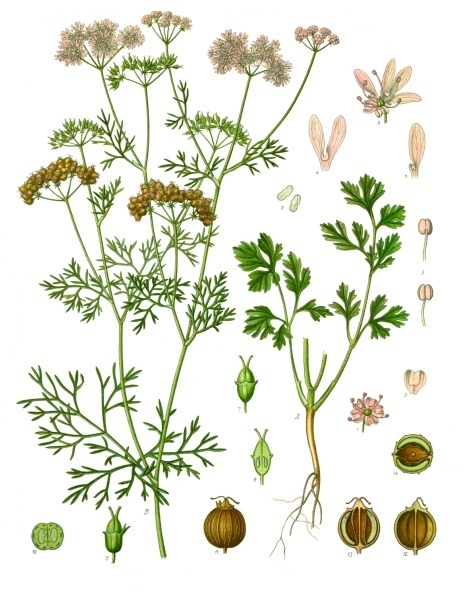 CorianderCoriandrum sativum
-
 Poison HemlockConium maculatum
-
 FennelFoeniculum vulgare
-
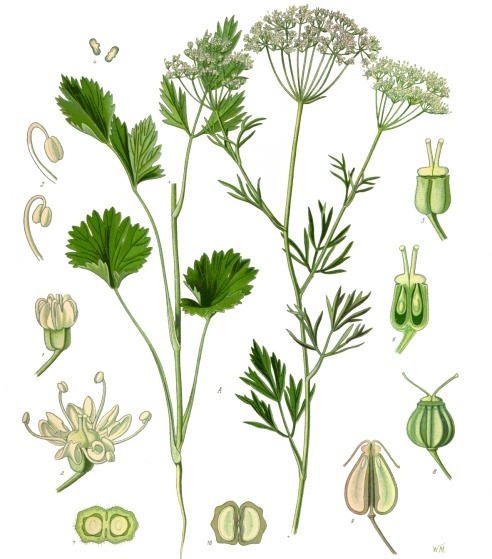 AnisePimpinella anisum
-
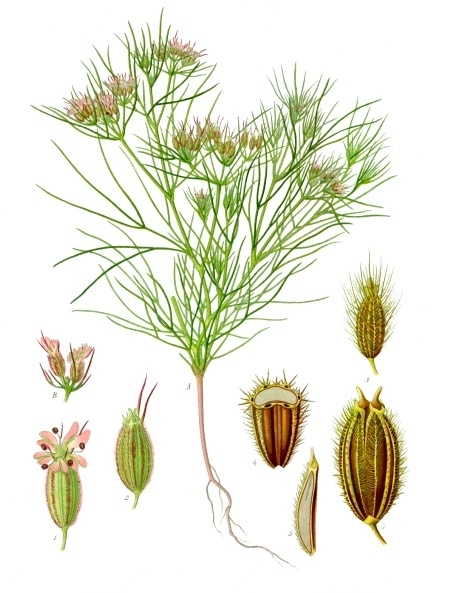 CuminCuminum cyminum
Compare
Questions and answers
What is the scientific name of the Bishop's Weed?
The scientific name of the Bishop's Weed is Ammi majus. Written with its author, the full name is Ammi majus L..
Which family does the Bishop's Weed belong to?
Ammi majus belongs to the family Apiaceae, in the order Apiales and the class Magnoliopsida.
Where is the Bishop's Weed found?
Checklists and occurrence records place Ammi majus in 79 countries, including France, Belgium, The Netherlands, Spain, Israel and Portugal.
What other names does the Bishop's Weed have?
Ammi majus is also known in English as Bullwort, Large Bullwort, Queen Anne's Lace, Bishop's-weed, False Bishop's-weed and Greater Ammi.
Is Ammi majus an annual or perennial?
Ammi majus is a herbaceous annual or biennial. Under cultivation, it behaves as an annual.[6]
Sources
Passages the profile rests on
- Ammi majus has white, lace-like flower clusters. Source passage: “The plant, which has white lace-like flower clusters” — English Wikipedia
- The species produces compound umbels of white, umbrella-shaped flowers. Source passage: “The inflorescence is compound umbel; they are white umbrella-shaped flowers” — English Wikipedia
- The lower leaves are pinnate or bipinnate. Source passage: “The lower leaves are 1-2-pinnate” — English Wikipedia
- The upper leaves are twice or occasionally three times pinnate, with serrated lobes. Source passage: “upper leaves 2(-3)-pinnate with serrate lobes.” — English Wikipedia
- Ammi majus occurs in gardens, where it is grown from seed annually. Source passage: “A. majus and its cultivars are frequently seen in gardens where they are grown from seed annually.” — English Wikipedia
- Ammi majus is a herbaceous annual or a biennial that behaves as an annual under cultivation. Source passage: “Ammi majus is a herbaceous annual, or rather a biennial that behaves like an annual in cultivation.” — English Wikipedia
- Ammi majus is grown annually from seed in gardens. Source passage: “grown from seed annually.” — English Wikipedia
- The species fruits from July to August. Source passage: “fruiting July–August.” — English Wikipedia
- Ammi majus contains the furanocoumarins bergapten and xanthotoxin. Source passage: “contains significant amounts of furanocoumarins bergapten and xanthotoxin” — English Wikipedia
- The species is cultivated as a source of furanocoumarins used in the treatment of skin diseases. Source passage: “A. majus is cultivated for its furanocoumarins, which are still used for the treatment of skin disease” — English Wikipedia
- Ammi majus is cultivated in medicinal farms in China. Source passage: “and cultivated in medicinal farms.” — English Wikipedia
- The seed powder of Ammi majus is still referred to by the trade name Aatrillal. Source passage: “the trade name Aatrillal is still used today to refer to the yellowish-brown powder made from its seeds.” — English Wikipedia
- Ammi majus is described as a close relative of Ammi visnaga. Source passage: “Like its close relative Ammi visnaga” — English Wikipedia
Data
- Catalogue of Life, 2026-10-16 XR cc by
- Global Biodiversity Information Facility CC BY 4.0
- Wikidata CC0
- GeoNames CC BY 4.0
- Wikimedia Commons per image; credit shown with each image
- Within the Catalogue of Life, this name comes from Synonymic Checklists of the Vascular Plants of the World cc by
References
- L. (1753). Sp. Pl. [Linnaeus] 1: 243 (1753). where the name was published
This species in other databases
Page built on 27 November 2026. See how the catalog is made and all sources and licences.
Cite this page
ScientificNames.org. (2026). Ammi majus (Bishop's Weed). Retrieved November 27, 2026, from https://scientificnames.org/species/ammi-majus
“Ammi majus (Bishop's Weed).” ScientificNames.org, 2026, scientificnames.org/species/ammi-majus. Accessed 27 Nov. 2026.
ScientificNames.org. “Ammi majus (Bishop's Weed).” Accessed November 27, 2026. https://scientificnames.org/species/ammi-majus.
@misc{scientificnames_ammi_majus_bishops_weed,
  author = {{ScientificNames.org}},
  title = {Ammi majus (Bishop's Weed)},
  year = {2026},
  url = {https://scientificnames.org/species/ammi-majus},
  note = {Accessed 2026-11-27}
}