Species · Mammals
Texas Antelope Squirrel Ammospermophilus interpres
The scientific name of the Texas Antelope Squirrel is Ammospermophilus interpres. It is a species of mammal in the family Sciuridae (squirrel), order Rodentia. The name dates from 1890.
- Scientific name
- Ammospermophilus interpres (Merriam, 1890)
- Common name
- Texas Antelope Squirrel
- Genus
- Ammospermophilus
- Family
- Sciuridae (Squirrel)
- Order
- Rodentia
- Class
- Mammalia
- Red List category
- LC Least Concern
- Recorded in
- 2 countries
- Name status
- accepted in the Catalogue of Life

Overview
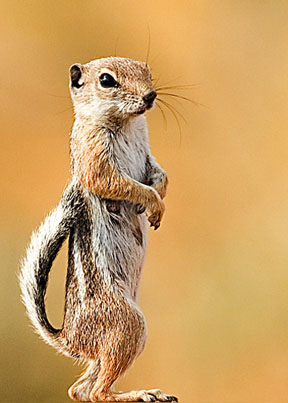
Ammospermophilus interpres occurs in western Texas, parts of south-central New Mexico, northern Mexico, and the Chihuahuan Desert. It has a narrow white stripe along each side of its back and characteristically carries its tail arched forward over its back.
Written 26 November 2026 from the sources listed below. Each statement was checked against the passage it cites; statements that could not be supported were removed.
Appearance
The Texas Antelope Squirrel has a narrow white stripe running along each side of its back from the shoulder to the rump. Its eyes are outlined with white fur, its ears are short and barely extend beyond a rim, and its legs have reddish fur.[1][2][3][4]
Its upperparts are vinaceous buff during summer and drab gray during winter. The underside of its tail is grayish white, while its lateral hairs have three black bands.[5][6]
The species characteristically carries its tail arched forward over its back.[7]
Male body weights range from 94 to 121 g, while female body weights range from 84 to 115 g. The species has ten mammae.[8][9][10]
Habitat
The Texas Antelope Squirrel primarily inhabits the edges of lower valleys and low hills in southwestern desert regions. It prefers hard-surfaced gravelly washes and rocky hillsides over level sandy terrain.[11][12]
On the Edwards Plateau, the species is associated with rocky, broken terrain having little ground cover and is often associated with creosote and juniper vegetation. It primarily occupies sparsely vegetated rocky areas and is less frequently found on flat sandy ground.[13][14][15]
The species uses burrows and rock crevices as den sites. Its dens may be located in cut banks or at the bases of bushes and rocks.[16][17]
Its nests can contain rabbit fur, shredded bark, feathers, dried grasses, and cotton fragments. One documented burrow had a main tunnel measuring 3 m long and 8.7 cm in diameter.[18][19]
Diet
The Texas Antelope Squirrel eats fruits, seeds, and stems of yucca and juniper, as well as salt grass. Its diet also includes prickly pear and cholla cactus fruits, mesquite, sotol, and creosote bush.[20][21][22][23][24]
The species also consumes insects when they are available. Individuals consume large quantities of succulents and other vegetation during spring.[25][26]
It collects food in its cheek pouches and stores it in dens and beneath rocks.[27]
Behaviour
The Texas Antelope Squirrel is strongly diurnal and can remain active during the hottest parts of the day. When overheated, individuals rest in shady places and stretch out against cool ground.[28][29]
The species spends most of its time on the ground but can climb into low bushes, yuccas, and prickly pears. Individuals flick their tails when excited.[30][31]
The species produces mellow, rolling, trill-like calls. Individuals are nimble-footed and can run at surprising speeds.[32][33]
The species does not hibernate at lower elevations. Individuals in the northern part of the range may become inactive during winter.[34][35]
Reproduction and life cycle
Breeding begins in February and generally continues through June. The gestation period is approximately 29 days.[36][37][38]
Females generally rear one litter of five to fourteen young annually. Some females may produce a second brood in the same year.[39][40]
Young remain in the nest until they reach approximately one-quarter of adult growth. At approximately one-quarter grown, they begin venturing aboveground and eating solid food.[41][42]
Similar species
Ammospermophilus interpres is distinguished geographically from Ammospermophilus leucurus, which occurs in Oregon, California, and New Mexico.[43]
Conservation
The IUCN classifies the Texas Antelope Squirrel as a species of least concern. The species does not appear on federal or state lists of species of concern.[44][45]
No immediate threat to the species' conservation status is identified in the Texas mammal account.[46]
Uses
The Texas Antelope Squirrel serves as a food source for numerous predators, including humans. It can become an agricultural nuisance by raiding crops.[47][48]
Classification of the Texas Antelope Squirrel
| Kingdom | Animalia |
|---|---|
| Phylum | Chordata |
| Subphylum | Vertebrata |
| Infraphylum | Gnathostomata |
| Parvphylum | Osteichthyes |
| Megaclass | Tetrapoda |
| Class | Mammalia (Mammal) |
| Subclass | Theria |
| Infraclass | Eutheria |
| Order | Rodentia (Rodent) |
| Suborder | Sciuromorpha (Squirrels) |
| Family | Sciuridae (Squirrel) |
| Subfamily | Xerinae |
| Tribe | Marmotini (Holarctic Ground Squirrels) |
| Genus | Ammospermophilus (Antelope Squirrel) |
| Species | Ammospermophilus interpres (Merriam, 1890) |
Where the Texas Antelope Squirrel is found
Checklists and occurrence records place Ammospermophilus interpres in 2 countries across North America. GBIF holds 883 georeferenced records of it.
Countries
Regions and cities with the most records
- Texas, United States 348
- New Mexico, United States 263
- Sunland Park, United States 146
- El Paso, United States 144
- Albuquerque, United States 75
- Ciudad Juárez, Mexico 74
- Rio Rancho, United States 53
- Durango, Mexico 39
- Enchanted Hills, United States 32
- South Valley, United States 23
- Chihuahua, Mexico 22
- Coahuila, Mexico 20
- Las Cruces, United States 16
- Gómez Palacio, Mexico 12
- Lerdo, Mexico 12
- Torreón, Mexico 10
- Zacatecas, Mexico 4
- Chihuahua, Mexico 3
- Manuel Ojinaga, Mexico 3
Range as the checklists state it
Middle America
North America
A number beside a place is its count of GBIF occurrence records. A place without a number comes from a checklist alone. Records show where a species has been observed or collected, which can include escapes and vagrants.
Common names
English
- Texas Antelope Squirrel
Names in 9 other languages
- Czech
- sysel antilopí
- Finnish
- teksasinorava
- German
- Texas-Antilopenziesel
- Italian
- Citello antilope del Texas
- Japanese
- テキサスレイヨウジリス
- Polish
- piaszczyk teksański
- Portuguese
- Esquilo-antílope-do-Texas
- Russian
- Техасский суслик
- Spanish
- Ardilla antílope texana, Ardilla-antilope texana
Synonyms
One other scientific name has been used for this species and is now treated as a synonym of Ammospermophilus interpres.
- Tamias interpres Merriam, 1890
Related species
-
 White-tailed Antelope SquirrelAmmospermophilus leucurus
-
 Harris's Antelope SquirrelAmmospermophilus harrisii
-
 San Joaquin Antelope SquirrelAmmospermophilus nelsoni
- Espíritu Santo Antelope SquirrelAmmospermophilus insularis
-
 American Red SquirrelTamiasciurus hudsonicus
-
 Indian Giant SquirrelRatufa indica
-
 Southern Flying SquirrelGlaucomys volans
-
 Northern Flying SquirrelGlaucomys sabrinus
Compare
Questions and answers
What is the scientific name of the Texas Antelope Squirrel?
The scientific name of the Texas Antelope Squirrel is Ammospermophilus interpres. Written with its author, the full name is Ammospermophilus interpres (Merriam, 1890).
Which family does the Texas Antelope Squirrel belong to?
Ammospermophilus interpres belongs to the family Sciuridae, in the order Rodentia and the class Mammalia.
Where is the Texas Antelope Squirrel found?
Checklists and occurrence records place Ammospermophilus interpres in 2 countries: United States and Mexico.
What is the conservation status of the Texas Antelope Squirrel?
The IUCN Red List category recorded for Ammospermophilus interpres is Least Concern (LC).
Where do antelope squirrels live?
The Texas Antelope Squirrel occurs in western Texas, parts of south-central New Mexico, northern Mexico, and the Chihuahuan Desert. In Texas, it occurs throughout the Trans-Pecos region, extending eastward to the extreme western Edwards Plateau and northward to Gaines County at the southern edge of the High Plains.[49][50][51][52][53]
What do antelope squirrels eat?
The Texas Antelope Squirrel eats fruits, seeds, and stems of yucca and juniper, salt grass, prickly pear and cholla cactus fruits, mesquite, sotol, and creosote bush. It also consumes insects when they are available.[20][21][22][23][24][25]
Sources
Passages the profile rests on
- The species has a narrow white stripe running along each side of its back from the shoulder to the rump. Source passage: “one narrow white line on each side of back from shoulder to rump” — depts.ttu.edu
- Its ears are short and barely extend beyond a rim. Source passage: “ears short, hardly more than a rim” — depts.ttu.edu
- Its eyes are outlined with white fur. Source passage: “The eyes are outlined by white fur.” — animaldiversity.org
- Its legs have reddish fur. Source passage: “The legs have reddish fur (Best, 1999).” — animaldiversity.org
- The underside of the tail is grayish white, while its lateral hairs have three black bands. Source passage: “underside of tail grayish white, the lateral tail hairs with three black bands” — depts.ttu.edu
- Its upperparts are vinaceous buff during summer and drab gray during winter. Source passage: “upperparts vinaceous buff in summer and drab gray in winter” — depts.ttu.edu
- The species characteristically carries its tail arched forward over its back. Source passage: “peculiar habit of carrying the tail arched forward over the back” — depts.ttu.edu
- Male body weights range from 94 to 121 g. Source passage: “Weight of males, 104 (94–121) g” — depts.ttu.edu
- Female body weights range from 84 to 115 g. Source passage: “of females, 104 (84–115) g.” — depts.ttu.edu
- The species has ten mammae. Source passage: “It has small external ears and ten mammae (Walker, 1983; Davis, 1960; LTER; Best, 1999).” — animaldiversity.org
- The species primarily inhabits the edges of lower valleys and low hills in southwestern desert regions. Source passage: “they live primarily around the edges of the lower valleys and in the low hills.” — depts.ttu.edu
- It prefers hard-surfaced gravelly washes and rocky hillsides over level sandy terrain. Source passage: “They seem to prefer hard-surfaced, gravelly washes or rocky hill slopes and are less common or entirely absent on level, sandy terrain.” — depts.ttu.edu
- On the Edwards Plateau, the species is associated with rocky, broken terrain having little ground cover. Source passage: “they seem to be limited to rocky, broken terrain with little ground cover.” — depts.ttu.edu
- In the Edwards Plateau area, the species is often associated with creosote and juniper vegetation. Source passage: “In this area, they are often associated with creosote and juniper vegetation.” — depts.ttu.edu
- The species primarily occupies sparsely vegetated rocky areas and is less frequently found on flat sandy ground. Source passage: “They are seen primarily in rocky areas and less often in flat sandy areas” — animaldiversity.org
- Its dens may be located in cut banks or at the bases of bushes and rocks. Source passage: “They normally locate these dens in a cut bank or at the base of a large object such as a bush or a rock.” — animaldiversity.org
- The species uses burrows and rock crevices as den sites. Source passage: “They usually live in burrows, but crevices in and among rocks may serve as den sites.” — depts.ttu.edu
- Its nests can contain rabbit fur, shredded bark, feathers, dried grasses, and cotton fragments. Source passage: “The nest was composed of rabbit fur, shredded bark, feathers, dried grasses, and bits of cotton.” — depts.ttu.edu
- One documented burrow had a main tunnel measuring 3 m long and 8.7 cm in diameter. Source passage: “The main tunnel was 8.7 cm in diameter, 3 m long” — depts.ttu.edu
- Its diet includes fruits, seeds, and stems of yucca. Source passage: “including the fruits, seeds, and stems of yucca” — depts.ttu.edu
- Its diet includes fruits, seeds, and stems of juniper. Source passage: “including the fruits, seeds, and stems of yucca, juniper, salt grass” — depts.ttu.edu
- Its diet includes salt grass. Source passage: “Common foods eaten include: yucca, juniper, salt grass, prickly pear fruits” — animaldiversity.org
- It consumes prickly pear and cholla cactus fruits. Source passage: “Common foods eaten include: yucca, juniper, salt grass, prickly pear fruits, cholla fruits” — animaldiversity.org
- Its diet includes mesquite, sotol, and creosote bush. Source passage: “mesquite, sotol, and creosote bush” — depts.ttu.edu
- The species also consumes insects when they are available. Source passage: “but insects may be consumed when available.” — depts.ttu.edu
- Individuals consume large quantities of succulents and other vegetation during spring. Source passage: “In the spring individuals eat a large number of succulents and other vegetation” — animaldiversity.org
- It collects food in its cheek pouches and stores it in dens and beneath rocks. Source passage: “It has been found to collect food using its cheek pouches and store it in the den and under rocks” — animaldiversity.org
- The species is strongly diurnal and can remain active during the hottest parts of the day. Source passage: “A. interpres is strongly diurnal, even venturing out in the heat of the day when other animals sleep.” — animaldiversity.org
- When overheated, individuals rest in shady places and stretch out against cool ground. Source passage: “Occasionally they retreat to a shady spot where they lie outstretched, with their limbs spread-eagle and their belly in contact with the cooler terrain” — depts.ttu.edu
- The species spends most of its time on the ground but can climb into low bushes, yuccas, and prickly pears. Source passage: “They spend most of the time on the ground, but they may be seen in the tops of low bushes, yuccas, and prickly pears” — depts.ttu.edu
- Individuals flick their tails when excited. Source passage: “When agitated they flick their tails” — animaldiversity.org
- The species produces mellow, rolling, trill-like calls. Source passage: “the mellow, rolling, trill-like calls further assist in identification.” — depts.ttu.edu
- Individuals are nimble-footed and can run at surprising speeds. Source passage: “They are nimble footed and can run with surprising speed” — depts.ttu.edu
- The species does not hibernate at lower elevations. Source passage: “Available evidence indicates that at lower elevations these ground squirrels do not hibernate.” — depts.ttu.edu
- Individuals in the northern part of the range may become inactive during winter. Source passage: “individuals in the northern range may become inactive during the winter” — animaldiversity.org
- Breeding begins in February. Source passage: “Breeding begins in February.” — depts.ttu.edu
- The breeding season generally continues through June. Source passage: “Breeding generally starts in February, continuing through June” — animaldiversity.org
- The gestation period is approximately 29 days. Source passage: “After a gestation period of about 29 days a litter of five to fourteen is born.” — animaldiversity.org
- Females generally rear one litter of five to fourteen young annually. Source passage: “One litter of 5–14 young, based on embryo counts, is reared each year” — depts.ttu.edu
- Some females may produce a second brood in the same year. Source passage: “but there is evidence that some females may rear a second brood.” — depts.ttu.edu
- Young remain in the nest until they reach approximately one-quarter of adult growth. Source passage: “The young remain in the nest until they are about one-fourth grown” — depts.ttu.edu
- Young begin venturing aboveground and eating solid food when they are approximately one-quarter grown. Source passage: “at which time they venture aboveground and begin eating solid foods.” — depts.ttu.edu
- Ammospermophilus interpres is distinguished geographically from Ammospermophilus leucurus, which occurs in Oregon, California, and New Mexico. Source passage: “It is distinct from A. leucurus , which lives in Oregon, California, and New Mexico” — animaldiversity.org
- The IUCN classifies the Texas antelope squirrel as a species of least concern. Source passage: “The IUCN lists the Texas antelope squirrel as a species of least concern” — depts.ttu.edu
- The species does not appear on federal or state lists of species of concern. Source passage: “it does not appear on the federal or state lists of concerned species.” — depts.ttu.edu
- No immediate threat to the species' conservation status is identified in the Texas mammal account. Source passage: “There does not appear to be any immediate threat to its status.” — depts.ttu.edu
- The species serves as a food source for numerous predators, including humans. Source passage: “it is an important food source for many predators, including humans” — animaldiversity.org
- The species can become an agricultural nuisance by raiding crops. Source passage: “In some areas A. interpres can become a nuisance by raiding crops” — animaldiversity.org
- The species occurs in western Texas and parts of south-central New Mexico. Source passage: “Within the United States they are found in western Texas, and in parts of south central New Mexico.” — English Wikipedia
- Its range includes northern Mexico and the Chihuahuan Desert. Source passage: “They are also found in northern Mexico, including in the Chihuahuan Desert.” — English Wikipedia
- In Texas, the species occurs throughout the Trans-Pecos region. Source passage: “Known throughout the Trans-Pecos region” — depts.ttu.edu
- Its Texas distribution extends eastward to the extreme western Edwards Plateau. Source passage: “extending eastward to the extreme western portion of the Edwards Plateau” — depts.ttu.edu
- Its Texas range extends northward to Gaines County at the southern edge of the High Plains. Source passage: “northward to the southern edge of the High Plains in Gaines County.” — depts.ttu.edu
Data
- Catalogue of Life, 2026-10-16 XR cc by
- Global Biodiversity Information Facility CC BY 4.0
- Wikidata CC0
- GeoNames CC BY 4.0
- Wikimedia Commons per image; credit shown with each image
- Within the Catalogue of Life, this name comes from The Integrated Taxonomic Information System cc0
References
- N. Am. Fauna vol.4 p.21 where the name was published
- Banks, R. C., R. W. McDiarmid, and A. L. Gardner. (1987). Checklist of Vertebrates of the United States, the U.S. Territories, and Canada. Resource Publication, No. 166.
- Wilson, Don E., and DeeAnn M. Reeder, eds. (1993). Mammal Species of the World: A Taxonomic and Geographic Reference, 2nd Ed., 3rd Printing.
- Wilson, Don E., and F. Russell Cole. (2000). Common Names of Mammals of the World.
- Thorington, Richard W., Jr., and Robert S. Hoffman / Wilson, Don E., and DeeAnn M. Reeder, eds. (2005). Family Sciuridae. Mammal Species of the World: A Taxonomic and Geographic Reference, 3rd Ed., Vol. 2.
- Thorington, Richard W., Jr., John L. Koprowski, Michael A. Steele, and James F. Whatton. (2012). Squirrels of the World.
This species in other databases
Page built on 27 November 2026. See how the catalog is made and all sources and licences.
Cite this page
ScientificNames.org. (2026). Ammospermophilus interpres (Texas Antelope Squirrel). Retrieved November 27, 2026, from https://scientificnames.org/species/ammospermophilus-interpres
“Ammospermophilus interpres (Texas Antelope Squirrel).” ScientificNames.org, 2026, scientificnames.org/species/ammospermophilus-interpres. Accessed 27 Nov. 2026.
ScientificNames.org. “Ammospermophilus interpres (Texas Antelope Squirrel).” Accessed November 27, 2026. https://scientificnames.org/species/ammospermophilus-interpres.
@misc{scientificnames_ammospermophilus_interpres_texas_antelope_squirrel,
  author = {{ScientificNames.org}},
  title = {Ammospermophilus interpres (Texas Antelope Squirrel)},
  year = {2026},
  url = {https://scientificnames.org/species/ammospermophilus-interpres},
  note = {Accessed 2026-11-27}
}