Species · Crustaceans
Amphionides reynaudii
Amphionides reynaudii has no English name on record in the checklists used here. It is a species of crustacean in the family Pandalidae (pandalid shrimps), order Decapoda. The name dates from 1832.
- Scientific name
- Amphionides reynaudii (H. Milne Edwards, 1832)
- Genus
- Amphionides
- Family
- Pandalidae (Pandalid Shrimps)
- Order
- Decapoda
- Class
- Malacostraca
- Recorded in
- 4 countries
- Name status
- accepted in the Catalogue of Life

Overview
Amphionides reynaudii (H. Milne Edwards, 1832) is a crustacean in the family Pandalidae, order Decapoda and class Malacostraca. The species occurs throughout the world's tropical oceans. It has reduced or absent body parts compared with typical adult shrimp morphology, and its adult stage remains undiscovered.
Written 26 November 2026 from the sources listed below. Each statement was checked against the passage it cites; statements that could not be supported were removed.
Appearance
The species has only one pair of mouthparts, consisting of the maxillae. Its mandibles and maxillules are vestigial.[1][2]
Males and females differ in the shape of their antennae. Males possess a reduced eighth thoracic appendage bearing the male gonopore, while the female gonopore is located on the sixth thoracic appendage.[3][4][5]
Females have a greatly enlarged first pleopod that almost surrounds their enlarged carapace. Male specimens have a more streamlined carapace and pleopods than females.[6][7]
Observed specimens have reached a maximum recorded length of 25 mm.[8]
Habitat
Larvae inhabit waters shallower than 100 m.[9]
Behaviour
Fewer male specimens are caught than females, possibly because their more streamlined bodies make them more hydrodynamic.[10]
Reproduction and life cycle
The enlarged first pleopod of females is presumed to form a chamber where eggs are fertilised and retained until hatching.[6][11]
Classification of Amphionides reynaudii
| Kingdom | Animalia |
|---|---|
| Phylum | Arthropoda |
| Subphylum | Crustacea |
| Class | Malacostraca |
| Order | Decapoda |
| Suborder | Pleocyemata |
| Infraorder | Caridea |
| Superfamily | Pandaloidea |
| Family | Pandalidae (Pandalid Shrimps) |
| Genus | Amphionides |
| Species | Amphionides reynaudii (H. Milne Edwards, 1832) |
Where Amphionides reynaudii is found
Checklists and occurrence records place Amphionides reynaudii in 4 countries. GBIF holds 38 georeferenced records of it.
Countries
Range as the checklists state it
Eastern Atlantic Ocean
Western Atlantic Ocean
Indo-West Pacific
East Pacific
A number beside a place is its count of GBIF occurrence records. A place without a number comes from a checklist alone. Records show where a species has been observed or collected, which can include escapes and vagrants.
Synonyms
3 other scientific names have been used for this species and are now treated as synonyms of Amphionides reynaudii.
- Amphion armata Koeppel, 1902
- Amphion provocatoris Spence Bate, 1888
- Amphionides valdiviae Zimmer, 1904
Related species
-
 Northern ShrimpPandalus borealis
-
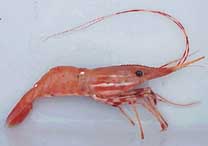 Spot PrawnPandalus platyceros
-
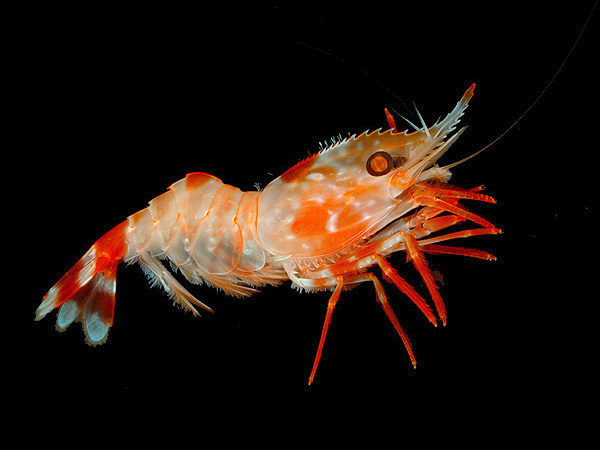 Armed Nylon ShrimpHeterocarpus ensifer
-
 Aesop ShrimpPandalus montagui
-
 Humpback ShrimpPandalus hypsinotus
-
 Alaskan Pink ShrimpPandalus eous
- Ocean Pink ShrimpPandalus jordani
- Heterocarpus reedi
Compare
Questions and answers
What is the classification of Amphionides reynaudii?
Molecular comparisons established that the species belongs to the shrimp infraorder Caridea. Molecular analyses confirmed its membership in the family Pandalidae.[12][13]
Has the adult stage been discovered?
The adult stage of the species remains undiscovered.[14]
Does the species belong to a recognised genus within Pandalidae?
The species does not appear to belong to any previously recognised genus within Pandalidae.[13][15]
What is the origin of the specific epithet reynaudii?
The specific epithet reynaudii honours a friend of Henri Milne-Edwards, possibly Count François Dominique Reynaud de Montlosier.[16]
Sources
Passages the profile rests on
- The species has only one pair of mouthparts, consisting of the maxillae. Source passage: “it has only one pair of mouthparts – the maxillae” — English Wikipedia
- Its mandibles and maxillules are vestigial. Source passage: “the mandibles and maxillules being vestigial.” — English Wikipedia
- Males and females differ in the shape of their antennae. Source passage: “Males and females differ in the form of the antennae” — English Wikipedia
- Males possess a reduced eighth thoracic appendage that bears the male gonopore. Source passage: “the presence in males of the eighth thoracic appendage, albeit in a reduced form. This is the site of the male gonopore” — English Wikipedia
- The female gonopore is located on the sixth thoracic appendage. Source passage: “the female's gonopore is on the sixth thoracic appendage” — English Wikipedia
- Females have a greatly enlarged first pleopod that almost surrounds their enlarged carapace. Source passage: “The first pleopod of the female is greatly enlarged and almost encloses the enlarged carapace.” — English Wikipedia
- Male specimens have a more streamlined carapace and pleopods than females. Source passage: “The more streamlined carapace and pleopods of the male” — English Wikipedia
- Observed specimens have reached a maximum recorded length of 25 mm. Source passage: “Amphionides specimens observed have been up to 25 mm (1.0 in) long.” — English Wikipedia
- Larvae inhabit waters shallower than 100 m. Source passage: “inhabiting waters less than 100 m (330 ft) deep as a larva.” — English Wikipedia
- Fewer male specimens are caught than females, possibly because their more streamlined bodies make them more hydrodynamic. Source passage: “The more streamlined carapace and pleopods of the male make it more hydrodynamic, so fewer males are caught than females.” — English Wikipedia
- The enlarged first pleopod of females is presumed to form a chamber where eggs are fertilised and retained until hatching. Source passage: “This is assumed to be a chamber in which the eggs are fertilised and retained until hatching.” — English Wikipedia
- Molecular comparisons established that the species belongs to the shrimp infraorder Caridea. Source passage: “the species was moved back to Decapoda and to the shrimp infraorder Caridea in 2015” — English Wikipedia
- Molecular analyses confirmed that the species belongs to the family Pandalidae. Source passage: “Broader analyses confirmed that Amphionides belongs to the family Pandalidae” — English Wikipedia
- The adult stage of the species remains undiscovered. Source passage: “while the adult stage still remains undiscovered.” — English Wikipedia
- The species does not appear to belong to any previously recognised genus within Pandalidae. Source passage: “it does not seem to be associated with any of the previously recognised pandalid genera” — English Wikipedia
- The specific epithet reynaudii honours a friend of Henri Milne-Edwards, possibly Count François Dominique Reynaud de Montlosier. Source passage: “The specific epithet reynaudii was given by Henri Milne-Edwards in honour of a friend of his, possibly Count François Dominique Reynaud de Montlosier.” — English Wikipedia
Data
- Catalogue of Life, 2026-10-16 XR cc by
- Global Biodiversity Information Facility CC BY 4.0
- Wikidata CC0
- GeoNames CC BY 4.0
- Wikimedia Commons per image; credit shown with each image
- Within the Catalogue of Life, this name comes from The Integrated Taxonomic Information System cc0
References
- McLaughlin, P. A., D. K. Camp, M. V. Angel, E. L. Bousfield, P. Brunel, R. C. Brusca, et al. (2005). Common and scientific names of aquatic invertebrates from the United States and Canada: Crustaceans. American Fisheries Society Special Publication 31.
- De Grave, Sammy, Tin-Yam Chan, Ka Hou Chu, Chien-Hui Yang, and José M. Landeira. (2015). Phylogenetics reveals the crustacean order Amphionidacea to be larval shrimps (Decapoda: Caridea). Scientific Reports, Vol. 5, No. 17464.
This species in other databases
Page built on 27 November 2026. See how the catalog is made and all sources and licences.
Cite this page
ScientificNames.org. (2026). Amphionides reynaudii. Retrieved November 27, 2026, from https://scientificnames.org/species/amphionides-reynaudii
“Amphionides reynaudii.” ScientificNames.org, 2026, scientificnames.org/species/amphionides-reynaudii. Accessed 27 Nov. 2026.
ScientificNames.org. “Amphionides reynaudii.” Accessed November 27, 2026. https://scientificnames.org/species/amphionides-reynaudii.
@misc{scientificnames_amphionides_reynaudii,
  author = {{ScientificNames.org}},
  title = {Amphionides reynaudii},
  year = {2026},
  url = {https://scientificnames.org/species/amphionides-reynaudii},
  note = {Accessed 2026-11-27}
}