Species · Crustaceans
Northern Shrimp Pandalus borealis
The scientific name of the Northern Shrimp is Pandalus borealis. It is a species of crustacean in the family Pandalidae (pandalid shrimps), order Decapoda. The name dates from 1838.
- Scientific name
- Pandalus borealis Krøyer, 1838
- Common name
- Northern Shrimp
- Genus
- Pandalus
- Family
- Pandalidae (Pandalid Shrimps)
- Order
- Decapoda
- Class
- Malacostraca
- Environment
- marine
- Recorded in
- 15 countries
- Name status
- accepted in the Catalogue of Life

Overview
Northern shrimp inhabit soft muddy seabeds at depths between 20 and 1,330 m.
Written 26 November 2026 from the sources listed below. Each statement was checked against the passage it cites; statements that could not be supported were removed.
Appearance
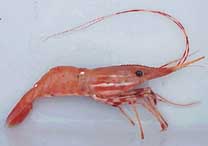
Northern shrimp have translucent shells and bodies, and their bodies and tails appear more red than pink when alive. Their tails have appendages called pleopods that function as paddles.[1][2]
Habitat
Northern shrimp commonly inhabit soft muddy seabeds at depths between 20 and 1,330 m. They generally inhabit waters with temperatures between 0 and 8 °C.[3][4]
Diet
Northern shrimp consume gelatinous zooplankton, chaetognaths, phytoplankton, and detritus, including sinking phytodetritus.[5][6]
Their opportunistic diet includes crustaceans, molluscs, jellyfish, plant material, plankton, and bottom-dwelling invertebrates. They also forage on worms, small crustaceans, algae, and detritus in bottom sediments during the day.[7][8][9]
Behaviour
Northern shrimp are diurnal and feed more actively during the day than at night. They form dense schools whose composition is influenced by shrimp size.[10][11]
Reproduction and life cycle
Northern shrimp are protandrous hermaphrodites, beginning life as males before transitioning into females at approximately three and a half years of age. Their larvae hatch as males.[12][13][14]
Northern shrimp generally begin spawning in late July in offshore waters. Female northern shrimp carry their eggs externally on their abdomens after extrusion and can carry between 600 and 4,900 eggs, depending on their size.[15][16][17]
Female northern shrimp can carry unfertilized eggs and stored sperm for up to eight months before fertilization. After the embryos hatch, females release larvae by fanning water beneath their abdomens.[18][19]
Conservation
The Atlantic northern shrimp stock has remained at historically unprecedented low levels following its collapse. Rising ocean temperatures in the western Gulf of Maine are considered increasingly unfavorable for northern shrimp.[20][21]
Climate-driven increases in water temperature have been associated with historical declines in Northwest Atlantic northern shrimp populations.[22]
Uses
Northern shrimp are a source of shrimp alkaline phosphatase, an enzyme used in molecular biology. Their carapaces provide chitosan for applications including wound treatment, wine filtration, and organic farming.[23][24]
Classification of the Northern Shrimp
| Kingdom | Animalia |
|---|---|
| Phylum | Arthropoda |
| Subphylum | Crustacea |
| Class | Malacostraca |
| Order | Decapoda |
| Suborder | Pleocyemata |
| Infraorder | Caridea |
| Superfamily | Pandaloidea |
| Family | Pandalidae (Pandalid Shrimps) |
| Genus | Pandalus (Shrimps) |
| Species | Pandalus borealis Krøyer, 1838 |
Where the Northern Shrimp is found
Checklists and occurrence records place Pandalus borealis in 15 countries. GBIF holds 18,743 georeferenced records of it.
Countries
- Canada 10,772
- Denmark 151
- France 3
- Germany 11
- Greenland 33
- Iceland 14
- Norway 649
- Russia 24
- Saint Pierre and Miquelon 5
- Spain 7
- Svalbard and Jan Mayen 383
- Sweden 608
- The Netherlands 6
- United Kingdom 172
- United States 5,905
Regions and cities with the most records
- Gloucester, United States 57
- Richmond, Canada 40
- Saco, United States 40
- Baie-Comeau, Canada 34
- Biddeford, United States 33
- Sept-Îles, Canada 31
- West Scarborough, United States 27
- South Portland, United States 26
- Vancouver, Canada 26
- Esquimalt, Canada 24
- Victoria, Canada 24
- Oak Bay, Canada 23
- Riley Park, Canada 23
- Ålesund, Norway 22
- Portland, United States 21
- Marblehead, United States 20
- West Vancouver, Canada 20
- Victoria-Fraserview, Canada 19
- Colwood, Canada 18
- Longyearbyen, Svalbard and Jan Mayen 18
- Rimouski, Canada 18
- Alaska, United States 16
- Langford, Canada 16
- Beverly Cove, United States 15
- Sooke, Canada 15
- Lynn, United States 14
- Newburyport, United States 14
- South Portland Gardens, United States 13
- Beverly, United States 12
- Svalbard, Svalbard and Jan Mayen 12
- Central Saanich, Canada 11
- Saanich, Canada 11
- Salem, United States 11
- Bergen, Norway 10
- Delta, Canada 9
- North Vancouver, Canada 9
1 more country has a few records outside this range
These countries hold a few records of Pandalus borealis but lie outside the range the checklists give for it. Such records are often zoo or garden specimens, museum material or vagrants, so the species is not counted as occurring there.
Range as the checklists state it
Eastern Atlantic Ocean
Western Atlantic Ocean
A number beside a place is its count of GBIF occurrence records. A place without a number comes from a checklist alone. Records show where a species has been observed or collected, which can include escapes and vagrants.
Common names
English
- Northern Shrimp
- Deep-sea Prawn
- Deepwater Prawn
- Great Northern Prawn
- Deep-water Prawn
- Northern Pink Shrimp
- Northern Prawn
- Northern Prawn/shrimp
- Pink Shrimp
- Sweet Shrimp
Names in 13 other languages
- Danish
- dybhavsreje
- Dutch
- Noorse garnaal, noorse steurgarnaal
- French
- crevette nordique
- German
- Eismeergarnele, Eismeershrimps, Grönland-Shrimp, Grönlandkrabbe, Nördliche Tiefseegarnele, Tiefseegarnele
- Icelandic
- Kampalampi
- Northern Sami
- reahkká, áhpehirrát
- Norwegian Bokmål
- dypvannsreke
- Norwegian Nynorsk
- djupvassreke
- Russian
- glubokovodnaya krevetka, Креветка северная, Северная креветка, северный чилим
- Slovenian
- severna kozica
- Spanish
- Camarón norteño
- Swedish
- grønlandsreje, nordhavsräka
- kal
- kinguppak, raaja
Synonyms
6 other scientific names have been used for this species and are now treated as synonyms of Pandalus borealis.
- Dymas typus Krøyer, 1861
- Pandalus borealis borealis Krøyer, 1838
- Pandalus borealis edenticulatus Retowsky, 1946
- Pandalus borealis var. edenticulatus Retowsky, 1946
- Pandalus edinticulatus
- Pandalus edinticulatus var. borealis Retovsky, 1946
Related species
-
 Spot PrawnPandalus platyceros
-
 Aesop ShrimpPandalus montagui
-
 Humpback ShrimpPandalus hypsinotus
-
 Alaskan Pink ShrimpPandalus eous
- Ocean ShrimpPandalus jordani
- Sidestripe ShrimpPandalus dispar
-
 Dock ShrimpPandalus danae
- Humpy ShrimpPandalus goniurus
Compare
Questions and answers
What is the scientific name of the Northern Shrimp?
The scientific name of the Northern Shrimp is Pandalus borealis. Written with its author, the full name is Pandalus borealis Krøyer, 1838.
Which family does the Northern Shrimp belong to?
Pandalus borealis belongs to the family Pandalidae, in the order Decapoda and the class Malacostraca.
Where is the Northern Shrimp found?
Checklists and occurrence records place Pandalus borealis in 15 countries, including Canada, United States, Norway, Sweden, Svalbard and Jan Mayen and United Kingdom.
What other names does the Northern Shrimp have?
Pandalus borealis is also known in English as Deep-sea Prawn, Deepwater Prawn, Great Northern Prawn, Deep-water Prawn, Northern Pink Shrimp and Northern Prawn.
Sources
Passages the profile rests on
- Northern shrimp have translucent shells and bodies and tails that appear more red than pink when alive. Source passage: “When alive, the tails and bodies of northern shrimp are more red than pink, and the shells are translucent.” — fisheries.noaa.gov
- Northern shrimp have appendages called pleopods on their tails that function as paddles. Source passage: “They have appendages called pleopods on their tail that act like paddles and enable them to move with remarkable agility over considerable distances.” — fisheries.noaa.gov
- Northern shrimp commonly inhabit soft muddy seabeds at depths between 20 and 1,330 m. Source passage: “Pandalus borealis usually lives on a soft muddy bottoms at depths of 20 to 1,330 m (66–4,364 ft)” — English Wikipedia
- Northern shrimp generally inhabit waters with temperatures between 0 and 8 °C. Source passage: “in waters with a temperature of 0 to 8 °C (32–46 °F)” — English Wikipedia
- Northern shrimp consume gelatinous zooplankton and chaetognaths. Source passage: “by feeding on a diverse array of prey, including gelatinous zooplankton and chaetognaths.” — English Wikipedia
- Northern shrimp consume phytoplankton and detritus, including sinking phytodetritus. Source passage: “significant contributions from both diatoms and zooplankton to the diet of P. borealis and highlighted the adaptability of this species to opportunistic feeding strategies based on sinking phytodetritus.” — pmc.ncbi.nlm.nih.gov
- Northern shrimp have an opportunistic diet that includes crustaceans, molluscs, jellyfish, and plant material. Source passage: “As opportunistic feeders, shrimp consume a diverse diet, including phytoplankton, detritus, crustaceans, molluscs, jellyfish, and plant material” — pmc.ncbi.nlm.nih.gov
- Northern shrimp consume plankton and bottom-dwelling invertebrates. Source passage: “They prey on plankton (tiny floating plants and animals) and bottom-dwelling invertebrates.” — fisheries.noaa.gov
- Northern shrimp forage on worms, small crustaceans, algae, and detritus in bottom sediments during the day. Source passage: “During the day however, they typically forage in the bottom sediments on worms, small crustaceans, algae, and detritus (dead organic matter).” — adfg.alaska.gov
- Northern shrimp are diurnal and feed more actively during the day than at night. Source passage: “These shrimp are diurnal and feed more during the day rather than at night.” — animaldiversity.org
- Northern shrimp form dense schools whose composition is influenced by shrimp size. Source passage: “Schooling in northern shrimp is dense and is determined by size of the shrimp.” — animaldiversity.org
- Northern shrimp are protandrous hermaphrodites, beginning life as males before transitioning into females. Source passage: “Northern shrimp are protandrous hermaphrodites – they begin life as males and sexually mature at roughly 2½ years old.” — fisheries.noaa.gov
- Northern shrimp typically transition from males into females at approximately three and a half years of age. Source passage: “They transform to females at about 3½ years old.” — fisheries.noaa.gov
- Northern shrimp larvae hatch as males. Source passage: “At hatching, all larvae are males” — animaldiversity.org
- Northern shrimp generally begin spawning in late July in offshore waters. Source passage: “They start spawning in late July in offshore waters, mainly in deep mud basins in the southwestern Gulf of Maine.” — fisheries.noaa.gov
- Female northern shrimp carry their eggs externally on their abdomens after extrusion. Source passage: “By early fall the females will start to extrude their eggs onto their abdomen.” — English Wikipedia
- Female northern shrimp can carry between 600 and 4,900 eggs, depending on their size. Source passage: “The number of eggs carried by the female is dependent on their size but can range from 600 to 4,900 eggs with the average of 2,000.” — animaldiversity.org
- Female northern shrimp can carry unfertilized eggs and stored sperm for up to eight months before fertilization. Source passage: “Female northern shrimp carry their unfertilized eggs and stored sperm externally for up to eight months before the eggs are fertilized and laid.” — animaldiversity.org
- Female northern shrimp release larvae by fanning water beneath their abdomens after the embryos hatch. Source passage: “When the embryos are ready to hatch the following spring, the female rests on the bottom and fans water under her abdomen to disperse the hatched larvae.” — adfg.alaska.gov
- The Atlantic northern shrimp stock has remained at historically unprecedented low levels following its collapse. Source passage: “the northern shrimp stock has collapsed and stock size has remained at unprecedented lows for several years.” — fisheries.noaa.gov
- Rising ocean temperatures in the western Gulf of Maine are considered increasingly unfavorable for northern shrimp. Source passage: “Ocean temperatures in the western Gulf of Maine have increased in recent years and are predicted to continue rising. This suggests an increasingly inhospitable environment for northern shrimp” — fisheries.noaa.gov
- Climate-driven increases in water temperature have been associated with historical declines in Northwest Atlantic northern shrimp populations. Source passage: “historical declines in P. borealis populations in the Northwest Atlantic Ocean have been linked to climate-driven increases in water temperature and shifts in predation pressure.” — pmc.ncbi.nlm.nih.gov
- Northern shrimp are a source of shrimp alkaline phosphatase, an enzyme used in molecular biology. Source passage: “shrimp alkaline phosphatase (SAP), an enzyme used in molecular biology, is obtained from Pandalus borealis” — English Wikipedia
- The carapace of northern shrimp provides chitosan for applications including wound treatment, wine filtration, and organic farming. Source passage: “the species' carapace is a source of chitosan, a versatile chemical used for such different applications as treating bleeding wounds, filtering wine or improving the soil in organic farming.” — English Wikipedia
Data
- Catalogue of Life, 2026-10-16 XR cc by
- Global Biodiversity Information Facility CC BY 4.0
- Wikidata CC0
- GeoNames CC BY 4.0
- Wikimedia Commons per image; credit shown with each image
- Within the Catalogue of Life, this name comes from The Integrated Taxonomic Information System cc0
References
- Krøyer, H. (1838). Conspectus Crustaceorum Groenlandiae. Naturhistorisk Tidsskrift. 2(3): 249-261. where the name was published
- Williams, Austin B., Lawrence G. Abele, D. L. Felder, H. H. Hobbs, Jr., R. B. Manning, et al. (1989). Common and Scientific Names of Aquatic Invertebrates from the United States and Canada: Decapod Crustaceans. American Fisheries Society Special Publication 17.
- Squires, H. J. (1992). Recognition of Pandalus eous Makarov, 1935, as a Pacific species not a variety of the Atlantic Pandalus borealis Krøyer, 1838 (Decapoda, Caridea). Crustaceana, Vol. 63, Pt. 3.
- McLaughlin, P. A., D. K. Camp, M. V. Angel, E. L. Bousfield, P. Brunel, R. C. Brusca, et al. (2005). Common and scientific names of aquatic invertebrates from the United States and Canada: Crustaceans. American Fisheries Society Special Publication 31.
This species in other databases
- Catalogue of Life 9CZ3G
- Wikidata Q122181
- iNaturalist 437504
- WoRMS urn:lsid:marinespecies.org:taxname:107649
Page built on 27 November 2026. See how the catalog is made and all sources and licences.
Cite this page
ScientificNames.org. (2026). Pandalus borealis (Northern Shrimp). Retrieved November 27, 2026, from https://scientificnames.org/species/pandalus-borealis
“Pandalus borealis (Northern Shrimp).” ScientificNames.org, 2026, scientificnames.org/species/pandalus-borealis. Accessed 27 Nov. 2026.
ScientificNames.org. “Pandalus borealis (Northern Shrimp).” Accessed November 27, 2026. https://scientificnames.org/species/pandalus-borealis.
@misc{scientificnames_pandalus_borealis_northern_shrimp,
  author = {{ScientificNames.org}},
  title = {Pandalus borealis (Northern Shrimp)},
  year = {2026},
  url = {https://scientificnames.org/species/pandalus-borealis},
  note = {Accessed 2026-11-27}
}