Species · Birds
Black-throated Sparrow Amphispiza bilineata
The scientific name of the Black-throated Sparrow is Amphispiza bilineata. It is a species of bird in the family Passerellidae (new world sparrow), order Passeriformes. The name dates from 1850.
- Scientific name
- Amphispiza bilineata (Cassin, 1850)
- Common name
- Black-throated Sparrow
- Genus
- Amphispiza
- Family
- Passerellidae (New World Sparrow)
- Order
- Passeriformes
- Class
- Aves
- Red List category
- LC Least Concern
- Environment
- terrestrial
- Recorded in
- 4 countries
- Name status
- accepted in the Catalogue of Life
Overview
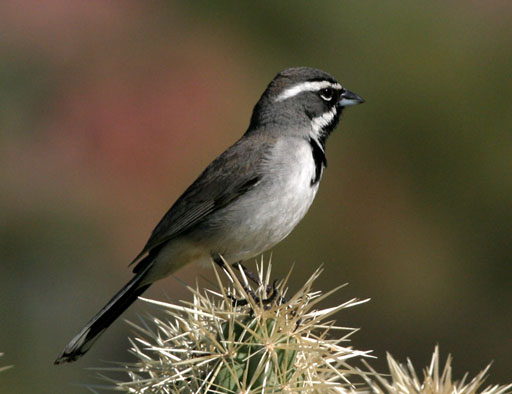
Amphispiza bilineata occurs naturally in Mexico and the United States. It has gray-brown plumage, a distinctive black-and-white facial pattern, and a dark tail.
Written 26 November 2026 from the sources listed below. Each statement was checked against the passage it cites; statements that could not be supported were removed.
Appearance
Adults of the nominate subspecies have a black forehead, gray crown and nape, and white supercilium and malar stripe bordered by thin black lines. The chin, throat, and central upper breast are black, while the remaining underparts are predominantly white.[1][2]
The species has dark grayish-brown irises, dark upper mandibles, bluish-gray lower mandibles, and black or brownish plumbeous legs and feet.[3]
Habitat
The Black-throated Sparrow inhabits open, shrubby desert environments and dry to arid semi-open landscapes with widely spaced shrubs and small trees, including mesquite and juniper. Its habitats include scrublands, thorn bush, alluvial fans, canyons, and badlands.[4][5][6]
The species breeds, feeds, and winters in sparsely vegetated chaparral or upland habitats. It occasionally occurs in grassy and weedy fields during migration and winter.[7][8]
Diet
During the breeding season in the United States, the species feeds mainly on insects, supplemented by seeds and other plant material. During winter, it feeds almost entirely on seeds.[9][10]
The species obtains food primarily by hopping on the ground and also gleans prey from low vegetation.[11][12]
Behaviour
During the breeding season, the species forages singly, in pairs, and in family groups. During winter, it forms larger flocks that may contain other sparrow species.[13][14]
Reproduction and life cycle
The breeding season for most populations occurs between March and July. Some populations in southern Arizona and New Mexico raise a second brood between July and early September, while populations on islands in the Sea of Cortez breed between late September and October.[15][16][17]
The female constructs an open-cup nest using plant fibers and lines it with fine fibers, sometimes including animal hair. Nests are generally built near the ground in branch forks within dense shrubs or in shrubs or cacti.[18][19][20]
Clutches contain two to five eggs, typically three or four. The eggs are glossy bluish-white to white and lack markings.[21][22]
Females incubate the eggs alone for 12–13 days in Arizona and New Mexico. Nestlings leave the nest approximately 10 days after hatching, and both parents provide them with food while the female also broods them.[23][24][25]
In Idaho, documented nests have been located 25–45 cm above the ground. Some nests are parasitized by brown-headed cowbirds.[26][27]
Conservation
The IUCN classifies the Black-throated Sparrow as Least Concern. Its estimated population is 62 million mature individuals, and the population is believed to be decreasing.[28][29]
Habitat loss may threaten some populations along the lower Colorado River, where mesquite woodlands have been cleared for agriculture and residential development.[30]
Classification of the Black-throated Sparrow
| Kingdom | Animalia |
|---|---|
| Phylum | Chordata |
| Subphylum | Vertebrata |
| Infraphylum | Gnathostomata |
| Parvphylum | Osteichthyes |
| Megaclass | Tetrapoda |
| Class | Aves (Bird) |
| Order | Passeriformes (Passerine) |
| Family | Passerellidae (New World Sparrow) |
| Genus | Amphispiza (Black-throated Sparrow) |
| Species | Amphispiza bilineata (Cassin, 1850) |
Where the Black-throated Sparrow is found
Checklists and occurrence records place Amphispiza bilineata in 4 countries across North America. GBIF holds 437,654 georeferenced records of it.
Countries
Regions and cities with the most records
- Arizona, United States 219,970
- Texas, United States 70,345
- California, United States 53,210
- Casas Adobes, United States 39,347
- New Mexico, United States 37,859
- Flowing Wells, United States 37,204
- Catalina Foothills, United States 36,663
- Oro Valley, United States 33,850
- Tanque Verde, United States 31,333
- Tucson, United States 31,148
- Green Valley, United States 23,197
- Nevada, United States 17,247
- Sahuarita, United States 14,794
- Utah, United States 13,810
- Rio Rico, United States 12,812
- Drexel Heights, United States 10,276
- Fountain Hills, United States 8,388
- Sierra Vista, United States 8,091
- Nogales, United States 7,537
- Marana, United States 7,162
- Scottsdale, United States 7,123
- Twentynine Palms, United States 7,028
- Apache Junction, United States 6,766
- Phoenix, United States 5,603
- Albuquerque, United States 5,501
- Desert Hot Springs, United States 5,407
- Tempe, United States 5,323
- Yucca Valley, United States 5,246
- Tempe Junction, United States 5,101
- Mesa, United States 5,069
- Rancho Mirage, United States 4,662
- Cathedral City, United States 4,540
- Palm Desert, United States 4,285
- Baja California Sur, Mexico 4,183
- Colorado, United States 3,991
- Chandler, United States 3,841
Range as the checklists state it
Middle America
North America
A number beside a place is its count of GBIF occurrence records. A place without a number comes from a checklist alone. Records show where a species has been observed or collected, which can include escapes and vagrants.
Common names
English
- Black-throated Sparrow
- Desert Sparrow
Names in 28 other languages
- Catalan
- Sit gorjanegre, sit golanegre
- Chinese
- 黑喉漠鵐, 黑喉漠鹀
- Croatian
- crnoprsi strnadar
- Czech
- strnádka černohrdlá
- Danish
- Sortstrubet Spurv
- Dutch
- Zwartkeelgors
- Esperanto
- Strigorĝa amfispizo, nigragorĝa paserelo
- Estonian
- manisksidrik
- Finnish
- aavikkosirkku
- French
- Bruant à gorge noire, Bruantin à gorge noire
- German
- Schwarzkehlammer
- Hungarian
- feketetorkú sármány
- Italian
- Passero golanera
- Japanese
- ノドグロヒメドリ
- Latvian
- melnrīkles zvirbulis
- Lithuanian
- juodagurklė dykuminė starta
- Norwegian
- svartstrupespurv
- Polish
- wąsatek czarnogardły
- Portuguese
- escrevedeira-de-garganta-preta, tico-tico-de-garganta-preta
- Russian
- Черногорлая пустынная овсянка, Чернозобая овсянка
- Serbian
- Crnogrli strnad
- Slovak
- strnádlik čiernohrdlý
- Spanish
- Chingolo gorjinegro, Zacatonero garganta negra
- Swedish
- svartstrupig sparv
- Turkish
- Kara Boğazlı Serçe
- Ukrainian
- вівсянка-пустельниця чорногорла, ґоріон чорногорлий
- Welsh
- bras gyddf-ddu
- nav
- Yaayááhalzhiin
Synonyms
One other scientific name has been used for this species and is now treated as a synonym of Amphispiza bilineata.
- Aimophila bilineata Cassin, J, 1850
Subspecies and varieties
- Amphispiza bilineata bangsi (Bangs's Sparrow) subspecies
- Amphispiza bilineata belvederei (Cerralvo Sparrow) subspecies
- Amphispiza bilineata bilineata (Texas Black-throated Sparrow) subspecies
- Amphispiza bilineata cana (San Esteban Sparrow) subspecies
- Amphispiza bilineata deserticola (Desert Black-throated Sparrow) subspecies
- Amphispiza bilineata grisea subspecies
- Amphispiza bilineata opuntia (Guadalupe Mountain Black-throated Sparrow) subspecies
- Amphispiza bilineata pacifica subspecies
- Amphispiza bilineata tortugae (Tortuga Sparrow) subspecies
Related species
-
 Dark-eyed JuncoJunco hyemalis
-
 White-throated SparrowZonotrichia albicollis
-
 White-crowned SparrowZonotrichia leucophrys
-
 Song SparrowMelospiza melodia
-
 Spotted TowheePipilo maculatus
-
 Lark BuntingCalamospiza melanocorys
-
 Rufous-collared SparrowZonotrichia capensis
-
 Chipping SparrowSpizella passerina
Compare
Questions and answers
What is the scientific name of the Black-throated Sparrow?
The scientific name of the Black-throated Sparrow is Amphispiza bilineata. Written with its author, the full name is Amphispiza bilineata (Cassin, 1850).
Which family does the Black-throated Sparrow belong to?
Amphispiza bilineata belongs to the family Passerellidae, in the order Passeriformes and the class Aves.
Where is the Black-throated Sparrow found?
Checklists and occurrence records place Amphispiza bilineata in 4 countries: United States, Mexico, Canada and Saint Pierre and Miquelon.
What is the conservation status of the Black-throated Sparrow?
The IUCN Red List category recorded for Amphispiza bilineata is Least Concern (LC).
What other names does the Black-throated Sparrow have?
Amphispiza bilineata is also known in English as Desert Sparrow.
Where do black-throated sparrows live?
The Black-throated Sparrow occurs naturally in Mexico and the United States. It inhabits open, shrubby desert environments, scrublands, thorn bush, alluvial fans, canyons, and badlands.[31][5][6]
Sources
Passages the profile rests on
- Adults of the nominate subspecies have a black forehead, gray crown and nape, and white supercilium and malar stripe bordered by thin black lines. Source passage: “Adults of the nominate subspecies A. b. bilineata have a black forehead, a gray crown and nape, a white supercilium and malar stripe both with thin black borders” — English Wikipedia
- The nominate subspecies has black chin, throat, and central upper breast, with predominantly white remaining underparts. Source passage: “Their chin, throat, and center of their upper breast are black. The rest of their underparts are white” — English Wikipedia
- The species has dark grayish-brown irises, dark upper mandibles, bluish-gray lower mandibles, and black or brownish plumbeous legs and feet. Source passage: “All subspecies have a dark grayish brown iris, a dark maxilla, a bluish gray mandible, and black or brownish plumbeous legs and feet.” — English Wikipedia
- The species primarily inhabits dry to arid semi-open landscapes containing widely spaced shrubs and small trees, including mesquite and juniper. Source passage: “The black-throated sparrow primarily inhabits a variety of dry to arid semi-open landscapes with well-spaced shrubs and smallish trees such as mesquite and juniper.” — English Wikipedia
- Its habitats include scrublands, thorn bush, alluvial fans, canyons, and badlands. Source passage: “These include scrublands, thorn bush, alluvial fans, canyons, and badlands.” — English Wikipedia
- The species inhabits open, shrubby desert environments. Source passage: “Black-throated Sparrow is a sharp-dressed denizen of open, shrubby desert.” — ebird.org
- The species occasionally occurs in grassy and weedy fields during migration and winter. Source passage: “It also occasionally occurs in grassy and weedy fields during migration and in winter.” — English Wikipedia
- The species breeds, feeds, and winters in sparsely vegetated chaparral or upland habitats. Source passage: “Breeds, feeds, and winters in sparsely vegetated chaparral or upland” — nrm.dfg.ca.gov
- During the breeding season in the United States, the species feeds mainly on insects, supplemented by seeds and other plant material. Source passage: “There during the breeding season it feeds mainly on insects with significant amounts of seeds and other plant material.” — English Wikipedia
- During winter, the species feeds almost entirely on seeds. Source passage: “In winter it feeds almost entirely on seeds.” — English Wikipedia
- The species obtains food primarily by hopping on the ground and also gleans prey from low vegetation. Source passage: “It forages mostly while hopping on the ground but also gleans prey from low vegetation.” — English Wikipedia
- The species is classified as a ground forager. Source passage: “BehaviorGround Forager” — allaboutbirds.org
- During the breeding season, the species forages singly, in pairs, and in family groups. Source passage: “In the breeding season it forages singly, in pairs, and in family groups” — English Wikipedia
- During winter, the species forms larger flocks that may contain other sparrow species. Source passage: “in winter it forms larger flocks that may include other sparrow species.” — English Wikipedia
- The breeding season for most populations occurs between March and July. Source passage: “The black-throated sparrow's breeding season varies latitudinally but for most populations falls within March to July.” — English Wikipedia
- Some populations in southern Arizona and New Mexico raise a second brood between July and early September. Source passage: “In southern Arizona and New Mexico many raise a second brood during the summer rains of July to early September.” — English Wikipedia
- Populations on islands in the Sea of Cortez breed between late September and October. Source passage: “On islands in the Sea of Cortez it breeds in late September through October.” — English Wikipedia
- The female constructs an open-cup nest using plant fibers and lines it with fine fibers, sometimes including animal hair. Source passage: “The female builds the nest, an open cup made from a wide variety of plant fibers lined with fine fibers and sometimes also animal hair.” — English Wikipedia
- Nests are usually built near the ground in branch forks within dense shrubs. Source passage: “It is usually built near the ground in a branch fork in a dense shrub of a wide variety of species.” — English Wikipedia
- The species builds cup-shaped nests in shrubs or cacti, generally close to the ground. Source passage: “Amphispiza bilineata builds cup-shaped nests in shrubs or cacti, usually close to the ground.” — animaldiversity.org
- Clutches contain two to five eggs, typically three or four. Source passage: “Clutches range from two to five eggs but are typically of three or four.” — English Wikipedia
- The eggs are glossy bluish-white to white and lack markings. Source passage: “The eggs are plain glossy bluish white to white.” — English Wikipedia
- Females incubate the eggs alone for 12–13 days in Arizona and New Mexico. Source passage: “The female alone incubates, for 12 to 13 days in Arizona and New Mexico.” — English Wikipedia
- Nestlings leave the nest approximately 10 days after hatching. Source passage: “Fledging occurs about 10 days after hatch.” — English Wikipedia
- Both parents provide food to the nestlings, while the female also broods them. Source passage: “The female broods nestlings and both parents provision them.” — English Wikipedia
- Some nests are parasitized by brown-headed cowbirds. Source passage: “Some nests are parasitized by brown-headed cowbirds (Molothrus ater).” — English Wikipedia
- In Idaho, documented nests have been located 25–45 cm above the ground. Source passage: “In Idaho, all located nests have been 25 to 45 cm” — animaldiversity.org
- The IUCN classifies the black-throated sparrow as Least Concern. Source passage: “The IUCN has assessed the black-throated sparrow as being of Least Concern.” — English Wikipedia
- The species has an estimated population of 62 million mature individuals, which is believed to be decreasing. Source passage: “its estimated population of 62 million mature individuals is believed to be decreasing.” — English Wikipedia
- Habitat loss may threaten some populations along the lower Colorado River where mesquite woodlands have been cleared for agriculture and residential development. Source passage: “Loss of habitat may threaten some populations on the lower Colorado River bottomlands where large tracts of mesquite woodlands have been cleared for agriculture and residential developments” — English Wikipedia
- The species occurs naturally in Mexico and the United States. Source passage: “It is found in Mexico and the United States.” — English Wikipedia
Data
- Catalogue of Life, 2026-10-16 XR cc by
- Global Biodiversity Information Facility CC BY 4.0
- Wikidata CC0
- GeoNames CC BY 4.0
- Wikimedia Commons per image; credit shown with each image
- Within the Catalogue of Life, this name comes from The Integrated Taxonomic Information System cc0
References
- Proc. Acad. Nat. Sci. Philadelphia 5: 103, pl. 3. 1850 where the name was published
- Banks, R. C., R. W. McDiarmid, and A. L. Gardner. (1987). Checklist of Vertebrates of the United States, the U.S. Territories, and Canada. Resource Publication, No. 166.
- Campbell, Wayne, Neil K. Dawe, Ian McTaggart-Cowan, John M. Cooper, Gary W. Kaiser, et al. (2001). The Birds of British Columbia Volume 4. Passerines. Wood Warblers through Old World Sparrows.
- Gill, Frank, & and Minturn Wright. (2006). Birds of the World: Recommended English Names.
- Dickinson, E. C., and L. Christidis, eds. (2014). The Howard and Moore Complete Checklist of the Birds of the World, 4th Edition, Vol. 2 Passerines.
This species in other databases
Page built on 26 November 2026. See how the catalog is made and all sources and licences.
Cite this page
ScientificNames.org. (2026). Amphispiza bilineata (Black-throated Sparrow). Retrieved November 26, 2026, from https://scientificnames.org/species/amphispiza-bilineata
“Amphispiza bilineata (Black-throated Sparrow).” ScientificNames.org, 2026, scientificnames.org/species/amphispiza-bilineata. Accessed 26 Nov. 2026.
ScientificNames.org. “Amphispiza bilineata (Black-throated Sparrow).” Accessed November 26, 2026. https://scientificnames.org/species/amphispiza-bilineata.
@misc{scientificnames_amphispiza_bilineata_black_throated_sparrow,
  author = {{ScientificNames.org}},
  title = {Amphispiza bilineata (Black-throated Sparrow)},
  year = {2026},
  url = {https://scientificnames.org/species/amphispiza-bilineata},
  note = {Accessed 2026-11-26}
}