Species · Flowering plants
Green-Winged Orchid Anacamptis morio
The scientific name of the Green-Winged Orchid is Anacamptis morio. It is a species of flowering plant in the family Orchidaceae (orchid), order Asparagales.
- Scientific name
- Anacamptis morio (L.) R.M.Bateman, Pridgeon & M.W.Chase
- Common name
- Green-Winged Orchid
- Genus
- Anacamptis
- Family
- Orchidaceae (Orchid)
- Order
- Asparagales
- Class
- Liliopsida
- Recorded in
- 51 countries
- Name status
- accepted in the Catalogue of Life

Overview
The Green-Winged Orchid is a flowering plant in the family Orchidaceae, order Asparagales and class Liliopsida. It grows in unimproved grassy meadows, particularly those with limestone-rich soil, as well as in dry and wet grazed meadows. Its flowers have two lateral sepals with prominent green veins that extend sideways like wings.
Written 26 November 2026 from the sources listed below. Each statement was checked against the passage it cites; statements that could not be supported were removed.
Appearance
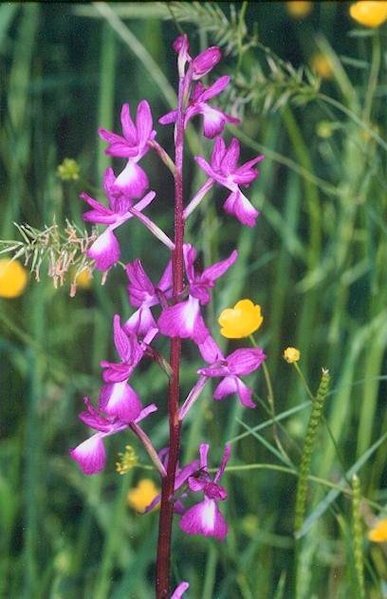
The Green-Winged Orchid usually produces purple flowers, although its inflorescence ranges from white and pink to deep purple. The helmet-shaped flowers grow in a loose, linear cluster at the top of a single stalk.[1][2][3][4]
Each flower has two lateral sepals with prominent green veins extending sideways like wings. The lower petal is broad and three-lobed, with a pale centre and dark spots.[5][6]
The leaves are green and lack spots, and are usually lanceolate or occasionally ovate. Basal leaves form a rosette, while thinner leaves clasp and sheath the stem nearly up to the flowers.[7][8][9]
Plants can reach a height of 40 centimetres.[10]
Habitat
The Green-Winged Orchid grows in unimproved grassy meadows, particularly those with limestone-rich soil. It occurs in both dry and wet grazed meadows.[11][12]
Its habitats include coastal grasslands, quarries, churchyards, roadsides and lawns. On mainland Europe, it also occurs in alpine pastures and xerothermic grasslands on porphyry outcrops.[13][14]
The species occurs at elevations up to approximately 1,500–2,000 metres.[15]
Behaviour
In the British Isles, the Green-Winged Orchid flowers from late April through June. In some other countries, including France, flowering can begin as early as February.[16][17]
Reproduction and life cycle
Bees pollinate the flowers, which do not produce nectar. They attract pollinators through their visual appearance despite the absence of nectar.[18][19][20]
Nectar deception promotes pollen exchange between individual plants and supports genetic diversity. Plants require a mycorrhizal partner to establish and are associated with the fungi Epulorhiza repens and Moniliopsis solani.[21][22][23]
Conservation
The Green-Winged Orchid is described as vulnerable and near threatened. In Northern Ireland, it is protected under the Wildlife (NI) Order of 1985.[24][25]
The species is vulnerable to chemical applications, including fungicides and fertilisers, which may reduce populations of associated fungi.[26]
Grassland management involving cutting once or twice annually after flowering can support the species. Grazing after flowering has finished is also compatible with its habitat requirements, while mowing immediately after flowering should be avoided to allow seeds to disperse.[27][28][29]
Similar species
The Green-Winged Orchid resembles the early purple orchid, Orchis mascula. Unlike that species, it has green stripes on its two lateral sepals and lacks spots or blotches on its leaves.[30][31][32]
Classification of the Green-Winged Orchid
| Kingdom | Plantae |
|---|---|
| Subkingdom | Pteridobiotina |
| Phylum | Tracheophyta |
| Class | Liliopsida |
| Order | Asparagales |
| Family | Orchidaceae (Orchid) |
| Genus | Anacamptis |
| Species | Anacamptis morio (L.) R.M.Bateman, Pridgeon & M.W.Chase |
Where the Green-Winged Orchid is found
Checklists and occurrence records place Anacamptis morio in 51 countries across Africa, Asia and Europe. GBIF holds 178,450 georeferenced records of it.
Countries
- Albania 91
- Algeria 220
- Austria 4,577
- Azerbaijan 11
- Belarus 16
- Belgium 671
- Bosnia and Herzegovina 135
- Bulgaria 277
- Croatia 1,069
- Cyprus 449
- Czechia 431
- Denmark 797
- Estonia 146
- France 77,507
- Georgia 174
- Germany 13,405
- Greece 909
- Guernsey 20
- Hungary 1,197
- Iran
- Iraq
- Ireland 103
- Israel 7
- Italy 8,094
- Jersey 38
- Kosovo 17
- Latvia 4
- Lebanon 44
- Liechtenstein 104
- Lithuania 38
- Luxembourg 293
- Montenegro 208
- Morocco 63
- North Macedonia 62
- Norway 740
- Poland 329
- Portugal 2,128
- Romania 638
- Russia 499
- Serbia 514
- Slovakia 1,417
- Slovenia 476
- Spain 8,707
- Sweden 3,333
- Switzerland 17,412
- Syria 61
- The Netherlands 9,144
- Tunisia 10
- Turkey 121
- Ukraine 1,362
- United Kingdom 20,382
Regions and cities with the most records
- Auvergne-Rhône-Alpes, France 23,456
- England, United Kingdom 17,391
- Occitanie, France 13,250
- Bavaria, Germany 9,396
- Bourgogne-Franche-Comté, France 7,336
- Centre-Val de Loire, France 5,666
- Valais, Switzerland 3,792
- Provence-Alpes-Côte d'Azur, France 3,730
- Martigny-Ville, Switzerland 3,227
- Grand Est, France 2,691
- Pays de la Loire, France 2,579
- Horgen, Switzerland 2,206
- Den Helder, The Netherlands 2,096
- Monthey, Switzerland 2,091
- Île-de-France, France 1,958
- Geneva, Switzerland 1,828
- Zeeland, The Netherlands 1,771
- Rapperswil, Switzerland 1,731
- Zurich, Switzerland 1,708
- Jona, Switzerland 1,690
- Uster, Switzerland 1,643
- Madrid, Spain 1,640
- Zug, Switzerland 1,599
- Carouge, Switzerland 1,596
- Vernier, Switzerland 1,586
- Baar, Switzerland 1,583
- Onex, Switzerland 1,579
- Adliswil, Switzerland 1,561
- Cham, Switzerland 1,549
- Bern, Switzerland 1,534
- Zürich, Switzerland 1,520
- Annemasse, France 1,515
- Wetzikon, Switzerland 1,503
- Meyrin, Switzerland 1,458
- Dübendorf, Switzerland 1,436
- Nyon, Switzerland 1,414
1 more country has a few records outside this range
These countries hold a few records of Anacamptis morio but lie outside the range the checklists give for it. Such records are often zoo or garden specimens, museum material or vagrants, so the species is not counted as occurring there.
A number beside a place is its count of GBIF occurrence records. A place without a number comes from a checklist alone. Records show where a species has been observed or collected, which can include escapes and vagrants.
Common names
English
- Green-Winged Orchid
- King-fingers
Names in 35 other languages
- Azerbaijani
- Mürgü səhləbi
- Belarusian
- Ятрышнік дрэмлік
- Bulgarian
- Обикновен салеп
- Catalan
- Abellera de muntanya grossa, pentecosta
- Chinese
- 齿缘红门兰
- Croatian
- Mali kaćun
- Czech
- vstavač kukačka
- Danish
- Salep-Gøgeurt, Salepgøgeurt
- Dutch
- Harlekijn
- Estonian
- arukäpp
- Finnish
- ruusukekalkkikämmekkä
- French
- Anacamptide bouffon, Orchis bouffon, Orchis bouffon et apparentés
- German
- Kleines Knabenkraut, Salepknabenkraut
- Greek
- Ανακαμπτίς η νηπία
- Hungarian
- Agárkosbor
- Italian
- Orchide minore, orchidea minore
- Japanese
- アナカンプティス・モリオ
- Latvian
- Zalkšu dzegužpuķe
- Lithuanian
- Mažasis anakamptis, Mažoji gegužraibė
- Luxembourgish
- Boken-Hondswuerzel
- Norwegian Bokmål
- narrmarihand, narrmarihånd
- Polish
- Storczyk samczy, Storczyk samiczy
- Portuguese
- Erva-do-salepo
- Romanian
- Untul vacii
- Russian
- Анакамптис дремлик, Ятрышник дремлик
- Serbian
- Обични каћун - Obični kaćun
- Slovak
- vstavač obyčajný
- Slovenian
- navadna kukavica
- Spanish
- Amor de dama, Compañón
- Swedish
- göknyckel, göknyckelblomster, göknycklar
- Turkish
- Gelincik Salebi
- Ukrainian
- Зозулинець салеповий, Плодоріжка салепова
- Welsh
- Tegeirian Ynfydyn, Tegeirian Ynfytyn, Tegeirian y Waun, Tegeiriau'r Waun
- hsb
- Mała pihawka
- nds
- Adam-en-eva
Synonyms
4 other scientific names have been used for this species and are now treated as synonyms of Anacamptis morio.
- Herorchis morio (L.) D.Tyteca & E.Klein
- Orchis morio L.
- Orchis morio var. genuina Cout.
- Orchis morio var. morio
Subspecies and varieties
- Anacamptis champagneuxii subsp. champagneuxii subspecies
- Anacamptis morio nothosubsp. cortesii subspecies
- Anacamptis morio nothosubsp. litardierei subspecies
- Anacamptis morio nothosubsp. romerae subspecies
- Anacamptis morio subsp. caucasica (Green-winged Orchid) subspecies
- Anacamptis morio subsp. champagneuxii (Champagne Orchid) subspecies
- Anacamptis morio subsp. longicornu subspecies
- Anacamptis morio subsp. morio subspecies
- Anacamptis morio subsp. picta subspecies
- Anacamptis morio subsp. syriaca (Syrian Green-winged Orchid) subspecies
- Anacamptis × cortesii subsp. cortesii subspecies
Related species
-
 Pyramidal OrchidAnacamptis pyramidalis
-
 Bug OrchidAnacamptis coriophora
-
 Loose-flowered OrchidAnacamptis laxiflora
-
 Eurasian Marsh OrchidAnacamptis palustris
-
 Pink-butterfly OrchidAnacamptis papilionacea
-
 Holy OrchidAnacamptis sancta
-
 Fan-lipped OrchidAnacamptis collina
-
 Bory's AnacamptisAnacamptis boryi
Compare
Questions and answers
What is the scientific name of the Green-Winged Orchid?
The scientific name of the Green-Winged Orchid is Anacamptis morio. Written with its author, the full name is Anacamptis morio (L.) R.M.Bateman, Pridgeon & M.W.Chase.
Which family does the Green-Winged Orchid belong to?
Anacamptis morio belongs to the family Orchidaceae, in the order Asparagales and the class Liliopsida.
Where is the Green-Winged Orchid found?
Checklists and occurrence records place Anacamptis morio in 51 countries, including France, United Kingdom, Switzerland, Germany, The Netherlands and Spain.
What other names does the Green-Winged Orchid have?
Anacamptis morio is also known in English as King-fingers.
Sources
Passages the profile rests on
- The species usually produces purple flowers. Source passage: “It usually has purple flowers” — English Wikipedia
- Its inflorescence ranges in colour from white and pink to deep purple, with purple being the predominant colour. Source passage: “The inflorescence is of various colours, mainly purple but ranging from white, through pink, to deep purple.” — English Wikipedia
- The flowers are helmet-shaped. Source passage: “From 5 to 25 helmet-shaped flowers grow” — English Wikipedia
- The flowers grow in a loose, linear cluster at the top of a single stalk. Source passage: “From 5 to 25 helmet-shaped flowers grow in a loose, linear bunch at the top of the single stalk.” — English Wikipedia
- Each flower has two lateral sepals with prominent green veins that extend sideways like wings. Source passage: “A pair of lateral sepals with prominent green, occasionally purple veins extend laterally like "wings"” — English Wikipedia
- The lower petal is broad, three-lobed, pale in the centre and marked with dark spots. Source passage: “The broad, three lobed, lower petal is pale in the center with dark spots.” — English Wikipedia
- The leaves are lanceolate or occasionally ovate. Source passage: “Leaves are lanceolate, or sometimes ovate” — English Wikipedia
- The basal leaves form a rosette, while thinner leaves clasp and sheath the stem nearly up to the flowers. Source passage: “grow in a rosette around the base of the plan, with some thinner leaves clasping the stem and sheathing almost up to the flowers.” — English Wikipedia
- The leaves are green and lack spots. Source passage: “Leaves are green and unspotted.” — English Wikipedia
- Plants can reach a height of 40 centimetres. Source passage: “Plants grow to 40 cm in height.” — English Wikipedia
- The species grows in unimproved grassy meadows, particularly those with limestone-rich soil. Source passage: “It grows in unimproved grassy meadows, especially on limestone-rich soil.” — English Wikipedia
- The species occurs in both dry and wet grazed meadows. Source passage: “It can grow in dry or wet grazed meadows.” — English Wikipedia
- Its habitats include coastal grasslands, quarries, churchyards, roadsides and lawns. Source passage: “It can also be found in coastal grasslands, quarries, churchyards, as well as on roadsides and lawns.” — English Wikipedia
- On mainland Europe, the species also occurs in alpine pastures and xerothermic grasslands on porphyry outcrops. Source passage: “On the European continent it is also found in alpine pasture and in xerothermic grassland on porphyry outcrops.” — English Wikipedia
- The species occurs at elevations up to approximately 1,500–2,000 metres. Source passage: “The maximum altitude for this species is somewhere between 1500 and 2000m.” — English Wikipedia
- The species flowers in the British Isles from late April through June. Source passage: “It flowers from late April to June in the British Isles” — English Wikipedia
- In some other countries, including France, flowering can begin as early as February. Source passage: “and as early as February in other countries, such as France.” — English Wikipedia
- Bees pollinate the flowers. Source passage: “Pollination is by bees.” — English Wikipedia
- The flowers do not produce nectar. Source passage: “The flowers do not produce nectar” — English Wikipedia
- The flowers attract pollinators through their visual appearance despite producing no nectar. Source passage: “but can attract pollinators with their visual appearance.” — English Wikipedia
- Nectar deception promotes pollen exchange between individual plants and supports genetic diversity. Source passage: “facilitates the mixing of pollen between different individual plants, promotes genetic diversity in the species” — English Wikipedia
- Plants require a mycorrhizal partner to establish. Source passage: “Plants cannot establish without a mycorrhizal partner.” — English Wikipedia
- The species is associated with the mycorrhizal fungi Epulorhiza repens and Moniliopsis solani. Source passage: “Mycorrhizal fungi known to grow in association with the green-winged orchid include Epulorhiza repens (Tulasnellaceae) and Moniliopsis solani (Ceratobasidiaceae).” — English Wikipedia
- The species is described as vulnerable and near threatened. Source passage: “This species' conservation status is vulnerable and near threatened.” — English Wikipedia
- The species is protected in Northern Ireland under the Wildlife (NI) Order of 1985. Source passage: “It is a protected species in Northern Ireland under the Wildlife (NI) Order of 1985.” — English Wikipedia
- The species is vulnerable to chemical applications, including fungicides and fertilisers, that may reduce populations of associated fungi. Source passage: “This makes them vulnerable to chemicals, particularly fungicides, but also other chemical applications, including fertilisers” — English Wikipedia
- Grassland management that involves cutting once or twice annually after flowering can support the species. Source passage: “This species thrives where grass is cut once or twice a year after flowering is complete” — English Wikipedia
- Grazing after flowering has finished is also compatible with the species' habitat requirements. Source passage: “or where it is grazed after flowering is complete.” — English Wikipedia
- Mowing immediately after flowering should be avoided to allow seeds to disperse. Source passage: “Cutting or mowing should not take place immediately after flowering but give time for seed dispersal.” — English Wikipedia
- The species resembles the early purple orchid, Orchis mascula. Source passage: “It is similar in appearance to the early purple orchid Orchis mascula” — English Wikipedia
- Unlike the early purple orchid, this species has green stripes on its two lateral sepals. Source passage: “Anacamptis morio has green stripes on the two lateral sepals” — English Wikipedia
- Unlike the early purple orchid, this species lacks spots or blotches on its leaves. Source passage: “and lacks the spots or blotches of the Early Purple's leaves.” — English Wikipedia
Data
- Catalogue of Life, 2026-10-16 XR cc by
- Global Biodiversity Information Facility CC BY 4.0
- Wikidata CC0
- GeoNames CC BY 4.0
- Wikimedia Commons per image; credit shown with each image
- Within the Catalogue of Life, this name comes from The World Checklist of Vascular Plants (WCVP) cc by
References
- Lindleyana 12: 120 (1997) where the name was published
This species in other databases
Page built on 28 November 2026. See how the catalog is made and all sources and licences.
Cite this page
ScientificNames.org. (2026). Anacamptis morio (Green-Winged Orchid). Retrieved November 28, 2026, from https://scientificnames.org/species/anacamptis-morio
“Anacamptis morio (Green-Winged Orchid).” ScientificNames.org, 2026, scientificnames.org/species/anacamptis-morio. Accessed 28 Nov. 2026.
ScientificNames.org. “Anacamptis morio (Green-Winged Orchid).” Accessed November 28, 2026. https://scientificnames.org/species/anacamptis-morio.
@misc{scientificnames_anacamptis_morio_green_winged_orchid,
  author = {{ScientificNames.org}},
  title = {Anacamptis morio (Green-Winged Orchid)},
  year = {2026},
  url = {https://scientificnames.org/species/anacamptis-morio},
  note = {Accessed 2026-11-28}
}